India Needs Asbestos Rules Before Buildings Fall
 TBH Editorial
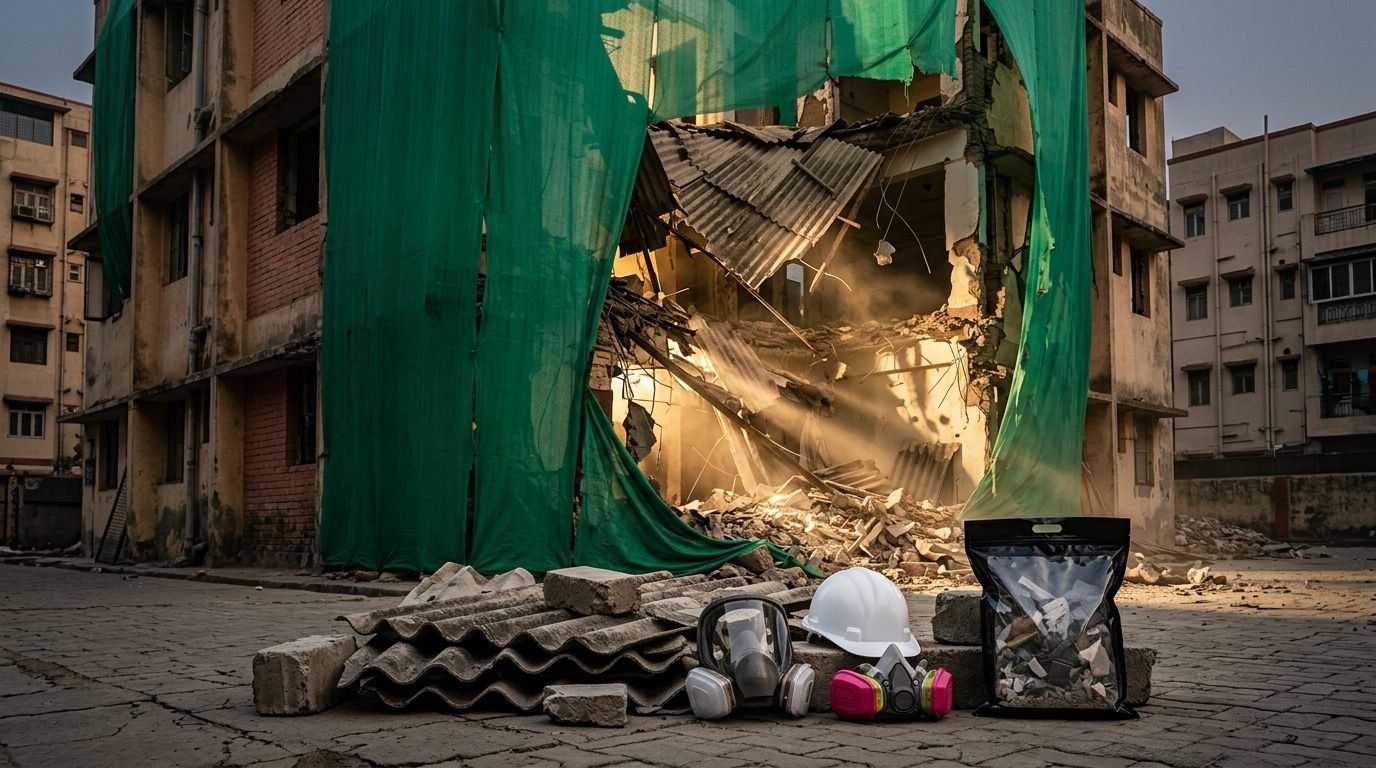
During building demolition, a site can look cleaner than it is. A green screen may hide broken roofing sheets, dry rubble, and workers carrying dust into the street on their clothes.
That is why asbestos demolition rules India needs cannot remain a vague mix of safety advice, hazardous-waste paperwork, and last-minute reactions. When an old building comes down, the risk does not stay inside its boundary wall. It moves with dust, debris trucks, wind, and people.
India is building fast, but many older structures are being dismantled with far less attention than new construction receives. Before another wall falls, we need to ask a harder question about this public health hazard, specifically who is being asked to breathe the cost.
Key Takeaways
- Asbestos demolition in India often releases invisible, harmful fibers due to lack of strict, standardized national rules and enforcement.
- Pre-demolition asbestos surveys are essential to identify hazardous materials before buildings are broken down and dust spreads.
- Proper asbestos abatement requires wet handling methods, trained personnel, specialized protective equipment, and controlled removal orders.
- Asbestos waste must be safely sealed, tracked via digital manifests, and disposed of at authorized hazardous facilities rather than mixed with general debris.
- Public records and Right to Information (RTI) requests empower communities and local residents to hold contractors and authorities accountable for safe demolition practices.
Why asbestos demolition rules India can no longer be optional
Asbestos was widely used because it was cheap, heat-resistant, and durable. It appears in roofing sheets, insulation, pipes, ceiling materials, asbestos cement products, and older industrial structures, including common forms like chrysotile asbestos. Those materials may sit undisturbed for years. Demolition changes the equation.
Cutting, drilling, crushing, or breaking asbestos-containing material can release microscopic asbestos fibers. You cannot judge the danger by a dramatic cloud of dust. The particles that matter most may be invisible, and they can stay in the air long after a machine has moved on, increasing occupational exposure risks.
The health consequences are not immediate in the way a burn or broken bone is. Asbestos exposure is linked to serious diseases that can appear years later, including asbestosis, lung cancer, and mesothelioma. This delay makes neglect easier. The contractor gets paid. The site gets cleared. The people exposed are left carrying a risk nobody recorded.
India still does not have a comprehensive nationwide ban on asbestos use and imports, despite warnings from the world health organization and the inclusion of certain fibers under the rotterdam convention. The government’s position has previously stated that there was no proposal to prohibit its use, a history examined in The Union’s analysis of India’s asbestos position.
That reality makes demolition controls more urgent, not less urgent. If asbestos remains in roofs, pipes, warehouses, schools, and housing, then every redevelopment project becomes a public-health test.
The problem is not only what happens inside a worksite. It is what happens outside it.
A security guard stands at the gate all day. A tea seller works beside the debris truck route. A child walks past an old school building under repair. A family dries clothes on a balcony facing demolition work. None of them signed a labour contract. Yet they may still be exposed.
A demolition permit should never mean permission to turn a neighbourhood into an unmonitored waste zone.
This is where systemic change begins. Safety cannot depend on whether one contractor happens to be careful. It has to be built into permits, budgets, inspections, waste routes, and public records.
The real danger begins when material is broken
Asbestos is often discussed as if it is a single product. It isn’t. The risk depends on asbestos containing materials, their condition, and what workers do to them.
A weathered asbestos-cement roof may look ordinary from the road. Once workers start snapping sheets of asbestos containing materials, dry-cutting them, or dropping them into a pile, the job becomes dangerous. Material that is damaged, crushed, or pulverised can become friable, meaning it can release asbestos fibers more easily. That risk is explained clearly in this overview of asbestos becoming hazardous when disturbed.
The usual shortcuts are painfully familiar:
- Workers break sheets to make them easier to carry or fit into a truck.
- Contractors use dry cutting because it is faster than controlled removal.
- Rubble sits uncovered in the sun and wind for days.
- Trucks leave with loose debris, then scatter dust across public roads.
- Labourers receive basic masks, or no respiratory protection at all, undermining occupational safety on site.
- Waste gets mixed with concrete, metal, soil, and household rubbish.
Each shortcut shifts the cost onto someone else. The contractor saves time. The city avoids asking questions. Workers, waste handlers, and nearby residents absorb the risk.
This is also why a citywide AQI number cannot tell the whole story. A monitor several kilometres away may show an average condition. It cannot show what a worker inhales while lifting broken roofing sheets for six hours.
Exposure is shaped by concentration, time, distance, and repetition. The person standing beside the source has a different reality than someone reading an air-quality app in an office.
Dust control matters here, but it is not the same as asbestos control. A misting system can suppress some visible dust. It cannot turn careless demolition into safe removal. Wet methods need to be paired with trained handling, containment, protective equipment, sealed packaging, and authorised disposal to stop airborne fibers from spreading.
The same lesson appears in ordinary urban construction sites and building renovation projects. Dust control failures during demolition often begin when a visible barrier becomes the entire plan. A screen can catch loose packaging. It cannot contain fibers released by dry cutting behind it.
India’s patchwork of laws leaves too much room for harm
India has rules related to hazardous waste management, workplace safety, construction activity, and pollution. What it lacks is one clear, enforceable national pathway that tells every demolition project what must happen before, during, and after asbestos removal.
That gap creates confusion, which is often another word for avoidance.
Municipal bodies may issue demolition permission. State Pollution Control Boards may oversee pollution concerns. Labour departments handle worker safety under the factory act. Waste rules sit elsewhere. A project can move through several offices without any one authority taking full responsibility for asbestos.
The Construction and Demolition Waste Management Rules, 2025 came into force on April 1, 2026. They apply to construction, remodelling, repair, renovation, and demolition. That is progress. Yet general debris management is not enough when a waste stream may contain a hazardous carcinogen.
A load of mixed rubble is not neutral. Once asbestos sheets are smashed into concrete and soil, separation becomes far harder. The waste may be dumped, reused as fill, or handled by informal workers with no warning about what is inside.
The National Green Tribunal pushed this issue into sharper focus in late 2025. Its reported directions asked the Ministry of Environment, Forest and Climate Change and the Central Pollution Control Board to develop a lifecycle policy and standard operating procedures for asbestos. That includes safer removal, demolition, transport, disposal, worker protection, and a review of asbestos roofing in schools.
The direction matters. But a deadline for a policy is not the same as protection at a site gate.
India needs asbestos demolition rules that do more than tell contractors to take precautions. They must state who surveys a building, who approves removal, what equipment is mandatory, where the waste goes, and what happens when anyone ignores the process.
The Supreme Court of India has often addressed public health, and while legal precedents exist, field enforcement remains inconsistent. The United States has its own legal framework, and India’s rules do not need to copy it line by line. Still, the OSHA standard for asbestos work shows an important principle: demolition and salvage work demand defined exposure controls, communication, training, and regulated practices. Vague responsibility protects nobody, and true environmental protection requires strict oversight of asbestos abatement before the wrecking ball swings.
What strong asbestos demolition rules India should require
A serious rulebook needs to be practical enough for a small contractor to follow and strict enough to stop reckless work. It should apply to public buildings, private redevelopment, industrial sites, informal removals, and emergency demolition after storms or fires.
Start with an asbestos survey before approval
No old building should be cleared for demolition without a pre-demolition asbestos survey by a qualified professional. The survey should identify likely asbestos containing materials, their location, condition, estimated quantity, and removal method.
This step changes the job before it becomes chaotic. A contractor knows whether a roof contains asbestos-cement sheets. Workers know what they are handling, much as a chemical safety data sheet makes hazards legible at work. The city knows whether a project needs special oversight.
A survey also prevents the familiar excuse: “We didn’t know.”
For schools, hospitals, anganwadis, rental housing, and public buildings, the standard should be even stricter. Children, patients, cleaners, teachers, and visitors should never discover a hazardous material only when renovation begins.
The survey should be filed with the local authority and made available to residents on request. Public safety cannot sit inside a private project folder.
Remove material in a controlled order
Asbestos removal should happen before general demolition. Bringing down the entire structure first and sorting the dangerous material later is not a plan. It is contamination.
Proper asbestos abatement requires careful protocols to keep communities safe. A workable protocol would require:
- Wet handling methods that reduce fibre release without creating contaminated runoff.
- Full personal protective equipment suited to asbestos work, not a thin cloth mask.
- Training for workers in removal, decontamination, emergency response, and safe packaging.
- Restricted access around the active removal zone.
- A ban on unnecessary cutting, breaking, throwing, or crushing of asbestos sheets.
- Cleaning methods that capture hazardous debris rather than dry sweeping it into drains.
Workers also need a place to wash, change clothes, and store protective gear. Without that, contamination leaves the worksite on skin, shoes, lunch boxes, and buses.
The burden should not fall on workers to buy their own safety equipment. If a builder can budget for cranes, excavators, and marketing boards, it can budget for protective gear and trained supervision.

Photo by Bas Geerlings
Track waste until it reaches an authorised facility
The most neglected stage is often the last kilometre.
Asbestos waste should be sealed in leak-tight, labelled packaging. It should travel in covered vehicles, with records showing the source site, quantity, transport route, and final disposal facility. If a container tears, it should be repacked immediately, not patched with hope.
India’s asbestos disposal rules must require compliance with strict standards, mirroring international frameworks like the Clean Air Act and the Toxic Substances Control Act to ensure worker safety. Every project must guarantee safe asbestos disposal by routing materials directly to an authorised hazardous waste facility with engineered safeguards. Dumping material beside a road, in a low-lying plot, or into a mixed construction debris pile is not disposal. It is delayed exposure.
Digital manifests can make this easier to track. A demolition permit number, waste quantity, transporter details, receiving facility, and date of disposal should create a simple chain of custody. Residents should not need investigative skills to find out where a dangerous roof ended up.
This is also where the circular economy needs honesty. Reusing steel, bricks, doors, and fixtures can reduce waste. But a circular system is not permission to recycle contaminated rubble into someone’s future foundation.
Recovering materials during demolition projects only works when asbestos containing materials are identified and separated first. Clean reuse is good practice. Contaminated reuse spreads harm.
Demolition justice is about people, not paperwork
The heaviest occupational exposure rarely falls on the people who approve a project. It falls on those with the least power to avoid it.
Construction workers may be hired through subcontractors and paid by the day, turning a preventable public health hazard into a daily gamble. If they question unsafe work, they may lose the job. Informal waste pickers can encounter asbestos mixed into debris without labels, training, or protective equipment. Nearby residents may not know they can demand information.
This is an issue of class, work, and public health. It is also an ecological issue.
Asbestos debris can settle into soil, drains, vacant plots, and roadside vegetation, spreading invisible chrysotile asbestos into local environments. Airborne asbestos fibers coat leaves that would otherwise cool streets and support birds and insects. In dense neighbourhoods, even small patches of urban biodiversity are already under pressure from heat, traffic, waste, and construction.
The ecological impact is not limited to one demolished building. Poor debris handling damages the systems that make city life bearable, such as trees, drains, local water flow, roadside workers, school routes, and shared air, undermining the foundations of true environmental protection.
There is a human cost to treating pollution as background scenery. People learn to accept the grey film on window grills. They stop complaining about dust on fruit carts. They assume coughing near a worksite is normal.
It isn’t normal. It is a sign that the public has been asked to adapt to conditions someone else created.
Everyday mindfulness can help people notice unsafe work. Look for broken roofing sheets, dry cutting, open waste piles, uncovered trucks, and workers without proper protection. But individual awareness cannot substitute for enforcement. People should not need to become amateur inspectors to breathe safely.
Public records can turn concern into pressure
A contractor may say, “All safety measures are in place.” A municipal office may say, “Action has been taken.” Those phrases mean little without records.
India’s Right to Information Act gives residents a route to ask for existing documents held by public authorities. The strongest requests are narrow and factual. Ask for inspection reports, notices, complaint logs, consent conditions, waste records, or action-taken reports for one named site over a defined period.
For example, a resident could ask for:
- Copies of inspection reports for a demolition site between January and June 2026.
- Directions issued on asbestos removal, dust control, transport, and safe asbestos disposal.
- Complaint records and the outcome of each complaint.
- Details of penalties, closure notices, or other enforcement action.
- Documents showing the authorised destination for hazardous demolition waste, verified against standard asbestos disposal rules.
Do not ask, “Why is this site unsafe?” That invites an opinion and can be rejected. Ask for documents that should already exist.
Accessing pollution data through RTI can turn a frustrated conversation into a dated public record. If no inspection happened, that fact matters. If an inspector found violations and no one followed up, that matters too. Clear enforcement aligns with broader frameworks outlined by the Supreme Court of India and the World Health Organization regarding community safety.
Transparent data also creates room for better sustainable business models. Builders that invest in surveys, trained crews, hazardous waste management, and safer material recovery for asbestos cement products should not compete on an uneven field with companies that cut every corner. Public procurement and green building ratings should reward proven safe practice, not polished brochures, while strictly following local asbestos disposal rules.
This is climate literacy in its most useful form. It connects a material choice, a labour condition, a waste route, and a child’s walk to school. It shows why pollution is never only a personal lifestyle issue.
Plant-based living, public transport, and lower-waste habits can reduce parts of our wider footprint. They matter. But no personal choice cancels a contractor’s duty to prevent toxic exposure at a demolition site.
For people who want action tied to local ecosystems and public accountability, Explore Our Active Missions connects climate literacy with work that reaches communities where environmental harm is felt first.
Frequently Asked Questions
What are the main health risks associated with asbestos demolition?
Cutting, breaking, or crushing asbestos-containing materials releases microscopic, invisible fibers into the air. Inhaling these fibers over time can lead to serious and delayed health consequences, including asbestosis, lung cancer, and mesothelioma.
Why are current demolition practices in India considered dangerous?
Many older structures are dismantled using shortcuts like dry cutting and crushing without prior surveys or proper containment. This causes hazardous asbestos dust to spread to nearby streets, workers, and residential neighborhoods, putting public health at risk.
What should a comprehensive asbestos demolition rule include?
Strong rules should mandate pre-demolition asbestos surveys, controlled removal orders before general demolition begins, mandatory personal protective equipment for workers, and strict tracking of hazardous waste to authorized disposal facilities.
India cannot build a safer future on contaminated rubble
A demolished building does not disappear. Its materials travel through streets, trucks, waste yards, drains, lungs, and sometimes into another construction project.
India needs asbestos rules that treat demolition as a controlled public health process, not a private cleanup job. Survey first, remove safely, protect workers, track asbestos containing materials, and prevent chrysotile asbestos from releasing invisible airborne fibers into neighborhoods. Publish records and penalise violations that put communities at risk.
The hard truth is simple: asbestos demolition rules India adopts will only matter when they reach the person standing beside the site, not only the file on an official’s desk.