

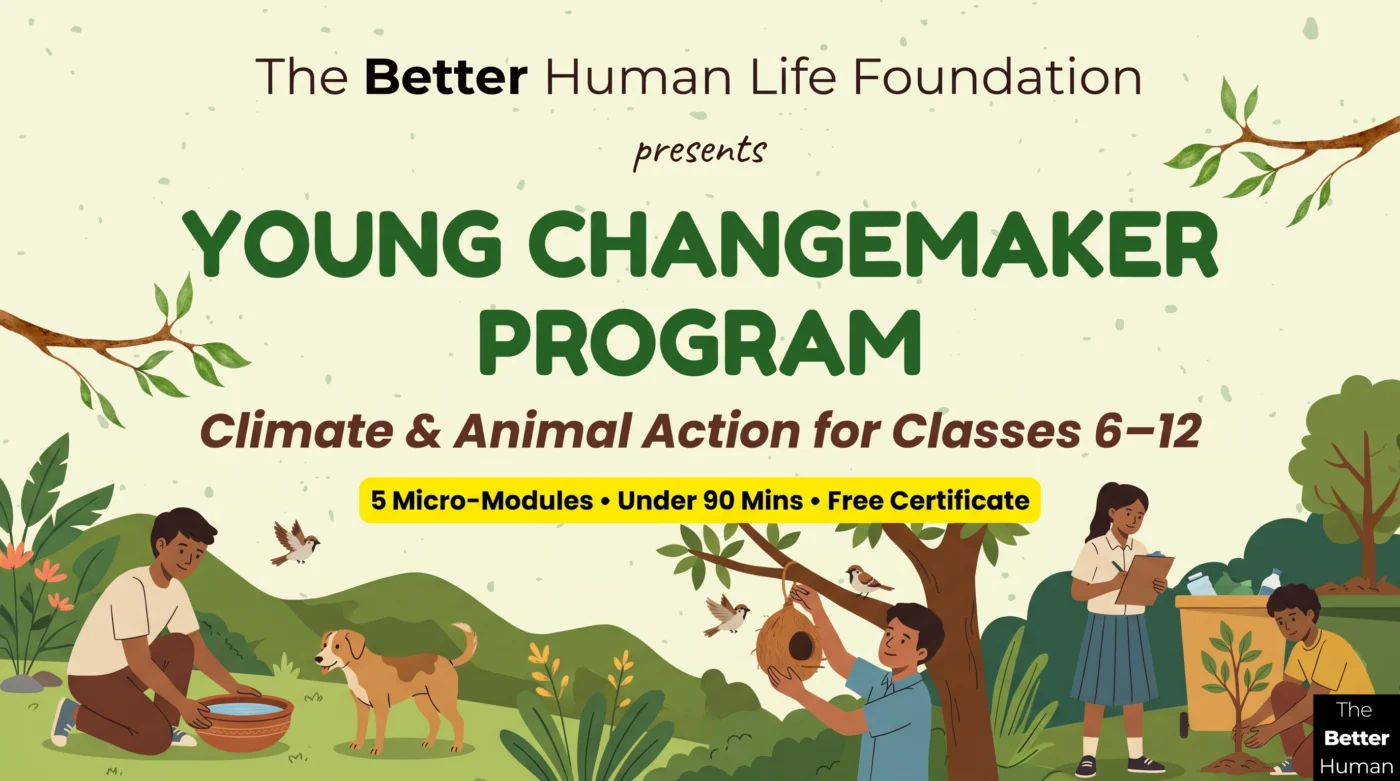
Tired of textbook essays on climate change that offer no practical solutions?
The Better Human Life Foundation has launched a free, 90-minute Young Changemaker Course focused on real-world, ground-level impact:
🐶 Street Animal First-Aid: Vet-safe feeding rules & heatstroke care
🐦 Urban Avian Support: Setting up natural clay water stations
♻️ Plastic Decoding: Spotting resin codes & hidden packaging waste
💧 Virtual Water: Measuring your real household water footprint
📢 Micro-Advocacy: How to pitch low-waste alternatives to school canteens & local shops
🎓 Complete all 5 short modules at your own pace to earn your official Young Changemaker Certificate!
🔗 Enrol for Free Here:
https://thebetterhuman.life/community/course/young-changemaker-course-by-the-better-human/lessons
(Feel free to share this with students, eco-club leads, and teachers!)
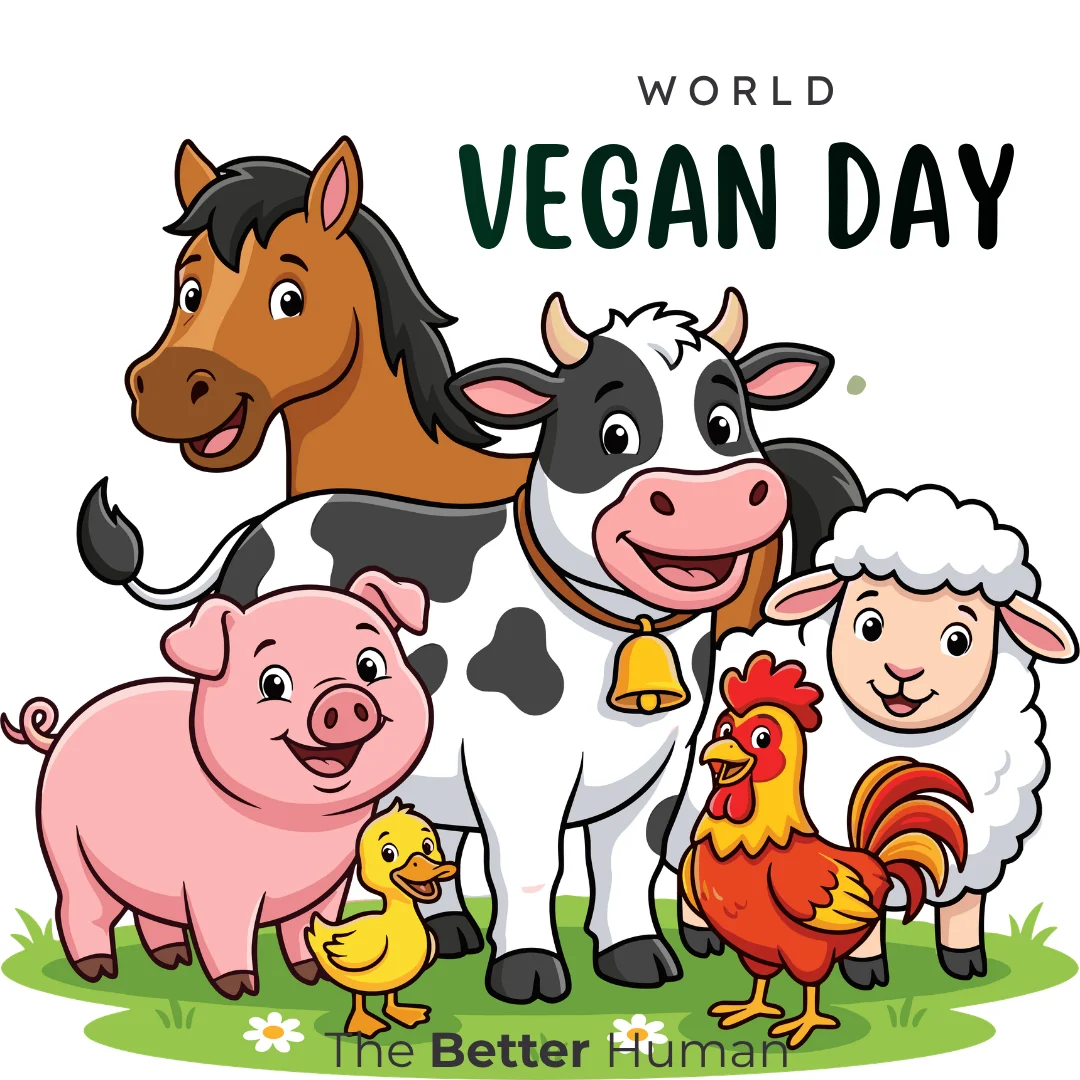
Most people will celebrate it with pictures of vibrant smoothie bowls, plant burgers, and discount codes.
That is fine. But let’s not reduce a moral revolution to a lifestyle trend.
Veganism was NEVER about diet.
It was never about salad.
It was never an exclusive club for wellness influencers.
It began with one fundamental realization: A living being is not a resource.
Look at how the modern human mind operates:
• If an animal exists, we look for its meat, milk, skin, or labour.
• If a forest exists, we calculate its timber or real estate value.
• If a river exists, we look for how much industrial waste it can carry away.
Everything in existence is reduced to a commodity for human gratification.
We take calves away from their mothers to drink their milk.
We breed gentle, sentient creatures into short, agonizing lives, confine them in industrial sheds, and slit their throats - all for 10 minutes of fleeting taste on the tongue.
And then, we call ourselves a civilised society.
We talk about climate change, ESG targets, carbon credits, and planetary boundaries.
Yet we turn a blind eye to animal agriculture - the leading driver of deforestation, freshwater depletion, habitat destruction, and greenhouse gas emissions.
You cannot HEAL an ailing planet with a violent heart.
World Vegan Day is not asking you to adopt an exotic routine.
In our own culture, traditional diets have always celebrated lentils, millets, grains, vegetables, and seasonal fruits - complete, cruelty-free nourishment straight from the soil.
Going vegan is not a sacrifice.
It is simply withdrawing your financial and moral support from an industry built on systemic exploitation.
It is waking up to the simple, undeniable truth:
The dog on your sofa and the cow in the dairy farm have the exact SAME DESIRE TO LIVE.
Before you choose your plate today, ask yourself:
Does another breathing life need to suffer and die just so I can eat lunch?
Real strength does not dominate the weak. Real strength PROTECTS them.

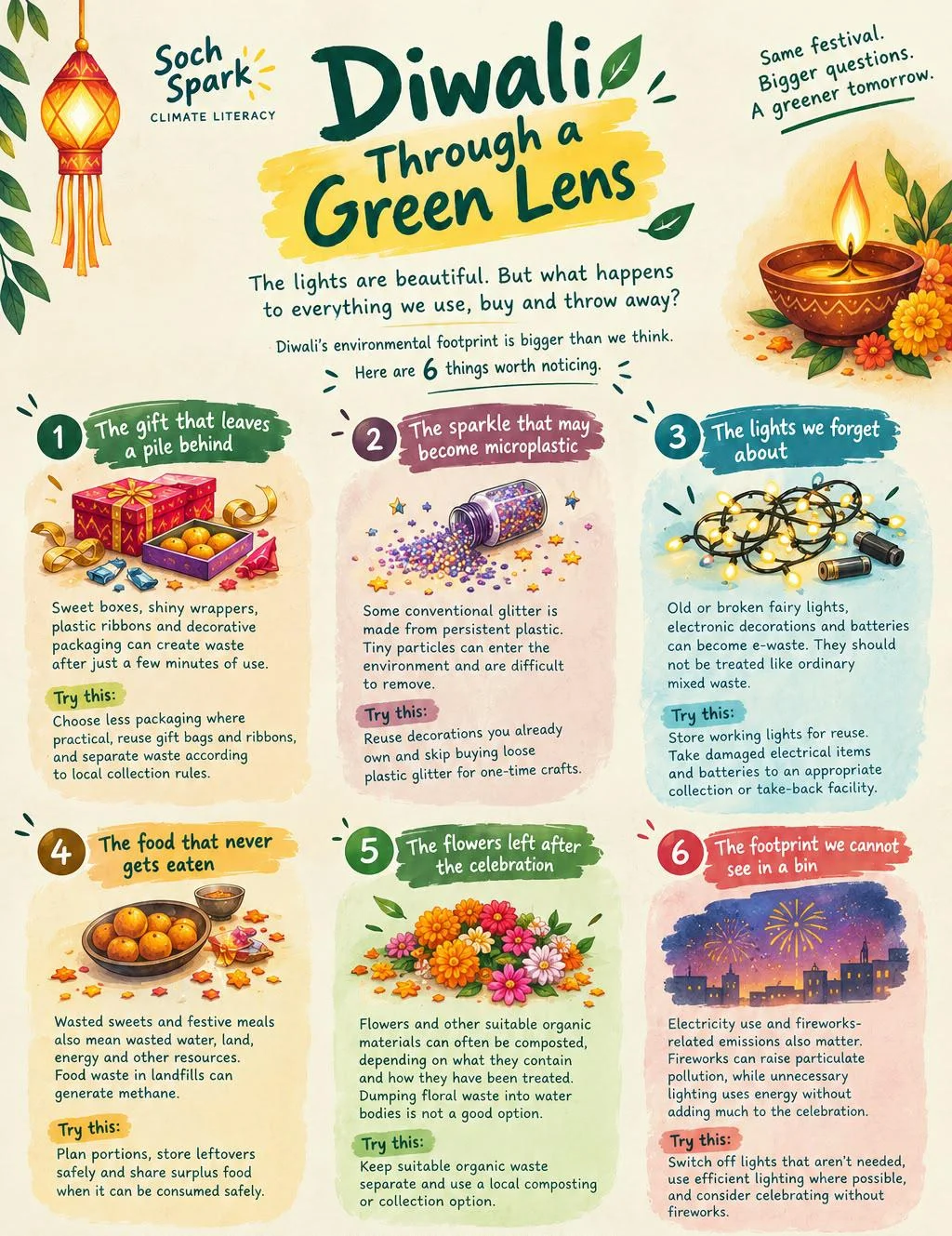
The lights come down. The sweets are finished. The celebrations wind down.
But what happens to everything left behind?
Some of Diwali’s environmental footprint is easy to see. Some is hidden in the things we buy, use briefly and throw away.
🔎 LOOK CLOSER: 6 THINGS WORTH NOTICING
🎁 1. The gift that leaves a pile behind
Sweet boxes, shiny wrappers, plastic ribbons and decorative packaging can create waste after just a few minutes of use.
Try this:Choose less packaging where practical, reuse gift bags and ribbons, and separate waste according to local collection rules.
✨ 2. The sparkle that may become microplastic
Some conventional glitter is made from persistent plastic. Tiny particles can escape into the environment and are difficult to remove. Not all glitter is plastic, so check what a product is made of.
Try this:Reuse decorations you already own and skip buying loose plastic glitter for one-time crafts.
💡 3. The lights we forget about
Old or broken fairy lights, electronic decorations and batteries can become e-waste. They should not be treated like ordinary mixed waste.
Try this:Store working lights for reuse. Take damaged electrical items and batteries to an appropriate collection or take-back facility; never burn or dismantle them yourself.
🍬 4. The food that never gets eaten
Wasted sweets and festive meals also mean wasted water, land, energy and other resources used to produce that food. Food waste in landfills can generate methane.
Try this: Plan portions, store leftovers safely and share surplus food when it can be consumed safely.
🌼 5. The flowers left after the celebration
Flowers and other suitable organic materials can often be composted, depending on what they contain and how they have been treated. Dumping floral waste into water bodies is not a good disposal method.
Try this: Keep suitable organic waste separate and use a local composting or collection option.
🌬️ 6. The footprint we cannot see in a bin
Electricity use and fireworks-related emissions also matter. Fireworks can raise particulate pollution, while unnecessary lighting uses energy without adding much to the celebration.
Try this:Switch off lights that aren't needed, use efficient lighting where possible, and consider celebrating without fireworks.
🌱 THE POINT ISN'T TO MAKE DIWALI LESS JOYFUL. IT'S TO MAKE OUR CHOICES MORE THOUGHTFUL.
A clay diya is not automatically impact-free. An LED light is not impact-free either. Materials, energy, how long something is used, and what happens to it afterwards all matter.
Climate literacy means looking beyond labels like natural, recyclable or eco-friendly and asking better questions.
🌍 Celebrate the festival. Question the footprint. Change what you can.
Explore the evidence:
- [Government of India — Identified single-use plastic prohibitions](https://www.pib.gov.in/Pressreleaseshare.aspx?PRID=1942104&lang=2®=3)
- [Central Pollution Control Board — E-waste information](https://cpcb.nic.in/uploads/Projects/E-Waste/FAQ_ewaste_23012024.pdf)
- [UN Environment Programme — Food loss and waste](https://www.unep.org/en/what-we-do/food-systems/food-loss-and-waste)
- [European Commission — Microplastics and glitter](https://single-market-economy.ec.europa.eu/sectors/chemicals/reach/restrictions/commission-regulation-eu-20232055-restriction-microplastics-intentionally-added-products_en)
- [Government of India — Floral waste and circularity](https://www.pib.gov.in/PressReleasePage.aspx?PRID=2032112&lang=1®=48)

Nowadays, many people are busy following new trends, buying fashionable clothes, using the latest gadgets, and trying to keep up with social media. Everyone wants to look modern and fit in with the changing world, but sometimes we forget about the world we actually live in. While we chase the latest fashion, forests are being cut down, rivers are becoming polluted, and the air is getting warmer. We worry about missing a new trend, but hardly notice the changes happening around us. Our Mother Earth is slowly losing her beauty, and the animals that share this planet with us are losing their homes. Trends come and go, but we have only one Earth to call home. Looking fashionable or being popular means nothing if we destroy the place that gives us life. It is time to look beyond our screens, care less about unnecessary things, and care more about nature. After all, the Earth doesn't need another trend; it needs our love, our care, and our action before it's too late.
Nepal tragedy isn't important
Assam tragedy isn't important
Bihar tragedy isn't important.
How I'd look in 80s, is the most important thing in life!!
In the last few weeks I saw something strange.
People are so much interested to see how they'd look in their 80s.
I was shocked to see this.....why do you want to go in the past?
❌ The time which you never lived in
❌ The time which you'd never live
Why not focus on what's going to happen in the future?
Do you know????
👉 In the next 2 years, we will cross the annual global temperature rise limit of 1.5 deg C
👉 In the next 20 years, we will cross the annual global temperature rise limit of 2 deg C
👉 After that, climate correction will be irreversible.
👉 Mumbai and Kolkata are on high alert due to sea level rise.
One more fact - one AI prompt wastes 500ml of water.
Water - which will be as rare and expensive as gold.
So, instead of going back by 45 years, go 45 years ahead and see yourself.
Do you even have those guts to see what destruction is to be seen in future?
And the destruction in Nepal, Assam, Bihar and the upcoming destructions are not natural.
They Are Man-made.
🌎 Every person who uses energy excessively, emits carbon dioxide excessively.
🌎 This carbon dioxide lives in the atmosphere for around 300 years.
🌎 This leads to global warming and annual global temperature rise.
🌎 This leads to melting of glaciers.
🌎 Melting of glaciers leads to sea level rise.
🌎 And if the sea level rises, the cities near the sea will be wiped of from the map soon.
This has happened earlier.
This will happen in future.
So don't go 45 years back.
Go 45 years ahead and try to fix it NOW.
Now is the time.
It's now or never.
Arya Warunjikar



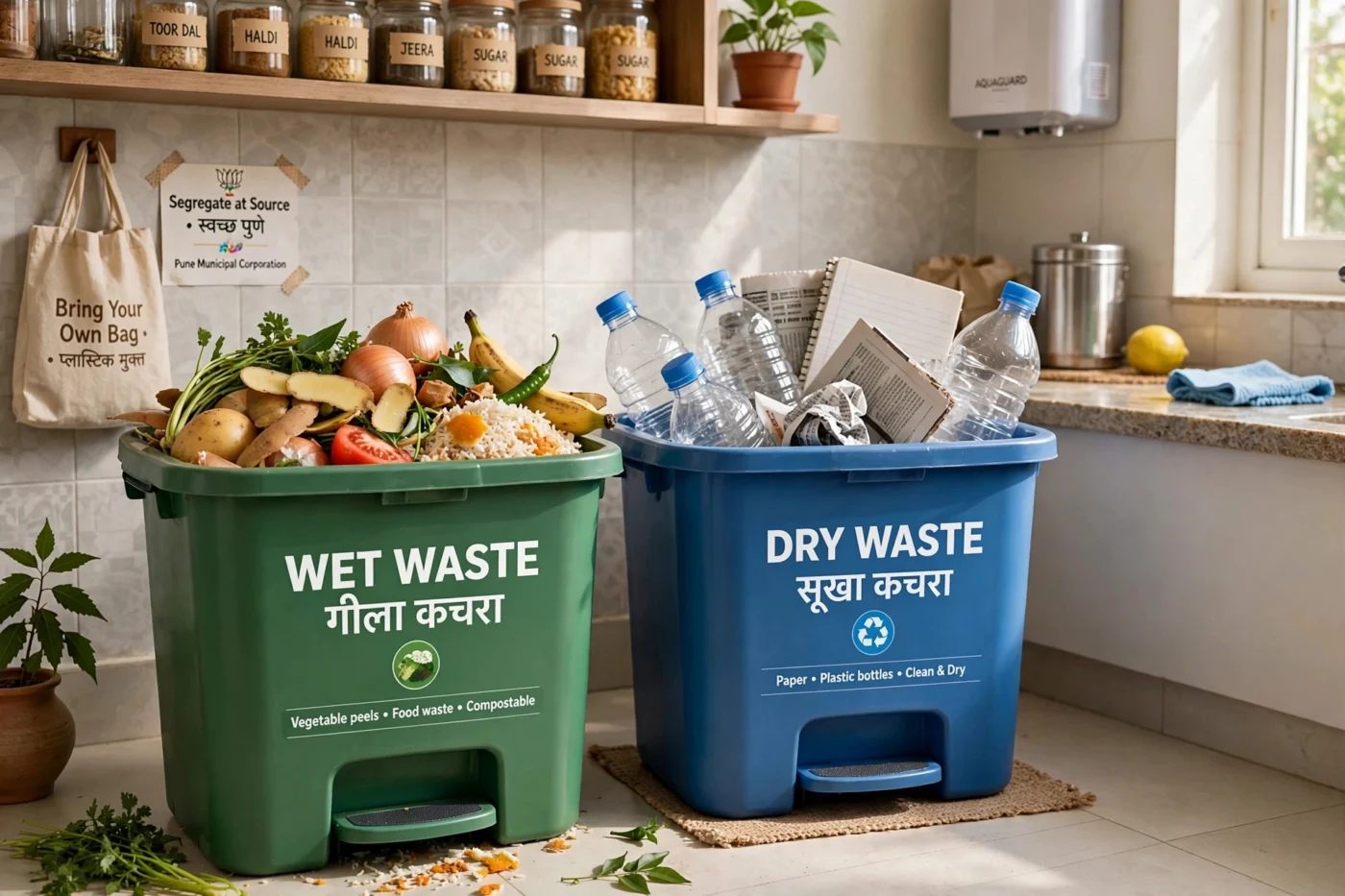
I have started waste segregation at home in Pune. Green bin for wet waste like vegetable peels, Blue bin for dry waste like plastic bottles. This is my small green action to reduce landfill waste and protect Mula-Mutha river. My Waste, My Responsibility! Let's make Pune Swachh.

We just rolled out a major update to the WriteToWin competition. We don’t just want great writers; we want to reward active changemakers.
From today, students can earn bonus points and increase their chances of winning by sharing a photo or video of a real-world green action - whether that’s planting a sapling, organizing a waste segregation drive, feeding street animals, or any such good and useful act.
How it works:
Students (or parents/teachers) can simply reply to our official WhatsApp chat with their media, Full Name, and School.
Let’s turn eco-anxiety into direct, geo-tagged action. 🌱
If you know students participating in the Monsoon Season, make sure they know about this!
Indore now hosts Asia’s largest food waste-to-CNG facility, processing 550 tonnes a day. The research proves that bio-CNG reduces emissions by 90% compared to conventional diesel fuels.
Source - https://gpsrenewables.com/