Fish Welfare in India: Crowding, Handling and Slaughter
 TBH Editorial
A fish can reach market weight while spending its life struggling to breathe. For anyone trying to make responsible food choices, that exposes a gap: production figures tell us little about the animal’s experience.
Fish welfare in Indian aquaculture depends on water quality, space, handling and how fish are killed. Accountability must follow the fish, including decisions made by buyers who never visit a pond.
Start with what the animal experiences, then examine who controls those conditions.
Key Takeaways
- Crowding becomes dangerous when fish cannot breathe, feed or move without repeated stress.
- Low mortality doesn’t prove good welfare. Behaviour, injuries and water conditions matter too.
- Handling and slaughter need their own assessments, beyond a farm certificate.
- Buyers must fund better practices instead of transferring every cost to farmers.
Aquaculture’s Growth Makes Welfare Harder to Ignore
In 2022, aquaculture produced 94.4 million tonnes of aquatic animals, accounting for 51% of global aquatic-animal production. According to FAO’s aquaculture production figures, it surpassed capture fisheries for the first time. These figures exclude algae.
The scale looks different when we count individuals rather than tonnes. Fish Welfare Initiative estimates that 165 billion farmed vertebrates are alive globally at any moment, including 125 billion farmed fishes.
That is an organisational estimate, not a global census. Still, it exposes how many animals disappear inside production statistics.
India’s freshwater farming includes rohu, catla, mrigal, common carp and tilapia. Their needs differ. A welfare system built around Atlantic salmon cannot simply be copied into a carp pond.
What Fish Welfare Means in Aquaculture
Good welfare includes physical health, suitable surroundings and opportunities for normal behaviour. Fish sentience also requires attention to pain, fear and distress.
The Five Freedoms Set a Starting Point
The Five Freedoms cover freedom from hunger and thirst; physical and thermal discomfort; pain, injury and disease; restrictions on normal behaviour; and fear and distress.
The review of fish-welfare science describes this influential framework. For aquaculture, it directs attention toward feeding, suitable water conditions, disease treatment, behaviour and stressful handling.
The Five Freedoms are questions to investigate, rather than a certificate earned by keeping fish alive. A pond can meet a feeding target while exposing fish to oxygen shortages.
Survival Leaves Important Questions Unanswered
Fraser and colleagues distinguish three approaches: function-based assessment examines health and biological performance; nature-based assessment considers normal behaviour; feelings-based assessment considers animals’ experiences.
We need all three. Fast growth answers one question. It doesn’t establish comfort or freedom from repeated distress.
The Five Domains Model, updated by David Mellor and colleagues in 2020, adds explicit attention to positive experiences. It considers nutrition, environment, health, behavioural interactions and mental state.
Mental state cannot be read directly. We infer it through evidence about the animal and its circumstances.
Crowding and Water Quality Must Be Assessed Together
Oxygen Can Become the Immediate Limit
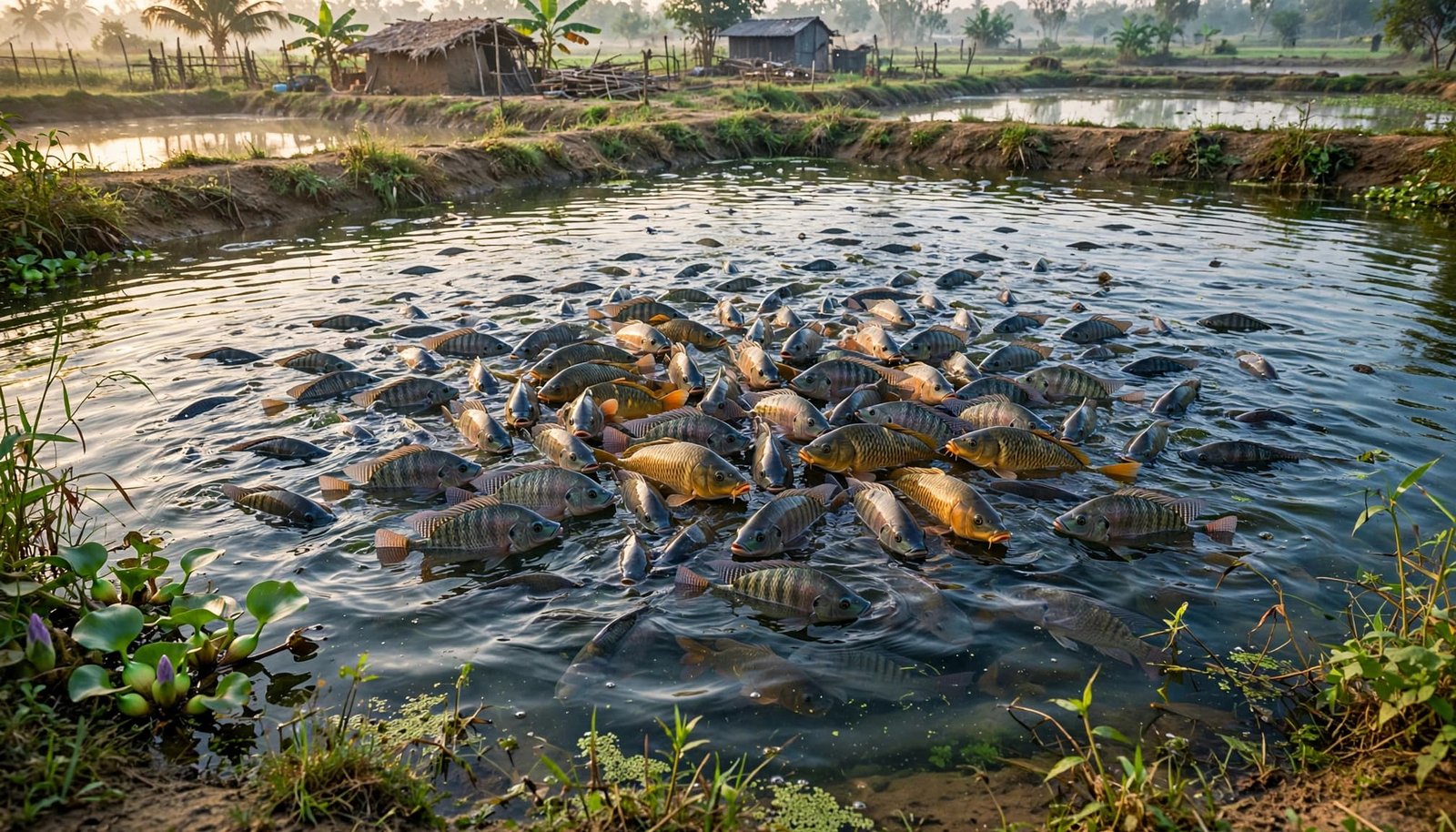
Stocking density means little without fish size, water volume, temperature, feeding and oxygen supply. The same number of fish creates greater pressure as they grow.
Warm water holds less oxygen. Fish, microbes and decomposing organic matter consume it. Pond oxygen can fall overnight, making early-morning measurements important.
This is practical climate literacy: hotter conditions can increase stress while reducing the oxygen available. Aeration also depends on reliable electricity and a workable backup plan.
Surface gasping deserves immediate attention. Waiting for mortality means waiting until the failure has already harmed animals.
Different Systems Create Different Risks
Species and farm systems change what inspectors should examine.
| Fish or system | Welfare pressure | Useful observations |
|---|---|---|
| Rohu, catla and mrigal in ponds | Oxygen shortages and unequal feeding access | Dawn oxygen, feeding response and injuries |
| Common carp in ponds | Poor water quality and harvest crowding | Gill condition, swimming and handling damage |
| Tilapia in intensive tanks | Crowding, aggression and waste accumulation | Fin damage, oxygen and ammonia |
| Fish in cages | Restricted movement and changing surrounding water | Water exchange, injuries and temperature |
These are inspection priorities, not universal density limits.
Tolerance of poor conditions isn’t permission to maintain them. Disease, parasites and chronic injury also require treatment, rather than being dismissed as routine production losses.
Read Welfare Indicators Before Fish Start Dying
A useful welfare assessment combines animal-based welfare indicators with measurements of the environment.
Watch feeding response, swimming, ventilation, fin condition, skin damage and aggression. Record mortality and growth, but don’t let those figures stand in for welfare indicators.
A sudden feeding decline can indicate trouble. Repeated injuries or aggression in intensive tilapia systems can reveal problems that a single water sample misses. Neither observation identifies the cause alone.
The fair-fish welfare analysis examines behaviour, habitat needs and knowledge gaps across farmed species. That broader view matters because a production metric cannot capture every welfare concern.
Records should connect observations with temperature, oxygen, feeding, stocking changes and handling events. Otherwise, patterns become isolated incidents.
Low mortality can coexist with poor welfare. Survival records need to be read alongside injuries, behaviour and water conditions.
Repeated records also make accountability harder to stage-manage. A tidy pond on inspection day cannot erase recurring oxygen crashes.
Handling and Transport Can Undo Months of Care
Harvesting concentrates fish into smaller spaces, often when oxygen demand is already high. Nets, pumps, sorting and loading can damage skin, scales and gills.
The FAO reference on farmed-fish welfare connects stocking, handling and slaughter with welfare risks.
Handling plans should minimise unnecessary crowding, air exposure and repeated transfers. Equipment must suit the fish being moved. Rough surfaces and poorly managed equipment add avoidable injury.
Transport adds another set of pressures: temperature changes, deteriorating water quality, confinement and unloading delays. Journey duration alone doesn’t describe the experience.
Records need to include loading injuries, deaths during transport and condition on arrival. A farm-only audit leaves these animals’ later experiences unanswered.
Staff training matters, but workers also need adequate time, suitable equipment and authority to stop a harmful operation. We can’t demand careful handling while rewarding speed alone.
Slaughter Welfare Depends on Effective Stunning
A fish’s welfare doesn’t stop when it becomes somebody else’s stock.
Assess pre-slaughter crowding, handling and confinement alongside stunning and killing. Humane slaughter requires an effective stun that keeps the fish insensible until death.
A stunning device being present doesn’t establish that it works. Assessment must examine outcomes, failures, corrective action and staff competence. Different species and sizes need appropriate, validated arrangements. EFSA’s species-specific opinions illustrate why protocols need validation for each fish type.
Air exposure and chilling shouldn’t be treated as proof of unconsciousness. A motionless fish may still require further assessment.
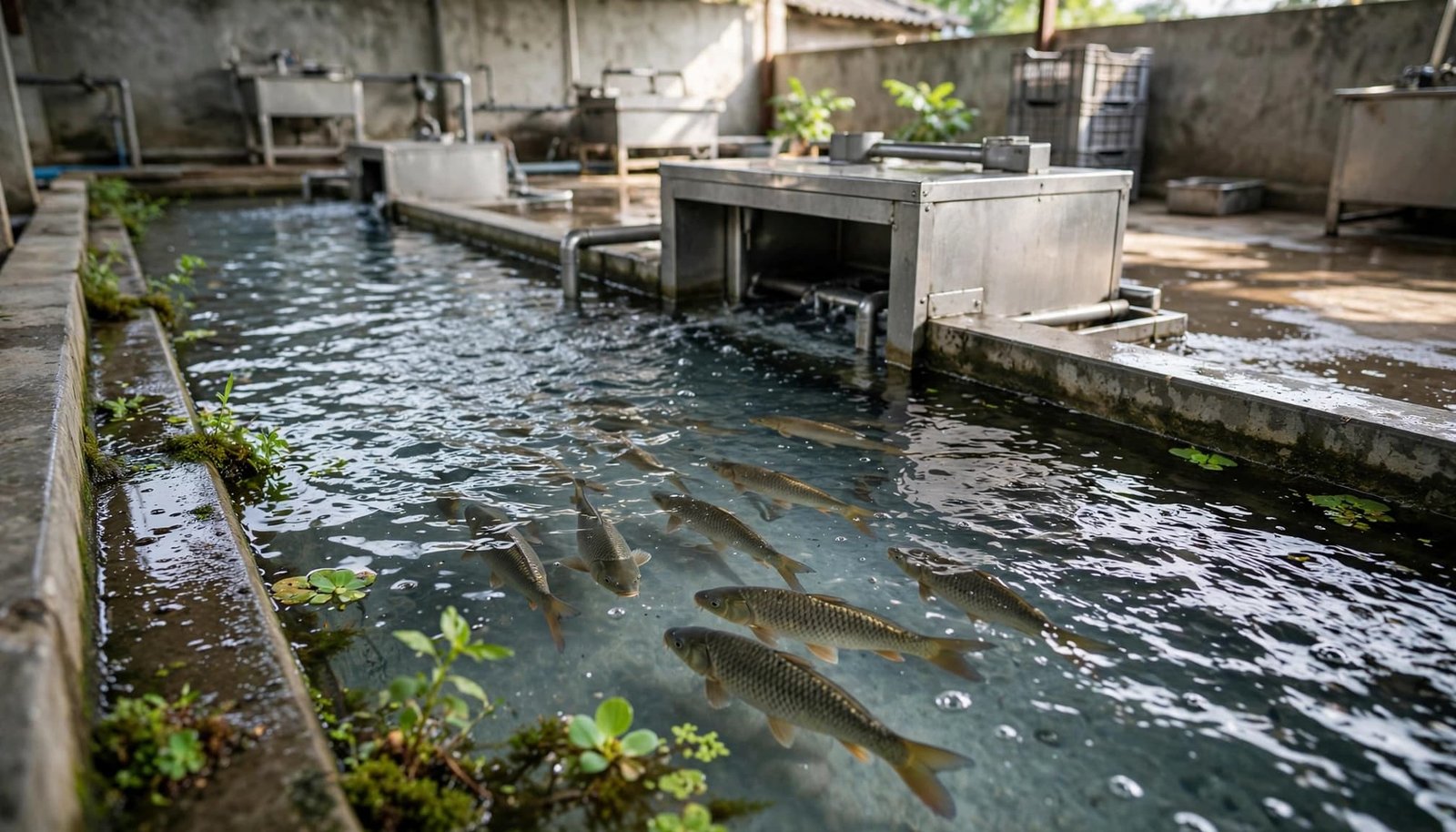
Buyers should require evidence covering the actual processing facility. A supplier’s general welfare promise leaves the slaughter stage unresolved.
Stress before death can also affect flesh quality. That gives businesses a commercial reason to improve practices, but the ethical duty doesn’t depend on whether better treatment produces a premium fillet.
What Indian Rules and International Standards Establish
Keep Legal and Certification Scopes Separate
India’s Prevention of Cruelty to Animals Act, 1960 provides a general anti-cruelty framework. It addresses unnecessary suffering, including concerns involving conveyance and confinement.
That framework doesn’t set species-specific stocking, oxygen or stunning thresholds. The Five Freedoms can guide welfare assessments, but they aren’t species-specific legal limits. ICAR’s 2026 Good Aquaculture Practices material addresses fish health, welfare and traceability, but guidance isn’t an enforceable welfare limit.
Coastal aquaculture regulation has a different scope from animal welfare. Registration or environmental permission doesn’t establish that fish experienced suitable conditions.
Food safety also answers a separate question. An FSSAI licence doesn’t demonstrate good on-farm welfare or effective stunning.
A meaningful certification claim identifies its standard, facilities, species and supply-chain stages. Audit reporting should show failures and corrective action, rather than only a logo.
International Guidance Offers Benchmarks, Not Indian Law
As EFSA’s fish-welfare overview explains, Council Directive 98/58/EC sets minimum protection standards for farmed animals, including fish.
The Council of Europe adopted a farmed-fish welfare recommendation in 2005. The OIE, now the World Organisation for Animal Health, adopted guiding principles in 2008.
In 2009, EFSA’s AHAW Panel adopted seven species-specific opinions on stunning and killing. They covered bluefin tuna, common carp, European eel, Atlantic salmon, rainbow trout, European turbot, and a combined European seabass and gilthead seabream assessment.
EFSA’s assessments provide scientific and policy benchmarks, but they aren’t automatically binding requirements for Indian farms.
Who Pays for Better Welfare and Cleaner Water?
Small farmers face feed costs, disease risks, electricity bills and volatile prices. Systemic change requires buyers to share responsibility for the conditions their purchasing contracts create.
Sustainable business models should fund oxygen monitoring, reliable aeration, veterinary support and safer handling. Lower mortality and improved feed conversion can support farm finances. They shouldn’t become the only tests of success.
Welfare and ecological impact need separate evidence. A healthy fish can live in a farm that pollutes neighbouring water. A low-emissions product can still involve prolonged suffering.
Our examination of shrimp farming and groundwater salinity shows why oversight must extend beyond the farm boundary. Water damage reaches homes, fields and livelihoods.
A circular economy can improve the handling of packaging, equipment and processing waste. It cannot compensate for untreated discharge or repeated welfare failures.
Protecting wetlands also supports fisheries and urban biodiversity where settlements meet aquatic habitats. Community knowledge belongs alongside laboratory results. Residents often notice changes before an inspection does.
For practical habitat protection beyond food purchasing, Explore Our Active Missions and support our on-the-ground biodiversity work.
Frequently Asked Questions
What does fish welfare depend on in Indian aquaculture?
Fish welfare depends on water quality, space, feeding, handling and slaughter. Species and farm systems also affect which conditions need attention.
Does low mortality mean fish have good welfare?
No. Assess mortality alongside behaviour, injuries, feeding response and water conditions, since fish can survive while experiencing poor welfare.
What should buyers check in a fish-welfare claim?
Check which standard, species, facilities and supply-chain stages the claim covers. Ask for audit results and corrective actions, including evidence from transport and processing.
What makes fish slaughter humane?
The fish must be effectively stunned and remain insensible until death. Assessment should check outcomes, failures, corrective action and whether the method is validated for the species and size.
Put the Fish Back Into the Decision
Fish welfare in aquaculture needs evidence about breathing, injuries, behaviour, handling and consciousness at slaughter. Production volume cannot answer those questions.
Everyday mindfulness can include replacing some fish meals with pulses, beans or tofu. Plant-based living reduces reliance on farming and slaughter, while institutional purchasing can demand better conditions across the supply chain.
If you buy farmed fish, ask for the latest welfare-outcome report with verifiable results for transport and humane slaughter. That makes your concern a measurable purchasing requirement.