How Indian Farmers Can Prevent Crop Raiding Humanely
 TBH Editorial
A louder response can make prevention of crop raiding less effective. Indian farmers can protect crops with early warnings, maintained barriers and species-specific guarding, without poisoning, trapping or injuring wildlife.
But asking a family to protect crops from an elephant while absorbing repeated harvest losses is unfair. Shared responsibility must address the costs of human-wildlife conflict alongside practical crop protection.
The starting point is knowing which methods have evidence, and what that evidence actually means.
Key Takeaways
- No crop-raiding prevention method is 100% effective. Study percentages show how often researchers identified a method as effective, not the share of raids it stops.
- Choose measures for the species, field boundary and local maintenance capacity. Compare installation costs with repairs, supplies and paid guarding.
- For elephants, combine early warnings with maintained barriers and trained responders. Avoid noise-driven chasing, direct use of irritants and unsafe electrical connections.
- Neighbouring farms need a shared plan to record incidents, maintain deterrents and check whether protection shifts damage to other fields. Public programmes need funded repairs, paid monitoring and accessible compensation.
What crop raiding prevention evidence tells us
Crop raiding means wild animals eat, damage or trample cultivated crops. Elephant crop damage attracts attention, but Indian farmers also face macaques, nilgai, wild boar and other species.
What researchers tested
A review of elephant crop-protection interventions examined 95 studies published between 1993 and 2019. The review covered 64 research sites across 20 countries and assessed each intervention.
Researchers identified 31 techniques in four categories: detection efforts, preemptive measures, fencing and trenches, and deterrent methods.
No single technique was 100% effective. Studies also measured effectiveness in different ways, including observed damage, farmer perceptions and comparisons between protected and unprotected plots. That makes a universal league table unreliable.
What the percentages mean
Chili pepper approaches, including fences, sprays and briquettes, were cited as effective in 28% of studies reporting efficacy: 22 of 79, across eight countries.
Crop guarding was cited in 23% of studies across 11 countries. Electric fencing appeared in 18% across seven countries.
These figures describe how often studies identified a method as effective. They don’t mean chili fences stopped only 28% of raids or predict results for a particular farm.
A frequently studied method isn’t necessarily the best option for your species, field boundary or maintenance budget.
Compare methods by evidence and recurring cost
The cheapest purchase can cost more through unpaid crop guarding, repeated repairs or crop damage.
Each deterrent has different operating demands.
| Method | Where it fits | Main cost to budget |
|---|---|---|
| Early warnings and coordinated crop guarding | Detection efforts by field guards before entry | Paid shifts, communication and equipment upkeep |
| Chili pepper-treated boundary ropes | Selected elephant-conflict sites | Materials, replenishment and labour |
| Spotlights | Trained elephant-response teams | Batteries, charging and safe observation points |
| Non-lethal electric fence | Boundaries suited to maintained fencing | Energiser, installation, vegetation clearance and repairs |
| Beehive fences | Locally suitable specialist projects | Hives, bee management and replacement |
Preemptive measures give teams time to act before animals enter; response starts after detection.
The practical choice depends on who can keep the system working throughout the vulnerable season.
Cost estimates appeared in fewer than 20% of intervention studies. Historical examples ranged from about US$22 per beehive to over US$1 million for metal fencing around a conservancy.
Neither figure is an Indian installation quote. The evidence doesn’t support one honest nationwide rupee-per-hectare rate.
For boundary protection, perimeter matters more than acreage alone. Compare installation, annual maintenance and paid labour together. A fence without a repair budget is an unfinished commitment.
For elephants, combine warnings with maintained barriers
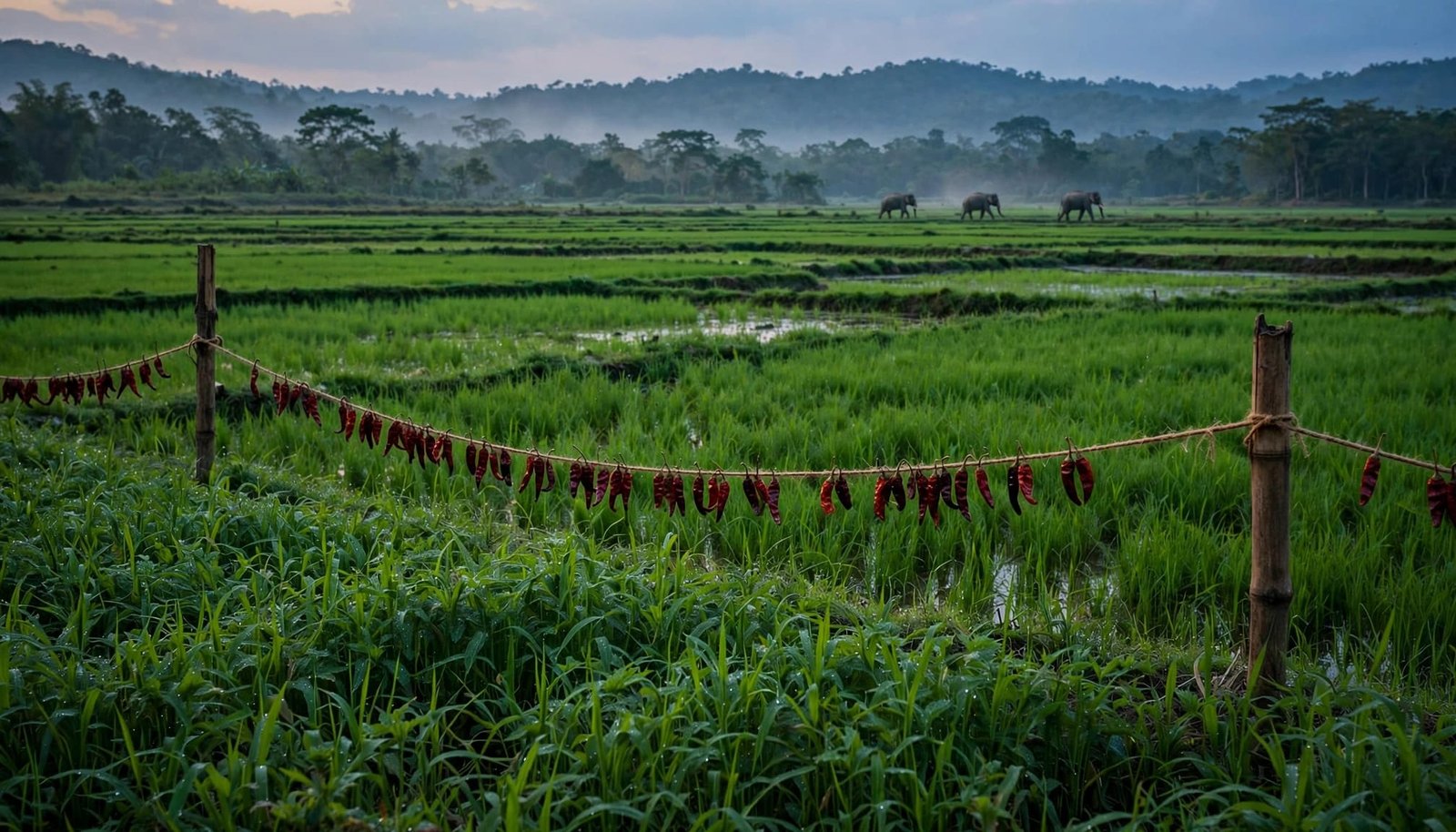
Illustrative farm scene, not a record of a field trial.
Use the Assam findings carefully
A three-year Assam study of elephant deterrents recorded 1,761 incidents. Spotlights, chili fences and electric fences were associated with effective protection when used alone. Adding noise compromised their effectiveness.
This was observational evidence for managing human-elephant conflict, not proof that every combination works the same way.
The lesson is practical: adding a deterrent or more commotion doesn’t automatically improve protection. Avoid noise and crowd-driven chasing. Trained responders need safe observation positions, communication and room for animals to withdraw without entering another settlement.
Keep deterrents non-lethal
Capsaicin in chili pepper irritates sensitive tissues and can discourage animals from crossing treated boundaries. That doesn’t make every chili recipe safe or effective. Rain and maintenance affect how well a boundary works.
Don’t spray irritants directly at wildlife or use discarded engine oil. Burning chili preparations adds smoke and fire risks.
An electric fence requires a purpose-built pulsed energiser and qualified installation. Never connect a fence directly to household or agricultural mains power. Solar power describes the energy source, not the safety of the electrical output.
Inspect fencing, clear vegetation safely and repair faults promptly. Keep water access and established movement routes outside poorly planned enclosures.
For monkeys, improve detection before adding guards
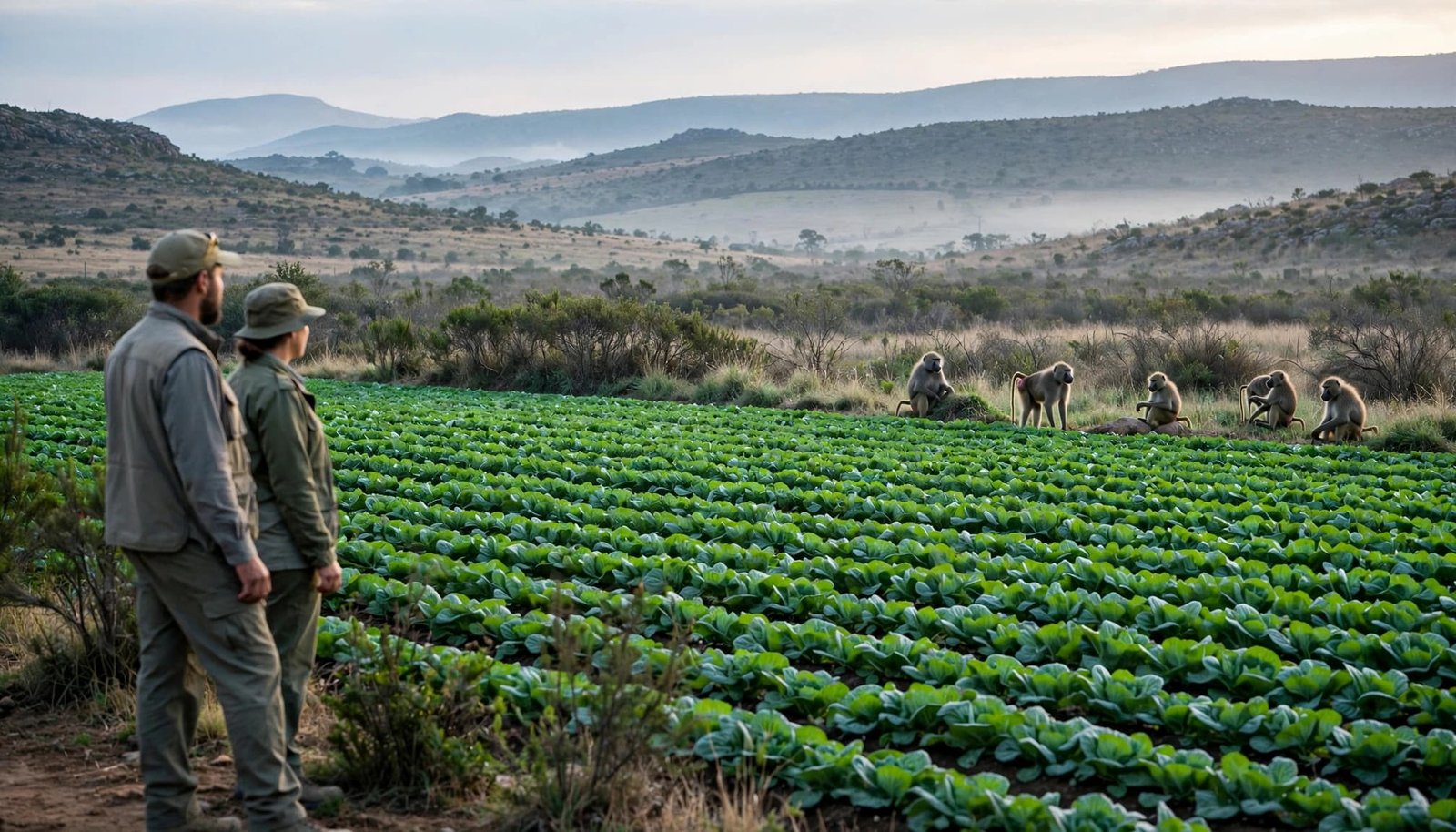
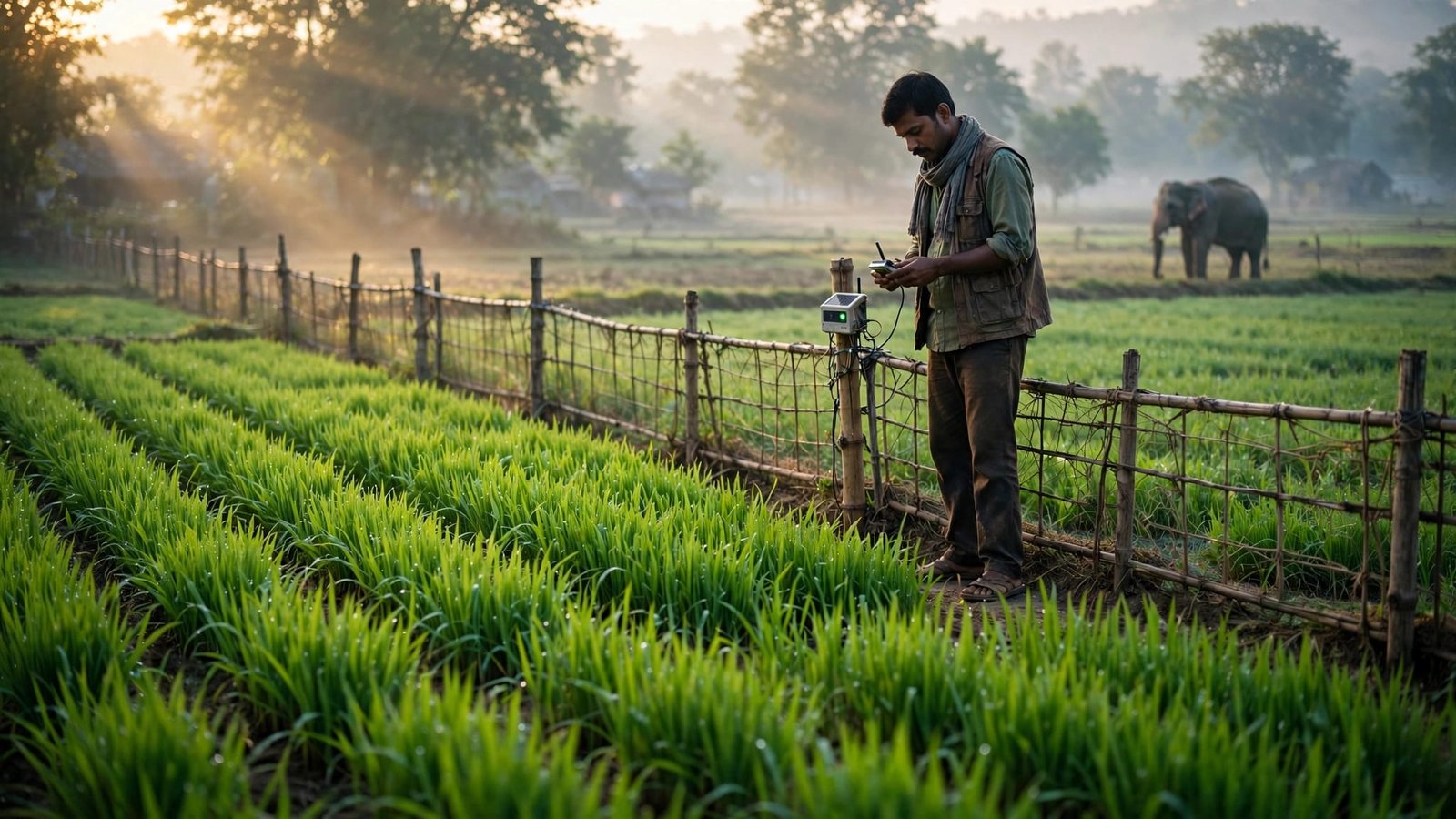
Illustrative scene of field-edge monitoring.
Understand what guards actually notice
A South African study of crop guarding found that field guards chased animals during 81% of baboon crop foraging events, but only 14% of vervet monkey events.
Responses were more likely when groups were larger and events occurred in the morning. This suggests that visibility and attention helped determine which raids triggered action. It doesn’t establish that vervets caused negligible damage.
Guard response delays increased during a low-productivity period of the productivity season, when NDVI fell below 0.32. NDVI is a satellite-derived indicator of vegetation greenness, not a universal staffing threshold for Indian farms during the productivity season.
Organise shorter, better-supported shifts
The study recommended early warning alarms, shorter shifts for field guards, and more staffing during mornings and low-productivity periods.
Its authors also proposed male guards or uniforms to increase perceived fear. That finding is context-specific, not a reason to exclude women from Indian monitoring teams.
These findings don’t establish how Indian macaques or langurs respond. Transfer the operational lesson: detect entry promptly, reduce fatigue, and record overlooked raids.
Don’t copy aggressive pursuit. Keep children out of guarding duties, avoid cornering animals, and use trained wildlife-response support when encounters become dangerous.
Read animal routes and food supply before spending
A fence cannot explain why animals keep arriving.
At Zambia’s Kasanka National Park, a study of crop nutrition and elephant raids found crops contained more protein, energy and moisture than natural vegetation. Natural vegetation contained more ash, vitamin C and fibre.
The researchers found no significant difference in raid incidence across the studied distances of 2 km, 10 km and 20 km from protected area boundaries.
That supports a nutritional explanation at that site. It doesn’t prove distance never matters elsewhere.
The consequences can be severe. Neupane and colleagues’ 2017 findings, summarised in this overview of crop raiding, attributed more than 40% of crop-raiding incidents and annual losses of 25% of crop production to the species in Nepal’s Terai.
Those aren’t Indian national estimates. They show why local exposure deserves serious attention.
Before choosing barriers, map recurring entry points, ripening periods, seasonal water and blocked routes. Assess the cumulative ecological impact of roads, railways and fencing.
Our work on safer wildlife crossings in India explains why protected approaches and connected habitat belong in conflict prevention.
Build a village plan that doesn’t export the damage
Protecting one field against crop raiding can redirect animals toward the next. Neighbouring farms need a shared plan with preemptive measures and detection efforts, particularly where fields lie along the same elephant route.
Begin with a small, documented intervention rather than buying every option at once.
- Record the species, entry point, crop stage, time and signs of crop foraging for each incident, from a safe location.
- Establish a warning chain with named adult contacts and the local forest-response team.
- Trial a suitable deterrent or fencing at the repeatedly used boundary, with someone responsible for maintenance.
- Track crop damage, guarding hours, repairs and incidents on neighbouring farms.
Compare losses against the exposed crop area and across each productivity season. A fall in reported raids means little if fewer people are reporting them.
For wild boar and nilgai, evidence from other species doesn’t establish effectiveness. Species-appropriate barriers need designs that avoid entanglement and injury. Never use snares, poison or explosive bait.
Residents often notice damaged fences, changed routes and blocked water access before a short survey does. Pay for that monitoring, document the response, and never require dangerous approaches to animals.
Public responsibility must include maintenance
Public responsibility for human-elephant conflict prevention starts when intervention budgets cover recurring work, not just installations.
Laikipia Wildlife Forum helped organise a 163 km fencing programme in Kenya. The first 84 km were completed by June 2008. Crop raiding declined, but breakages persisted.
Funding involved Dutch and Kenyan public bodies, alongside community and ranch contributions. The lesson isn’t to copy the fence length in India. Fund repairs and shared management after construction.
Indian programmes need named responsibilities for inspections, vegetation clearance, equipment replacement and paid monitoring. Public reporting should track repair delays and damage trends, not just kilometres installed.
Sustainable business models for equipment suppliers should reward serviceable systems and dependable repairs. Reusable components fit circular-economy principles, but repaired devices still need a safety assessment.
Accessible compensation should accompany prevention. A damaged harvest shouldn’t force a family into repeated travel and paperwork.
For readers outside farming, climate literacy includes understanding who carries conservation’s costs. Urban biodiversity projects and rural coexistence work both depend on maintained habitat and accountable institutions.
Frequently Asked Questions
What does the research say about crop-raiding prevention?
No single method stopped every raid, and studies measured effectiveness in different ways. The reported percentages show how often studies found a method effective, not the percentage of raids it prevents on a particular farm.
How should farmers choose a prevention method?
Match the method to the animal, field boundary and local ability to maintain it. Include installation, repairs, supplies and paid labour when comparing costs.
How can farmers deter elephants without harming them?
Use early warnings, maintained barriers and trained responders with safe observation points. Avoid noise and crowd-driven chasing, spraying irritants directly at animals, and connecting a fence to household or agricultural mains power.
What should a village crop-raiding plan include?
Record each incident from a safe location, set up a warning chain with named adult contacts, and assign someone to maintain any trial deterrent. Track damage and guarding hours on neighbouring farms too, so the plan can detect whether raids shift to other fields.
Protect the harvest without passing on the harm
Humane crop raiding prevention needs maintained protection and shared costs. Loudness, expensive equipment and unpaid vigilance cannot substitute for a working local plan.
Farmers deserve protection from crop damage. Wildlife needs usable routes, water and protection against lethal retaliation.
Start with one shared incident record and a named maintenance team. Build the next decision around what happens on the ground.