How to Read Chemical Safety Data Sheets at Work in India
 TBH Editorial
The most dangerous line on a chemical safety data sheet is often the one nobody reads.
A drum can look ordinary. A cleaner can smell familiar. A solvent may arrive in a container with a bright label and a supplier’s phone number. None of that tells you what happens if it splashes into an eye, meets the wrong chemical, or enters a drain. Chemical safety data sheets turn that missing information into actions people can use.
In Indian workplaces, reading an SDS well is not paperwork. It’s a way to protect the person handling the material, the co-worker beside them, and the neighbourhood beyond the factory gate.
Key Takeaways
- An SDS tells you what a chemical is, what can go wrong, and what to do before exposure becomes an emergency.
- Check the product identity, hazard statements, first-aid instructions, PPE, storage conditions, and incompatibilities before work starts.
- India uses more than one document format. MSIHC Schedule 9 has a nine-part format, while BIS and UN GHS guidance use a 16-section structure.
- A missing, outdated, or mismatched SDS is not a small administrative gap. It is a safety problem that needs escalation.
- The sheet must shape real conditions: ventilation, gloves, spill controls, waste routes, training, and access to medical support.
A safety data sheet is useful only when the person closest to the chemical can find it, understand it, and act on it.
How Chemical Safety Data Sheets Fit Indian Rules
An SDS may still be called an MSDS in older files, supplier emails, or storerooms. Don’t get stuck on the label. What matters is whether the document identifies the exact substance or mixture and gives usable safety information.
Schedule 9 and the Indian format
The Manufacture, Storage and Import of Hazardous Chemicals Rules, 1989 require occupiers handling hazardous chemicals to obtain or develop a safety data sheet in the Schedule 9 format. The information must be scientifically sound, kept current, and made available when requested.
The MSIHC Rules also require updates when important new hazard information emerges. That means an SDS downloaded years ago is not automatically good enough.
Schedule 9 is commonly described as a nine-section Indian format. Meanwhile, IS 17889:2022, India’s guideline for material safety data sheets, follows a 16-heading format aligned with wider international practice. The BIS safety-hazard standards listing includes IS 17889:2022.
Factory duties go beyond a document
Where a factory runs a hazardous process, Chapter IV-A of the Factories Act, 1948 matters too. Sections 41B to 41H address disclosure of danger, health records, competent supervision, medical checks, and a worker’s ability to report reasonably feared imminent danger.
Section 41C includes medical examination requirements before assignment, during employment, and after employment ends, at intervals not exceeding 12 months where the provision applies. An SDS does not replace those duties. It gives the safety team the exposure information needed to make them real.
Read the 16-Section SDS Without Getting Lost
A 16-section sheet can feel like a legal file designed to defeat your attention span. Don’t read it like a novel. Read it like you are about to use the chemical in front of you.
The UN guidance on preparing safety data sheets sets out the familiar 16-section order used in GHS-style documents.
Start with identity, hazards, and ingredients
Sections 1 to 3 answer the first hard questions: What is this? Who supplied it? What are the dangers? What is inside it?
Match the SDS product name, grade, and supplier with the container. If the container says “industrial cleaner” but the sheet refers to a different product, stop treating it as a match.
Then find the signal word, hazard statements, pictograms, and listed ingredients. “Causes severe skin burns” demands a different work setup than “causes skin irritation.” Flammable vapour, reproductive toxicity, aspiration danger, and aquatic toxicity should change how you plan the job.
Find the emergency and control details
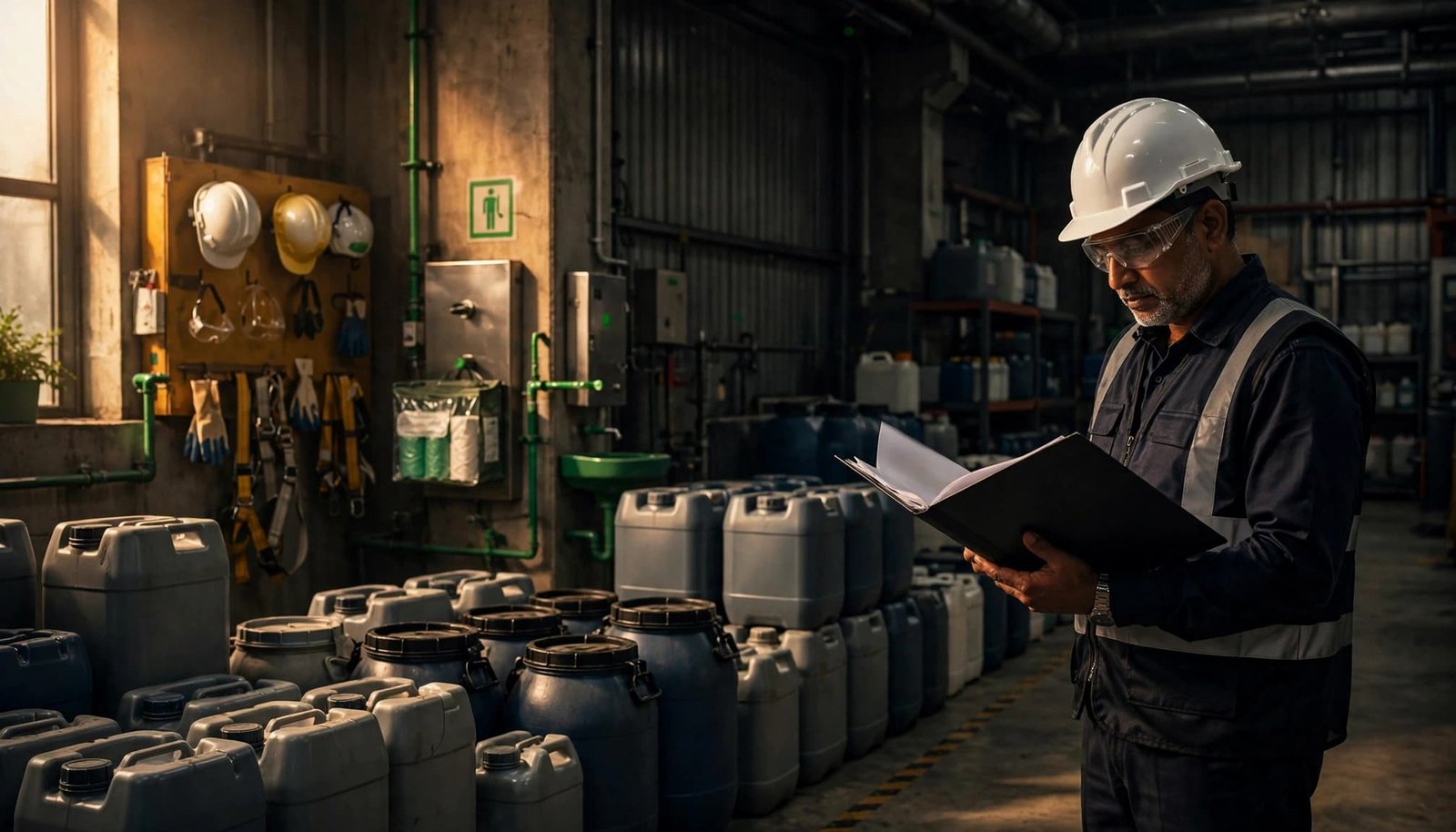
Sections 4 to 8 cover first aid, firefighting, accidental release, handling, storage, exposure controls, and PPE. For daily use, these are often the pages that matter most.
Read Sections 9 to 16 next for physical properties, reactivity, toxicology, ecological information, disposal, transport, regulation, and revision dates. Density, flash point, vapour pressure, pH, and solubility may look technical. They tell you whether a vapour can travel, whether a liquid may float on water, or whether a spill could behave badly in a closed room.
Check These Details Before Work Begins
You do not need a chemistry degree to read an SDS responsibly. You need the discipline to ask the right questions before opening the lid.
Match the job to the product
Look at the intended use. Is the material being sprayed, poured, heated, mixed, transferred, or cleaned up? Exposure changes with the task.
A worker using a closed transfer pump faces different risks than someone brushing a coating in a poorly ventilated room. The same product can also become more dangerous when heated or aerosolised.
Before beginning, confirm:
- The SDS matches the exact product and container.
- The revision date is current enough to trust.
- The work area has the controls named in the sheet.
- Everyone handling the material knows where the SDS is stored.
Read incompatibilities before mixing anything
Section 10, Stability and Reactivity, is where complacency gets expensive. It may warn against acids, alkalis, oxidisers, moisture, heat, ignition sources, or certain metals.
Never assume two cleaning products are safe together because both are sold for routine use. Never pour leftovers into a common waste drum without checking compatibility. Chemical reactions do not care whether the shortcut saved five minutes.
PPE deserves the same attention. “Wear gloves” is weak guidance unless the sheet identifies the right material and breakthrough protection. Thin disposable gloves can be the wrong choice for solvents. Goggles may not be enough where splashing needs a face shield, apron, or both.
An SDS Also Protects People Outside the Worksite
We often talk about chemical safety as though harm ends at the gate. It doesn’t. Dust rides home on clothing. A leaking drum reaches a drain. Smoke from a waste fire enters homes that never consented to the risk.
Waste is part of the exposure story
Section 13 tells you about disposal, but it cannot clean up weak systems on its own. Waste must move through a documented route to an authorised facility, not into an open plot, drain, roadside heap, or mixed municipal waste stream.
This matters in battery and e-waste work. Informal and small recycling units can involve crushing, heating, acid stripping, or storage of damaged cells. The risks include toxic fumes, skin contact, fire, and contaminated runoff. A shiny circular economy claim means little if workers breathe the cost of recovering the material.
Ecological data deserves attention
Section 12 is easy to skip because it discusses aquatic toxicity, persistence, degradability, and bioaccumulation. Yet this is where the sheet speaks to the ecological impact of poor handling.
A solvent or metal-bearing residue that enters a pond does not stay a factory issue. It can affect insects, fish, birds, soil organisms, and urban biodiversity long before anyone sees a visibly polluted water body.
Plant-based living can reduce pressure in parts of our consumption system. It cannot make unsafe workplace chemicals harmless. Climate literacy also needs chemical literacy, because a cleaner product story is incomplete when it hides unsafe labour or unmanaged waste.
When the SDS Is Missing, Old, or Useless
A document that sits in a locked office is not safety information. It is evidence that somebody values compliance theatre over people.
Ask for the right thing
Request an SDS when a new chemical arrives, when the product formula or supplier changes, or when a worker reports a reaction that the old sheet does not explain. Ask for it in a language and format workers can use.
A useful SDS must name the product, identify hazards, give first aid, state spill actions, list PPE, and show a revision date. If it says only “use suitable gloves” or “avoid exposure,” push for clarity.
Everyday mindfulness helps here. Notice unlabelled bottles, damaged containers, missing eye-wash access, strong odours, and workers improvising PPE. Awareness is not a substitute for enforcement, but it can stop us accepting danger as normal.
Treat imminent danger as a reason to pause
If the SDS is missing and no one can explain the hazard, do not proceed as if uncertainty is harmless. Tell a supervisor, safety officer, occupier, or worker representative. Record the product name, location, date, and what information was unavailable.
Workers in hazardous processes have legal grounds to report a reasonably apprehended imminent danger. That right matters most when it is used before exposure, not after an injury.
This is where systemic change becomes practical. Employers must fund training, ventilation, spill response, PPE, medical checks, and safe waste routes. Workers should never have to buy their own protection to keep a job.
Frequently Asked Questions
Is an MSDS different from an SDS?
Older documents often use “Material Safety Data Sheet” or MSDS. SDS is the more current term. The practical question is whether the document is current, product-specific, and complete enough for safe handling.
Must every Indian workplace use a 16-section document?
Not automatically. The MSIHC Rules refer to the Schedule 9 format, while IS 17889:2022 and GHS-style sheets use 16 sections. Follow the applicable legal requirement, but never accept a shorter document that leaves workers without usable hazard and emergency details.
Can I rely on the label instead of the SDS?
No. A label gives fast warnings. The SDS explains first aid, incompatible substances, storage conditions, exposure controls, firefighting measures, and disposal needs. You need both.
Chemical Safety Is a Test of Accountability
A chemical safety sheet should answer one plain question: What must happen so nobody pays for this product with their lungs, skin, water, or livelihood?
Sustainable business models do not hide risks in contract labour, scrap lanes, or nearby settlements. They make protection visible, funded, and routine.
For action that treats environmental responsibility as proof, not performance, Explore Our Active Missions.