Why India Needs Indoor Air Warnings for Incense Smoke
 TBH Editorial
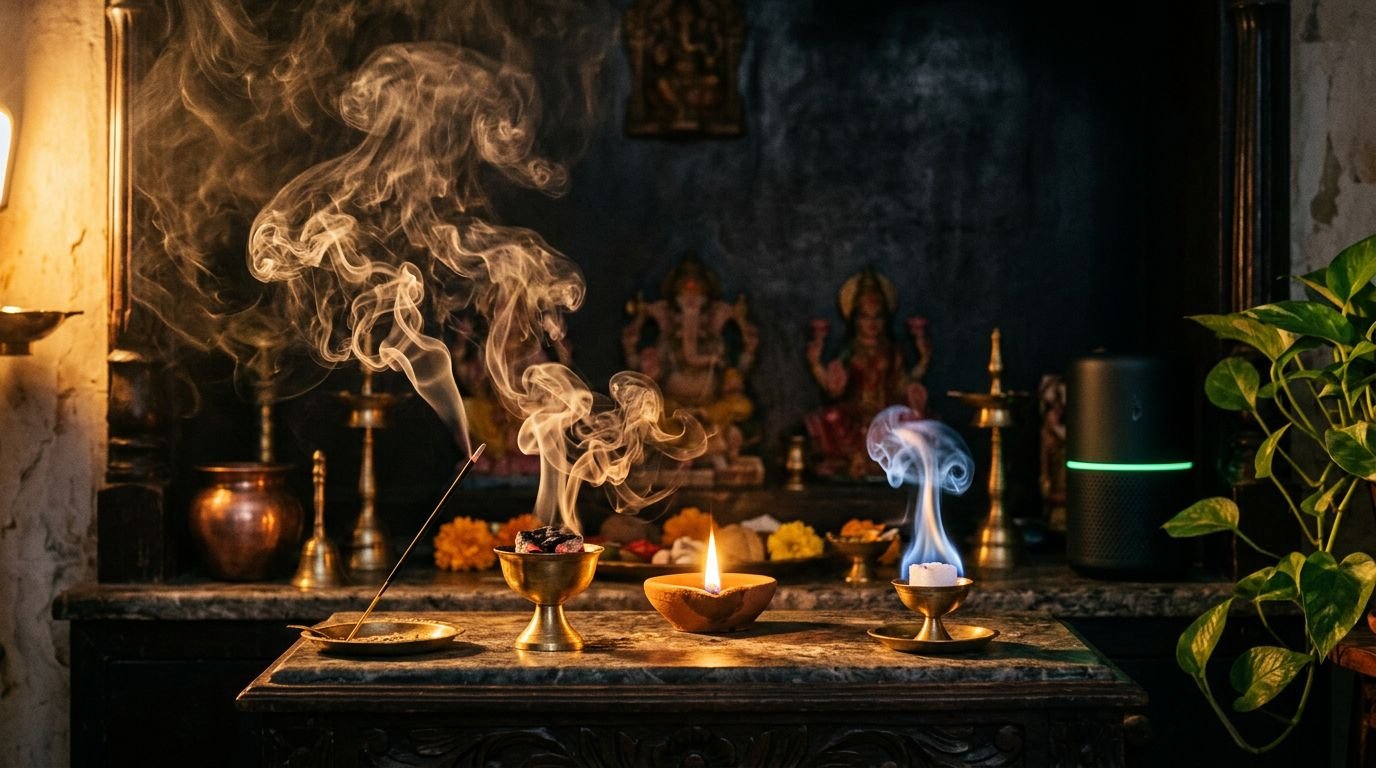
One fragrant stick is a combustion source that can turn a small puja room into a serious source of indoor smoke. That isn’t an attack on faith. It is a basic fact of combustion.
If you have searched for incense smoke indoor air pollution India, you are probably not looking to abandon a ritual. You want to know whether the haze around an agarbatti, dhoop cup, camphor flame, or traditional diyas is harming the people you love.
India measures outdoor air with growing urgency. But home air quality can still contain PM2.5 even after the smell fades. We need the same honesty about what happens inside homes, shrines, shops, and temples.
Key Takeaways
- Incense sticks, dhoop, camphor, diyas, and candles are combustion sources that can release PM2.5, PM10, volatile organic compounds, carbon monoxide, and other pollutants indoors.
- A room can smell fragrant while still containing harmful particulate matter. PM2.5 can travel deep into the lungs, and repeated exposure may be especially concerning for children, older adults, people with asthma, and temple workers.
- Ventilation and source control matter most: burn fewer products, avoid sealed rooms, use fresh-air exchange, and keep vulnerable people away from the smoke plume.
- HEPA air purifiers may reduce particulate matter, but they do not remove every gas and cannot make heavy indoor smoke safe. Ionizers that produce ozone should be avoided.
- Warning labels, emissions data, safer temple ventilation, air-quality monitoring, and worker protections can support informed rituals without treating faith as the problem.
Incense Smoke Indoor Air Pollution India: A Home Warning
Incense sticks are not only fragrance. They are fuel burning slowly in an enclosed space.
One stick may seem minor, but repeated incense sticks can shape household air quality.
As an agarbatti burns, it releases fine particulate matter, including PM2.5 and PM10. It can also release PM2.5 and PM10, along with volatile organic compounds (VOCs), formaldehyde, carbon monoxide, nitrogen dioxide, polycyclic aromatic hydrocarbons (PAHs), and other combustion by-products.
PM2.5 is the part that should worry us most. PM10 is larger, but both PM2.5 and PM10 can remain suspended indoors. These PM2.5 particles are small enough to travel deep into the lungs and enter the bloodstream. The smell fades fast. PM2.5 and PM10 may linger, making enclosed-room exposure a health hazard.
A NIH review of incense smoke risks summarizes the health risks of incense smoke. It reports that incense can produce roughly 45 milligrams of particulate matter per gram burned, compared with around 10 milligrams per gram for cigarettes. Those figures describe total emissions, not a fixed PM2.5 or PM10 cigarette equivalent.
That does not mean one incense stick equals a fixed number of cigarettes. The mix, dose, room size, and ventilation all change exposure.
Delhi and NCR measurements have shown sharp indoor spikes in PM10 during incense and dhoop burning. In one study, mean PM2.5 levels during incense burning reached about 780 micrograms per cubic metre. Dhoop produced even higher levels, while PM10 remained part of the particle mix. India’s 24-hour outdoor PM2.5 standard is 60 micrograms per cubic metre, placing indoor air quality in sharp contrast with outdoor air quality standards.
Source comparison: PM2.5 and PM10 context: the cited comparison concerns total mass. It reports roughly 45 milligrams per gram burned for incense versus around 10 milligrams for cigarettes. Neither figure is a fixed cigarette equivalent for PM2.5 or PM10.
A room can smell sacred and still contain air that asks too much of the lungs.
This is why indoor air pollution should not be dismissed as a niche concern. It is a daily exposure for millions of households.
The particles are only part of the problem
Smoke is a chemical mixture, not one pollutant with one outcome. It contains particulate matter, gases, and other compounds that can alter indoor air quality.
Fine PM2.5 can worsen asthma symptoms, trigger coughing, and inflame airways. Larger PM10 can add to this burden. These effects matter for respiratory health, especially for children with asthma or chronic lung disease. Older adults with heart problems may also be more vulnerable. Repeated exposure may contribute to airway dysfunction, but individual effects vary.
Volatile organic compounds and aldehydes add another layer. Formaldehyde can irritate the eyes, nose, throat, and airways. Carbon monoxide is more concerning when several flames burn in a closed room, alongside gas stoves, mosquito coils, or faulty appliances, because it can build up silently. Homes with gas equipment should install carbon monoxide alarms near gas appliances.
Research on PM1 and PM2.5 from incense burning also shows that the smallest particles dominate the smoke. PM2.5 and PM10 can remain suspended rather than settle near the prayer shelf. PM1, PM2.5, and PM10 move with the air you breathe.
The health case for indoor air pollution is strongest around repeated exposure. A brief exposure to indoor smoke from incense sticks in an open, airy space differs from daily dhoop in a closed one-room home. Room size, occupancy, and repeated rituals shape household pollution. Dose and frequency matter. So does the person breathing it.
Temple workers carry the highest daily burden
Worshippers may stay for ten minutes. Priests, cleaners, flower sellers, guards, and shop workers can stay for hours.
A Kanpur temple study recorded indoor PM10 concentrations as high as 2,184 micrograms per cubic metre. More than 99 percent of the measured particle count was in the PM2.5 range. The study also captured PM10 and PM2.5 in the same indoor setting. That is an air quality, public-health, and labour issue.
PM2.5 and PM10 are forms of particulate matter, but they are not interchangeable. PM2.5 describes finer particles, while PM10 includes a broader size range. A PM2.5 reading and a PM10 reading can describe the same room without measuring a worker’s personal dose. Repeated PM2.5 readings can show changing conditions, but they still cannot show a worker’s full daily dose.
We shouldn’t use one study to make claims about every temple worker. But we also shouldn’t demand perfect evidence before offering basic protection. Exhaust systems, designated ventilation zones, shorter burn periods, and worker health checks are reasonable safeguards.
Nobody should have to choose between earning a living and breathing clean air.
Ventilation is not a decorative window
A closed room turns a small flame into a concentrated indoor smoke exposure. Poor ventilation lets PM2.5 accumulate quickly, while PM10 can linger on nearby surfaces. A fan may spread particulate matter around the room, but it does not remove PM2.5 or PM10 unless air can leave the space.
Opening a window after the ritual ends is better than nothing. Opening opposing windows or doors before lighting incense is better. Burning incense near an exhaust fan or outdoor-facing opening supports fresh-air exchange and protects air quality.
For households that want to keep the ritual while reducing smoke, the practical steps are plain. These measures protect air quality by addressing the source, not merely moving smoke around. Air cleaning options can support them, but they cannot replace them:
- Burn fewer incense sticks, and avoid combining incense, dhoop, camphor, traditional diyas, and scented candles in the same small room. Fewer simultaneous sources usually mean lower PM2.5 and PM10.
- Choose a balcony, courtyard, veranda, or open window instead of a sealed bedroom or kitchen. This reduces PM2.5 and PM10 exposure.
- Keep children, older adults, and anyone with asthma away from the smoke plume.
- Run a properly sized air purifier with a HEPA filter before, during, and after the ritual. It traps much of PM2.5 and PM10, both forms of particulate matter, but does little for gases such as volatile organic compounds. This can improve air quality, though it cannot make heavy smoke safe.
- Use damp cloths or mops after heavy smoke settles. PM2.5 and PM10 can return to the air during dry sweeping, so damp cleaning is preferable.
- Skip incense on days when someone at home already has wheezing, chest tightness, fever, or a respiratory infection.
An air purifier is useful, but it is not permission to fill a room with smoke. Think of it as a seatbelt, not a free pass to drive carelessly.
What about a bipolar air ionizer and natural alternatives?
Some controlled studies of a bipolar air ionizer have reported particle reductions approaching 90 percent. The limits matter. Lab rooms are not crowded homes, and lower readings may mean PM2.5 and PM10 settled onto surfaces instead of disappearing. Readings are only one part of air quality, not proof that pollutants are gone.
Do not buy an ionizer that produces ozone. If you use one, look for independent ozone emission information and clean surfaces regularly. The product’s published ozone emission should meet applicable safety limits. Any ozone emission from an ozone-generating device is a reason to reject it.
Use this compact checklist before considering a device:
| Checkpoint | What to examine |
|---|---|
| bipolar air ionizer, particle reduction | Compare claimed reductions with results from a room like yours. A laboratory percentage is not a household guarantee. |
| bipolar air ionizer, PM2.5 interpretation | Check whether it lowers PM2.5 consistently, rather than during one short test. |
| bipolar air ionizer, surface deposition | It may make PM2.5 settle on furniture, so inspect surfaces instead of trusting one monitor. |
| bipolar air ionizer, room size | Match the rated room size to the actual space, especially when doors stay closed. |
| bipolar air ionizer, maintenance | Clean collection plates and nearby surfaces on schedule, since dirty components can reduce performance. |
| bipolar air ionizer, certification | Prefer independent certification with clear test methods, not only a seller’s percentage. |
| bipolar air ionizer, placement | Keep it away from the smoke plume and leave space around air inlets and outlets. |
| bipolar air ionizer, monitoring | Track PM2.5 during and after operation, then compare readings over time. |
| bipolar air ionizer, sensitive occupants | Never treat it as permission to expose children, older adults, or people with asthma. |
| bipolar air ionizer, ozone safety | Check ozone emission test results before purchase, and reject ozone-generating models. |
| bipolar air ionizer, replacement costs | Confirm replacement-part costs and cleaning needs before purchase. |
| bipolar air ionizer, operating pattern | Consider noise and runtime, because a device that stays off cannot help. |
Soy candles, beeswax candles, natural incense, and “chemical-free” agarbattis may sound safer. They may reduce certain ingredients, depending on the product. But anything that burns creates combustion particles.
A recyclable box does not make smoke harmless. Plant-based living is a meaningful climate choice, but it will not clear a smoky puja room. Neither of these air cleaning options replaces source control. The honest lower-smoke option protects air quality through less burning, fresh-air exchange, and shorter exposure.
A warning label is not a ban on belief
I am not asking families to stop praying. I am asking manufacturers, temples, housing societies, and public-health bodies to stop pretending that fragrance cancels physics.
Treating incense smoke indoor air pollution India as only a private choice is unfair. Families in one-room rentals may lack a balcony, airflow between openings, an exhaust fan, or money for air cleaning options. That household pollution is structural, so telling families to “make better choices” is moral theatre.
Systemic change starts with basic accountability:
- Incense packaging should carry clear warnings about air quality, PM2.5, and PM10 exposure, especially for children and people with respiratory health conditions.
- Manufacturers should publish standardised emissions data for incense sticks. That data should cover particulate matter, PM2.5 measurements, peak PM2.5 readings, PM10 readings, and volatile organic compounds. They should also disclose particle performance and ozone emission safety for any bipolar air ionizer.
- Temples and enclosed shrines should invest in local exhaust, smoke-managed ritual areas, and air quality monitoring. They should track PM2.5 and PM10 levels and protect workers.
- Housing rules should treat ventilation as a health requirement, not a luxury feature. They should protect home air quality through enforceable PM2.5 and PM10 limits. Public-health bodies should apply the same air quality standards to shared buildings, using PM2.5 and PM10 thresholds.
Air-device standards should make the same distinction. Manufacturers of a bipolar air ionizer should disclose particle performance and any ozone emission. Each bipolar air ionizer should be tested under realistic room conditions. Manufacturers should report ozone safety, not market a bipolar air ionizer through broad green claims.
Sustainable business models cannot hide behind fragrant branding. A circular economy can support eco-friendly practices and cut packaging waste, but neither can recycle smoke out of lungs. The ecological impact of one household ritual may be modest, yet repeated pollution still reveals a wider failure to treat public health as shared infrastructure.
Climate literacy means learning to see pollution sources that feel familiar. Everyday mindfulness means noticing when a ritual leaves you coughing, when walls turn grey near the altar, or when a child moves away from the room.
Urban biodiversity, clean air, and human health belong in the same conversation because all of them depend on communities refusing preventable harm. For practical work that connects local ecosystems with public accountability, Explore Our Active Missions.
Frequently Asked Questions
Is one incense stick as harmful as a cigarette?
No fixed comparison is accurate because exposure depends on the product, room size, ventilation, and time spent nearby. Incense can produce substantial particulate matter, but total emissions do not establish that one stick equals a particular number of cigarettes.
Does incense smoke contain PM2.5 and PM10?
Yes. Burning incense can release both PM2.5 and PM10, along with gases and compounds such as volatile organic compounds, formaldehyde, carbon monoxide, and polycyclic aromatic hydrocarbons. PM2.5 is especially concerning because it can travel deep into the lungs.
How can I reduce indoor air pollution while keeping the ritual?
Burn fewer incense sticks and avoid combining incense, dhoop, camphor, diyas, and candles in a small sealed room. Use an open window or outdoor-facing area, improve air exchange, and keep children, older adults, and people with asthma away from the smoke.
Can an air purifier remove incense smoke?
A properly sized HEPA purifier can trap much of the PM2.5 and PM10 in incense smoke, but it does not remove every gaseous pollutant. It should support source control and ventilation, not be used as permission to fill a room with smoke.
Are natural incense and soy candles safer?
“Natural,” plant-based, or chemical-free labels do not make combustion smoke harmless. Any product that burns can create particulate matter, so the lower-smoke choice is to burn less and provide better fresh-air exchange.
Keep the ritual, change the air
Incense smoke should come with indoor air warnings because people deserve informed choice about health risks, not silent exposure. Burning less reduces PM2.5 and PM10.
Faith does not become weaker when we reduce smoke and protect people who pray and work nearby. Monitoring PM2.5 and PM10 still matters, but source control comes first; a bipolar air ionizer cannot replace burning less.
The hard truth is simple: smoke contains particulate matter, even when it smells beautiful. Cleaner rituals protect devotion and health while improving air quality.