Clean Cooking India: Why Households Still Burn Biomass
 TBH Editorial
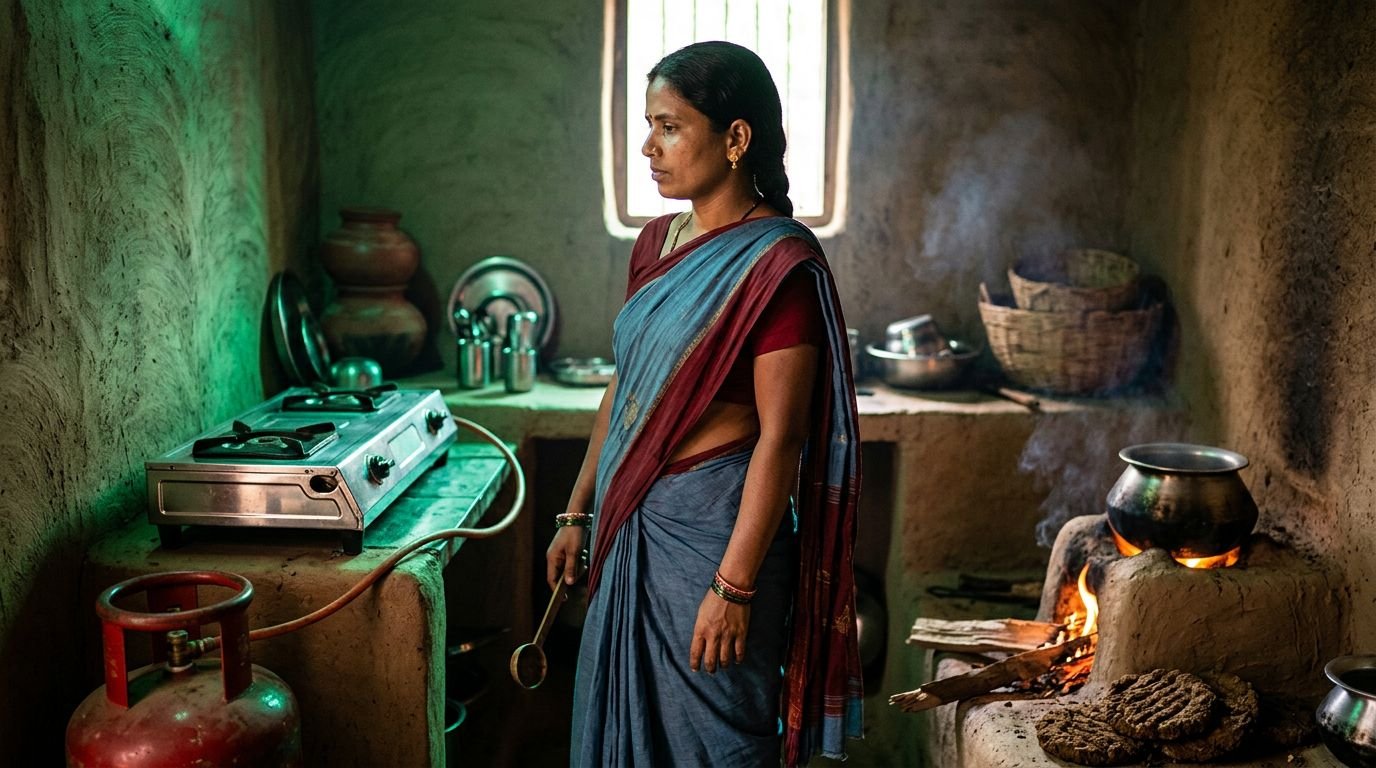
A gas connection can sit in a kitchen while the chulha keeps burning outside. That is the hard truth behind clean cooking India. Access has improved, but a connection is not the same as a reliable, affordable way to cook every meal.
For rural households and low income families, cooking fuel is not a climate slogan. It is cash in hand, a cylinder delivered on time, a familiar stove that works during a bad month, and food ready before work begins. Until policy meets that daily reality, clean cooking will remain a promise printed on paperwork.
Key Takeaways
- LPG connections expanded access, but refill costs keep many families tied to firewood and dung cakes.
- Most rural households do not make a clean switch, preferring to use several fuels, including traditional solid fuels, depending on cash, season, and supply.
- Women often carry the health risks, the fuel collection burden, and the risk of a kitchen fuel crisis.
- Counting connections rewards visible progress, whereas tracking the adoption of clean cooking solutions reveals the real gap.
- Systemic change during the energy transition means better delivery, flexible payment, local alternatives, and accountability for outcomes.
Why Clean Cooking India Policy Hasn’t Reached the Kitchen
India’s clean-cooking push has often treated the first cylinder as the finish line. It isn’t. It is the front gate.
Pradhan Mantri Ujjwala Yojana helped millions of rural households obtain LPG connections. That mattered. A family using a smoky chulha in an enclosed kitchen does not need lectures about personal responsibility. They need a practical way to stop breathing smoke every day.
Yet the policy question has shifted. It is no longer, “Who has an LPG connection?” It is, “Who can afford to refill it often enough to stop using traditional solid fuels?”
Government initiatives have successfully expanded LPG connections across the country, but the financial burden remains heavy. A 14.2 kg LPG refill can cost around Rs 1,000. For a salaried professional, that might be irritating. For a household dependent on seasonal farm work, construction work, domestic work, or daily wages, it can swallow a week of food money.
That is why fuel stacking is so common. LPG is saved for fast morning tea, guests, or rainy days. Firewood, crop waste, and dung cakes remain the default for longer cooking. Research on rural LPG use found that rural households often keep using solid fuels after receiving LPG, which blocks the full health gains of cleaner cooking solutions and exacerbates indoor air pollution and health risks documented in this rural India study.
A connection changes a statistic. A dependable refill changes a household’s air.
The gap is not a failure of poor families to understand smoke. It is a failure to build reliable clean cooking solutions around the way low-income communities actually manage their cooking fuel needs.
The Refill Bill Collides With Irregular Income
Household budgets do not arrive in neat monthly columns. Income may come after harvest, after a contractor pays, after a relative sends money, or after a woman gets a few more days of paid work.
LPG asks for a large payment at once. Biomass fuels ask for time, labour, and exposure, but often little cash. In a cash crisis, that difference decides the meal.
This is why targeted financial support matters, but it is not enough on their own. A subsidy that appears late, feels uncertain, or does not cover the immediate payment still leaves the family at the counter with an empty cylinder.
The burden is also gendered. Women commonly manage domestic cooking, queue for refills, arrange delivery, collect cooking fuel when supplies run out, and absorb the health risks from indoor smoke. Children and older relatives stay near that smoke too. A 2024 study examining Indian households linked cooking-fuel practices and indoor air pollution with poorer self-reported health among older adults, a reminder that exposure follows people through their lives, not only through childhood as the research shows.
Safety worries can add another barrier, particularly for rural households unfamiliar with pressurized gas. A family new to LPG may fear a leak, a fire, or an unfamiliar regulator. Those concerns deserve patient support, not ridicule. A first-time user needs a responsive distributor and someone who can answer questions in the local language.
The clean-cooking conversation gets weaker when it pretends every household starts with the same income, confidence, and supply access. They don’t.
Fuel Stacking Is Rational, Not Backward
It is tempting to see a wood-fired stove as a relic. That view misses the point. Biomass fuels survive because they are local, flexible, and available when formal systems fail.
A household with cattle may have dung cakes. A village near common land may have access to twigs and crop residue. A family with no cash today can still cook dinner using traditional solid fuels. That is not ignorance. It is a survival calculation made inside a broken energy system.
LPG also does not meet every cooking need equally. Large pots, long-simmering foods, and cooking for extended families can use a lot of gas. Some people prefer the taste of food cooked on a traditional chulha. Others keep these traditional solid fuels because power cuts, delayed deliveries, or an empty cylinder make them the only fallback.
The answer is not to romanticise smoky kitchens. Indoor air pollution is dangerous, and everyday energy consumption patterns directly impact family wellbeing. A four-country study found that shifting away from biomass fuels lowered pollution exposure, even where the measured health gains were harder to detect in the study period reported here. Exposure reduction still matters, especially for the person standing over the stove twice a day, and mitigating these health risks requires practical clean cooking solutions.
But policy must stop treating exclusive LPG use as a simple matter of attitude. A household cannot be asked to abandon its backup cooking fuel without being offered a reliable upgrade, such as efficient improved cookstoves that work alongside primary connections.
That could include smaller refill sizes, refill credit through self-help groups, dependable doorstep delivery, repair support, and clear grievance channels as part of broader clean cooking solutions. It also means tracking whether cylinders are used, not merely whether they were issued.
The Last Mile Is Where Good Intentions Break
A distribution map can look impressive in Delhi. The kitchen experience for rural households can look very different in a remote village.
If the LPG agency is far away, collecting a cylinder can mean losing a day’s wage, arranging transport, and carrying a heavy load home. When expanding LPG connections, doorstep delivery may be irregular or unavailable. Documents can be difficult to obtain. Complaints can disappear into a phone number nobody answers.
This is the same mistake cities make when they judge a construction site by its green dust screen. The screen may look responsible from the road while cement powder still escapes above, below, and around it. A clean cooking fuel connection can work the same way. It is visible proof of action, but not proof of daily performance.
Visible infrastructure is not the same as lived access.
Real accountability needs simple questions:
- Did the household refill the LPG connections regularly over the past year?
- How far must someone travel to collect a refill of their preferred cooking fuel?
- What happens when delivery fails or a subsidy does not arrive?
- Who pays the cost of switching back to firewood?
- Are women able to report unsafe service without being dismissed?
These are not minor operational details. They decide whether a public programme delivering clean cooking solutions reduces smoke or simply moves it outside, where women cook on a temporary stove near the door. Achieving true universal access and affordable energy depends on fixing these delivery breakdowns.
Climate change literacy and policy evaluation have to include this kind of scrutiny. It means learning to ask who bears the hidden cost when the promotion of clean cooking solutions is declared successful.
Cleaner Options Need More Than One Fuel
LPG remains important, but it should not become the only answer. India imports a large share of its LPG, which leaves households exposed to price volatility and supply shocks. A strategy built around one fuel can become fragile fast.
Decentralised biogas can work well where livestock, water, maintenance skills, and household space make it practical. It can turn organic waste into cooking fuel and slurry for farms. That is a real circular economy opportunity, but only if the system is maintained and the household is not left alone with a broken digester.
Electric cooking also deserves more serious public investment. Advanced induction cooktops can reduce indoor smoke and remove the burden of cylinder delivery. But device costs, unreliable electricity, limited awareness, and poor wiring still shut many households out. A shiny induction cooktop is useless during a long power cut.
Renewable energy solutions must expand beyond a single grid connection. Solar powered microgrids and solar powered cookstoves offer vital resilience when the main power fails. Expanding electric cooking through these channels supports broader decarbonisation and long term sustainability goals.
Sustainable business models can help where public systems fall start, especially through public private partnerships. Local women led enterprises, self help groups, repair networks, and last mile delivery partnerships can make any clean cooking fuel more dependable. They should be paid for service quality, not only for signing up new customers.
Improving energy efficiency in domestic cooking reduces overall carbon emissions and advances sustainable development. Plant based living is a personal value for many climate conscious people, but it is not a clean cooking policy. Nor is everyday mindfulness enough when a family must choose between a refill and school expenses. Private choices have value, but they cannot replace public duty.
The ecological impact also reaches beyond the kitchen. Dependence on biomass can add pressure to local trees and common lands. Smoke harms people first, but it also degrades the small green systems that support urban biodiversity and rural life.
What Honest Progress Would Look Like
Clean cooking solutions need a scorecard that is harder to celebrate and harder to fake. Count sustained use. Measure refill affordability as a share of household income. Publish delivery times. Track complaints. Ask women what actually changed in their kitchens to better measure progress under government initiatives.
That is systemic change, and it forms the bedrock of a successful energy transition. It looks less glamorous than a launch event. It looks like flexible payment options, reliable distributors, local repair, social protection during fuel price spikes, and alternatives that match local conditions while driving true decarbonisation.
Community action matters here because energy poverty never sits alone. The same household may face unsafe housing, poor transport, flood risk, weak schools, and a shrinking local ecosystem. Achieving sustainable development requires financial support and improved energy efficiency to curb carbon emissions alongside everyday poverty relief. Support for ongoing, on-the-ground climate and community work can connect climate concern and the fight against climate change to people facing these layered pressures through reliable clean cooking solutions.
Frequently Asked Questions
Why do many rural households continue to use firewood even after getting an LPG connection?
Many families practice fuel stacking because the high cost of regular LPG refills can swallow a week of food money during tight cash months. Traditional solid fuels like firewood and dung cakes remain a free or low-cost fallback when cash is scarce, deliveries are delayed, or large meals need to be cooked.
What is fuel stacking and why is it considered rational?
Fuel stacking means using multiple cooking fuels depending on seasonal availability, household income, and immediate needs. It is a rational survival calculation for low-income families navigating an irregular energy supply rather than a reluctance to adopt cleaner methods.
How does indoor air pollution from traditional cooking affect family health?
Burning biomass on traditional chulhas in enclosed spaces releases heavy indoor smoke that directly contributes to chronic respiratory issues and poorer health over time. Women and older adults who spend the most time near the stove typically bear the highest burden of these health risks.
A Clean Kitchen Must Be Affordable Every Month
A woman should not have to return to smoke because a refill arrived at the wrong price, on the wrong day, or not at all. Realizing clean cooking India will succeed when it treats clean fuel as a continuing public service, supported by effective cooking fuel policies and reliable renewable energy initiatives, rather than a one-time product handover. Achieving universal access requires dependable domestic cooking systems and affordable energy pricing that matches real household energy consumption patterns, similar to the broader goals of the Pradhan Mantri Ujjwala Yojana.
The chulha will not disappear through awareness campaigns alone. It will disappear when the cleaner choice is the choice a low-income household can trust on an ordinary Tuesday.