India Crematorium Emissions Need Public Monitoring
 TBH Editorial
A funeral pyre can be a place of grief, prayer, and family duty. While traditional funeral pyres and long-held funeral traditions carry deep spiritual significance, they can also release fine particles into the same air that children, workers, and nearby residents breathe. India crematorium emissions deserve public attention because dignity for the dead should never require silence about harm to the living.
Most cities track traffic, factories, and construction in fragments. Cremation grounds often sit outside that conversation, even when they operate beside homes, markets, temples, school routes, or riverbanks. We need facts, not blame, to address the resulting air pollution.
Public monitoring is how we protect both cultural practice and community health.
Key Takeaways
- The smoke emissions from traditional funeral pyres can contain PM2.5, PM10, carbon monoxide, nitrogen oxides, and other combustion pollutants.
- Citywide AQI data can miss the short, intense exposure near cremation grounds.
- India crematorium emissions need site-level records that show fuel use, operating hours, emissions tests, and complaints.
- Cleaner technologies like electric crematoriums matter, but public proof matters more than equipment announcements.
- Monitoring should protect workers, neighbours, and families without turning grief into a compliance spectacle.
Why India Crematorium Emissions Are a Public Health Risk
The first mistake is treating cremation pollution as only a carbon issue. High wood consumption during body cremation for religious rituals matters. So do forests. But someone standing near a pyre is not breathing an abstract climate number. They may be breathing smoke rich in fine particulate matter, carbon monoxide, nitrogen oxides, sulphur dioxide, volatile compounds, and, depending on materials burned, toxic pollutants such as mercury and dioxins.
A 2019 emissions assessment estimated that traditional funeral pyres in India released 393 tonnes of PM2.5 annually, alongside substantial carbon dioxide emissions and other greenhouse gas emissions. Those figures should not be used to shame families at their hardest moment. They should force municipal bodies to answer a more honest question: what is happening at each high-use site, and who is exposed?
The burden is also local. A study of urban crematoriums in Kanpur found average PM2.5 concentrations of more than 1,000 micrograms per cubic metre at sampled cremation grounds. That was far above readings at nearby real-time stations. The Kanpur crematorium PM2.5 study points to a problem that city averages can blur.
This is why one distant monitor cannot settle the matter. A citywide AQI may look moderate while a guard, priest, wood handler, street vendor, or child walking past a cremation ground faces a far heavier dose for an hour.
A pollution average cannot show what someone breathes beside a smoke source at ground level.
The evidence is not perfectly uniform, and that is part of the problem. A parliamentary response said source-apportionment studies between 2018 and 2022 did not identify crematoria as a contributor to air pollution. Yet Delhi-focused technical material describes crematoria as a meaningful local source of air pollution. Contradictions like this are not a reason to do nothing. They are the strongest reason to measure properly.
Public Monitoring Must Track Exposure, Not Just Equipment
A chimney, furnace, or “green” label doesn’t prove clean operation. Nor does a single emissions test on a quiet day. India crematorium emissions change with burning firewood, wood moisture, body count, weather, combustion temperature, maintenance, and the way a facility handles ash disposal and waste.
Monitoring needs to capture those real conditions.
Measure the source and the neighbourhood
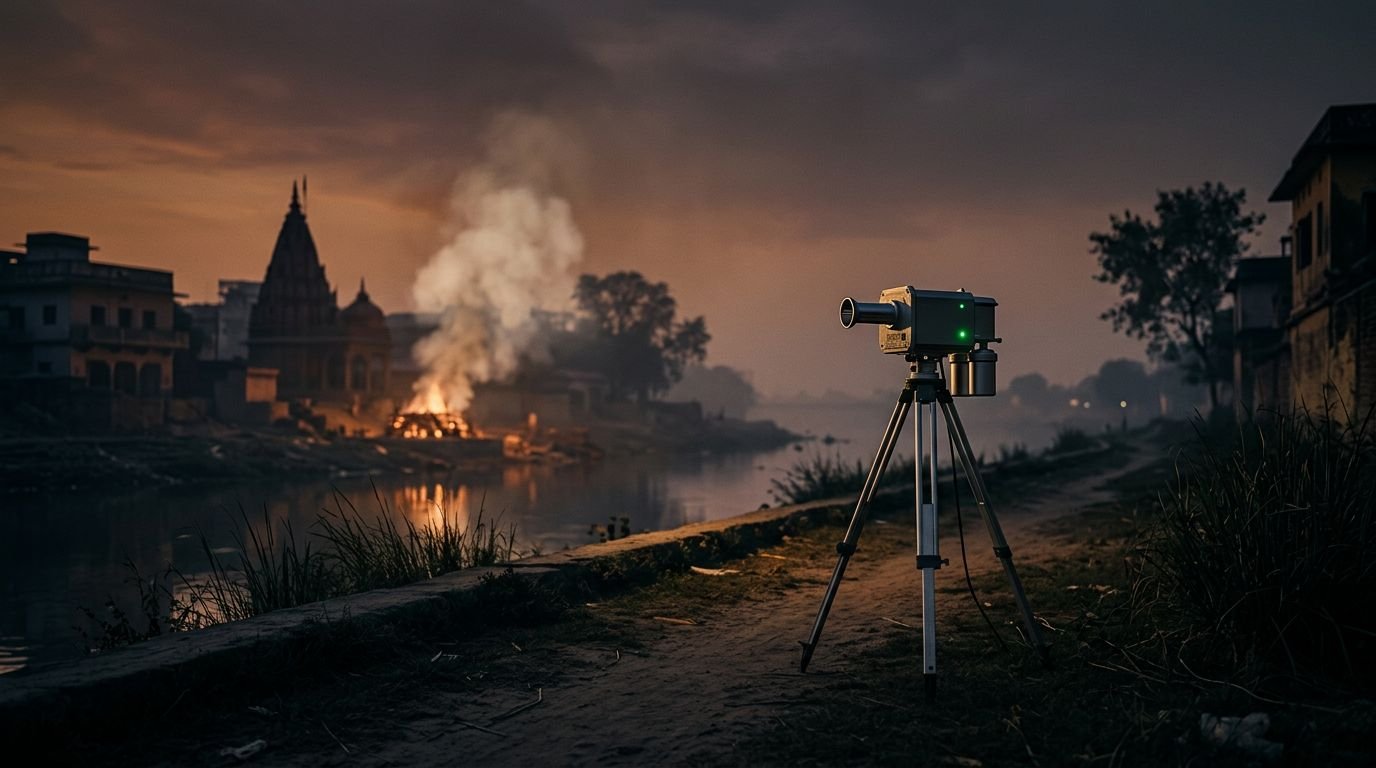
A serious system would combine stack or outlet testing with boundary monitoring. It would also place monitors where people spend time, especially along public paths, nearby homes, schools, food stalls, and worker areas.
| What to track | Why it matters | What the public should see |
|---|---|---|
| PM2.5 and PM10 | Fine smoke can reach deep into lungs | Daily and hourly readings |
| Carbon monoxide and nitrogen oxides | Incomplete combustion and high-temperature burning produce harmful gases | Test results and exceedances |
| Crematorium capacity and fuel use | Cremation systems and wood or gas choices create different smoke emissions | Monthly fuel use and number of cremations |
| Operating conditions | Equipment works differently under heavy use | Maintenance logs and breakdowns |
| Complaints and inspections | Residents often spot failures first | Complaint status and action taken |
The monitoring plan should also include periodic checks for pollutants that aren’t easy to capture through routine sensors, including mercury and dioxins where relevant. The goal isn’t to create an impossible reporting burden. It is to stop public health being managed through assumptions.
Delhi has already examined local pollution-control options. The NEERI report on crematorium pollution controls makes clear that crematoria belong in a wider air-pollution discussion. That work should now lead to open, repeated, site-specific measurement.
Public Data Turns Assurances Into Accountability
People are often told that pollution controls are in place. Fine. Show the records.
A public dashboard should name each municipal crematorium, its technology, fuel source, permitted capacity, inspection dates, emissions reports, malfunction history, and complaint response. Data must be simple enough for neighbours to read, but downloadable enough for researchers and journalists to check. By tracking the true environmental impact of these facilities, communities can better understand local air quality.
India already has useful foundations for this kind of transparency. The UrbanEmissions public inventory repository shows how emissions data can be mapped and shared for Indian cities. Cremation grounds should not remain a blank spot in that picture, particularly in rapidly growing urban areas where air quality is already fragile.
Residents can also use the Right to Information Act to ask for existing records. A focused request can seek:
- Inspection reports for a named crematorium across a defined period.
- Emissions tests, sampling locations, and laboratory reports.
- Fuel purchase logs and daily cremation counts.
- Notices, penalties, and action-taken reports after complaints.
- Maintenance records for furnaces, filters, ducts, and pollution-control devices.
Keep the request narrow. Ask for documents, not an official opinion. “Provide copies of inspection reports between January and June 2026” is harder to evade than “Why is this crematorium polluting?” When citizens demand this level of transparency, they uncover hidden environmental threats that might otherwise go unnoticed.
Systemic change begins when pollution control becomes part of operating budgets, municipal contracts, and public reporting, encouraging the adoption of sustainable practices across the board. A certificate filed in an office does not protect a person inhaling smoke outside the gate.
Cleaner Cremation Technology Needs Independent Proof
Transitioning away from a traditional wood-based system that relies heavily on burning firewood is a necessary step, but a technology switch is not a blank cheque. Modern electric crematoriums, pellet-based units, and every other green cremation system deserve fair consideration alongside hybrid setups.
CSIR-NEERI has installed a green cremation system at pyres in Delhi’s Nigam Bodh Ghat. Mumbai’s civic body has also moved toward pellet-based units at several crematoria. The BMC has stated that these alternative cremation options can use 100 to 125 kilograms of pellet biomass instead of roughly 350 to 400 kilograms of wood per cremation.
That sounds promising. The next question is simple: where is the before-and-after emissions data?
There is a hard limit to circular economy language at a cremation ground. A pellet made from agricultural residue may reduce wood demand, but it still needs combustion testing. A filter only helps if it is installed, powered, cleaned, and checked. Relying on electric crematoriums also depends on reliable electricity and the emissions profile of the grid supplying it.
Municipal tenders should reward sustainable business models that include maintenance, independent testing, worker safety, and public reporting. When upgrading cremation systems, the lowest upfront bid is often the most expensive option once broken equipment and lost trust enter the picture.
No family should be pushed into a method they do not trust or cannot afford. Change works better when communities have choice, clear information, respectful facilities, and evidence that cleaner options actually reduce harm.
The Ecological Cost Extends Beyond the Crematorium Gate
Smoke does not stop at a boundary wall. Fine particles settle on roadside leaves, homes, water bodies, food carts, and school bags. That wide environmental impact adds pressure to already fragile urban biodiversity, especially in dense neighbourhoods with few healthy trees.
The broader environmental threats include heavy wood consumption that drives continuous tree cutting near regional forests. When runoff carries ash and unburned residue into local rivers, it causes severe water pollution. At the same time, inefficient combustion contributes to rising greenhouse gas emissions, including significant carbon dioxide emissions that warm the atmosphere.
We should keep personal choices in proportion. Plant-based living, public transport, and eco-friendly initiatives can reduce wider climate pressures. They cannot protect a worker from an unmonitored smoke plume during a six-hour shift.
That is where climate literacy becomes practical. It helps us ask better questions: Who runs the facility? What fuel is used? Where does the smoke travel? Which agency inspected it? What changed after residents complained?
Everyday mindfulness can include checking local air conditions and noticing smoke at public sites. It must also mean refusing to accept vague assurances when evidence should be public.
For people who want to connect local accountability with practical work on ecosystems and public awareness, Explore Our Active Missions.
Frequently Asked Questions
Why do traditional funeral pyres cause air pollution concerns?
Traditional funeral pyres release fine particulate matter such as PM2.5 and PM10, along with carbon monoxide, nitrogen oxides, and other combustion pollutants. While these practices carry deep spiritual significance, the resulting smoke can expose nearby workers, children, and residents to high levels of local air pollution.
Can citywide air quality index (AQI) data capture crematorium emissions?
No, citywide AQI data often misses short and intense pollution spikes near cremation grounds. People standing close to a pyre can breathe much heavier doses of smoke than what is recorded by distant regional monitoring stations.
What does public monitoring of crematoria involve?
Effective monitoring combines stack or outlet testing with boundary monitors placed near homes, paths, and worker areas. It tracks parameters like PM2.5, carbon monoxide, fuel use, maintenance logs, and complaint histories to ensure transparent data.
Are modern electric or green crematoriums completely clean?
While cleaner technologies and alternative fuels like pellet biomass can reduce wood demand and smoke emissions, they still require independent testing and regular maintenance. A green label or new equipment does not guarantee clean operation without ongoing, site-specific measurement.
Public Monitoring Is a Matter of Respect
Managing India crematorium emissions and the broader environmental impact of traditional funeral pyres are not reasons to attack faith, tradition, or grieving families. Instead, these challenges are reasons to demand better municipal planning, cleaner options, safer workplaces, and honest public records that respect sacred funeral traditions and religious rituals.
We don’t need another symbolic announcement or a glossy machine beside a polluted road. We need measurements that match real exposure, published results that people can inspect, and authorities that act when controls fail. Providing safe choices for body cremation through alternative cremation methods like electric crematoriums helps reduce hazardous air pollution while keeping deep respect for solemn cultural practices.
Grief deserves privacy. Pollution data does not.