
The Backup-Power Pollution Indian Cities Don’t Count
 TBH Editorial
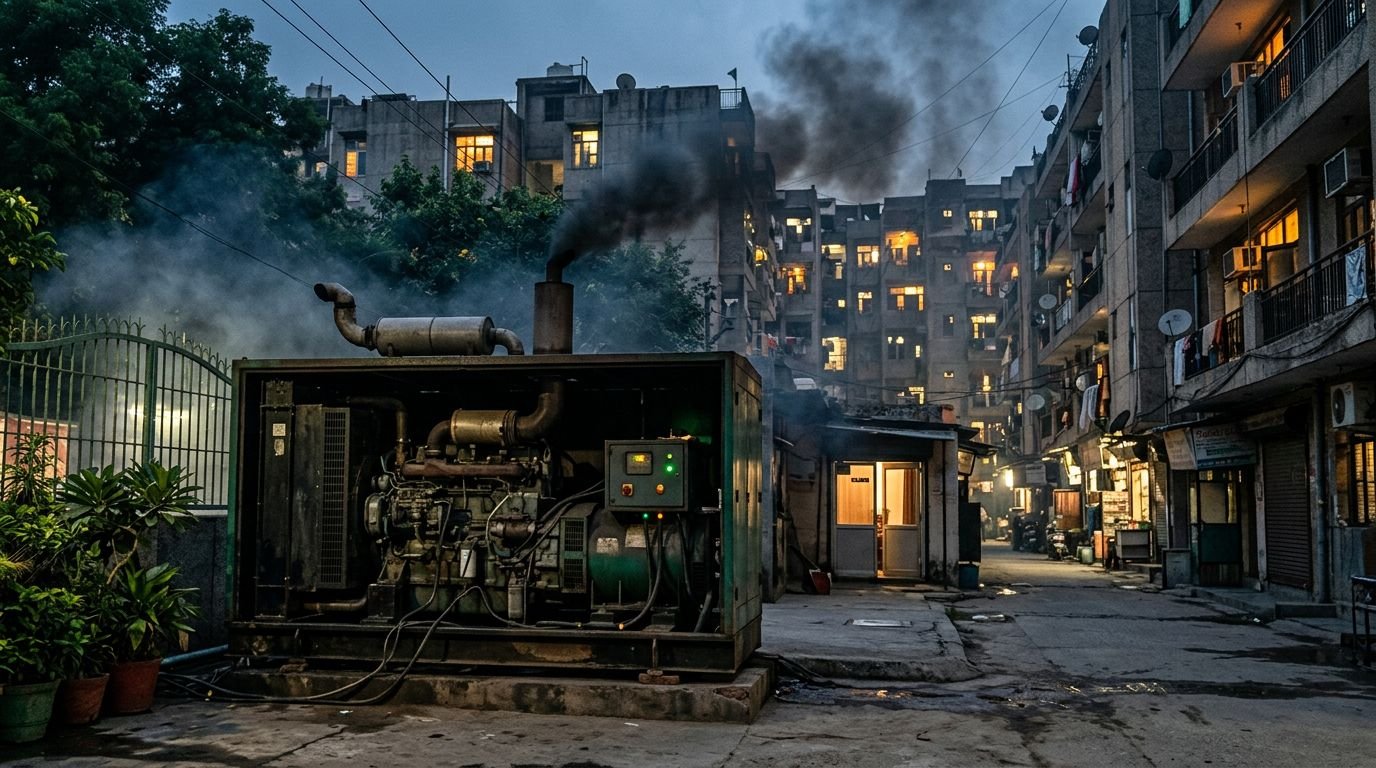
The generator starts with a low mechanical growl. Then the lights return, the lift moves, the office resumes, and most people stop thinking about these diesel generators.
Search the public record for diesel generator emissions India, and you will find rules, scattered studies, and press releases. What you will not find is a complete, street-level account of who breathes the exhaust, how long it runs, and which neighbourhoods carry the burden of worsening air pollution.
That gap isn’t a technical footnote. It is a public-health failure built into how Indian cities measure pollution.
Key Takeaways
- Diesel generators release particulate matter, black carbon, nitrogen oxides, carbon monoxide, and carbon dioxide at ground level, often close to homes, schools, markets, and hospitals.
- Cities count vehicle exhaust and industrial stacks more often than they track thousands of privately owned backup generators.
- A national 2025 study estimated that India had about 14.7 lakh operating DG sets in 2022, producing 42 gigagrams of PM2.5 and 23 gigagrams of black carbon.
- Citywide averages can hide severe local exposure near generator rooms, basements, service lanes, and housing societies.
- Real accountability means measuring generator use, publishing local data, enforcing limits, and reducing dependence on diesel backup power.
Why diesel generator emissions India data still misses the mark
Diesel generators are treated as temporary machines. The pollution they create is not temporary for the person standing beside the exhaust.
In Indian cities, DG sets sit behind malls, beside apartment towers, outside clinics, under office blocks, near metro construction, and in narrow service lanes. They run during outages, but also during voltage fluctuations, planned maintenance, peak-demand periods, and events where uninterrupted power matters more than clean air.
The problem is not that cities have no pollution data. India has monitors, action plans, source-apportionment studies, and an Air Quality Index that many people now check every winter. The Central Pollution Control Board oversees national baseline data and compliance, yet generator emissions often disappear inside larger categories such as industry, diesel combustion, or other sources.
That makes them easy to ignore.
A 2025 national inventory found that DG sets were responsible for substantial emissions across India. The districts with the largest PM2.5 burden included Bengaluru Urban, Mumbai City, Patna, Gautam Buddha Nagar, Thane, North 24 Parganas, Bhopal, Ajmer, Alwar, and Jodhpur. Those are not isolated industrial pockets. They are dense places where people live, work, study, and wait for buses.
Studies focused on the National Capital Region have placed backup units at roughly 7% to 13% of particulate pollution in some source-apportionment estimates. Whether powering commercial complexes or heavier industrial applications, each individual power generating set contributes to an air pollution burden that is not small when the city is already choking on traffic, dust, waste burning, construction, and industrial smoke. New CPCB IV+ emission standards and updated emission norms attempt to target these categories, but tracking them remains difficult.
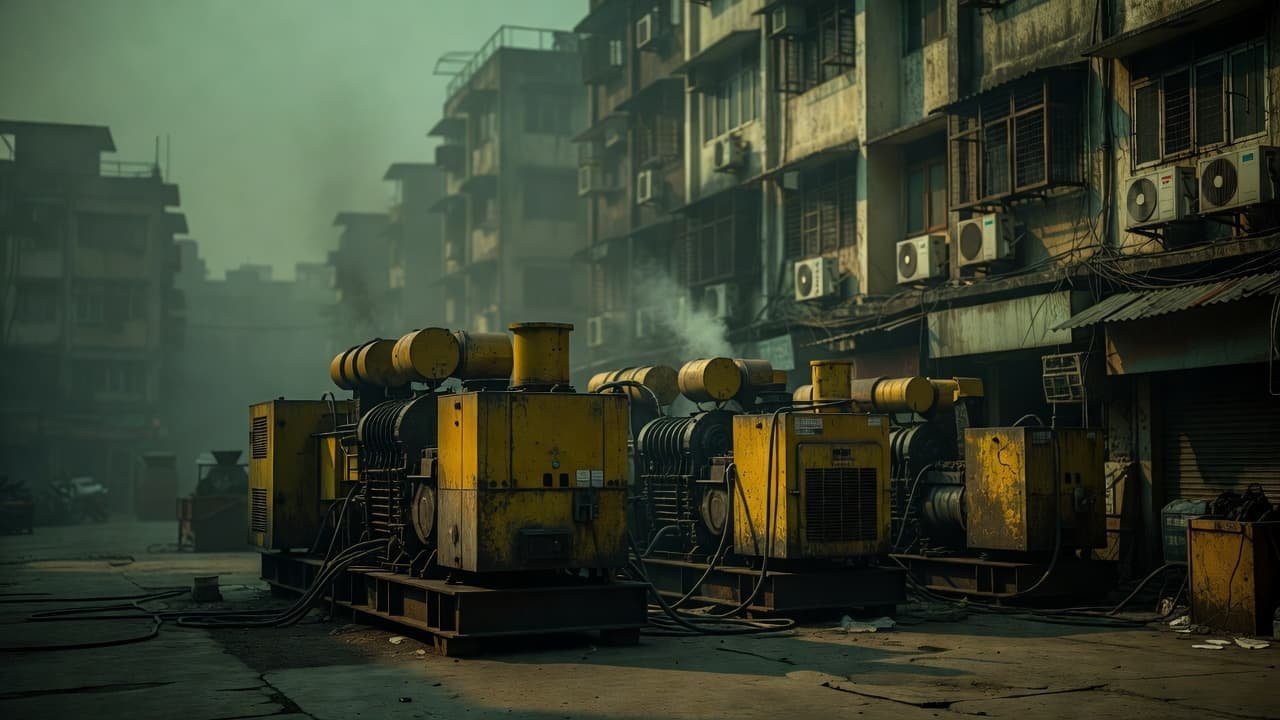
The usual response is to point at the generator’s purpose. It keeps a hospital functioning. It protects food storage. It prevents a data centre outage. All true.
But a machine can be necessary and still be harmful. Accountability begins when we stop treating those facts as opposites.
The generator is logged as backup, but its pollution is not
A private power generating set has one big advantage over a factory chimney. It is easier to overlook.
Factories usually need environmental permissions, stack monitoring, inspections, and consent conditions, all tied to strict regulatory compliance and broader environmental regulations. Larger power plants face public attention because their emissions are visible and their ownership is clear. A DG set may belong to a housing society, telecom operator, hotel, warehouse, restaurant, school, builder, bank, or office complex.
No single city dashboard brings those machines together.
A generator may be registered when it is purchased. It may appear in a fire-safety file. It may be mentioned in a building plan. Yet its actual operating hours, fuel use, maintenance condition, and exhaust location often remain unknown outside the premises.
That is why diesel generator emissions India remains less visible than it should be. We count equipment. We rarely count exposure.
Fuel consumption offers a blunt but useful clue, and monitoring fuel efficiency helps operators track both costs and combustion health. CSTEP notes that a DG set can emit roughly 2.7 kilograms of carbon dioxide for every litre of diesel burned, alongside particulate pollution and nitrogen oxides. Its analysis of the diesel generator dilemma makes the point plain: reliable electricity comes with a cost that is often pushed into the surrounding air.
The smallest machines can be the hardest to trace. A large campus generator may have staff, a maintenance contract, and some compliance paperwork. A compact unit outside a shop, clinic, banquet hall, ATM cluster, or residential block can run with little scrutiny, often lacking mandatory Retrofit Emission Control Devices.
Even where pollution control rules exist, data collection is often built around permits rather than use. The city may know that a generator exists. It may not know whether it ran for 20 minutes or eight hours.
A backup generator becomes a public pollution source the moment its exhaust enters a shared street, courtyard, school route, or housing lane.
That distinction should change how cities report diesel use. Backup power is a private service. The air around it is not private.
The data gaps are physical, administrative, and political
Counting generator emissions sounds simple until you look at the city as it actually is.
One apartment complex may have a large DG set on the ground floor. Another may keep several smaller units in separate blocks. A telecom network may operate equipment across thousands of sites. Construction projects use mobile generators that arrive, move, and disappear. Diesel pumps, temporary offices, event venues, warehouses, and industrial applications add another layer.
The inventory is fragmented because ownership is fragmented.
There is also a practical measurement problem. Pollution monitoring stations are few compared with the number of roads, service alleys, school corridors, and dense housing clusters. A citywide monitor might show an average reading for air pollution, but it cannot show what a security guard inhales beside an exhaust pipe at 7:30 each morning.
That missing detail matters. A study reported in Mumbai found that stationary DG emissions can include large quantities of ultrafine and submicron particles, with pollution rising as engine load increases. The Mumbai research on hidden generator pollution should make us wary of judging danger by whether smoke looks dramatic.
The administrative gap is just as serious. Municipal bodies regulate building use. State Pollution Control Boards oversee emissions. Electricity distribution companies know about outages and demand stress. Fire departments inspect safety systems. None of these records automatically become one usable public account for air quality management.
Then politics enters the room.
A smog tower is easy to unveil. A ban on old generators can be announced in one line. A serious citywide inventory takes staff, inspections, fuel records, enforcement, penalties, and public disclosure. It also creates uncomfortable questions for powerful property owners and businesses.
That is why spectacle keeps winning over proof.
We have seen the same pattern with construction dust. A green mesh screen can look responsible while dry cutting, uncovered debris, loose truck loads, and dirty tyres keep sending dust onto public roads, showing how easily environmental regulations and pollution control are bypassed by superficial fixes. The object is visible. The actual exposure remains unmeasured.
Air monitors miss the people beside the exhaust
Air pollution is not shared equally. Because of urban disparities, ambient air pollution impacts various communities in profoundly different ways.
A professional in an air-conditioned office may experience generator exhaust for a few seconds when entering a building. A guard, delivery rider, street vendor, cleaner, parking attendant, or tea seller may stand near it for hours. Children walk past generator rooms on their way to school. Residents in lower-floor flats may have no choice but to keep windows shut, trapping stagnant air and toxic gas buildup.
The health burden lands hardest on people with the least control over their surroundings.
PM2.5 particles, which are a dangerous form of particulate matter, are small enough to reach deep into the lungs. Black carbon adds to the toxic mix. Nitrogen oxides and carbon monoxide help form ground-level ozone and other harmful pollutants. Those exposures matter for asthma, cardiovascular stress, respiratory illness, and missed school or work.
A Gurugram study cited by the Centre for Science and Environment found that long generator use in housing societies was linked with sharp PM2.5 increases. When use exceeded eight hours, average PM2.5 reached 130 micrograms per cubic metre, while peak readings reached 300 micrograms per cubic metre.
Numbers like these should end the myth that generator smoke simply disperses.
It disperses somewhere. Usually into the breathing zone of people outside.
The same injustice appears across the city. A generator placed behind a premium office may blow toward a staff parking area or a low-income settlement. A hospital may protect its operating theatre while its backup exhaust reaches a footpath vendor. A construction site may keep its lights on with diesel power beside a school wall.
This is where ecological impact becomes personal. Pollution does not stop at the building boundary. Exhaust settles on leaves, window grills, street food, water tanks, parked scooters, and roadside soil. It also adds stress to fragile patches of urban biodiversity, including street trees, birds, insects, and small green spaces already coated with road dust.
A clean-air plan that only measures averages can make a harmful place look acceptable. Exposure depends on proximity, time, wind, building height, and whether fresh emissions keep entering the same lane.
Restrictions mean little without inspections
Delhi-NCR and the wider National Capital Region have already shown that regulators understand the problem, especially under the framework of the Graded Response Action Plan. The Commission for Air Quality Management revised DG-set directions in 2023, limiting non-compliant use and allowing key emergency services under defined conditions. Central Pollution Control Board guidelines, alongside updated CPCB IV+ emission standards, form a core part of that policy push.
The rulebook is not the missing piece. Enforcement is.
A generator can have a retrofit kit on paper and a bypass in practice. It can be serviced once before inspection, then run poorly for months. A building may claim emergency use while relying on diesel during recurring power-quality issues. Smaller sets may never receive a visit at all.
The condition of the machine matters too. An overloaded or badly maintained engine produces dirtier exhaust. So does a set running at the wrong load, using poor-quality fuel, or venting through a short pipe into a confined service lane. Achieving true regulatory compliance and meeting strict emission norms requires constant vigilance.
Research on diesel engine emission controls shows that filtration, fuel changes, and after-treatment systems can reduce harm. Modern technological advancements bring forward effective abatement options, including Retrofit Emission Control Devices, a dual fuel system, exhaust gas recirculation, and diesel particulate filters. Utilizing advanced emission control technologies and dependable pollution control hardware is essential for better air quality management. But technology cannot compensate for a system that refuses to check whether equipment is used, maintained, or located safely.
A city should not accept a single compliance certificate as proof of clean operation.
It should ask:
- How many hours did the DG set run this month?
- How much diesel did it consume?
- Where does the exhaust discharge?
- Is a verified emission-control device installed and working?
- Is the exhaust near homes, schools, food stalls, or pedestrian routes?
- What happens after a resident files a complaint?
These are ordinary questions. They become powerful when answers are public.
Residents can also use India’s Right to Information process to request inspection reports, complaint logs, consent conditions, notices, and action-taken records for a named site. Ask for existing documents over a clear date range. “Provide inspection reports for this generator between January and June” is stronger than “Why is the air polluted here?”
Documentation turns a vague complaint into a record someone must answer.
What an honest diesel generator emissions India account looks like
Cities do not need perfect data before they begin. They need a system that stops treating generator pollution as invisible.
A serious account would start with a ward-level registry. It should include capacity, ownership type, fuel, location, stack height, installation year, operating purpose, and nearby sensitive sites such as schools, clinics, markets, and dense housing.
The next step is reporting use, not merely ownership. Larger users should disclose monthly operating hours, fuel efficiency, and diesel consumption. Telecom networks, commercial complexes, hospitals, data centres, warehouses, and major housing societies already track much of this information for maintenance and billing.
The public deserves to see the patterns.
| What cities often track | What they should also publish |
|---|---|
| Number of registered DG sets | Capacity, age, fuel, and exact ward location |
| Annual compliance certificates | Operating hours and diesel consumed |
| Citywide AQI averages | Local monitoring near known generator clusters |
| Complaint totals | Inspection dates, findings, and penalties |
| Emergency-use exemptions | Evidence showing when and why units operated |
The takeaway is simple. Count the machine, the fuel, the hours, and the people nearby.
Cities should also use mobile monitoring around generator clusters, especially during outages and high-pollution periods. Fixed stations remain useful, but they cannot capture every hotspot. Portable sensors, periodic audits, fuel-sale data, and remote reporting can reveal where diesel dependence is highest. Central Pollution Control Board guidelines and strict CPCB IV+ emission standards should guide these audits to ensure proper regulatory compliance. Every power generating set must also be checked for emission norms adherence, including whether a retrofit kit or other Retrofit Emission Control Devices are installed.
This is not about shaming every housing society or clinic. It is about deciding where public money and enforcement should go first.
A 1,650 kVA generator consuming hundreds of litres per hour is not equivalent to a small emergency unit. A Jaipur inventory of generator emissions found high-capacity sets can consume around 300 litres of diesel an hour. Scale matters. So does location.
Systemic change means reducing the need for diesel
The cleanest generator is the one that does not need to run.
That does not mean pretending India can switch off backup systems tomorrow. Hospitals, water pumping stations, rail infrastructure, emergency services, and essential communications need dependable power. But commercial convenience cannot receive the same exemption as life-saving service.
Systemic change means reducing outages, improving grid quality, managing demand, and making cleaner backup options practical. It means pushing large users toward battery storage, rooftop solar where suitable, cleaner fuels, and verified emission controls during the transition. For necessary backup power units, meeting stringent CPCB IV+ emission standards becomes essential. Facilities can also adopt a dual fuel system to improve fuel efficiency and minimize toxic outputs. Embracing modern emission control technologies and technological advancements helps operations comply with stricter emission norms over time.
It also means asking hard questions of business. Sustainable business models should not treat pollution as an external cost that neighbours absorb for free. Companies can disclose backup-power emissions, invest in storage, maintain equipment properly, and choose facilities with cleaner power plans.
There is a circular economy angle here too. Battery systems must be designed with safe repair, reuse, take-back, and recycling routes to support long-term environmental sustainability. Replacing diesel pollution with poorly handled battery waste would only move the harm into another community.
Individual choices still matter, but they have limits. Everyday mindfulness can mean checking air quality before outdoor exercise, reporting smoky generators, and noticing when exhaust vents face a public path. Plant-based living can lower parts of a household’s wider climate footprint. Neither choice can replace clean infrastructure or regulatory action.
That is where climate literacy becomes more than a social media slogan. It helps people connect the hum behind a building with fuel supply, weak grids, public health, unequal exposure, and climate responsibility.
For people who want climate concern to become work on the ground, Explore Our Active Missions connects community action with climate literacy, ecosystems, and local accountability.
Frequently Asked Questions
Why are diesel generator emissions often missing from official air quality reports?
Diesel generators are treated as temporary machines and their emissions often disappear inside broader categories like industry or diesel combustion. Because ownership is fragmented across housing societies, offices, and small businesses, cities usually count equipment rather than actual operating hours or street-level exposure.
How much pollution do backup generators actually produce in Indian cities?
A national 2025 study estimated that India had about 14.7 lakh operating DG sets in 2022, producing substantial amounts of particulate matter and black carbon. In regions like the National Capital Region, source-apportionment estimates have linked backup units to roughly 7% to 13% of particulate pollution.
Who suffers the most from diesel generator exhaust in urban areas?
The health burden lands hardest on people who spend hours near exhaust outlets, such as security guards, delivery riders, street vendors, and children walking to school. Residents living in lower-floor flats near generator rooms also experience severe exposure when toxic gases enter their immediate living spaces.
What can be done to reduce the environmental and health impacts of backup generators?
Reducing dependence on diesel requires improving grid reliability, transitioning toward battery storage and rooftop solar, and enforcing strict emission standards. For necessary backup units, operators must install verified emission-control devices, maintain engines properly, and ensure exhaust pipes are safely located away from public pathways.
The pollution we ignore still enters someone’s lungs
Diesel generators are easy to excuse because they solve an immediate problem. The lift works. The clinic stays open. The server does not crash. But every litre burned creates a cost that someone nearby may carry in their body.
The answer is not a photo-op machine that cleans one small pocket of air. It is accountability that reaches the service lane, the school gate, the apartment basement, and the road where people spend their day, all while keeping environmental sustainability at the core of urban planning.
A city that counts generator emissions honestly can finally decide which ones it is willing to tolerate, and which ones it must replace to truly reduce the burden of air pollution.