
Why India’s Heat Action Plans Leave Workers Exposed
 TBH Editorial
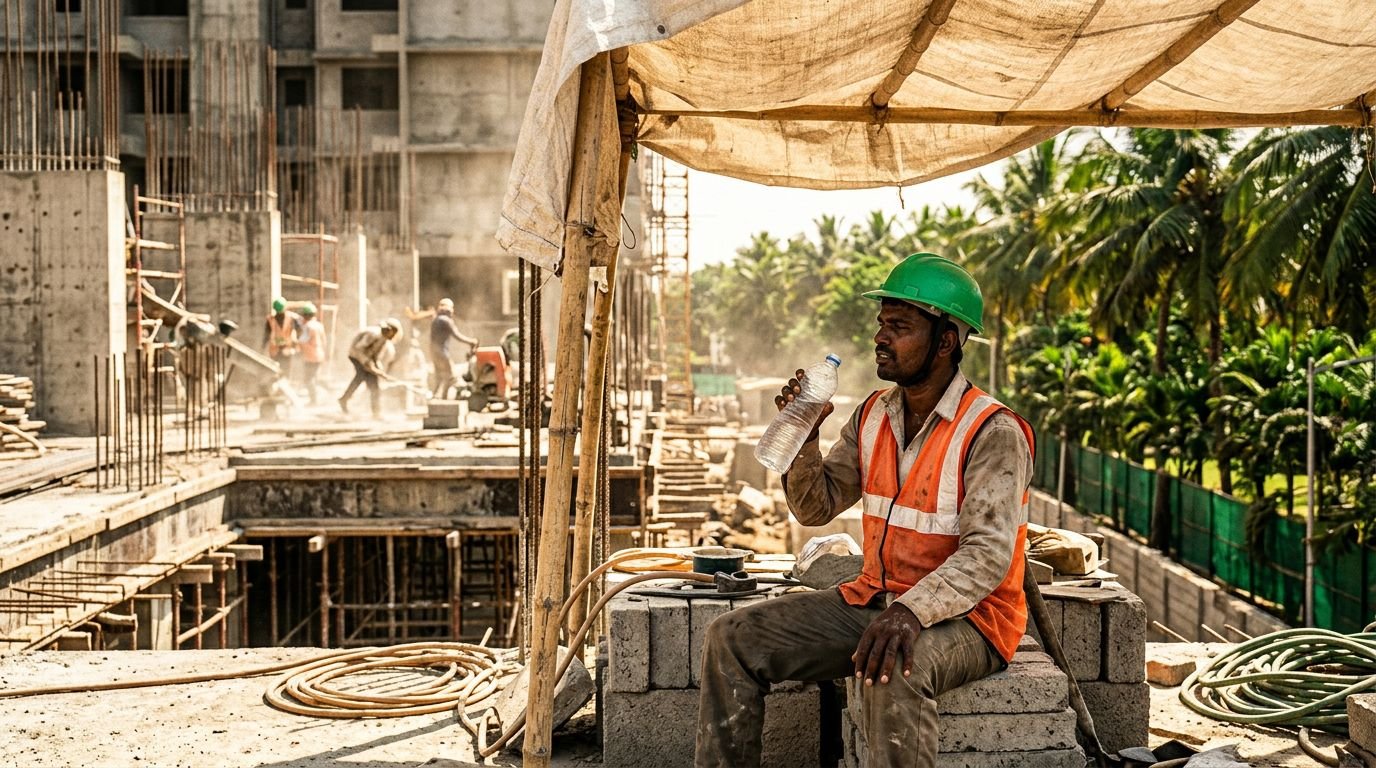
A heat warning can reach a phone at 9 a.m., long after a construction worker has already started lifting steel in direct sun.
That gap tells the real story. India heat action plans have improved public awareness, but too many still treat these extreme heat events as weather events instead of a labour crisis. For people who can step into air-conditioning, an alert may feel useful. For a delivery rider, street vendor, sanitation worker, farm labourer, or welder, it often changes nothing.
If a plan cannot protect the people who keep a city moving during its hottest hours, it isn’t finished.
Key Takeaways
- India heat action plans often warn people about danger without changing unsafe work conditions.
- Outdoor workers need paid rest, water, shade, medical support, and the right to stop work during severe heat.
- Informal workers carry much of the risk because they often lack contracts, insurance, toilets, or safe places to recover.
- Sustainable urban planning, tree cover, road materials, and public transport shape heat exposure as much as weather forecasts do.
- Systemic change means treating heat safety as a labour right, not a seasonal awareness campaign.
- True climate resilience requires moving from awareness to enforceable heatwave preparedness.
Heat alerts don’t reach workers on equal terms
India’s heat action plans grew out of a real Public health response. After the deadly 2010 heatwave in Ahmedabad, the city developed one of India’s earliest formal Heat Action Plan initiatives. It linked Early warning systems with a robust Heat alert system, hospital preparedness, and communication campaigns.
That mattered. A city that knows extreme heat is coming can prepare clinics, issue alerts, and tell residents when to avoid the worst hours.
But here’s the hard truth: a warning only works if someone has the power to act on it.
A salaried office worker may postpone a meeting or work indoors. A street vendor can’t close their cart without losing the day’s income. A construction worker may know the sun is dangerous, yet still face a supervisor who wants concrete poured before the afternoon. A delivery rider may be pushed by app incentives, deadlines, and customer ratings.
Extreme temperatures don’t land equally because work doesn’t.
The World Health Organization’s heat and health guidance is clear about the risk. High temperatures can cause dehydration, heat exhaustion, heatstroke, kidney stress, and cardiovascular strain. For people doing physical work outside, those dangers stack up fast.
India’s plans often focus on broad Public awareness campaigns:
- Drink water.
- Stay indoors at midday.
- Avoid strenuous activity.
- Check on elderly neighbours.
None of that is wrong. Yet it becomes hollow when the person reading it cannot afford to follow it.
“Stay indoors” is not advice for someone whose wages depend on standing beside traffic for ten hours. It is a reminder that the plan was written for somebody else, often failing to reach Vulnerable populations who lack the agency to prioritize their physical safety over their financial survival.
A heat alert is not worker protection if missing work means missing rent.
The real measure of a heat plan is simple: when temperatures turn dangerous, can the most exposed person slow down without punishment?
Outdoor work turns weather into a wage penalty
Heat is not only about air temperature. It is about the body working under a hot roof, beside exhaust fumes, on dark asphalt, near machinery, or inside a poorly ventilated workshop.
A road crew in Delhi may face heat radiating upward from bitumen. A farm worker in Rajasthan may work far from drinking water. A sanitation worker may wear gloves, masks, and uniforms that trap heat. A welder works close to sparks and metal that holds the afternoon sun.

Photo by Tuğba Yıldırım
The danger is not always dramatic. Many workers don’t collapse in public. They push through headaches, nausea, dizziness, cramps, and weakness because stopping feels riskier than continuing. That repeated strain can cause a range of Heat-related illness long before anyone calls it an Extreme heat event.
The International Labour Organization has warned that heat stress reduces safe working capacity and threatens decent work across sectors such as agriculture and construction. Its report, Working on a warmer planet, puts labour at the centre of the climate problem, highlighting that effective Heat stress management is vital for protecting workers in these industries.
That framing matters. Lost productivity is often discussed as an economic issue. It is also a human issue.
When Extreme temperatures cause output to drop because workers are overheating, somebody usually tries to make up the difference. The contractor extends hours. The worker skips a break. The rider drives faster. The vendor stays at the roadside longer. Heat turns into a wage penalty carried by people with the least room to absorb it.
Many heat action plans still measure success through alerts sent, posters displayed, or hospital cases reported. Those are partial signals.
They do not tell us:
- How many workers received paid heat breaks.
- How many construction sites had shade and cool drinking water.
- How many delivery platforms reduced unsafe targets.
- How many workers lost income after stopping due to Heat-related illness.
- How many people were treated outside the formal health system.
If we don’t count those realities, we create a clean dashboard and leave the dangerous work untouched.
Informal workers fall through the policy gaps
India’s outdoor workforce is not one neat group. It includes gig workers, migrant labourers, domestic workers, waste pickers, agricultural labourers, street vendors, loaders, security guards, and people doing piece-rate work without formal protection. Collectively, these individuals represent one of the most vulnerable populations in the country.
Many are not covered by the workplace systems a heat plan assumes exist.
A large factory may have a manager, a medical room, a shift schedule, and a visible employer. A woman selling fruit beside a bus stop may have none of those things. A waste picker moving through a landfill has no air-conditioned recovery room. A gig rider may be managed by an algorithm that never feels the temperature.
This is where policy language gets slippery. According to the National Disaster Management Authority, employers must provide basic amenities like water, shade, and rest. But who enforces that where there is no clear employer?
The worker often gets blamed instead.
Did they drink enough water? Did they wear a cap? Did they leave home too late? Those questions are easy because they put responsibility on the individual. They also avoid the harder questions about wages, work targets, public infrastructure, and enforcement.
Women workers face another layer of risk. Heat stress becomes worse when toilets are distant, unsafe, or unavailable. Many workers reduce water intake because using a public toilet is difficult or humiliating. Pregnant workers, older workers, and people with diabetes, heart conditions, or kidney disease may face higher danger without anyone at work knowing or caring.
A serious plan cannot stop at vulnerability mapping. That phrase is a technical requirement, not a soft label, especially when the same people are repeatedly exposed by design.
Workers are not vulnerable because they lack discipline. They are exposed because cities and labor markets make safety expensive, leaving these workers to face extreme temperatures without institutional support.
Hot streets are a planning failure, not bad luck
Step off a shaded lane onto a broad road at 2 p.m. You can feel the difference through your shoes.
Concrete, glass, asphalt, parked vehicles, diesel generators, and sparse tree cover hold and radiate heat, a phenomenon known as the urban heat island effect. Dense neighbourhoods with little ventilation can remain dangerously hot after sunset. A heat action plan that ignores the built environment is trying to treat a fever without asking what caused it.
The India Meteorological Department can forecast heatwaves and provide essential data for local governments. It cannot, by itself, fix a bus stop with no shade, a market with no drinking water, or a worksite surrounded by exposed metal sheets.
Cities need to map heat where people actually work:
| Place | What raises risk | What workers need |
|---|---|---|
| Construction sites | Bare soil, machinery, reflective sheets | Shade tents, water points, adjusted shifts |
| Market streets | Asphalt, traffic fumes, no rest space | Cool shelters, public taps, toilets |
| Bus depots and stops | Long waits, low tree cover, exhaust | Shaded platforms and drinking water |
| Industrial edges | Hot roofs, emissions, poor ventilation | Heat stress management, breaks, medical response |
| Waste sorting areas | Open exposure and heavy physical work | Covered stations, recovery rooms, fair pay |
The takeaway is blunt. A city cannot keep planting saplings for a photograph while paving over the soil that keeps mature trees alive.
Healthy tree cover lowers surface temperatures, offers shade, and supports urban biodiversity. Through active community engagement, cities can ensure that local residents help maintain these green spaces. Birds, insects, and native plants are not decoration around a heat plan. Green cover affects how a street feels at human height.
That does not mean planting a few ornamental palms beside a flyover. It means protecting existing canopy, keeping tree roots unsealed, restoring ponds and wetlands, and designing streets where rain can enter soil rather than rush across burning pavement.
The ecological impact of heat also reaches beyond people. Hotter, drier cities strain urban birds, reduce flowering cycles, and remove refuge for pollinators. A city that kills its trees for tidier footpaths then spends public money on cooling measures. That is a failure of sustainable urban planning. It is paying twice for the same mistake.
What worker-first heat action plans should actually require
India needs a Heat Action Plan that moves from simple advice to enforceable protection. The best policies will still use forecasts and public warnings, but they must also change who holds responsibility when conditions become unsafe.
First, heat triggers need to connect directly with workplace rules. When local conditions reach specific threshold temperatures, outdoor shifts should move to earlier hours, slow down, or stop entirely. That decision cannot depend only on a contractor’s mood or a platform’s delivery targets.
Second, heat safety needs a financial cost. It should not be a cost paid by the worker, but one built into public contracts, company budgets, and project timelines.
A worker-first plan should include the following:
- Paid heat breaks during high-risk periods, especially for heavy physical work.
- Free, clean drinking water placed close to work areas, not locked in an office.
- Shaded rest zones with seating, ventilation, and first-aid supplies.
- Heatwave preparedness through shift timing that avoids the hottest hours of the day.
- Clear symptoms training for supervisors, workers, and co-workers.
- Medical referral systems that do not punish workers for reporting illness.
- Wage protection when work pauses because heat has crossed a danger threshold.
- Public heat shelters managed by the municipal corporation near markets, transport hubs, labour nakas, and dense work corridors.
These measures should not be presented as charity. They are basic operating costs in a country facing increasing temperatures.
Public procurement is one powerful place to start. Government agencies award huge contracts for roads, buildings, sanitation, maintenance, and transport. Every tender can require a heat safety plan, water access, shaded rest, medical protocols, and independent inspections. Contractors who fail should lose money and future eligibility.
Private companies also have no excuse to hide behind climate pledges while workers bake outside. Sustainable business models are not just glossy ESG reports. They are delivery systems that do not punish riders for taking a water break. They are construction budgets that pay for shade. They are warehouses that monitor indoor heat and publish injury data.
The same principle belongs in the circular economy. Repair technicians, scrap workers, warehouse staff, and waste pickers often work in hot, poorly ventilated spaces around hazardous materials. A phone return scheme is not responsible if the people handling damaged batteries and electronic waste have no safe thermal conditions.
Systemic change is boring on a launch day. It looks like contracts, inspections, wage rules, maintenance budgets, and workers who can say that they need a break without fear.
That is exactly why it works. True climate resilience is built through these necessary, systemic changes.
Cities need data that exposes unequal heat risk
A city’s average temperature can hide the places where people are getting hurt.
A weather station may show one number, but a traffic officer on a wide junction experiences another. So does a woman waiting under a tin roof at a labour naka, or a child walking home along a road with no trees. Effective heat plans must utilize inter-agency coordination to combine meteorological forecasts with granular, neighbourhood-level information. Surface temperature maps, tree canopy data, hospital admissions, water-point access, worksite inspections, and worker reports can show exactly where heat is piling up.
The public should be able to see that information clearly.
The District Disaster Management Authority should oversee comprehensive heat dashboards that offer more than just red, orange, and yellow warning colours. These tools should display the locations of open cooling centres, the status of public water taps, wards that lack adequate shade, and the results of heat-safety checks at labour sites. This data must be available in local languages and shared through unions, resident groups, market associations, schools, and worker collectives.
This is where climate literacy becomes practical. By defining climate literacy as a form of community engagement, people learn to recognize the signs of heat illness while understanding that risk is shaped by policy decisions regarding land use, transport, housing, and energy.
A good plan listens to the people living that reality. Street vendors know which pavements become unbearable when extreme temperatures strike by noon. Bus conductors know which terminals lack drinking water, and sanitation workers know which routes provide nowhere to recover.
Their experience is evidence, not just an anecdote to place at the end of a consultation report.
Community-led action can also build pressure for better public systems. Projects that connect local ecology, public health, and climate education make the issue visible where official India heat action plans and their associated maps often fail. You can Explore Our Active Missions supporting on-the-ground urban biodiversity and climate literacy work.
Personal choices help, but they cannot replace public duty
We should carry water. We should check on neighbours. Everyday mindfulness can make us notice the delivery rider waiting in full sun or the guard sitting beside a heat-trapping wall.
Adopting plant-based living can also lower the emissions linked to food systems, serving as a meaningful form of climate change adaptation when it replaces high-impact consumption with affordable, nourishing options. Those choices matter.
But no reusable bottle can solve a worksite with no water. No individual diet change can create shade on a road designed like a griddle. Relying solely on these individual habits becomes a distraction when it lets employers and governments avoid the long-term measures that are truly required to protect the workforce.
The same goes for heat-proofing homes. Cool roofs, reflective paint, ventilation, and shade can help families. Yet renters, informal settlers, and low-income households often lack control over roofs, walls, and electricity bills.
Ultimately, we need personal care and a comprehensive public health response working together. One without the other leaves the most vulnerable behind and threatens to drive up mortality rates as temperatures continue to climb.
Frequently Asked Questions
Why are heat alerts often ineffective for outdoor workers?
A heat alert simply notifies someone that temperatures are dangerous, but it does not remove the necessity of working for income. For informal workers and labourers, ignoring a warning is often the only way to avoid a wage penalty or job loss, making the alert a hollow gesture without accompanying workplace protections.
What specific protections should employers provide during extreme heat?
Employers should guarantee paid heat breaks, ensure access to clean drinking water near the worksite, and provide shaded rest areas with adequate ventilation. Additionally, shifts should be adjusted to avoid the hottest hours of the day, and workers must be trained to recognize the symptoms of heat-related illness without fear of repercussions.
How does urban planning contribute to heat exposure?
Urban design often prioritizes concrete and asphalt, which absorb and radiate heat, creating urban heat islands. A lack of tree cover and poor building ventilation trap heat at the street level, meaning that workers in these environments face temperatures much higher than the officially reported air temperature.
Can personal choices like drinking more water solve the problem?
While personal habits are beneficial, they cannot replace the need for structural, institutional support. No amount of individual mindfulness can compensate for a job site that provides no shade, no water, or no permission to rest when physical health is at risk.
Conclusion
India heat action plans continue to fail outdoor workers when they stop at simple warnings and never address essential protections like wages, adjusted work hours, access to shade, clean water, and strict enforcement.
A city cannot claim to be prepared for the climate crisis while the people building its roads, delivering its food, cleaning its streets, and selling at its markets are forced to endure extreme heat events for survival. True progress requires shifting the burden from the individual to the institution. By integrating inter-agency coordination and municipal corporation accountability, we can turn a simple heat action plan into a life-saving labor standard that successfully lowers mortality rates.
Heat safety is a labor right. When plans protect workers first, they protect the whole city.