7 Questions to Ask Before Buying an Indoor Air Monitor
 TBH Editorial
Your living room can look spotless and still hold yesterday’s frying smoke, stale breath, and traffic particles that slipped through a window. That is why an indoor air monitor matters: it makes invisible indoor air quality problems visible.
Buy the wrong air quality monitor, and its cheerful score can bury the problem, especially if poor battery life leaves it unused. Buy the right one, and you can spot a pattern, open a window, or demand a repair before another headache or damp patch gets dismissed as harmless, despite the health risks.
Key Takeaways
- Choose an indoor air monitor based on the pollutants and patterns that matter in your home, such as CO2, PM2.5, humidity, radon, VOCs, or carbon monoxide.
- For dependable carbon dioxide readings, look for a true NDIR or photo-acoustic sensor and avoid treating estimated eCO2 values as reliable ventilation data.
- Laser particle counters can reveal useful PM2.5 trends, but consumer monitors are affected by particle type, humidity, placement, and maintenance; they are not laboratory or regulatory instruments.
- Place the monitor around breathing height, away from windows, vents, sunlight, cooking steam, and walls, then collect several days of data before drawing conclusions.
- A monitor is useful when it leads to action, such as improving ventilation, reducing combustion smoke, investigating dampness, or using a proper CO alarm or radon sensor where necessary.
Seven Questions Before Checkout
1. Which pollutants do you actually need to track?
Start with the room, not the brand.
A bedroom with closed windows may need carbon dioxide tracking. A kitchen needs particulate matter data. A newly painted flat or a heavily fragranced office may benefit from a VOC trend sensor. A basement or ground-floor home in a radon-prone area needs radon-specific monitoring.
Because different air quality sensors answer different questions, the useful starting set for indoor air quality is:
- PM2.5 and PM10 for cooking smoke, incense, dust, outdoor pollution, and construction residue.
- Carbon dioxide as a practical signal of stale, poorly ventilated air.
- Temperature and relative humidity for heat, dampness, and mould risk.
- TVOC or nitrogen oxides (NOx) indexes for changes linked to cleaners, paint, combustion, or traffic infiltration.
Do not expect one small device to measure every threat well. An incense-heavy prayer room, for example, needs serious particulate tracking. Indoor air pollution from incense is not solved by a vague “good” air score.
The question is simple: what enters, burns, dries, leaks, or gets trapped where you live?
2. Does it measure real carbon dioxide, or estimate it?
For carbon dioxide, look for an n-dir sensor, although the industry-standard label is NDIR. NDIR, short for nondispersive infrared, measures how CO2 absorbs infrared light. It is the dependable consumer standard because it measures the gas directly.
Photo-acoustic CO2 sensors also measure real CO2. They use pulsed light to create tiny pressure waves inside the sensor, then read those waves with a microphone. The technology can be accurate, but performance depends on the maker’s calibration, temperature compensation, and maintenance.
The red flag is “eCO2.” Many cheap devices estimate carbon dioxide from volatile organic compounds. That can make a freshly cleaned room appear packed with people. It is not reliable enough for ventilation decisions.
Ask whether the device has a true NDIR or photo-acoustic CO2 sensor, whether calibration guidance is public, and whether the reading can be checked against outdoor fresh air. Sustainable business models should reward honest sensor specifications, not impressive-looking dashboards.
A persistent rise above roughly 1,000 ppm is a prompt to improve ventilation, not a diagnosis or universal legal threshold. Open windows if outdoor conditions allow it, run mechanical ventilation systems when available, and reduce crowding for a while.
3. Can the monitor measure particulate matter with a laser sensor?
For PM2.5, a laser particle counter is the sensible choice. A laser particle counter draws air through the device, counts particles by scattered light, and estimates concentration from that signal.
That is not the same as a government reference station or the reference instruments and methods used by an environmental protection agency. Regulatory-grade systems use controlled sampling, strict calibration, and audited methods. A home air quality monitor is best at showing changes: the pan starts smoking, construction begins nearby, or outdoor pollution enters after the window opens.
A 2026 review of low-cost indoor sensors makes the limitation plain. Lower-cost air quality sensors built around a laser particle counter can be useful. But sensor accuracy shifts with particle type, humidity, placement, and maintenance.
One performance assessment found many tested devices under-reported reference particulate matter measurements by as much as 50 percent. That was true even when their NDIR CO2 responses were more acceptable. Read the low-cost monitor performance study before treating a consumer reading as laboratory proof.
A consumer monitor can reveal a repeatable exposure pattern. It cannot, by itself, prove a legal violation or diagnose a home.
4. Do you need radon, carbon monoxide, VOCs, or all three?
TVOC, radon, and CO use different gas sensors, so their readings are not interchangeable.
A TVOC sensor reports a changing mixture of gases. It cannot tell you which chemical is present or whether it is formaldehyde, perfume, paint solvent, or something else. Treat it as a trend signal. A sudden spike after mopping or repainting tells you to ventilate, not to panic over one number.
Radon is different. It is a radioactive gas that needs a radon-specific sensor. The Airthings View Plus is worth considering when ongoing radon measurement is non-negotiable. The AirGradient ONE does not include radon sensing, though it covers PM, CO2, TVOC, NOx, temperature, and humidity.
Carbon monoxide is a life-safety issue, not a wellness metric. If you have a gas geyser, fuel-burning appliance, fireplace, or attached garage, use a proper audible CO alarm in addition to an air quality monitor. Read this guide to carbon monoxide alarms for homes before trusting a general-purpose screen with that job.
5. Where will you put it, and what can it reveal?
A monitor placed above a gas stove will mostly measure the stove. One pushed beside an open window may mostly measure outdoor air quality. Neither tells you much about the rest of the room.
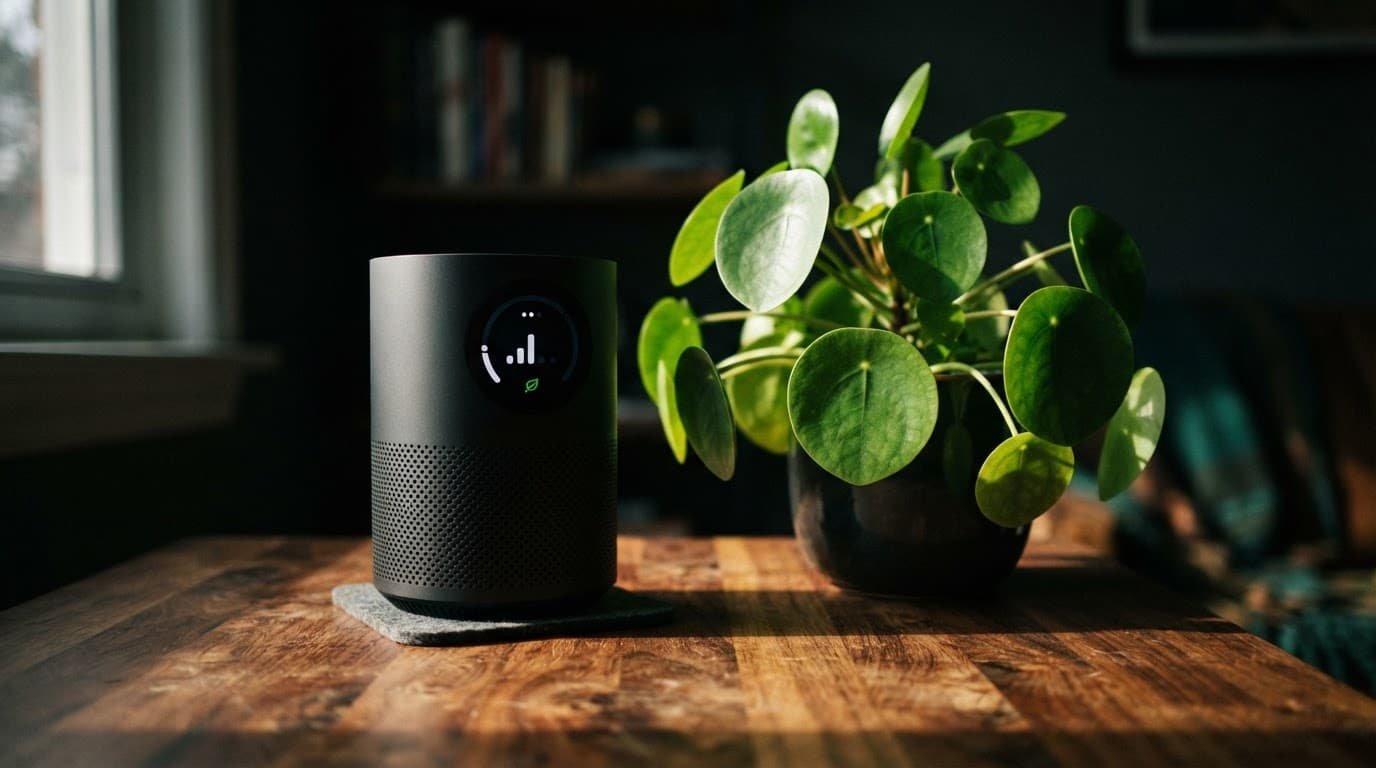
Placement determines whether the reading represents the room’s indoor air quality. Place it around breathing height, away from direct sunlight, air-conditioner outlets, cooking steam, and walls.
Give it several days before drawing conclusions. One dramatic reading is a moment. Repeated spikes at the same hour are evidence. For a portable model, check battery life so it can remain in a useful position and collect a consistent trend.
For a bedroom, prioritize CO2, humidity, and temperature. For a kitchen, prioritize PM2.5 and ventilation. If dampness keeps returning, a humidity trend can support your case, but it cannot prove mould or identify who caused it.
Everyday mindfulness means noticing what the numbers line up with: showering, cooking, incense, laundry drying indoors, roadwork, or a leaking pipe. Photograph stains and report moisture in writing. Paint is not a repair plan when water keeps entering through a wall.
6. Does the product match your needs, not somebody else’s?
The right device is not always the one with the most sensors.
The AirGradient ONE is a strong multi-pollutant option. Its current sensor set includes SenseAir NDIR CO2 sensing, a Plantower laser-scattering particulate sensor, and Sensirion sensors for TVOC, NOx, temperature and humidity. It suits people who want one device to see several indoor patterns.
The Aranet4 HOME asks a narrower question: is this room getting enough fresh air? Its portable design, long battery life, and NDIR CO2 focus make it useful for bedrooms, classrooms, and meetings. It is not a full replacement for particulate matter or radon monitoring.
Before spending, check the sensor list, power source, battery life, and display readability. Also review its touch screen display, Wi-Fi needs, mobile app support, data export, optional data logging, firmware support, and warranty. Hands-on air monitor testing can help you compare real-world strengths instead of buying from a polished product page.
A circular economy asks harder questions too. Can the device receive updates? Will it still work if the company changes its app? Is there a repair path, or will one failed part send another electronic product into a drawer?
7. Will you act on the data, or only watch it?
An air quality monitor earns its place when it changes a decision.
| Pattern you see | Likely cause | First response |
|---|---|---|
| CO2 rises overnight or during meetings | Too many people, too little fresh air | Ventilate safely, run mechanical ventilation, or reduce occupancy briefly |
| PM2.5 jumps while cooking or burning incense | Combustion smoke | Use an exhaust fan that vents outside, cover pans, and run a HEPA purifier after the source stops |
| VOC levels rise after cleaning or painting | Fragrances or solvents | Stop using the product, ventilate, and keep people out of the room if symptoms appear |
| Humidity stays high for days | Poor exhaust, laundry drying, or hidden moisture | Improve extraction and investigate leaks at the source |
If you want smart home automation, confirm that the monitor supports Home Assistant, local export, or a documented integration before buying it. You should not need advanced coding to trigger a fan when CO2 rises or receive a phone alert when PM2.5 surges.
Wireless alerts also depend on continuous power, so check battery life before relying on automation.
Still, we need proportion. Air purifiers cannot remove CO2. A personal sensor cannot fix a construction site that sends dust across a neighbourhood every afternoon. Citywide air quality averages can hide a local exposure pattern when an air quality index compresses many locations into one number. Pollution may still concentrate at your school gate, bus stop, or kitchen window.
That is where climate literacy becomes public action. Dust that settles on your monitor’s intake also coats roadside leaves, weakens urban biodiversity, and carries a wider ecological impact. Plant-based living and careful consumption matter, but they do not replace source control, enforceable standards, or systemic change.
For practical work that connects clean-air accountability, urban biodiversity, and community action, Explore Our Active Missions.

Frequently Asked Questions
What should an indoor air monitor measure?
The right measurements depend on your home and concerns. CO2, PM2.5, temperature, and humidity are useful starting points, while radon, VOCs, and carbon monoxide require more specific sensors or alarms.
Is eCO2 the same as real carbon dioxide?
No. eCO2 is often estimated from volatile organic compounds and can be misleading, so choose a monitor with an NDIR or photo-acoustic CO2 sensor for ventilation decisions.
Can a home monitor accurately measure PM2.5?
A laser particle counter can show useful changes and repeated exposure patterns, such as cooking smoke or outdoor pollution entering through a window. However, readings vary with particle type, humidity, placement, and maintenance, so they should not be treated as laboratory proof.
Where should I place an indoor air monitor?
Place it around breathing height in the room you want to understand, away from direct sunlight, walls, cooking steam, air-conditioner outlets, and open windows. Leave it there for several days so you can identify recurring patterns rather than reacting to one dramatic reading.
Can an indoor air monitor replace a carbon monoxide or radon alarm?
No. Radon needs a radon-specific monitor, and carbon monoxide requires a proper audible CO alarm, especially near fuel-burning appliances or an attached garage. A general-purpose air quality monitor should supplement—not replace—these safety devices.
The monitor should change the room
A good air quality monitor does not offer false certainty about indoor air quality. It helps you see what repeats, what worsens, and what needs a response.
Choose a reliable device for the conditions you face, place it well, and consider its battery life when moving it between rooms. Use the data to improve airflow, investigate recurring problems, and question the systems that keep sending pollution through your door.
The best indoor air monitor is the one that turns invisible exposure into a clear next step.