Furniture VOCs India: A Practical Guide for New Homes
 TBH Editorial
That sharp “new furniture” smell isn’t proof of quality. It can reflect toxic chemicals, but the smell alone doesn’t prove a product is dangerous.
Buyers researching furniture emissions in India often get buried under labels, sales claims, and vague promises of “eco-friendly” materials. The useful question is simpler: what is inside this board, glue, paint, or coating, and can the seller prove it?
Before blaming a headache on the weather or the air conditioner, look at what arrived in your home this week and how it may affect indoor air quality.
Key Takeaways
- A sharp new-furniture smell can indicate chemical emissions, but smell alone cannot measure VOC exposure or prove that a product is safe.
- MDF, particle board, plywood, adhesives, laminates, paints, varnishes, foam, and coatings can all contribute to indoor air pollution. Formaldehyde emissions from the board core and VOCs from surface finishes should be assessed separately.
- E1 and E0 claims are useful only when supported by product-specific certificates, test methods, laboratory reports, and clear details about the exact materials supplied. FSC, GreenPro, GREENGUARD, CARB, and BIFMA certifications also vary in scope and should not be treated as interchangeable.
- Before buying, request a component-by-component material list, formaldehyde and total-VOC documentation, and relevant heavy-metals testing. Prefer lower-emission products, improve ventilation after delivery, and treat source control as more important than relying on an air purifier.
Why the New-Smell Problem Matters
Furniture emissions in India can come from new wardrobes, modular kitchens, beds, desks, TV units, and office furniture. Volatile organic compounds are gases released from products at room temperature, often through engineered wood, adhesives, laminates, varnishes, foam, and solvent-based paint.
Formaldehyde is one of the most discussed VOCs because it is common in resin-bonded boards such as MDF and particle board. Short-term chemical exposure can irritate the eyes, nose, throat, and lungs. Some people notice headaches, worsening asthma symptoms, or other respiratory problems. Long-term formaldehyde exposure raises more serious health risks, which is why the International Agency for Research on Cancer classifies it as carcinogenic to humans.
Heat and humidity can make off-gassing worse. So can a sealed bedroom, a packed office cabin, or a newly furnished flat with poor ventilation. Research on wooden-furniture emissions shows that temperature and indoor conditions affect how chemicals move from furniture into room air.
Indoor air quality in Indian cities has another layer of trouble. Outdoor PM2.5, traffic soot, and road dust can enter through windows and gaps. These particles differ from indoor chemical emissions, but both can contribute to indoor air pollution. Closing every window may block some outdoor pollution, but it can also trap chemicals released indoors.
Heavy metals may occur in some pigments, coatings, or hardware, but they aren’t VOCs and don’t evaporate in the same way.
A smell is not a meter. Furniture can emit VOCs without a strong smell, but a harsh chemical odour should never be dismissed as “normal newness.”
Air purifiers may help with some pollutants, but they can’t replace reducing the emission source.
The risk is not equal in every room. A dining chair in a breezy space is different from a new MDF bed in a small nursery where a child sleeps for ten hours.
The Materials That Bring VOCs Into Your Home
Engineered wood isn’t automatically bad. It can make furniture more affordable and use raw materials efficiently. The concern is the resin holding those fibres together, plus whatever gets sprayed, glued, laminated, or sealed on top.
MDF boards and particle board can use more adhesive than solid timber. That makes formaldehyde emissions from resin-bonded cores worth checking, but neither material is automatically unsafe. Plywood, blockboard, veneers, edge bands, laminate adhesive, and drawer back panels also deserve questions. A beautiful solid-wood table can still have a high-VOC lacquer.
Board grades help, but they do not describe the adhesive, laminate, coating, or hardware.
These labels are useful starting points, but E1-grade boards still need a declaration for the specific product.
| Emission label | What it usually signals | What buyers should do |
|---|---|---|
| E2 | A higher formaldehyde-emission class than E1 | Keep it out of enclosed bedrooms, nurseries, and workspaces where possible. |
| E1 | A common lower-emission class for interior boards | Ask for the declaration for the exact MDF, plywood, or particleboard supplied. |
| E0 | A stricter low-emission claim used in the market | Ask which test standard, laboratory report, and board manufacturer support the claim. |
E1 and E2 are recognised under European-style board testing. E0 is commonly used in Indian marketing, but it is not one universal legal category. Its meaning depends on the test method and certification behind it. Don’t accept a brochure line as proof.
Also, a low-emission board can still receive a high-emission coating. A study of VOCs from coated furniture makes that distinction clear: the board core and the surface finish are separate sources worth checking. Pigments or surface treatments can introduce a separate heavy metals concern, distinct from VOC emissions.
Water-based finishes usually contain fewer solvents than traditional solvent-heavy paints. Low-VOC finishes may reduce emissions from a surface, but neither label proves the whole item is low-emission. Powder coating for metal furniture can also reduce solvent use during manufacturing. Like any finish, powder coating, its pigments, pretreatment, and substrate still require product-specific documentation. Ask for the product’s technical sheet or safety data sheet. Check whether coatings or hardware have relevant testing for heavy metals, not just a verbal assurance.
India’s Standards Gap Leaves Buyers Doing Too Much
India has board standards and green-building frameworks, yet buyers still face a basic accountability gap. Rules may cover building materials or one board, not finished furniture. No single, simple, enforceable national rule caps every VOC emitted inside a home.
Some current BIS specifications include requirements for formaldehyde emissions in plywood. An E1 plywood certificate does not cover particle board or MDF shelves hidden inside a wardrobe. It also does not prove that the paint, adhesive, laminate, foam, or other surface treatments meet the same standard.
For anyone researching furniture VOCs India, this is the hard truth: sellers often market a furniture item as safe when only one component has documentation.
Third-party labels can help, but eco-certifications differ in purpose and scope:
- FSC certified wood indicates responsible forest sourcing. It does not prove low emissions, and sourcing labels generally do not automatically test for heavy metals.
- GREENGUARD certification focuses on chemical emissions from finished products or materials, depending on the certificate scope.
- GreenPro certification can support broader environmental claims in India, but check what the certified product and criteria actually cover.
- CARB Phase 2 and EPA TSCA Title VI relate to formaldehyde limits for composite wood in the US market.
- BIFMA certifications can help assess workplace products. Check whether a finished-product or metal-furniture certificate covers the exact model, frame, raw board, and powder coating.
Ask for a certificate number, exact product name, board thickness, manufacturer, and test date, plus a laboratory report covering formaldehyde, total VOCs, and testing for relevant heavy metals. If a dealer cannot show those details or explain the scope, the claim is not ready for your home or consistent with basic safety standards.
How to Buy Lower-Emission Furniture Without Falling for Greenwash
You don’t need a chemistry degree. Sustainable furniture requires documented materials, repair options, and a seller who answers plain questions without changing the subject.
Before placing an order, use this buying routine:
- Ask for a component-by-component material list for panel furniture, covering the carcass, back panel, drawers, shelves, laminate, adhesives, and finish. Request a separate declaration for heavy metals in pigments, paints, coatings, and hardware.
- Request the declared formaldehyde class for each component. For bedrooms and children’s rooms, prefer E0 claims backed by records or verified E1-grade boards. Avoid E2 in enclosed living spaces.
- Ask whether the finish uses water-based coatings, low-VOC finishes, solvent-based coatings, or powder coating. Get the answer on the quotation or invoice.
- Check whether the eco-certifications belong to the exact board, material, or furniture model. A brand-level sustainability badge is not enough.
- If the purchase is large, ask for a recent report from an NABL-accredited laboratory. Confirm whether it tested formaldehyde, total VOCs, or only the raw board. Check whether any testing for heavy metals is listed separately from the VOC results.
- Walk away from pressure tactics. If the showroom sample has a sharp, eye-watering smell, don’t negotiate with your lungs; air purifiers can’t make undocumented materials acceptable.
Office facility managers should put these requirements into the purchase order. Specify maximum emission classes, supporting documentation, and low-VOC finish expectations. For metal components, require documented powder coating and a right to reject substituted materials. That is systemic change in its least glamorous form: paperwork that prevents a cheap board from being quietly swapped into a crowded workplace.
A responsible circular economy also needs this discipline. Reuse, repair, and resale are good ideas only when materials are known and safe. Passing an old, high-emitting cabinet into a tuition centre or low-income rental home is not circularity. It is shifting exposure to people with fewer choices.
Reduce Off-Gassing After Delivery
The first days after installation matter most for off-gassing. If possible, unwrap and air out new furniture in a covered space with good airflow before placing it in a bedroom. Keep windows open during cleaner outdoor hours to support indoor air quality. Close them when roadside dust or smog could combine with indoor emissions and worsen indoor air pollution.
Don’t fill every drawer, shut every door, and sleep beside a new wardrobe on the first night if you have another option. Leave cabinets open for part of the day, and increase ventilation with exhaust fans that vent outdoors. Air exchange moves pollutants out faster than a single cracked window.
Air purifiers can help with particles, but HEPA filters don’t remove gases well. For VOCs, you need substantial activated carbon or another gas-phase filter, and those filters have limits. Even air purifiers can’t replace source control or a low-emission purchase.
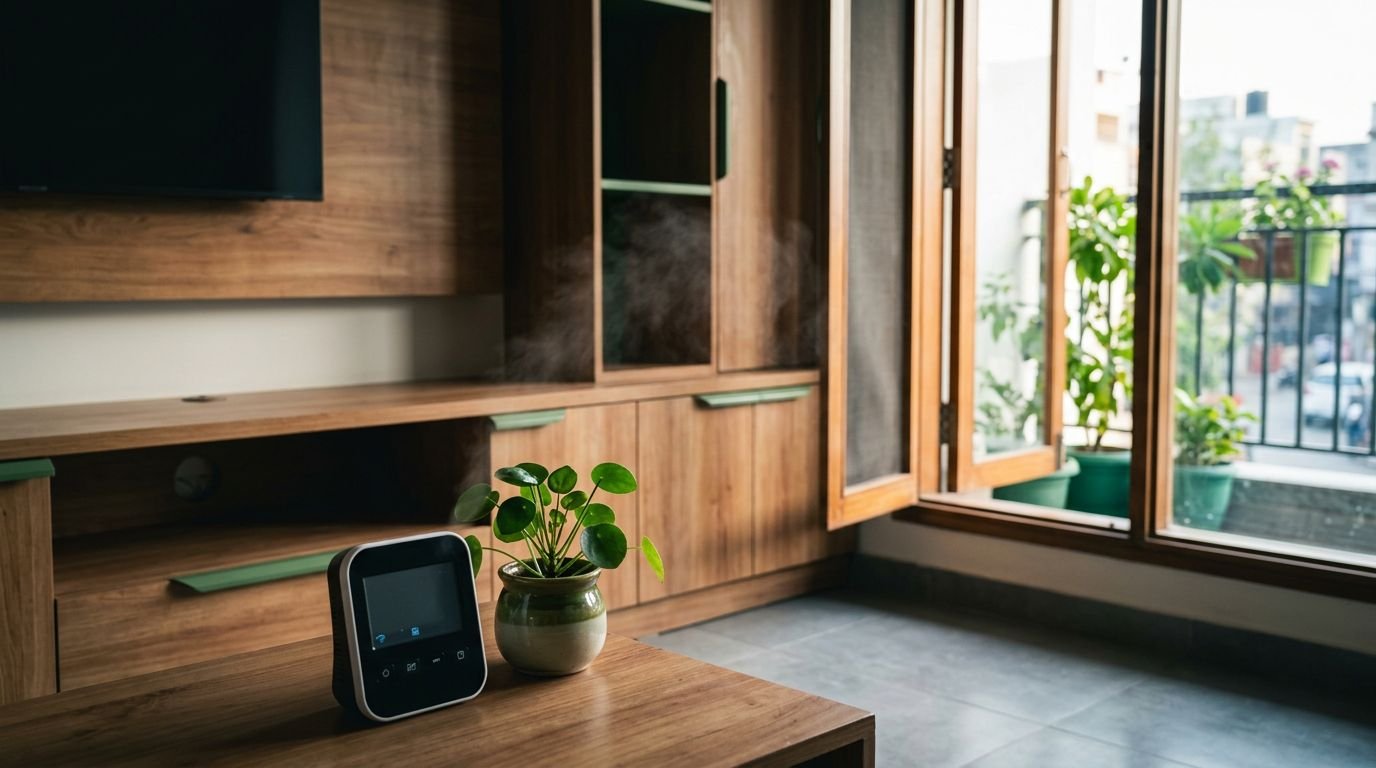
If a child, older adult, or person with asthma develops persistent irritation or respiratory problems after new furniture arrives, take the possible health risks seriously. Move the item if you can, increase airflow, and speak with a qualified clinician. A low-cost indoor air monitor may show changing patterns, but it can’t identify every toxic chemical or test for separate hazards such as heavy metals. For persistent problems, ask an indoor-air laboratory about formaldehyde and VOC testing.
Research on furniture VOC and formaldehyde patterns points to a reality retailers rarely mention: emissions change with room conditions and product age. A one-time sniff test won’t settle the question.
A Healthier Home Needs More Than Better Shopping
Everyday mindfulness helps. Notice the smell, ask for records, and resist the urge to furnish an entire flat in one rushed weekend. Plant-based living, lower-waste habits, and climate literacy can shape how we consume. They cannot ventilate a sealed nursery or force a manufacturer to disclose its resin.
Sustainable furniture should combine repairable design, clear material disclosure, take-back routes, and a long useful life. A repairable metal component with a durable powder coating may remain useful longer, too.
Household exposure to indoor air pollution belongs in a wider conversation about pollution and shared responsibility. People, birds, trees, and pollinators all lose when pollution is treated as somebody else’s problem. For local work that ties climate literacy to visible community action, Explore Our Active Missions.
Frequently Asked Questions
Does a strong new-furniture smell mean the furniture is dangerous?
Not necessarily, because smell intensity does not reliably measure VOC levels. However, a harsh or eye-watering odour is a reason to delay use, increase ventilation, and ask the seller for material and emissions documentation.
Which furniture materials can release VOCs?
MDF, particle board, plywood, adhesives, laminates, varnishes, paints, foam, and other coatings can release VOCs. A low-emission board can still be paired with a high-emission adhesive or finish, so the complete product needs to be assessed.
Is E0 furniture safer than E1 furniture?
E0 is generally marketed as a stricter low-emission claim, but it is not one universal legal category in India. Ask for the test method, laboratory report, certificate, and exact product details before treating an E0 or E1 claim as proof of safety.
Can an air purifier remove furniture VOCs?
HEPA filters mainly remove particles and do not remove gases effectively. VOC reduction requires substantial activated carbon or another gas-phase filter, but ventilation and choosing documented, low-emission materials remain more important than relying on an air purifier.
What should I do if new furniture causes irritation or breathing problems?
Move the furniture if possible, increase airflow, and avoid sleeping or working beside it until the odour and symptoms improve. Persistent irritation or respiratory problems should be discussed with a qualified clinician, and an indoor-air laboratory can test for formaldehyde and other VOCs when necessary.
The Better Standard for New Furniture
New furniture shouldn’t come with a chemical guessing game. Ask about the boards, resin, finish, certificates, and reports before money changes hands.
Furniture VOCs India isn’t a niche concern for anxious buyers. It’s a basic public-health question inside the rooms where we sleep, work, recover, and raise children.
Buy less when you can, and buy documented materials when you must. Air purifiers can help, but they can’t replace documented materials or controlling emissions at the source. Don’t let a pleasant showroom design hide an answer the seller refuses to provide.