Textile Dyeing Pollution in India: The Groundwater Cost
 TBH Editorial
A bright pink shirt can leave behind water that nobody should have to drink.
Across the textile industry in India, dye houses turn yarn and fabric into color, but the wastewater often carries salt, chemicals, dyes, and metals into drains, soil, rivers, and aquifers. Textile dyeing pollution in India is not only a factory problem. It becomes a kitchen water problem, a farm problem, and a public health problem.
If the groundwater below an industrial town turns salty or discolored, the damage caused by industrial water pollution can outlive the contract, the fashion season, and sometimes the factory itself.
Key Takeaways
- Textile dye effluent often contains high levels of dissolved salts, colour, alkalis, organic chemicals, and sometimes metals.
- Groundwater contamination is common where untreated effluent, leaking pipes, damaged treatment plants, or polluted drains meet shallow aquifers.
- Clusters such as Tiruppur, Pali, Balotra, Jetpur, and Sanganer show how industrial growth can shift environmental costs onto nearby communities.
- Common treatment systems can remove visible colour while leaving behind difficult pollutants such as dissolved salts, which significantly increases the overall environmental impact.
- Systemic change within the textile industry means preventing pollution at the dye house, treating wastewater properly, reducing water use, and making brands share responsibility.
Why textile dye wastewater is harder to clean than it looks
Textile dyeing uses far more than pigment and water. Fabric must be washed, bleached, scoured, dyed, rinsed, softened, printed, and finished. Every stage adds something to the wastewater stream.
Cotton dyeing often uses reactive dyes, along with large quantities of salt and alkali. Polyester processing can involve dispersing agents and high-temperature dyeing, while various synthetic dyes are used to achieve specific colorfastness in modern textiles. Printing introduces thickeners, binders, solvents, and pigments. Denim processing may add bleaching agents and finishing chemicals.
The result is not one simple wastewater problem. It is a moving chemical mixture that changes with each order.
Here is what commonly ends up in textile dye effluent:
| Pollutant or condition | Where it comes from | Why it matters underground |
|---|---|---|
| High total dissolved solids | Salt used to fix reactive dyes | Makes groundwater saline and difficult to treat |
| Strong colour | Unfixed dyes and printing residues | Blocks light in water bodies and signals poor treatment |
| High pH | Alkalis, soda ash, caustic soda | Can alter soil chemistry and damage treatment systems |
| Organic load | Surfactants, sizing agents, starches; includes biochemical oxygen demand and chemical oxygen demand | Uses up oxygen when discharged into water |
| Metals | Some dyes, pigments, machinery wear | Can accumulate in soil and sediment |
| Chlorides and sulphates | Salts and chemical auxiliaries | Persist through many treatment processes |
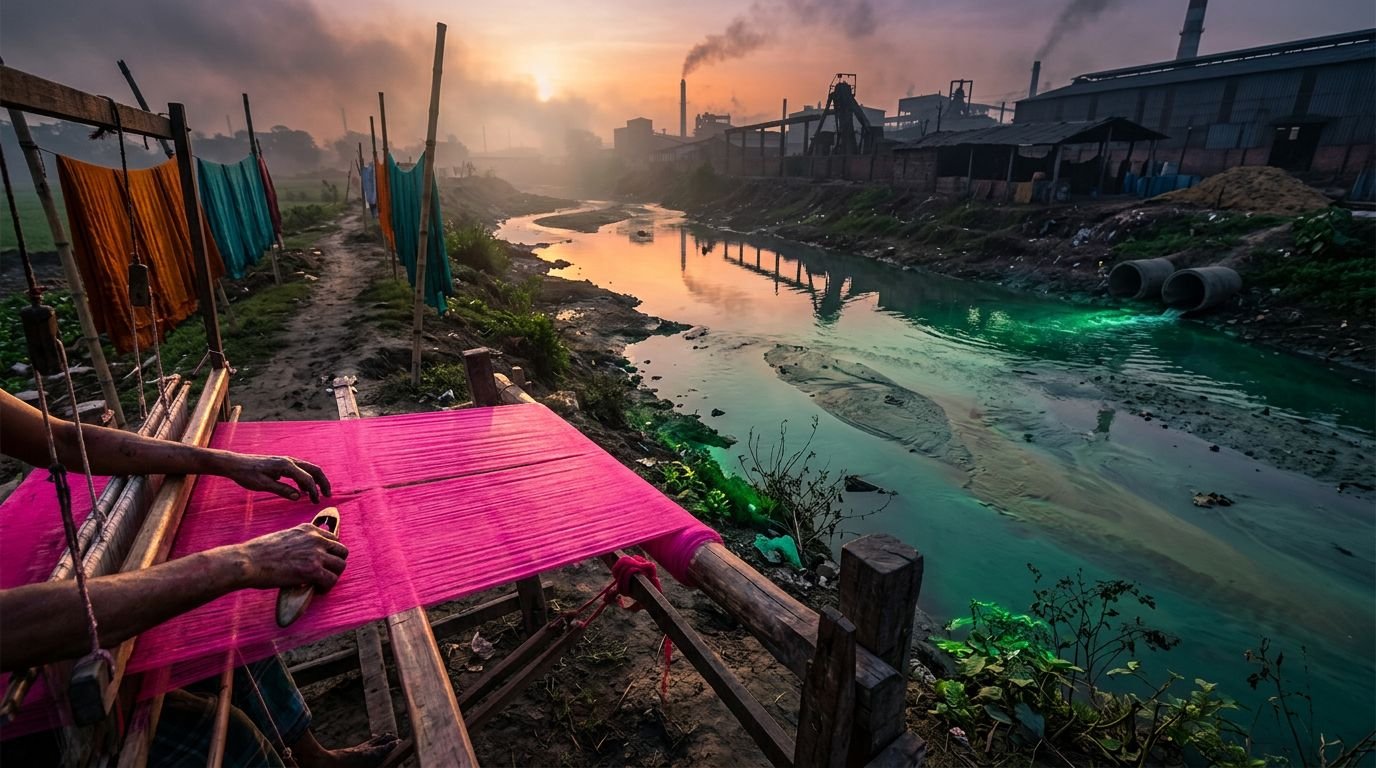
The visible colour gets attention because it is dramatic. A drain running blue, red, or black tells people something is wrong. Often, these vivid hues are produced by azo dyes, which can break down into carcinogenic chemicals if not managed correctly. But colour is only part of the story.
Salinity is often the quieter danger. Water can look clear and still carry dissolved salts that make it unfit for irrigation or drinking. Once chloride, sulphate, and total dissolved solids enter groundwater, they do not disappear because a drain looks cleaner.
A treated discharge is not automatically safe discharge. The question is what remains dissolved after treatment.
Many conventional wastewater treatment plants handle suspended solids and some organic pollution. They struggle with high dissolved salt loads unless they include advanced systems such as reverse osmosis, evaporators, and careful salt management. Those systems cost money, consume energy, and create concentrated reject streams or sludge that still need safe handling.
That is where accountability often breaks. The wastewater has not vanished. It has only changed form or moved somewhere less visible.
How contaminated dye water reaches groundwater
Groundwater does not need a dramatic spill to become polluted. It can be contaminated slowly through thousands of ordinary failures, a quiet form of industrial water pollution that compounds over time.
An unlined evaporation pond leaks. A pipe cracks behind a factory wall. A tanker dumps wastewater at night. A common effluent treatment plant receives more waste than it was designed to handle. A polluted drain crosses open land for years and seeps downward after every monsoon.
The ground keeps a record.
In industrial areas with sandy soil, fractured rock, shallow water tables, or poorly built drainage, pollutants can move down faster than people expect. Seasonal rain may dilute wastewater on the surface, but it can also push contaminants deeper into the soil.
The route often looks like this:
- A dyeing unit releases untreated or partly treated wastewater.
- Effluent enters a drain, pond, vacant plot, irrigation channel, or damaged sewer line.
- Water seeps through soil or travels through cracks and shallow channels.
- Pollutants reach groundwater used by homes, farms, small businesses, and livestock.
- Residents discover the problem only after wells taste salty, smell strange, stain vessels, or stop supporting crops, signaling a drastic decline in water quality.
The damage rarely stays inside the factory gate. That is the lie built into weak enforcement.
A dyeing unit may call wastewater disposal an operational issue. A family with a brackish borewell experiences it as a daily loss. They buy tanker water, travel farther for drinking water, or use poor-quality water because there is no affordable alternative.
The World Health Organization’s guidance on drinking-water quality makes the basic point clear: safe water depends on protection at the source, not only treatment after contamination reaches households.
That matters in textile towns, where groundwater often carries the burden of rapid expansion in the textile industry without meaningful consent from the people drawing it from hand pumps and borewells.
What India’s textile clusters reveal
India’s textile processing clusters support millions of jobs, but they also concentrate chemical risks in areas where dyeing, printing, washing, and finishing units are densely packed together.
Tiruppur in Tamil Nadu serves as one of the clearest examples. The city became a major knitwear export hub, while dyeing and bleaching units placed heavy pressure on the Noyyal River basin and surrounding groundwater. Years of river pollution disputes led to court action, factory closures, and a widespread push toward Zero Liquid Discharge (ZLD) systems. ZLD aims to recover water for reuse and prevent liquid effluent from leaving a facility, which is a significant improvement over untreated discharge. However, it is not a permission slip to keep producing waste without limits. Reverse osmosis creates concentrated brine, and evaporators create solid residue, meaning someone must still manage that material safely. Even with Common Effluent Treatment Plants in place, these systems are often overloaded or poorly maintained.
Rajasthan’s Pali and Balotra regions tell a related story. Textile processing has long been linked with colored wastewater entering drains and the Luni River system. Nearby villages have raised persistent concerns about damaged soil, poor-quality water, and the high cost of living beside industrial pollution.
In Gujarat, Jetpur and nearby dyeing and printing centers have faced scrutiny over wastewater discharge into local waterways. Sanganer, near Jaipur, has also become a familiar name in discussions of textile printing pollution. These are not isolated bad actors; they reveal what happens when production grows faster than wastewater systems, regulatory inspections, and public disclosure.
The environmental impact varies by location, but the pressure points repeat across the country:
- Dense clusters produce wastewater faster than treatment capacity grows.
- Small units may lack the land, capital, or technical staff required for proper treatment.
- Common Effluent Treatment Plants often struggle to handle the sheer volume of toxic runoff.
- Groundwater monitoring is frequently too weak, too infrequent, or too far from exposed communities.
- Global fashion buyers demand speed and low prices in garment manufacturing while the pollution costs remain local.
The Central Pollution Control Board sets national pollution-control standards and supports state boards, but rules only matter when monitoring, penalties, and public records have teeth.
A factory can pass an occasional inspection while residents still live with polluted water every day. That gap between regulatory paperwork and daily exposure is where public trust dies.
The health and ecological cost travels beyond the well
When textile dye effluent enters groundwater, people are not exposed only by drinking it. They may bathe with it, wash clothes in it, irrigate vegetables with it, or breathe dust from contaminated soil after a dry season.
High salt levels can ruin farmland over time. Soil contamination makes the ground harder, less fertile, and less able to hold water. Farmers may see lower yields without having a laboratory report that explains why. A field does not announce chloride contamination. It simply starts giving less back.
Some toxic chemicals and heavy metals also raise longer-term concerns. Their risk depends on the substance, concentration, frequency of exposure, and local conditions. That is why regular testing matters. Communities deserve data on actual groundwater quality, not vague reassurance.
The ecological impact is wider than human health.
Polluted water can reduce oxygen in ponds and streams. Persistent colour blocks sunlight that aquatic plants need. Salty runoff changes soil conditions along drains and riverbanks, creating significant threats to local aquatic life. Frogs, insects, fish, birds, and grazing animals lose habitat quality in places already short on clean water.
This is also an urban biodiversity issue. Industrial towns are not empty production zones. They contain street trees, wetlands, cattle ponds, small farms, birds, insects, and people trying to live around factories. When wastewater damages a local water body, it strips away the small ecological buffers that make dense settlements more livable.
The burden is not shared equally.
Workers, informal settlement residents, women managing household water, farmers near drains, and children playing near polluted channels often face the worst exposure. These vulnerable groups face significant human health risks while they did not approve the production schedule. They do not negotiate contracts with global brands. Yet they absorb the cost.
That is why pollution cannot be treated as a technical footnote in a sustainability report. It is a question of who gets clean water and who gets told to adapt.
Why treatment plants alone don’t solve the problem
A Common Effluent Treatment Plant can be useful, as it allows multiple small factories to send wastewater to a shared system rather than dumping it into local drains. However, any individual or shared effluent treatment plant is only as strong as its design, operation, power supply, maintenance, and incoming wastewater controls.
If units send highly variable waste into the system, wastewater treatment becomes significantly harder. If factories bypass the plant during peak production, the system becomes a performance rather than a solution. If hazardous waste like toxic sludge is dumped on open land, pollutants return to the environment through another door.
The hard part is that textile wastewater needs more than one type of treatment process to be effective.
Primary treatment can remove some solids, while biological treatment can reduce biodegradable organic matter. Chemical processes can reduce colour and adjust pH levels, and membranes can recover water while lowering dissolved salts. None of these steps excuse weak source control at the factory level.
A dye house that uses excessive salt, poor-quality chemicals, and wasteful rinse cycles creates a massive treatment problem long before the wastewater reaches the plant.
This is where sustainable business models within the textile industry need to become more than a catchy phrase. The lowest-cost supplier cannot satisfy every environmental requirement while buyers demand impossible prices and shortened delivery windows.
Brands, exporters, textile processors, finance partners, and state agencies all shape production conditions. If a buyer pays for 45-day credit, cuts prices each season, and audits only finished garments, it helps create the same corner-cutting practices it later condemns.
The National Green Tribunal has become an important legal route for environmental cases in India. Still, court orders arrive after damage has often built up for years. A village should not need litigation to learn whether its borewell is safe.
The cleanest litre of wastewater is the litre a factory never creates.
What real accountability looks like in textile dyeing
Systemic change starts inside the dye house, but it cannot end there.
Factories need to measure water use by process, not only by the total monthly bill. They need chemical inventories that name what enters the plant and what leaves it. They need separate streams for highly concentrated waste instead of mixing everything into one difficult mess.
Practical improvements already exist. Low-liquor-ratio dyeing machines use less water per kilogram of fabric. Counter-current washing can reduce rinse-water demand. Better dye fixation leaves less colour in the wastewater. Salt-reduction methods can lower the dissolved load before wastewater treatment begins.
These measures are not charity. They reduce raw-material use, water demand, treatment costs, and regulatory risk.
But technical upgrades alone are not enough. The cluster must also make pollution visible.
A serious accountability system would include:
- Real-time effluent monitoring connected to regulators, with public summaries that local residents can understand.
- Independent groundwater testing in villages and neighbourhoods around industrial areas to monitor water quality.
- Results published in local languages, including total dissolved solids, pH, chlorides, sulphates, colour, aromatic amines, and other toxic chemicals.
- Clear penalties for bypasses, illegal tankers, false records, and sludge dumping.
- Financial support for small units that prove they are upgrading, paired with strict action against repeat violators.
- A polluter-pays fund for safe drinking water, aquifer restoration, health checks, and soil recovery where damage is documented.
A functioning circular economy also has a role. Textile waste recycling should be prioritized to repurpose scraps where possible. Better production planning can reduce over-dyeing and rejected fabric. Recycled water can serve suitable industrial processes when safety standards are met.
Still, circularity cannot become another word that hides discharge. Recycling wastewater inside a factory is useful only when the remaining concentrate and sludge are handled safely. Reusing textile scraps is useful only when the recycling process does not shift chemical exposure onto informal workers.
Brands should publish the wet-processing facilities behind their products, not only their final garment factories. People deserve to know where fabric was dyed, how water was treated, and who checks the claims.
This is where climate literacy matters. A consumer who understands supply chains can ask better questions. A professional inside a brand can challenge a procurement target. A young person can see that water justice is not separate from fashion.
What consumers and communities can do without carrying the whole burden
Personal choices matter, but they are not a substitute for regulation. No shopper can inspect a hidden drain behind every dye house.
Still, everyday mindfulness can change what we reward. Buy fewer clothes, especially when resisting the cycle of fast fashion, and focus on items you will actually use. Repair what still works. Ask brands whether they disclose the specific garment manufacturing facilities they use and their wastewater standards. Be sceptical of vague claims about clean fashion with no evidence behind them.
Plant-based living may reduce pressure in other parts of your footprint, but it does not clean a contaminated aquifer beneath a textile cluster. The same is true of carrying a reusable bag or choosing organic soap. Helpful habits are not a replacement for industrial pollution control.
Community action has more weight when it asks for something concrete: public groundwater test results, transparent CETP data, enforcement against illegal discharge, and safe water support for affected households. Engaging in local advocacy is also a vital way to address regional river pollution that stems from industrial runoff.
Climate anxiety often grows when the problem feels too large to touch. Local evidence gives people a place to start. A tested well, a mapped drain, a documented complaint, and a public hearing can force a conversation about environmental impact that glossy sustainability campaigns avoid. By demanding transparent water quality reports, communities can hold corporations accountable for the true cost of their production.
For work that connects community action with urban biodiversity and climate literacy, Explore Our Active Missions. Clean water, healthy soil, and living ecosystems are never separate fights.
Frequently Asked Questions
Why does textile dye wastewater remain toxic after basic treatment?
Conventional wastewater treatment plants often struggle to remove dissolved salts and persistent chemical compounds like sulfates and chlorides. While these systems may successfully clear visible color, they often leave behind invisible pollutants that make groundwater unfit for drinking or irrigation.
How does textile pollution reach groundwater supplies?
Pollutants travel through a cycle of industrial failures, including unlined evaporation ponds, cracked factory piping, and illegal dumping into drains. Over time, these chemicals seep through soil and porous rock into shallow aquifers, where they contaminate the water used by nearby homes and farms.
Why is salinity considered a quiet danger in textile production?
Unlike bright dyes that alert communities to pollution, high levels of dissolved salts are often invisible and tasteless until they reach critical concentrations. Salinity fundamentally alters soil chemistry and renders groundwater saline, creating long-term agricultural and health risks that persist even after the wastewater appears cleaner.
Can consumers stop this pollution through their buying habits alone?
While mindful consumption and supporting brands with transparent supply chains help, individual choices cannot replace the need for industrial regulation. Holding textile clusters accountable requires government monitoring, public access to water quality data, and strict enforcement of treatment standards at the factory source.
Conclusion
Textile dyeing has given India colour, jobs, exports, and global recognition. It cannot keep doing so by leaving contaminated groundwater beneath the communities that make those gains possible.
The strongest response is not a photo-ready cleanup drive after a polluted drain goes viral. It is accountability at the source, backed by transparent data, efficient wastewater treatment systems, fair supply-chain contracts, and consequences for those in the textile industry who continue to pollute.
A garment’s colour should not come at the cost of a family’s water.