Why Solar Parks Put India’s Grasslands at Risk
 TBH Editorial
Clean power can still erase a living ecosystem. I think we need to retire one lazy idea, that open grassland is empty land waiting for a climate solution.
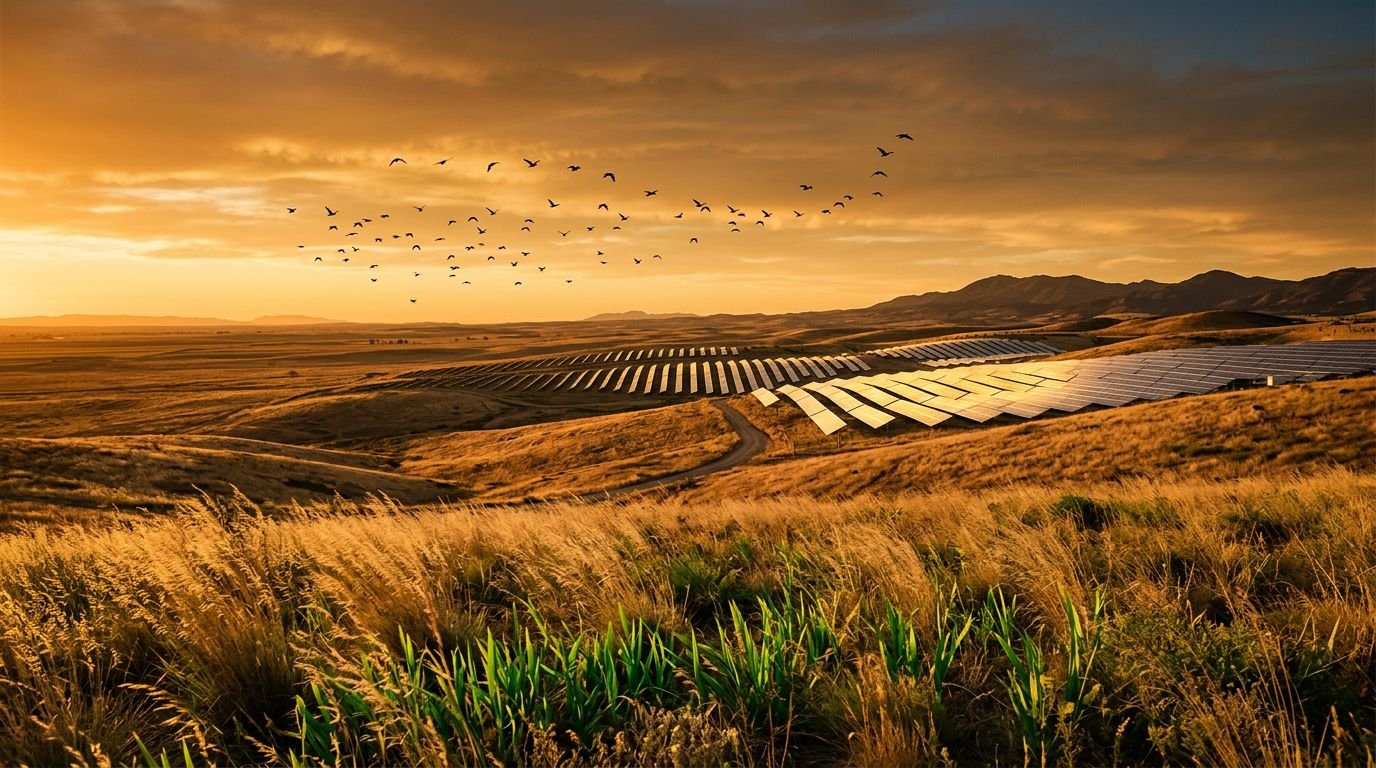
Across India, utility-scale solar projects are moving into dry plains, commons, and bird habitats because these places look unused on paper. While these developments are a key part of climate change mitigation, we must evaluate them carefully. The real test is not simply whether solar is green, but where renewable energy production takes place and what it costs the environment.
That is where the India solar parks biodiversity debate gets real.
Key Takeaways
- Large solar parks are vital for renewable energy production, but they can wipe out fragile grassland habitats when placed on ecologically rich open land.
- India’s grasslands are often mislabeled as spare or low-value land, even though they support diverse bird populations, essential pollinators, pastoral livelihoods, and vital soil health.
- The biggest risks extend beyond the panels themselves to include fencing, roads, power lines, glare, vegetation change, and habitat fragmentation.
- Better siting options exist, such as rooftops, brownfields, industrial land, and other already disturbed surfaces, which can expand solar capacity with far less ecological damage.
- Systemic change matters more than green spectacle; climate change mitigation policy must account for habitat loss, community impact, and long-term land use rather than focusing solely on megawatt targets.
Grasslands look empty only if you ignore life
A forest announces itself. A grassland whispers.
That whisper has cost India dearly. Dry grasslands, scrublands, savannas, and open plains have spent years being treated as wasteland in planning files. Once that label sticks, the land starts looking available for almost anything, such as mining, roads, industry, and now utility-scale solar.
But these places are not empty. They are functional, working ecosystems that provide vital ecosystem services.
They hold nesting grounds, insect abundance, grazing routes, seed banks, reptiles, small mammals, and native vegetation that ground-dwelling bird populations rely on to survive. These species require open sightlines to thrive, and the landscape often serves as a critical pollinator habitat that supports broader agricultural health. In many regions, they also support pastoral communities whose livelihoods depend on access to shared land. What looks sparse from a satellite image can be full of motion at ground level.
That matters because grassland species are not built for disruption in the same way some urban species are. A bustard does not adapt to fencing like a pigeon. A lark does not negotiate with transmission lines. Once open habitat is chopped into blocks, the damage to soil health and biodiversity is often quiet at first, then permanent.
The public conversation around renewable energy often misses this. We talk about land banks and capacity as if land were a spreadsheet cell. It is not. Land has memory. It has species, seasonal patterns, and human dependence layered into it.
This is why the conflict is not solar versus wildlife in some abstract sense. In India, the clash between solar parks and biodiversity is a land use problem. Put clean energy on the wrong ground, and you create a new ecological debt while paying down a carbon one.
The right question is not whether a solar park makes clean electricity. The right question is whether it does that without erasing a living grassland.
Kachchh is a warning, not an exception
You can see the problem clearly in Kachchh, Gujarat.
A recent report on the proposed Kachchh solar project described a 900 MW NTPC project spread across about 4,500 acres in 11 villages under the Fulay group gram panchayat in Nakhatrana taluka. While this scale of renewable energy production is significant, the land is classified as revenue land outside the notified Ramsar boundary. On the ground, it sits beside Chhari Dhandh, which is one of western India’s most important wetland and grassland landscapes for migratory bird populations on the Central Asian Flyway.
That distinction matters. Legal boundaries do not stop ecological processes. Birds do not read notification maps.
In this landscape, solar panels can become a collision risk because their reflective surfaces resemble water from above. For migratory birds arriving tired and low, that visual confusion can turn fatal. A climate solution starts looking a lot less clean when it tricks birds into crashing.
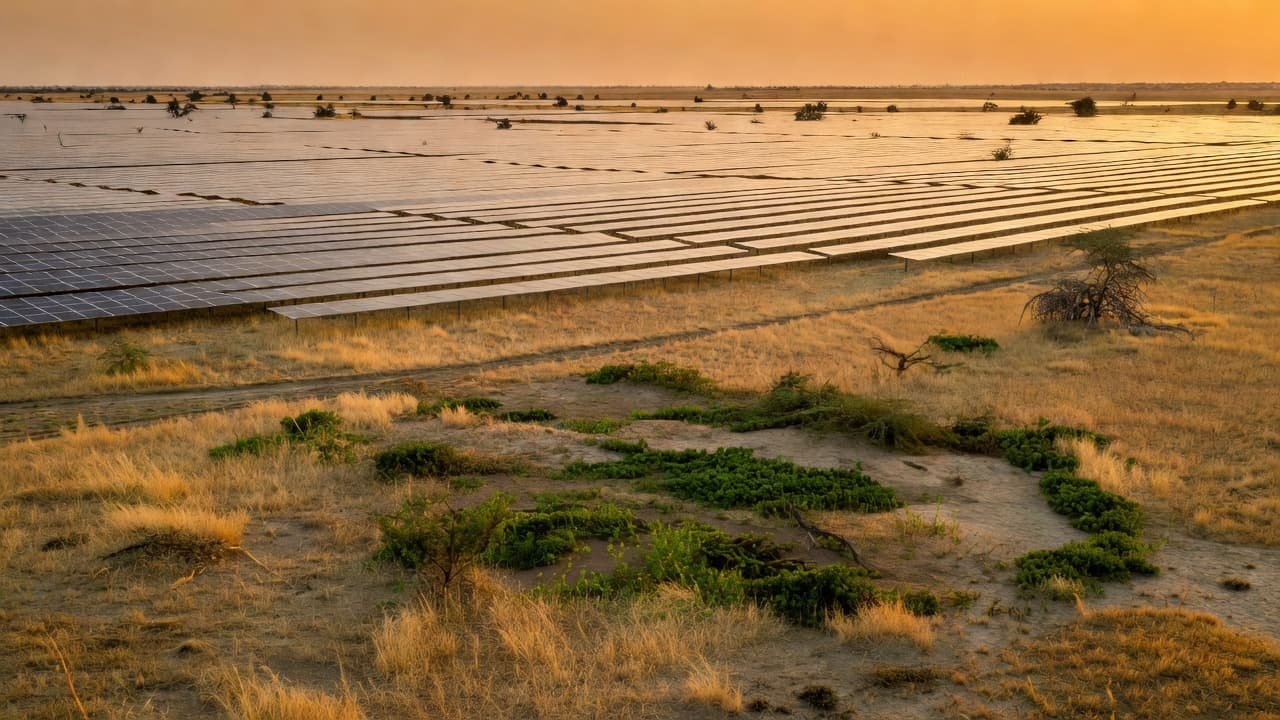
When solar infrastructure spreads across open habitat, the conflict is not visual alone. It reshapes the entire ecology of the site through constant vegetation management and human presence.
The Great Indian Bustard makes the stakes even sharper. As one of our most threatened species, it has already disappeared from most of its former range. In Rajasthan and Gujarat, renewable infrastructure has become part of that story, especially regarding overhead lines. Bustards are large, heavy fliers with limited frontal vision, which leaves them exposed to collision risk.
The Supreme Court has already pushed for stronger safeguards in priority bustard habitat, including major limits on new infrastructure and undergrounding in sensitive areas. That did not happen for symbolic reasons. It happened because bird deaths from power infrastructure are a known, repeated harm. We should be considering habitat restoration in these areas instead of further industrial development.
This is what accountability looks like. Not a ribbon-cutting photo. Not a megawatt headline. A hard question about whether the same project would be approved if the ecological losses were counted honestly.
The damage doesn’t stop at the panel edge
A solar park is never only panels.
It is fencing, access roads, trenching, security patrols, substations, cleaning needs, transmission lines, lighting, and long-term vegetation management. Each piece may look manageable in isolation, but together, they alter the landscape.
Fragmentation is one of the first impacts. Open-habitat birds and mammals need connected space. Once a grassland gets carved into industrial blocks, movement patterns change. Nesting habits shift, and predator-prey dynamics are disrupted. Even traditional grazing routes are blocked, which affects both wildlife and local herders.
Then comes the edge effect. Fenced boundaries and maintenance corridors create harsher micro-conditions. Soil health deteriorates under the pressure of construction activity, and water runoff patterns are often altered. While native vegetation may thin out as tougher, invasive species move in, these edges also frequently see a decline in insect abundance. Research from a review of solar PV biodiversity impacts points to a consistent pattern where solar infrastructure built on high-value habitat often harms ecosystems, whereas projects on degraded land can perform much better.
Sensory issues extend beyond glare. Light polarization from panel surfaces can alter animal behavior, though emerging fields like ecovoltaics offer potential solutions to mitigate these sensory disturbances. New roads bring vehicle movement into once quiet areas, and transmission corridors extend the physical footprint far beyond the fenced boundary.
There is also a social layer that is frequently overlooked. In Rajasthan and Gujarat, open landscapes often include common areas, pasture, and culturally significant sites. When these areas are converted, the loss is not only ecological but also deeply local. A family may lose grazing access, or a village may lose a shared landscape that serves as essential pollinator habitat and a foundation for daily stability.
This is why the ecological impact of a solar park should be measured across the whole system, rather than just inside the lease boundary. Current land management practices often treat these sites as isolated plots, but a more responsible approach would integrate agrivoltaics as a community-friendly alternative. By shifting toward nature-inclusive solar and prioritizing biodiversity net gain, developers can ensure that a cleaner grid does not come at the expense of our most vulnerable ecosystems. Moving forward, a better solar farm design must account for these complex interactions, ensuring that the move toward renewable energy does not sacrifice the very land it seeks to protect.
Why policy keeps choosing the wrong land
Part of the answer is blunt. Open land is politically easy to take.
Rooftops require coordination. Brownfields need cleanup. Canal-top solar needs engineering. Distribution reform takes time. Community consultation slows deals down. A giant park on available land looks simpler for large-scale renewable energy production.
It is also more photogenic. A government can inaugurate a mega-project in one afternoon. The harder work, such as feeder upgrades, rooftop incentives, storage, ecological surveys, and land-rights clarity, takes years and makes weaker pictures.
That bias toward visible assets should sound familiar. We often reward spectacle before outcomes. The same mistake shows up in air pollution policy, waste policy, and urban planning. A single impressive object gets more attention than patient repair of the system around it.
This is where systemic change matters. While climate change mitigation is a vital goal, policy cannot treat biodiversity loss as a rounding error attached to clean power. It has to ask where the energy goes, where the land comes from, who loses access, and what species pay the price.
The business logic needs work too. Right now, many developers are pushed toward the cheapest large parcel, not the least harmful parcel. That is not a law of nature. It is an incentive design problem. Better tariffs, land-use screening, storage integration, and rooftop aggregation could shift project economics. Sustainable business models for energy should reward low-conflict siting and ecological sustainability, not land conversion dressed up as progress. Internationally, frameworks like the Nature Restoration Law offer a template for how we might better integrate conservation into infrastructure development, yet local policies still lag behind.
For readers who care about climate and feel torn here, the answer is not anti-solar politics. Coal still kills. Oil still cooks the planet. We need solar fast.
We also need it smart. Speed without ecological discipline is not climate leadership. It is lazy planning with green branding.
Where solar belongs, and where it doesn’t
The good news is that this is not a choice between blackout and bustard.
Solar can coexist with nature when we stop treating all land as interchangeable. A growing body of evidence shows that nature-inclusive solar projects, when sited on degraded or already altered land, can support wildlife better than many people assume. The RSPB’s reporting on nature-friendly solar farms shows bird and biodiversity gains where sites are designed for habitat, not stripped of it. Similarly, a study on rewetted peatlands with solar parks found bird diversity benefits in restored, carefully managed landscapes. When we apply the principles of ecovoltaics, we prioritize projects that create biodiversity net gain rather than simple land clearing.
That nuance matters. These are not arguments for occupying intact Indian grasslands. They are arguments for siting solar on the right land and managing it well. Proper solar farm design should prioritize the restoration of local ecosystems, perhaps through the introduction of wildflower meadows or managed pollinator habitat beneath the panels.
This simple comparison makes the hierarchy clearer:
| Site type | Climate value | Biodiversity risk | Better use case |
|---|---|---|---|
| Intact grasslands and commons | High power output possible | High risk to habitat and species | Usually avoid |
| Factory roofs and warehouses | Strong, close to demand | Low new habitat loss | Strong priority |
| Brownfields and mined land | Useful re-use of disturbed land | Moderate, often manageable | Strong priority |
| Canal-top or parking-lot solar | Saves open land | Lower land conflict | Good where practical |
| Agrivoltaics or pollinator habitat | High dual utility | Potential for habitat support | Best for landscape health |
The pattern is simple. Build first where the land is already disturbed, sealed, or industrial.
This is also where a circular economy lens helps. A good solar transition is not only about generation. It is about materials, end-of-life panels, grid efficiency, and land hierarchy. The cleanest kilowatt is not one that quietly creates fresh ecological damage two districts away. Nature-inclusive solar represents a shift toward more responsible infrastructure.
Even readers drawn to plant-based living or everyday mindfulness should care about this. Those values ask us to notice hidden harm, not only visible virtue. Energy deserves the same honesty we already apply to food, fashion, and waste.
What communities should ask before a solar park gets approved
Most people are told this debate is too technical for public scrutiny. It isn’t.
You do not need an engineering degree to ask better questions. You need climate literacy, local memory, and the confidence to refuse bad framing. Using frameworks similar to the Nature Restoration Law as a benchmark can help communities demand better environmental accountability.
A few questions cut through the fog fast:
- Is the site an intact grassland, grazing common, scrubland, wetland edge, or corridor for threatened species, even if official records label it as revenue land?
- What will the full footprint include beyond panels, such as roads, fencing, substations, transmission lines, security lights, and water use?
- Has the biodiversity survey covered bird populations, insect life, essential pollinator habitat, and seasonal use, or is it limited to a narrow compliance checklist?
- Were rooftop, industrial, brownfield, or agrivoltaics options seriously compared, or were they skipped because they were less convenient?
- Who loses access if this land changes use, whether they are pastoralists, farmers, local wildlife, or nearby villages?
Those questions matter in cities too. If you care about urban biodiversity, you should care about how we value overlooked habitat everywhere. The same planning habit that dismisses a grassland as empty often dismisses wetlands, scrub edges, and roadside ecology later.
Public pressure can change this. Developers respond to delay risk. Regulators respond to scrutiny. Investors respond when ecological controversy becomes a reputational risk. Communities should insist on nature-inclusive solar, ensuring that project designs actively support rather than displace local ecology. That is why community attention is not a side note. It is part of the approval process, whether officials admit it or not.
And if the project claims climate virtue while refusing habitat transparency, trust the signal. Good projects do not hide their land logic.
Frequently Asked Questions
Are utility-scale solar parks the only way to meet India’s renewable energy targets?
No, large-scale parks are only one piece of the puzzle. India has immense potential to expand solar capacity through distributed options like rooftop solar, brownfield redevelopment, and industrial sites, which avoid the high ecological costs of carving up natural grasslands.
Why are solar panels considered a risk to bird populations?
Large arrays can confuse migratory birds, who may mistake reflective glass surfaces for water bodies, leading to fatal collisions. Additionally, the proliferation of overhead transmission lines poses a significant threat to large, heavy-flying species like the Great Indian Bustard that struggle to navigate around new infrastructure.
What does ‘nature-inclusive’ solar mean in practice?
Nature-inclusive solar shifts the focus from simply generating power to maintaining ecosystem health through thoughtful design. This includes using agrivoltaics to allow grazing or farming underneath panels, preserving wildlife corridors, and prioritizing sites where habitat restoration can occur alongside energy production.
How can local communities influence the approval of a solar project?
Communities can demand transparency by questioning the site selection process and asking for comprehensive biodiversity surveys that look beyond narrow compliance checklists. When residents voice concerns about the loss of grazing rights or the disruption of local wildlife, they force developers and regulators to address the real-world costs of land use.
A cleaner grid should not mean emptier grasslands
India needs more solar. That part is settled. What is not settled is whether we build it with care, or by sacrificing ecosystems that were already politically easy to ignore.
The hard truth is simple. A solar park can cut carbon and still damage life. If we want honest climate progress, we have to stop treating grasslands as blank space and start embracing nature-inclusive solar that prioritizes habitat restoration. This means shifting our focus toward designs that protect vital pollinator habitat and allow for the return of native vegetation, ensuring land use is a core component of the project rather than a footnote.
If you want climate action tied to real habitat care, community impact, and on-the-ground accountability, Explore Our Active Missions. Clean energy matters. So does the living world we are supposed to protect with it.