5 Steps to Lower Your Ecological Footprint and Beat Eco-Anxiety
 Saket Sambhav
Eco-anxiety is not a "mental health fluke." It is a rational, biological response to an accounting failure. When you look at the world and see a "repeating wallpaper" of corporate empty promises and symbolic gestures, your brain correctly identifies a systemic risk. We are living on ecological credit, and the bill is coming due.
Most advice on lowering your ecological footprint feels like rearranging deck chairs on a sinking ship. You are told to use a paper straw while the "farm's skin": our precious topsoil: is being stripped away to make bricks. You are told to "spread awareness" while 80% of your donations to traditional charities evaporate into administrative "leakage" before they ever touch the soil.
If you want to beat eco-anxiety, you must stop being a passive observer of the collapse. You must move from ceremony to accountability. At The Better Human™ Life Foundation, we don't believe in "green theater." We believe in direct action and 100% transparency.
Here are five steps to actually lowering your footprint and reclaiming your agency.
1. Move from Passive Awareness to Climate Literacy
Environmental awareness is the "ceremony" of the climate movement. It’s easy to post a black square or a leaf emoji. It is much harder to understand the climate change action required to fix a broken coastal drain or the hypersalinity of a dying mangrove swamp.
Eco-anxiety thrives in the fog of the unknown. When you don't understand the underlying mechanics of how our world is breaking, everything looks like a catastrophe. To beat this, you must become "literate" in the systems that sustain us.
Instead of reading headlines, look at the source of the damage. For instance, do you know where the materials for your "green" home come from? Often, they are born from the liquidation of agricultural land. You can read our deep dive on how brick kilns in India are devouring topsoil to understand why the "object" (the brick) is less important than the "source" (the soil).
The Clincher: Awareness is a feeling; literacy is a weapon. Choose the weapon.
2. Plug the "Admin Leakage" in Your Giving
Your ecological footprint is also a financial footprint. When you donate to traditional large-scale NGOs, you are often funding a "debt cycle" of marketing and executive salaries. This is "green theater" at its finest: a high-gloss performance that does little to heal the earth's broken hydrology.
To lower your footprint, ensure your capital has a 1:1 impact. We founded The Better Human™ Life Foundation on a simple, blunt logic: 100% of your funds go to the field. Our founders cover all operational costs. We use a Live Mission Tracker to provide geo-tagged, numbered data for every act of contribution.

| Feature | Traditional Charity | The Better Human™ Life Foundation |
|---|---|---|
| Fund Transparency | Opaque (Admin fees up to 80%) | 100% Direct-to-Field |
| Verification | Annual Reports (High-level) | Live Mission Tracker (Geo-tagged) |
| Focus | Long-term "Awareness" | Urgent, Time-Sensitive Action |
| Accountability | Symbolic Gestures | Verifiable Impact Data |
The Warning Flare: If you cannot track your dollar to a specific coordinate on a map, you aren't fighting climate change: you're funding a marketing budget.
3. Prioritize Direct-Action Restoration
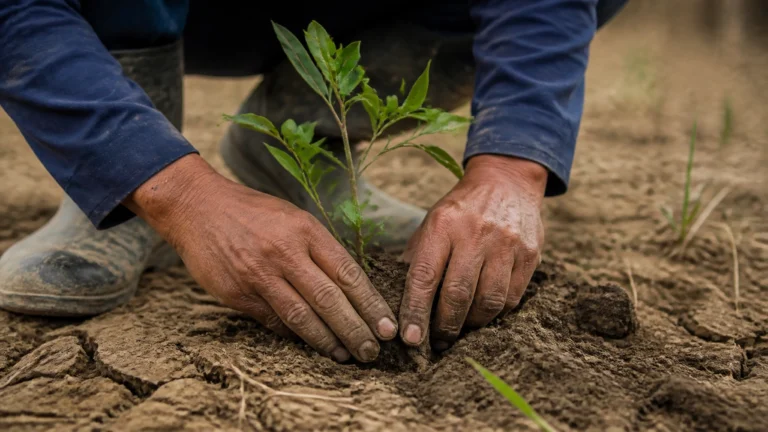
The most effective way to lower your footprint is to participate in the restoration of biodiversity. This isn't about "symbolic" tree planting in a park that will be cemented over in two years. It's about planting propagules in the mud where they are needed most.
Take our work in the Sundarbans. We don't just "plant trees"; we work with grassroots activists to restore the "coastal skin" of India. Mangroves are one of the most efficient carbon sinks on the planet, yet they are being lost to land liquidation and industrial sprawl.

When you support a mangrove planting mission, you are engaging in a problem of logic. You are replacing a "debt" with a "biological asset." Seeing the literal fruit of your labor: geo-tagged and verified: is the ultimate antidote to the feeling of helplessness.
The Clincher: The earth doesn't need your "hopes and prayers"; it needs your hands in the dirt or your capital in the field.
4. Challenge the Logic of Waste
Eco-anxiety is often fueled by the "wallpaper" of waste we see every day: from PFAS in our water to the massive waste generated by solar panels.
Lowering your footprint requires you to look beyond the immediate "object" and see the "source."
- Stop buying into "fast-solutions" that create long-term waste.
- Question the "green" labels that hide the bulk density of the resources used to create them.
- Audit your life for "ceremonial" consumption: things you buy to feel ecological but which actually contribute to the debt cycle.
If you want to make a real difference, support projects that solve the "logic problems" of waste. This includes our initiatives in RO water wastage reduction and urban heat island mitigation.
The Warning Flare: A "sustainable" product that ends up in a landfill in three years is just a slower form of destruction.
5. Radical Accountability as Mental Health
The final step to beating eco-anxiety is to turn your anxiety into leadership. Silence and inaction are the breeding grounds for despair. At the Foundation, we actively engage the youth through our Climate Literacy Platforms and competitions.
Our "WriteToWin" initiative is designed to turn environmental anxiety into advocacy. We don't want you to be a "victim" of climate change; we want you to be an accountable leader who can identify "red flags" in environmental impact assessments.

By participating in active missions, you join a community of "Truth-Tellers" who refuse to look away from the blunt reality of our ecological debt. When you act, the anxiety loses its power because it is replaced by the weight of responsibility and the satisfaction of verified impact.
The Clincher: Action is the only cure for a mind that is awake to the truth of the world.
Summary of Action
To truly lower your ecological footprint and find peace of mind, you must move from the "ceremony" of caring to the "accountability" of doing.
- Audit your sources of information (seek technical literacy over emotional headlines).
- Direct your funds where they are 100% verified (no admin leakage).
- Join a mission that has a specific, geo-tagged impact.
- Speak the blunt truths that others are too afraid to voice.
The planet is not a "background" for our lives; it is the skin and bone of our existence. It's time we started treating it like the vital organ it is.
Ready to take the first step toward real impact? Explore our active missions and see where you can make a difference today.