
Informal E-Waste Recycling in India Is Toxic Work
 TBH Editorial
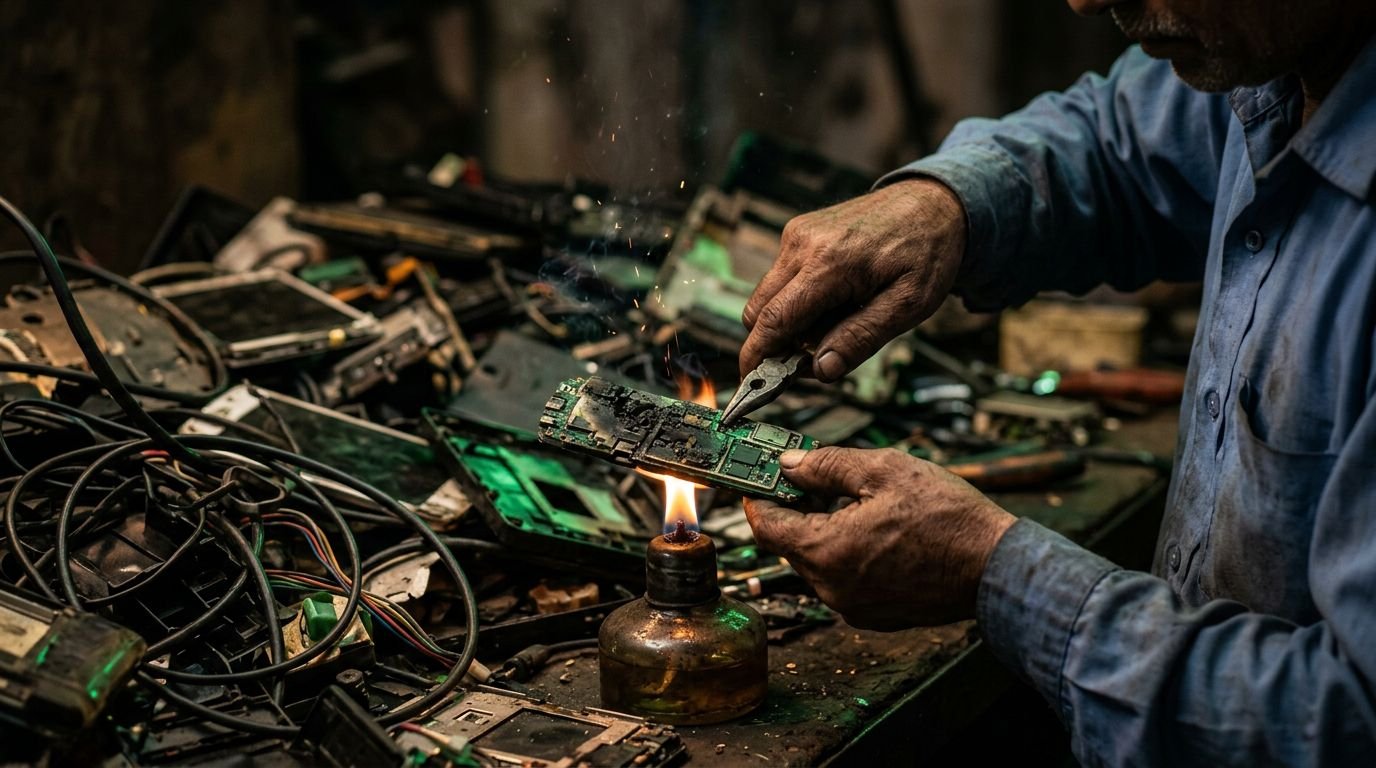
A broken phone looks harmless until someone heats its circuit board over an open flame.
India’s informal e-waste recycling system presents a hidden danger that begins the moment we discard our devices. These piles of electronic waste do not simply disappear when you replace a charger, earbuds, laptop, or battery. Too often, they move into a recycling process where workers recover valuable metals with bare hands, crude tools, acid, fire, and almost no protection.
The real cost is not hidden in a landfill. It sits in the lungs, skin, homes, drains, and school routes around the places where our gadgets are taken apart. Addressing the health risks and environmental damage caused by this informal sector remains a critical challenge for India and across the Global South.
Key Takeaways
- Informal e-waste recycling India practices recover useful materials, but workers often face exposure to lead, mercury, cadmium, toxic fumes, and battery fire risks.
- Open burning, acid stripping, and hand breaking of electronics release pollutants into the air, soil, drains, and nearby homes.
- The burden falls hardest on workers, waste pickers, kawadiwalas, and those in the informal sector living near dismantling and scrap markets.
- India’s e-waste rules put responsibility on brands, but enforcement and safe collection still fail many workers.
- A real circular economy must protect people doing recovery work, not only celebrate higher recycling numbers.
Why India’s informal recycling system keeps growing
India produces a massive and rising flow of electronic waste. Phones, televisions, laptops, chargers, wires, printers, appliances, and lithium-ion batteries all reach the end of their useful lives eventually. Yet, the country’s formal recycling capacity has not always matched the speed at which these products enter homes and offices.
That gap has created a vital source of income for thousands of people.
In informal markets such as Seelampur in Delhi, old devices are bought, sorted, repaired, stripped, resold, and dismantled piece by piece. This labor-intensive process supports countless families. It also keeps usable parts in circulation, preventing them from hitting landfills while brands and consumers continue to prioritize new purchases.
We need to say this plainly. Informal workers are not the problem. They are performing essential labor that the formal e-waste management system has long depended on, yet the industry consistently fails to provide them with adequate support or safety protocols.
The problem lies in the unsafe economics surrounding this work.
The primary incentive for the informal sector is the recovery of precious metals, such as gold, copper, and silver, hidden within circuit boards and wiring. A recycler who earns more by extracting these materials quickly than by safely storing a damaged battery has little room to choose the safer route. A small workshop cannot afford ventilation, protective gear, licensed transport, fire safety systems, or compliant disposal if it is being paid scrap-level prices for hazardous material.
Then there is the collection problem. Many households still sell their old electronics to a kawadiwala, the neighborhood scrap dealer who provides an easy, immediate, and cash-based transaction. By contrast, a facility for formal recycling may be far away, poorly advertised, or unable to collect low-value items.
The material naturally moves toward whoever can process it the fastest.
Recycling is not automatically safe because something gets recovered. The method matters, and so do the people standing next to it.
A circular economy that relies on informal workers inhaling toxic smoke is not circular in any meaningful moral sense. It is a one-way transfer of risk, moving the burden from consumers and brands to the people with the least protection.
The toxic metals inside everyday consumer electronics
Your old phone is small, but it is not chemically simple. Circuit boards, screens, cables, solder, batteries, and plastic casings contain a mix of useful and hazardous waste.
Recovering precious metals like copper, gold, silver, aluminium, and palladium drives the dismantling and processing phase of this industry. However, the same electronic waste also contains dangerous materials, including lead, mercury, cadmium, chromium compounds, brominated flame retardants, and battery metals such as cobalt, nickel, manganese, and lithium.
None of this means every device exposes a worker in the same way. Risk depends on the product, its condition, and how it is handled. Health and safety standards are effectively non-existent in these informal settings, creating a toxic environment where danger rises when items are crushed, burnt, melted, soaked in acid, or broken apart without dust control.
Here is what unsafe recovery can release:
| Material or process | Common source | Main danger |
|---|---|---|
| Lead-containing solder and components | Circuit boards, older electronics | Dust exposure can harm the nervous system |
| Mercury | Some lamps, switches, older displays | Vapour exposure can damage the nervous system |
| Cadmium | Batteries, semiconductors, coatings | Can affect kidneys and bones |
| Brominated flame retardants | Plastic casings and cables | Burning can create toxic fumes |
| Acid stripping | Gold-plated contacts and boards | Burns workers and contaminates drains |
| Lithium-ion batteries | Phones, laptops, power banks | Fire, explosion, and toxic smoke risks |
The most visible danger is often fire. Swollen batteries, punctured battery packs, and mixed piles of damaged cells can ignite fast. Water is not always the right response for a lithium-ion battery fire, and workers in cramped scrap lanes may have no training, extinguishing equipment, or safe exit.
The slower danger is dust.
When circuit boards are snapped, sanded, smashed, or heated, microscopic particles settle on hands, hair, clothes, food, and nearby floors. A worker may not see the dust entering their body, but that does not make it harmless.
Lead exposure is especially troubling because it can affect brain development in children. Mercury can become a vapour that spreads indoors. Acid waste can move into drains after one quick wash-down. What begins as a small pile of devices can become contamination far beyond the worktable.
What unsafe dismantling looks like on the ground
The sanitized version of recycling is easy to sell. In this ideal scenario, automated machinery separates parts, valuable materials return to manufacturing, and nothing is wasted.
Reality, however, looks very different.
The dismantling and processing of electronic waste often begins with a worker salvaging reusable components. A screen that still functions might be sold, or a motor may find another life in a different machine. Cables get stripped for copper wire, and circuit boards are sorted by their perceived value, often through skills refined over years of manual labor.
Then, the hazardous part begins.
Plastic-coated wires are frequently burned in open air to expose the metal. Circuit boards may be heated over makeshift stoves to loosen chips or solder, and crude acid baths are used to separate precious metals from plated components. Often, much of the remaining plastic, foam, and mixed waste is discarded because there is little financial incentive to process it safely.
These are not rare shortcuts created by careless individuals. They are the predictable results of a global supply chain that prioritizes recovered metal while failing to pay for safe handling. Many of these materials originated in the Global North before being shipped to India, where informal workers struggle to manage the toxic burden. Large recycling hubs, such as Seelampur, exemplify how these processes often operate in plain sight yet remain hidden from the broader public view.
A device can pass through many hands before its materials are recovered:
- A household sells the item with other scrap.
- A collector sorts it for resale or dismantling.
- A trader moves valuable parts to a specialist.
- An informal worker in a small workshop extracts metals or strips components.
- Low-value residue is dumped, burned, or sent to a landfill.
At each stage, the people handling the material may know the technical aspects of the work well, but they lack essential health and safety protections, such as properly fitting gloves, local exhaust ventilation, goggles, clean water, or medical checks.
The health impact is also difficult to quantify. Because these individuals are rarely part of formal workplace exposure monitoring, their experiences remain largely invisible. Many are self-employed, temporary, migrant, or paid by the kilogram. If coughing, chronic headaches, skin burns, or breathing trouble become their daily reality, these symptoms are seldom recorded as occupational illnesses.
That invisibility protects the system, not the worker.
It also distorts public debate. Consumers might see a high recycling rate, a collection target, or a shiny corporate sustainability report, but they do not see the person leaning over a smoking bundle of wires behind a market lane.
Toxic exposure does not stop at the scrapyard gate
Pollution has no respect for property lines.
Smoke from burnt cables and toxic dust settle into nearby homes, creating a pervasive form of environmental pollution. This residue lands on food stalls, roof tanks, laundry, roadside fruit, and children’s hands. Acid residues reach drains, eventually contaminating soil and water. In the Global South, informal recycling areas are often dense, interconnected spaces where work, housing, shops, and schools sit side by side. Unlike the more visible piles of textile waste that might clutter a landfill, the microscopic dangers of e-waste are often ignored until the health impacts become impossible to hide.
A family may never earn money from e-waste, yet they still breathe its toxic fallout every day.
Children face a different level of risk because they spend more time close to the ground and often put their hands near their mouths. They may live above or beside a dismantling room or walk through scrap lanes on the way to school. For them, exposure is not just a workplace issue; it is a fundamental violation of environmental justice, as they have a right to a clean and safe neighborhood.
The ecological impact spreads as well. Toxic residues enter small urban green spaces, vacant plots, drains, and ponds. Soil organisms and insects suffer long before anyone starts counting visible damage. Birds forage in waste-heavy areas, and stray animals eat around open piles. Urban biodiversity shrinks when contaminated land becomes normal city infrastructure.
This is where everyday mindfulness has a place, but only a small one. Keep old electronics out of household bins. Do not hand swollen batteries to an unprepared scrap collector. Store damaged devices away from heat and flammable materials until they can reach a safe channel.
Still, personal care cannot solve a broken collection system.
You cannot shop your way out of a city where formal return points are scarce, brands hide behind fine print, and unsafe recycling remains the most convenient option. Implementing effective sustainable waste management is the only way to protect these communities. Individual choices matter most when systems make the safer choice easy for everyone.
Why repair must come before recycling
The greenest phone is not always the newest phone with a trade-in offer. Often, it is the one you keep using because its battery, screen, port, or cable can be repaired.
That sounds obvious, yet most consumer electronics are designed around quick replacement. Batteries are glued in, screws are hidden, parts are unavailable, and repair manuals are withheld. A minor fault can turn a working device into scrap because the repair costs too much or feels impossible.
This is where brands need to face their own responsibility.
A product designed for repair stays out of the hazardous waste stream longer. It also gives independent technicians a safer, more legitimate role in the economy. While repair does not remove the need for recycling, it significantly reduces how quickly e-waste piles up and delays the dangerous dismantling and processing of devices that are otherwise still functional.
Better product design for consumer electronics includes:
- Replaceable batteries, ports, cables, screens, and other common wear parts.
- Standard screws instead of sealed cases and brittle clips.
- Clear repair manuals and spare-part pricing.
- Take-back systems that accept damaged products, not only premium trade-ins.
- Packaging and instructions that explain safe battery handling.
Repairability also supports more honest circular economy business models. A brand can sell spare parts, refurbish returned devices, offer repair credits, and recover its own products through traceable channels. By prioritizing repair, companies avoid the crude methods often used to salvage materials like copper wire from discarded hardware. This approach requires more effort than launching another disposable accessory, but it prevents waste before someone has to burn or dissolve it in an informal setting.
Consumers often hear that formal recycling is the responsible final step. The better order is simpler: use less, maintain what you own, repair what fails, reuse what still works, then recycle through a safe route.
Even plant-based living, while important for reducing pressure on land and livestock systems, cannot become a substitute for looking at the electronics on our desks. Sustainability cannot be a menu choice alone. It has to include the materials, workers, and waste hidden behind our daily convenience.
India’s e-waste rules need enforcement that reaches workers
India’s E-Waste Management Rules 2022 put Extended Producer Responsibility, or EPR, at the centre of the system. Under these e-waste rules 2022, brands that place covered electronics on the market must take responsibility for managing what happens after those products are discarded.
That is the right direction for sustainable waste management.
A company should not profit from selling a device, then act surprised when the same device becomes hazardous waste. Producers can work with registered recyclers and Producer Responsibility Organisations, but they cannot outsource their moral or legal responsibility. The core weakness remains the gap between government regulations and the physical reality on the ground.
EPR targets can create a market for certificates rather than safe collection. A brand may show compliance with e-waste rules 2022 on a dashboard while its discarded products still move through informal channels. Meanwhile, informal workers who have collected and repaired devices for years may be locked out of formal systems because registration, finance, land rules, and equipment costs are too high.
Formalisation cannot mean pushing people out of work.
It should mean giving informal workers a safer place in the circular economy. That includes training to identify batteries, fair prices for properly sorted material, collection partnerships, protective equipment, and fire-safe storage. To truly improve our e-waste management, we must create accessible recycling hubs that provide health checks and clear routes for dangerous fractions to reach licensed facilities.
Municipal bodies also need better local collection. A box in a mall is not enough. People need reliable ward-level drop-offs, scheduled pickup options, and public information in local languages. The system should support formal recycling for an older television, a cracked power bank, or a bag of cables, not only for high-value smartphones.
Systemic change looks less glamorous than a marketing campaign. It requires a working chain of collection, transport, worker protection, material tracking, and consistent government regulations. Without all of these components, the toxic work of handling hazardous electronics stays hidden behind cleaner language.
What businesses and citizens can demand now
If you work for a company that buys electronics in bulk, procurement is a critical part of the solution for managing electronic waste. Ask where retired laptops, phones, routers, and batteries go once they leave your facility. Demand documentation from authorised recyclers to ensure your equipment does not end up in dangerous recycling hubs. Wipe data safely, but do not let data security become an excuse to hoard obsolete devices in cupboards for years.
Ask sharper questions of consumer brands as well. Do they publish a clear take-back route? Can you easily find a service centre? Are spare parts available to extend device lifespans? Will they safely accept a damaged lithium-ion battery? Most importantly, do they name their registered recycling partners and provide transparency regarding how they work with the informal sector?
The answers reveal whether a brand truly believes in sustainable waste management or only uses the language of the circular economy to improve their public image.
Public pressure matters because this form of pollution is easy to ignore. Its damage accumulates through thousands of small decisions, then lands hardest on people whose labour is treated as disposable. This reflects a deep imbalance in environmental justice, where the consequences of our digital consumption in the Global North are disproportionately exported to vulnerable communities in the Global South.
Climate literacy should include this kind of critical reading. We need to look beyond the recycling symbol and ask who handles the waste, under what conditions, and where the toxic residue goes.
For people who want climate action tied to real neighbourhood outcomes, Explore Our Active Missions connects concern with on-the-ground work for communities, environmental awareness, and urban biodiversity.
A better system does not demand that every person become a waste expert. It demands that companies, regulators, and cities stop treating worker safety as an optional extra.
Frequently Asked Questions
Why is informal e-waste recycling considered toxic?
Informal recycling often involves crude, hazardous methods like open burning, acid stripping, and manual dismantling without protective gear. These processes release lead, mercury, and toxic fumes into the immediate air, soil, and living spaces of the workers.
Can’t formal recycling centers handle all of India’s e-waste?
While India has established formal recycling facilities, their capacity currently fails to match the massive, rising volume of discarded electronics. Many households rely on informal scrap collectors because they are convenient and offer immediate, cash-based transactions that formal channels struggle to provide.
Are informal workers to blame for the environmental damage?
No, informal workers perform essential labor by keeping materials in circulation that would otherwise reach landfills. The core problem is an economic system that fails to provide these workers with safe infrastructure, training, or fair compensation for handling hazardous materials without causing harm.
What should I do with my old, damaged electronics?
Avoid putting devices in household trash and instead seek out verified take-back programs or authorized collection centers. If a device contains a damaged lithium-ion battery, store it away from flammable materials until it can be handed over to a professional service or safe disposal facility.
The cost of cheap recycling cannot stay hidden
India’s informal e-waste recycling industry is not a disposable link in a green supply chain. These workers are individuals performing difficult electronic waste recovery to extract precious metals under conditions that expose them and their families to hazardous fumes, fires, and contaminated dust.
When we address the informal sector, we must prioritize health and safety standards that protect workers from a toxic environment. We should value repair, demand accountable take-back systems, and refuse to support recycling stories that erase the worker from the narrative. A circular economy is only credible when the people closing the loop can breathe safely while doing it.