How Brick Kilns in India Strip Fertile Topsoil
 TBH Editorial
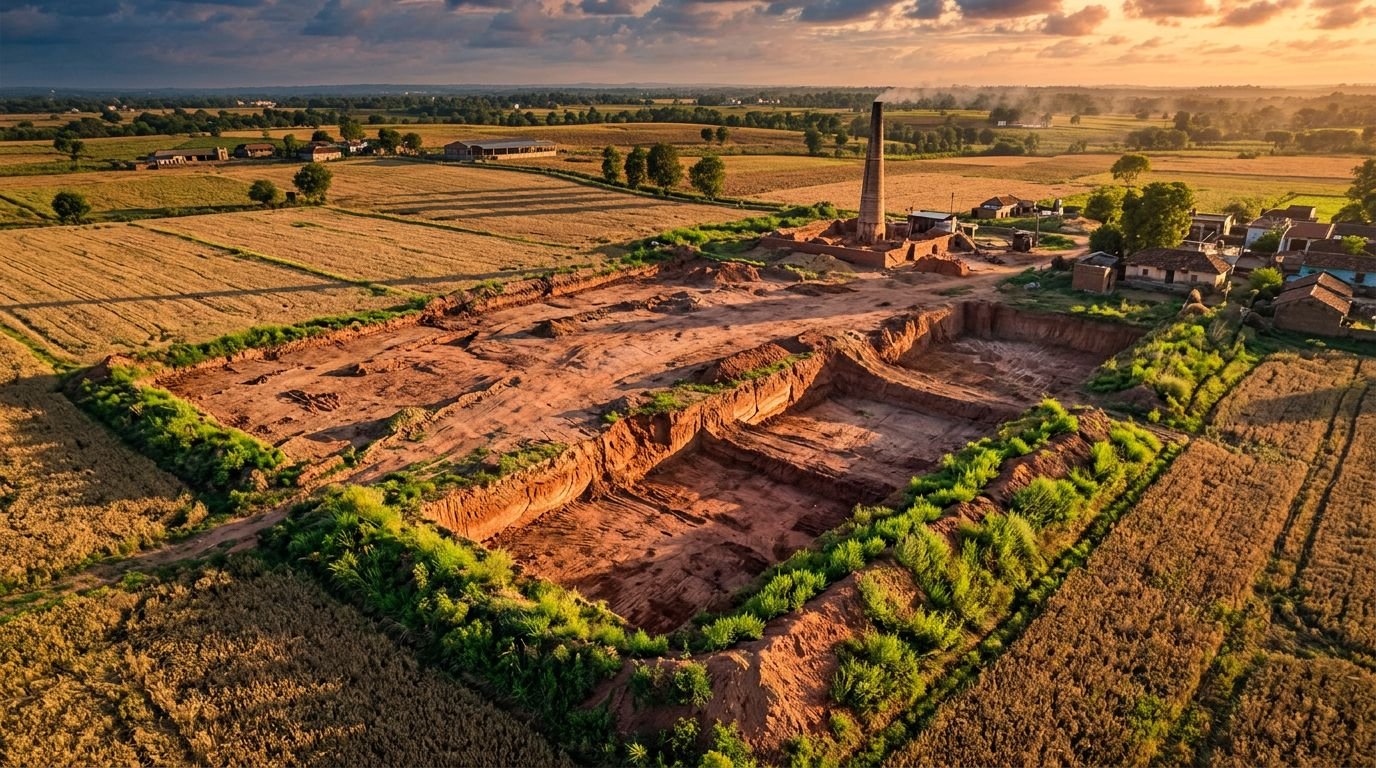
Across India, the production process for many brick kilns in India does not begin at the chimney. Instead, it begins in a local field.
That is the part most people in cities never see. A wall goes up, a road edge gets finished, or a warehouse expands, and somewhere a farmer has lost the thin living layer of soil that made crops possible.
If you care about the climate, food security, or fair business practices, this is not a side issue. It is the hidden accounting behind cheap bricks, and once you see it clearly, the whole industry looks different.
Key Takeaways
- Brick kilns in India often mine agricultural topsoil rather than waste clay, a practice that can permanently destroy a field’s fertility in a single round of extraction.
- The damage extends beyond digging. Kiln emissions release black carbon and metal contaminants that degrade nearby ecosystems, while the underlying supply chains frequently rely on forced labour to maintain low production costs.
- Farmers often sell their topsoil under intense financial pressure, as systemic debt, medical costs, and cash gaps leave them with few alternatives.
- While transitioning to cleaner kiln designs can reduce harmful emissions, these upgrades do not address the fundamental issue of topsoil depletion or the problematic labour practices embedded within the industry.
- Achieving systemic change requires enforcing stricter land-use policies, promoting the adoption of sustainable alternative building materials, and increasing transparency throughout construction supply chains to ensure builders and banks are held accountable.
The raw material is not just clay, it’s the farm’s skin
Topsoil looks ordinary until it’s gone. Then you realize it was doing almost everything.
That upper layer holds organic matter, microorganisms, moisture, and the crumbly structure roots need. It takes a long time to build and almost no time to destroy. In many kiln belts, the easiest clay to mold into bricks sits right under cultivated land, so the industry does not hunt for dead earth. It cuts into living farmland, where the physical process of brick production relies on stripping away the very surface layer that sustains our food systems.
Research tied to food insecurity and fired bricks links brick-making with soil degradation and falling food security. The mechanism is blunt. Soil is scraped or dug from clay-rich agricultural plots, often far deeper than what a field can recover from quickly. The real-time research summarized for this piece points to excavation around 1 meter deep in some places, with fertility losses reaching roughly three-quarters in a single operation.
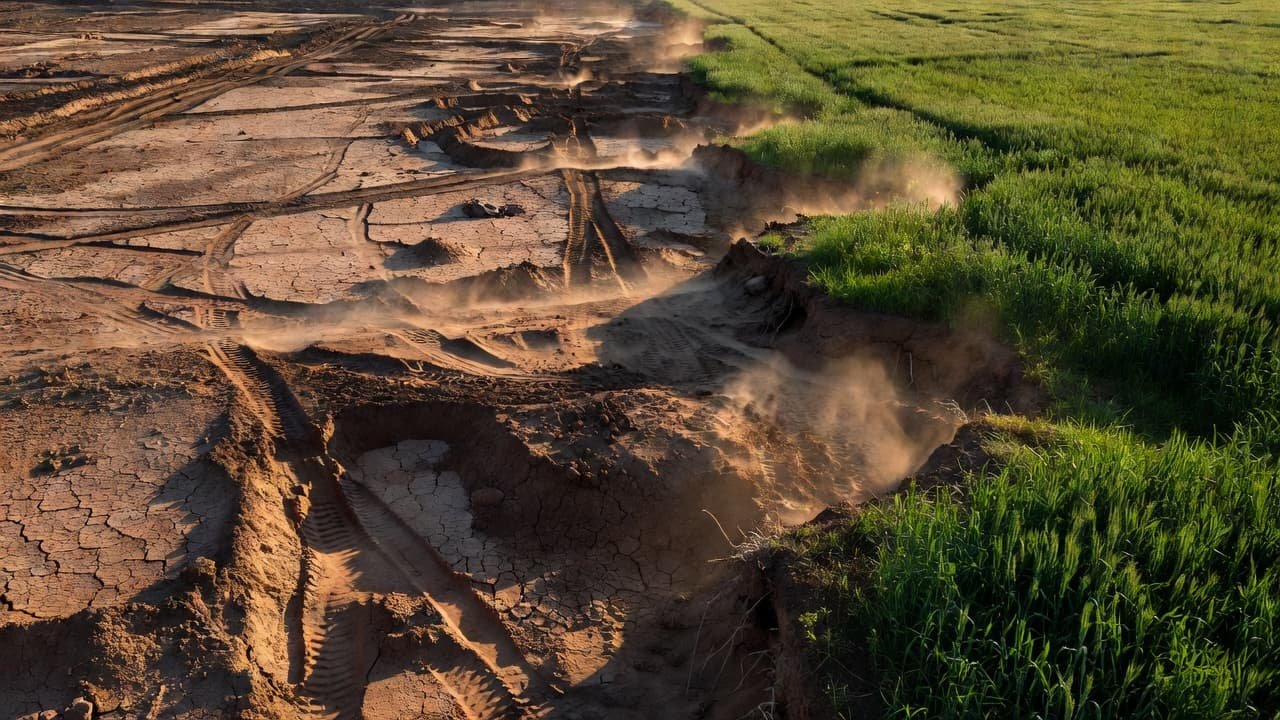
In places such as Perera Pur, reporting has shown how this becomes normal over time. One family sells soil in a crisis. Another does it to pay for a wedding, a loan, or a medical bill. Then the practice spreads, and an agricultural landscape slowly turns into a patchwork of cuts, pits, and weaker harvests.
A field can survive a bad season. It struggles to survive repeated soil mining.
We make a mistake when we call this a cheap building material story. It is a land liquidation story. The brick lasts for decades. The missing soil may not come back in any usable form within a farmer’s working life.
Once topsoil goes, the field stops behaving like a field
A healthy field works like a sponge. It holds water, lets roots move, feeds microbes, and softens the force of rain. Strip off the top layer, and that whole system changes.
What remains is usually denser subsoil with less organic carbon and poorer structure. Water runs off faster. The surface hardens. Roots struggle. Irrigation becomes less effective because the land no longer stores moisture well. Even when farmers add manure later, recovery is slow and incomplete.
A regional soil quality study regarding brick kilns India found the same pattern seen in kiln belts again and again, lower water-holding capacity, higher bulk density, and poorer soil chemistry close to kiln activity. In plain language, the land becomes less forgiving.
This quick view shows what changes when topsoil is removed or damaged by kiln activity:
| Soil change | What it means on the ground |
|---|---|
| Organic carbon drops | Weaker soil life and poorer fertility |
| Water-holding capacity falls | Faster drying and more irrigation stress |
| Bulk density rises | Harder soil and weaker root growth |
| Runoff increases | More erosion and less groundwater recharge |
That is why the loss does not end with one excavation season. The field often keeps paying.
A study associated with IIT-Mumbai researcher Vinish Kumar Kathuria in Tamil Nadu’s Thrivallur district found that land used for brick-related soil extraction took years to regain something like its earlier manure condition, and even then did not return to its former fertility. That is the sort of sentence that should stop policy rooms cold. Recovery is not a reset button.
The ecological impact widens with every monsoon. Once the surface is disturbed, rain carries loose particles away. Ponds silt up. Drainage changes. Farm edges weaken. What looked like a local cut turns into a broader land problem.
Smoke doesn’t stay in the chimney
Topsoil stripping is only the first wound, and the operation of brick kilns in India adds another.
The brick sector burns huge amounts of coal, around 25 million tons a year by some estimates, and the emissions load is toxic: carbon dioxide, black carbon, particulate matter, sulfur dioxide, nitrogen oxides, and carbon monoxide. A broader review on brick kiln emissions, land, water, and livelihoods pulls together the damage clearly. Kilns do not only consume soil. They also degrade the land that remains.
Ash settles on leaves and soil. Heat changes local soil conditions, and metal contamination can build up. The research summary behind this article flagged chromium, lead, zinc, mercury, copper, nickel, cadmium, and other residues linked to poor fuel burning and fly ash. Near kilns, organic matter tends to fall, soil pH can shift, and the ground holds less water. This pollution extends beyond crops; it compromises animal welfare, as working donkeys and livestock grazing near these sites inhale toxic particles and consume contaminated forage.
That matters for yields. Some reviews have linked heavy metal buildup near kiln zones with large crop losses, even in the range of 40 to 80 percent in affected settings. The exact number varies by place and exposure, but the direction is consistent. Dirty air becomes weaker soil, then weaker harvests.
The plant world tells the story before policy files do. A recent paper on plant diversity around brick kilns found measurable harm to surrounding vegetation. That should widen the conversation beyond smoke stacks and compliance charts. This is also about habitat, pollinators, pond health, and the rural edge of urban biodiversity where cities pull materials from surrounding districts and send pollution back.
Kiln pollution does not respect a farm boundary. It settles on food, fodder, water, and lungs. The plume does not ask where the field ends and the settlement begins.
Why farmers sell soil anyway
It is easy to read this story and ask why anyone would agree to this practice. The hard truth is that many farmers are not choosing between a good option and a bad one. They are choosing between bad and urgent.
Cash pressure is a brutal planner. Loans come due, medical costs hit without warning, and social obligations do not wait for a better crop cycle. When land records are weak and rural incomes fall below the poverty line, topsoil turns into emergency money. The deal looks useful for a moment because the loss arrives later, often trapping households in a cycle of debt bondage.
That timing is everything. The kiln owner or middleman provides cash upfront through an advance payment system, while the farmer absorbs the long tail of damage through lower yields, more runoff, and rising input costs. Because many of these landowners are Dalit, they frequently lack the legal protections or capital buffers to refuse these predatory offers. A field that once gave steady crops becomes harder to manage and easier to abandon, forcing the family into seasonal migration.
This is not a morality tale about careless landowners. It is a market failure with human faces. Reporting on soil extraction has shown families selling topsoil to meet wedding costs and medical emergencies, but this practice also mirrors the patterns of modern slavery. When the land grows less productive, younger family members leave as migrant workers. This creates a cycle where migrant workers are not just leaving for better pay, but because the local economy has been stripped of its base. Agriculture becomes riskier, and a local community that once depended on soil health starts depending on extraction.
The bargain looks something like this:
| Short-term relief | Long-term cost |
|---|---|
| Loan repayment | Lower fertility for years |
| Medical cash | More irrigation and soil restoration costs |
| Social expenses | Weaker crop yields and income instability |
| Quick lease income | Land that no longer performs the same |
If we want sustainable business models, they cannot be built on rural desperation or the debt bondage that often characterizes these transactions. Cheap input prices often mean that the most vulnerable populations are carrying the real bill for the construction industry.
India’s brick policy still rewards extraction
India does not have a brick shortage problem. It has a materials governance problem.
Demand keeps rising because housing, roads, boundary walls, factories, logistics parks, and urban expansion all need masonry products. The construction sector remains dominated by traditional firing systems, low mechanization, and a heavy dependence on clay. That dependence is the trap. When the standard brick assumes agricultural soil is available, fertile land becomes an unpriced subsidy to development.
Policy has tried to move, but not far enough. Rules requiring fly ash content in certain bricks have existed for years, yet adoption has been uneven. Builders still favor the familiar red clay brick for color, texture, and habit. Some manufacturers raise durability concerns. Public procurement often follows old comfort rather than better material accounting.
This is where circular economy language has to grow up. It is not enough to recycle a few materials in brochures while fields keep getting skinned for brick production. A real circular system would push hard toward fly ash bricks, construction and demolition waste blocks, and other alternatives that do not depend on stripping farm soil.
I don’t buy the idea that this is only an enforcement issue at the kiln gate. It is also a demand-side problem. Banks finance projects. Developers specify materials. Municipal buyers approve works. Architects keep legacy preferences alive. Everyone in the supply chains benefits when the brick arrives cheap and uniform. Almost nobody asks where the soil came from.
This is a climate literacy failure as much as a policy one. We talk about carbon, but we ignore material extraction. We praise green buildings while the countryside pays the hidden land cost. If a sustainable project uses bricks made from fertile topsoil, the label is doing too much work.
Cleaner kilns help, but they don’t solve soil mining
There is one distinction that matters here. Lower emissions are good, but lower emissions alone are not enough.
Performance assessments have found that zigzag and Hoffmann kilns can emit less black carbon than older fixed-chimney designs. That matters for workers, nearby communities, and the climate. With brick kilns India relying on practices that contribute tens of millions of tonnes of CO2 and around 100,000 tonnes of black carbon a year by some estimates, cleaner combustion is not optional.
But cleaner firing does not magically make the clay ethical.
A zigzag kiln fed by agricultural topsoil still depends on land stripping. A better chimney does not restore lost organic matter. A more efficient burn does not rebuild the farm’s upper layer. That is why clean brick claims can mislead when they discuss fuel and skip feedstock.
The honest hierarchy is simple. First, stop taking fertile topsoil from productive land. Second, improve kiln technology where kilns still operate. Third, reclaim damaged land where possible, knowing some losses will linger.
Relocation away from prime agricultural plots can help. Better land mapping can help. So can serious restoration plans for mined fields. Still, none of that works at scale if clay bricks remain the unquestioned default for every boundary wall, low-rise structure, and public project.
A lower-emission kiln that still eats farmland is a cleaner machine. It is not a just system.
What accountability looks like for builders, banks, and buyers
Personal values matter, but this problem will not be solved by good intentions alone.
Yes, plant-based living can reduce pressure on land and emissions in other parts of the economy. Yes, everyday mindfulness can make us less wasteful and more alert to hidden supply chains. Keep those habits. They help. But they will not protect a single field if procurement rules still reward soil extraction.
Systemic change starts with plain questions and hard paperwork. It also requires a rigorous examination of the human cost behind every kiln. Brick production is notorious for systemic human rights abuses, including the prevalence of child labour and the cycle of debt bondage that traps vulnerable families. As highlighted by organizations like Anti-Slavery International through their blood bricks campaign, the industry frequently relies on forced labour to maintain its output. When we overlook the poor living conditions of workers, we ignore a form of modern slavery that remains embedded in the construction sector.
Meaningful accountability requires structural reforms:
- Builders should ask suppliers whether clay came from agricultural topsoil and require documentation that excludes bricks produced under exploitative conditions.
- Public works departments should favor bricks and blocks made from fly ash or construction waste where safe and appropriate.
- Banks and investors should treat topsoil sourcing and social labor standards as significant land-risk issues rather than minor side details.
- State agencies should map kiln clusters against productive farmland and enforce no-go zones.
There is also a cultural piece. We need to stop treating the classic red fired brick as the automatic symbol of quality. In many cases, it is a symbol of missing soil and human suffering.
The wider ecological impact reaches beyond one harvest. Disturbed land affects local water, insects, birds, roadside trees, and the fragmented edges where villages and cities meet. That is why accountability belongs in rural development, urban planning, agriculture, and pollution control all at once.
If you want that awareness tied to real work on the ground, Explore Our Active Missions and see how climate literacy and community-rooted ecological action can look when the money trail stays visible.
Frequently Asked Questions
Why is the removal of agricultural topsoil for brick production considered a permanent loss?
Topsoil contains essential organic matter and microorganisms that take decades or even centuries to develop naturally. Once this layer is stripped away for brick molding, the remaining subsoil lacks the nutrients and physical structure needed to support healthy crop growth, making full restoration nearly impossible.
How does brick kiln activity impact food security in surrounding areas?
Beyond the direct loss of arable land, kilns release toxic pollutants and particulate matter that settle on nearby vegetation and soil. This contamination, combined with the loss of the soil’s water-holding capacity, leads to significantly reduced yields and compromised crop quality for local farmers.
Can transitioning to cleaner, more efficient kiln technology solve the industry’s environmental issues?
While upgrading to zigzag or Hoffmann kilns reduces harmful carbon emissions, it does not address the core problem of land degradation. These technologies still require large amounts of clay, meaning the underlying issue of stripping fertile agricultural soil for feedstock remains unchanged.
Why do farmers choose to sell their topsoil despite the long-term consequences for their land?
Many farmers face intense financial pressure due to systemic debt, unexpected medical expenses, or the need to fund social obligations like weddings. Faced with these immediate crises, selling topsoil provides quick cash that is often necessary for survival, even though it sacrifices the long-term productivity of their farm.
Conclusion
Brick kilns in India are often discussed as a primary source of air pollution. However, they are also a significant soil extraction issue, a food security concern, and a matter of systemic fairness.
When fertile topsoil is scraped away to produce bricks, the impact does not stay confined to the mining pit. The loss manifests in weaker crop harvests, contaminated water sources, damaged natural habitats, and farmers being pushed into increasingly desperate economic bargains. Addressing the environmental footprint of brick kilns in India requires looking beyond the chimney smoke to the very land being hollowed out beneath our feet.
The next time a new wall, school, warehouse, or apartment block rises, ask one blunt question: where did the soil come from? That single question gets closer to the truth than a hundred green slogans.