How LED Streetlights Hurt Urban Insects in India
 TBH Editorial
Modern LED streetlights can make a city appear cleaner, brighter, and more efficient at night. Yet, that same artificial glow contributes to light pollution and can strip life from the air. While these lights save energy, many of them create a strong pull for insects that already live on the edge in Indian cities.
If you care about the climate, public design, or urban nature, this issue sits at the intersection of all three. The problem is not just the presence of LED streetlights, but also the color, intensity, timing, and spread of the illumination. Cities must stop treating these choices as mere technical details and recognize them as ecological decisions that directly impact local insect populations.
Key Takeaways
- Efficiency is not enough: While LED streetlights offer significant carbon and cost reductions, focusing solely on energy metrics ignores the severe ecological damage caused by light pollution.
- The blue light problem: Cool-white LEDs emit short-wavelength blue light that acts as a powerful, often lethal, attractor for nocturnal insects, disrupting their navigation, feeding, and mating behaviors.
- Food web disruption: By altering insect movement and survival, artificial light affects essential ecosystem services like pollination and natural pest control, impacting predators such as bats, frogs, and birds.
- Need for better standards: Indian cities must shift toward intelligent lighting design, which includes using warm-spectrum LEDs, installing full cut-off fixtures, and dimming lights in sensitive areas like wetlands and parks.
White light is not neutral
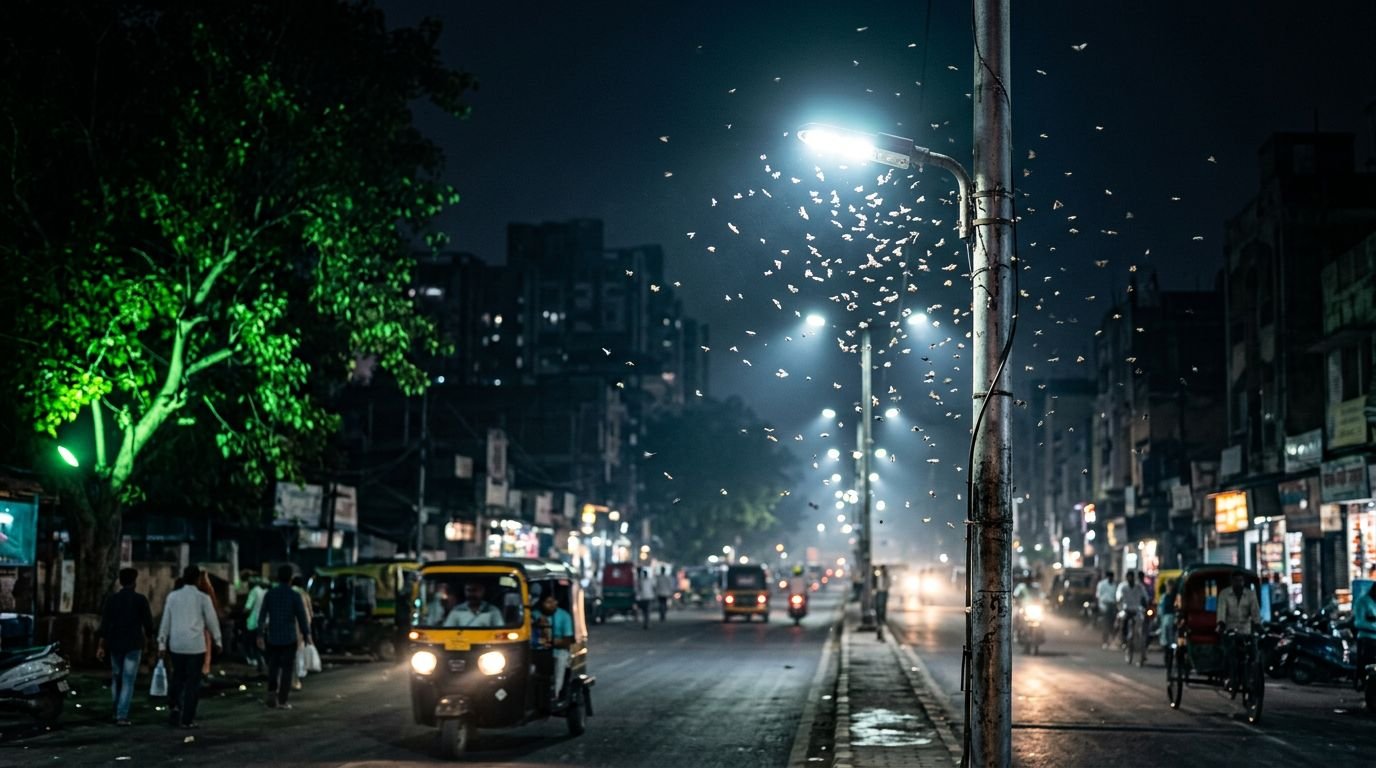
When people think about the impact of LED streetlights insects often flock to, they visualize moths circling a lamp. That image is familiar, but it misses the true scale of the ecological harm. A harsh white streetlight can act like a magnet, a lethal trap, and a feeding station for predators all at once.
Many insects rely on natural light cues to orient themselves during flight. Moonlight and starlight are distant and stable sources. In contrast, streetlights are close, intense, and confusing. The blue light emitted by many white LEDs interferes with navigation because most nocturnal insects are highly sensitive to these short wavelengths. While these modern bulbs often lack significant ultraviolet light, their strong blue emission is enough to cause insects to spiral toward the lamp, burn vital energy, collide with surfaces, or remain exposed instead of feeding, mating, or laying eggs.
Older high-pressure sodium lamps, also known as HPS lamps, provided a warmer yellow glow that was less disruptive to nocturnal activity. Still, many newer cool-white LEDs appear worse because their specific light spectrum is more attractive to a wider range of species. A broad review of artificial light at night and nocturnal insects shows that artificial light can alter movement, feeding, mating, and survival across various insect groups.
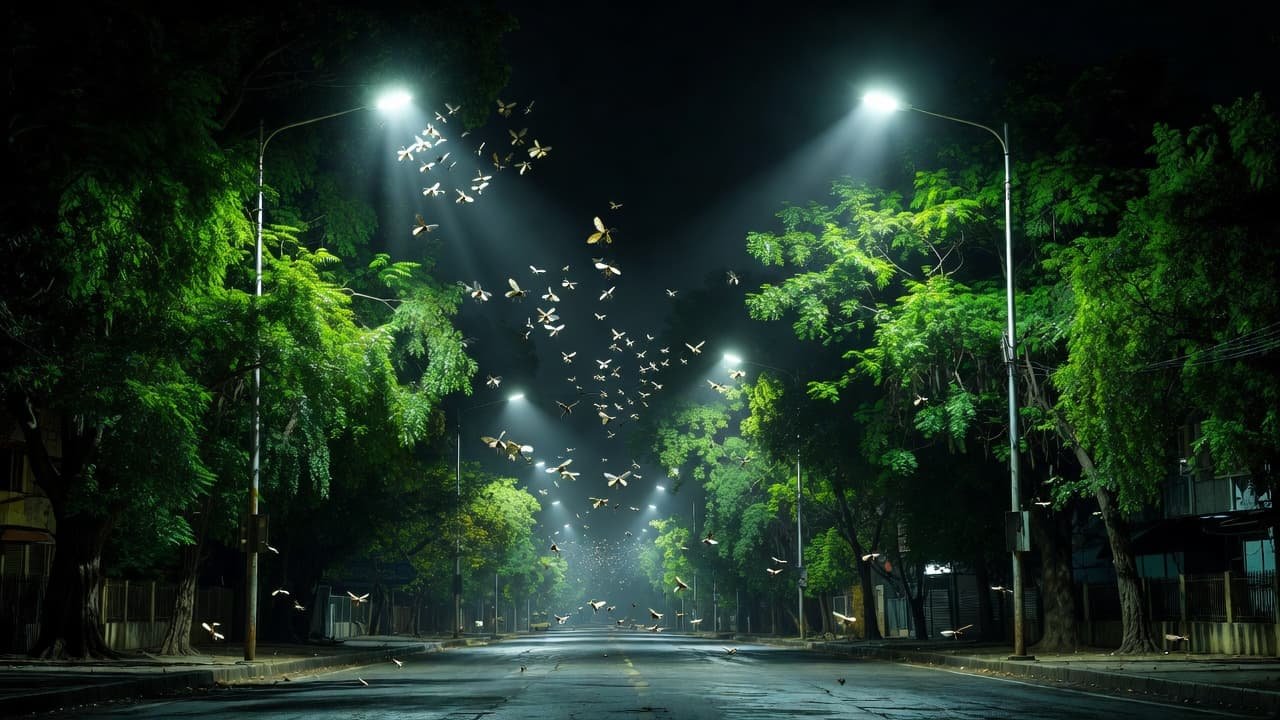
This is why the transition to LED technology cannot be judged by electricity savings alone. LEDs are not one single type of product. A warm amber LED and a bright cool-white LED behave very differently in the natural environment. Yet, many municipal retrofits in India prioritized low cost, brightness, and visual uniformity over the biological response of insects.
The public story is simple: lower utility bills, lower emissions, and better visibility. However, the biological story is much messier. A brighter street is not necessarily harmless just because it uses fewer watts. If the light keeps insects pinned in place for hours, the ecological damage begins long before sunrise.
The damage spreads through the food web
The harm does not stop at the lamp post. Insects function as essential pollinators, decomposers, prey, and pest controllers. Remove or disrupt them, and the rest of the urban food web starts to wobble, leading to significant biodiversity loss.
Moths, beetles, caddisflies, lacewings, and many small flies are active at night. Some pollinate flowers that bloom after dark. Others feed bats, geckos, frogs, spiders, and birds that hunt at dawn. When bright lights concentrate insects in exposed spots, predators get easy meals in the short term. Over time, however, these concentrated kills and the exhaustion of energy reserves contribute to a broader insect decline.
That loss matters in Indian cities because habitat is already fragmented. A roadside tree, a pond edge, a vacant lot, and a neighborhood park may form a patchwork route for insect movement. Artificial light can break those routes. Research on urban forest-edge lighting found that streetlights along wildlife corridors can change which species stay, which species leave, and how ecological edges function.

Photo by Quintin Gellar
Plants can shift too. Recent global research suggests that artificial night lighting can change leaf traits and plant defenses. One study found tougher leaves under streetlights, which meant less feeding by herbivorous insects like moth caterpillars. That sounds small until you follow the chain. Harder leaves mean less food for these larvae, a subsequent drop in caterpillar abundance, fewer insects for predators, and weaker ecosystem function overall.
The ecological impact also lands on people, even when it stays invisible. Fewer nocturnal insects can mean weaker pollination, less natural pest control, and thinner urban biodiversity in places where cities already have little ecological slack. A tree-lined road may still look green under white LEDs, but a green canopy is not proof of a healthy night ecology.
Indian cities are exposed to a bigger risk
India maintains a massive and fast-growing network of LED streetlights. This infrastructure exists alongside dense human populations, hot nights, and seasonal insect populations that rely on roadside trees, pressured wetlands, and fragmented habitats to survive. That combination makes light pollution more than a side issue for the subcontinent.
As of mid-2026, published research that measures the exact effect of street lighting on insects in Indian cities remains limited. That gap matters, but it does not give urban planners a free pass. Global evidence provides a strong warning against the careless rollout of bright, blue-heavy lighting in insect-rich urban environments.
Conditions in Indian cities may even amplify the problem. Heat islands keep many built areas warmer after dark, which can extend insect activity late into the night. If you want a broader view of how warming and habitat stress stack together, this piece on urban heat management and biodiversity connections shows why cities can no longer treat nature as an afterthought.
Water edges add another layer to this complexity. Lakes, drains, marshy patches, and monsoon-fed depressions are major zones for wildlife. Placing bright lighting around these areas creates disruption where breeding, feeding, and emergence occur. The same pattern appears in the hidden trade-offs around why biodiversity matters in urban lake projects, where visual cleanup often outruns ecological thinking.
Municipal reporting rarely tracks the ecological impacts of these lighting choices. Cities count lumens, outages, costs, and complaint rates, but they almost never monitor insect activity, pollination shifts, bat foraging changes, or the breakage of nocturnal corridors. That is a governance failure, not a data accident.
A streetlight can save power and still damage a living system if its color, brightness, and timing ignore insect life.
India does not need perfect local data before acting. It needs better standards, improved monitoring, and more honest definitions of success that account for the health of local ecosystems.
Energy savings alone are a weak success metric
LED conversions are often sold as a climate win, and on carbon terms, they often are. These upgrades prioritize energy efficiency, as LEDs draw less electricity than older lamps, last longer, and reduce maintenance visits. Those gains are real. Still, the public ledger is incomplete if it ignores the true cost of biodiversity loss.
A city can cut wattage and increase ecological harm at the same time. Lower operating costs can encourage more fixtures, brighter settings, longer burn hours, and lighting in places that were once dark. This is the rebound problem. When electricity is cheap, artificial light tends to spread further across the night.
The comparison below captures the basic trade-off between modern and traditional lighting technology.
| Lighting type | Typical night color | Relative insect attraction | Energy profile | Planning note |
|---|---|---|---|---|
| High-pressure sodium (HPS lamps) | Warm yellow-orange | Lower than cool-white LEDs | Less efficient than LEDs | Older sodium lamps are less disruptive to nocturnal insects |
| Cool-white LED | White, often blue-rich | Higher for many nocturnal insects | Highly efficient | Common in retrofits, but risky near sensitive habitats |
| Warm or amber LED | Warm white to amber | Lower than cool-white LEDs | Efficient, though sometimes slightly less than coolest LEDs | Preferred option where ecology matters |
The point is not to bring back older systems wholesale. The point is to stop pretending all LEDs are equal. By evaluating the spectral output and color temperature of new installations, planners can mitigate environmental damage without sacrificing the benefits of modern technology.
A paper on LED lighting and biodiversity costs found that the ecological downsides of certain LED setups can outweigh the neatness of the energy story. That finding should push Indian cities toward more careful specifications, not away from efficiency.
This is also where circular economy thinking should become concrete. A city that buys sealed, disposable fixtures and measures success only in kilowatt-hour savings is solving one problem while creating another. Stronger procurement can ask about specific color temperature requirements, dimming controls, repairability, component recovery, and ecological monitoring. If public agencies talk about sustainable business models, those models need to count living systems, not only balance sheets.
What better street lighting looks like
The answer is not darker roads everywhere. People need safe streets, clear crossings, and reliable public lighting. The answer is precision. Light should go where it is needed, at the level needed, for the time needed, and in a spectrum that does the least damage.
That means using warm white LEDs in insect-sensitive areas, especially near parks, water bodies, tree corridors, school grounds, and residential green edges. It also means installing full cut-off fixtures that push light downward instead of into canopies and the sky. Proper shielding is essential because many insects are not drawn only to the bulb; they respond to the stray glow spread across branches, walls, and open air. By minimizing blue light in these fixtures, cities can significantly reduce the ecological disruption caused by modern LED streetlights.
Cities can cut harm further with a few practical rules:
- Use warm white LEDs, often below 3000K, in ecological zones and mixed residential streets to maintain a lower color temperature.
- Dim lights late at night where pedestrian activity is low and road safety allows it.
- Avoid over-lighting around lakes, wetlands, avenue trees, and known movement corridors for insect populations.
- Audit pole spacing and glare instead of assuming brighter means safer.
- Monitor biodiversity before and after retrofits, as healthy local ecosystems require more than just reduced electricity use.
These choices are not abstract. They are part of systemic change in how cities define infrastructure. A road is not only asphalt and drainage. It is also shade, temperature, movement, and habitat. If a city plants native trees, restores a wetland, or funds micro-forests, then bathes those spaces in intense, blue-rich light all night, it undercuts its own investment.
That is why habitat projects need to be judged by more than survival photos. This article on can tiny forests restore ecological balance makes the same point in another context: visible greenery is not the same as functioning habitat.
Good policy also needs public proof. Residents should know what color temperature their ward uses, whether dimming is enabled, and how authorities assess urban biodiversity after lighting upgrades. If you want to support work grounded in measurable repair, not vague promises, Explore Our Active Missions for on-the-ground projects tied to biodiversity and climate literacy.
Awareness matters, but policy matters more
Personal action can help, but this issue should not collapse into lifestyle guilt. Your balcony light is not the same as a citywide contract. Still, household and neighborhood choices can reduce pressure on local insect populations where creatures are already struggling against the tide of light pollution.
Warm outdoor bulbs are better than cool-white ones. Timers are better than all-night floodlights. Shielded fixtures are better than bare glare spilling into trees. If your housing society is replacing common-area lights, ask about color temperature, dimming, and direction. Those details shape insect survival more than most residents realize.
This is where climate literacy needs to grow up a bit. Carbon matters, but climate-aware living cannot stop at carbon alone. Electricity, public safety, ecology, and design all meet in a single streetlight. Once you see that, the issue stops looking niche.
The same goes for plant-based living. If your values include lower-impact food systems, consider that pollination is a critical component of that picture. Moths, beetles, and flies support crops, wild plants, and the animals that keep urban gardens functioning. Food ethics should extend beyond what is on your plate to include the nocturnal insects that make our food systems possible.
There is also room for everyday mindfulness here. Step outside after dark and look up. Is light pouring into tree crowns? Is a pond edge lit like a parking lot? Are insects clustering under one harsh lamp while the rest of the street stays empty? That kind of noticing will not fix procurement on its own, but it builds the sharper public pressure needed to mitigate the effects of light pollution on our surroundings.
In the end, street lighting policy needs citizen attention because cities rarely correct these blind spots by themselves. Ask better questions at the ward level. Support biodiversity monitoring. Push for lighting standards that treat insect populations as part of public infrastructure, not background noise.
Frequently Asked Questions
Why are cool-white LEDs more harmful to insects than older yellow lights?
Cool-white LEDs emit high levels of blue light, which corresponds to the spectrum many nocturnal insects use for natural navigation. Older high-pressure sodium (HPS) lamps produce a warmer, yellow-orange light that is significantly less attractive and disorienting to these species.
Can cities save energy while protecting biodiversity?
Yes, by moving away from a ‘brighter is better’ mindset to a ‘precision lighting’ approach. Cities can achieve efficiency through smart controls like dimming, motion sensors, and the use of warm amber LEDs that provide adequate visibility for humans while minimizing ecological disruption.
What are ‘full cut-off’ fixtures and why do they matter?
Full cut-off fixtures are designed to direct all light downward toward the ground, preventing light from spilling into the sky or onto surrounding tree canopies. This reduces the ‘attraction zone’ for insects and limits light pollution in areas where artificial illumination is not necessary for public safety.
Is the damage from streetlights limited to insects?
No, the impact ripples through the entire urban food web, affecting everything from leaf-eating caterpillars to birds and bats that rely on insects as a primary food source. Additionally, excessive artificial light can even alter plant behavior, leading to tougher leaves that change the quality of food available to insects.
Conclusion
India’s transition to LED streetlights does not have to become a trap for nocturnal insects. The harm stems from poor choices during this transition, including the use of cool white spectra, excessive brightness, a lack of shielding, and a total absence of ecological monitoring.
The strongest takeaway is simple: energy efficiency alone is not enough. When streetlight policy prioritizes power savings while ignoring the impacts of light pollution, it directly weakens urban biodiversity. We must acknowledge the conflict between lowering energy consumption and protecting the fragile health of insect populations that are vital to our ecosystems.
Cities already know how to count watts. It is time they learn how to count life after dark.