
Why Lake Rejuvenation in India Can Harm Wetland Ecology
 TBH Editorial
A lake can look cleaner and still be less alive. That is the uncomfortable truth behind many lake rejuvenation projects in Indian cities.
If you care about cleaner water, birds, flood safety, and public health, appearance alone isn’t enough. The real question is whether a project restores the living wetland around the lake, or strips it away in the name of improvement. That difference shapes everything that follows.
When “rejuvenation” flattens a living system
Across cities, lake rejuvenation in India often starts with good intent. Local governments want less stink, fewer weeds, clearer water, and a public space that feels safe. Residents want relief from sewage, mosquitoes, and trash.
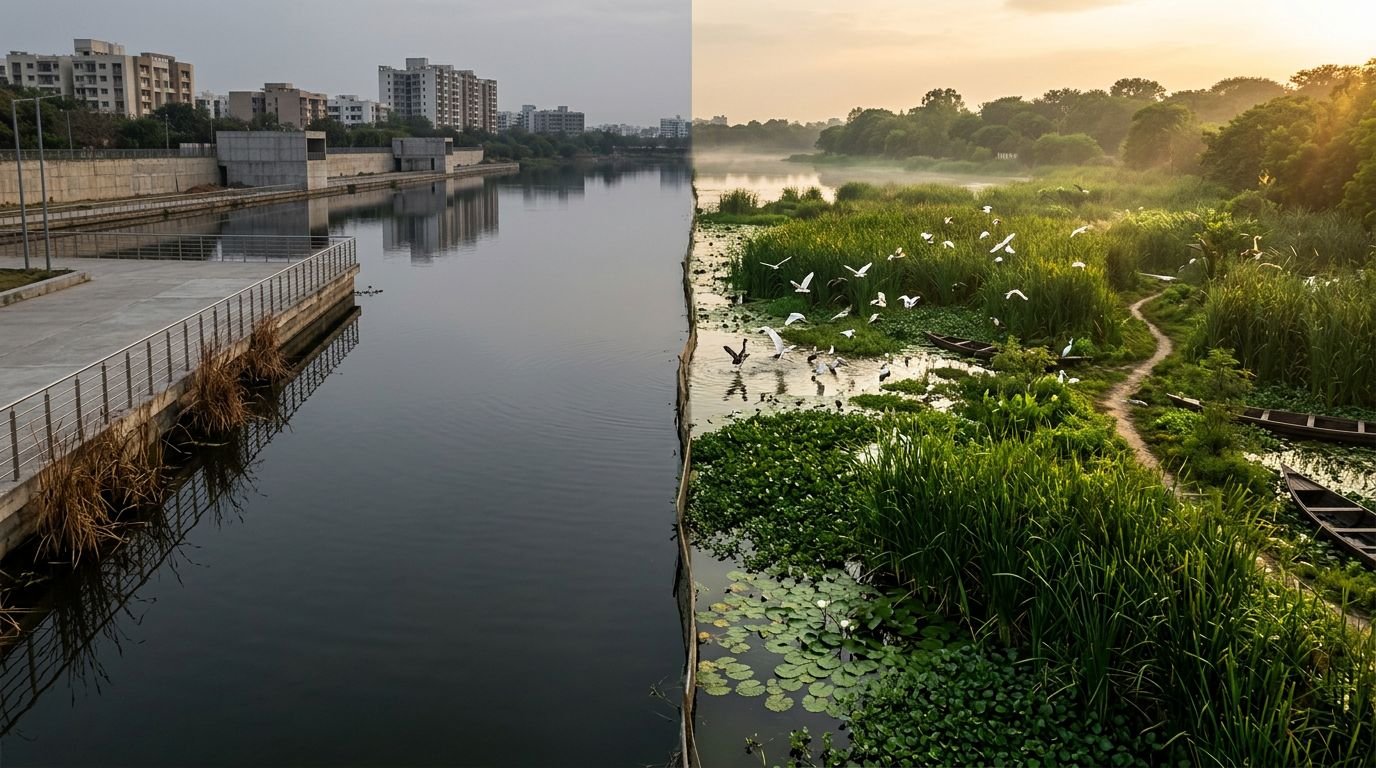
Yet a wetland is not an empty bowl waiting for a makeover. It is a shifting edge where shallow water, mud, reeds, algae, insects, fish, microbes, and birds depend on one another. When a project treats that edge as waste, the lake may look neater, but the ecosystem gets poorer.
Many projects follow a familiar script. Desilt the basin. Remove “encroachments” and “weeds.” Build retaining walls. Add walking tracks, railings, lights, and decorative planting. Keep open water visible. Each step looks practical on paper. Together, they can erase the mess that makes wetlands work.
Research on wetland management by IISc has long warned that wetland loss harms both ecology and livelihoods. That warning applies when wetlands are drained, and it also applies when they are simplified into polished urban lakes.
A healthy wetland is supposed to look irregular, seasonal, and full of life at the edges.
This matters because a wetland does jobs that a deep, hard-edged lake can’t do well. It slows floodwater, filters pollutants, supports breeding grounds, recharges groundwater, and creates niches for many species. In other words, its value comes from complexity.
So the problem is not restoration itself. The problem is a model of lake rejuvenation that prizes visibility over function. Once that happens, the ecological impact may stay hidden until birds disappear, water quality slips again, or monsoon runoff has nowhere soft to spread.
The first losses happen at the edges
The first casualties are often the shallow zones. These are the marshy margins, reed beds, seasonal pools, and muddy shelves that many people dismiss as dirty or overgrown. In reality, they are the nursery wing of the wetland.
Fish spawn in calmer, plant-rich areas. Frogs use damp edges and emergent vegetation. Dragonflies, snails, beetles, and other invertebrates thrive in shallow water and wet mud. Wading birds feed there because food is concentrated and easy to reach. Remove those margins, and the food web thins out fast.
That is why “weed removal” can be so destructive. Not all aquatic growth is invasive. Native reeds, sedges, lilies, and submerged plants help trap sediment, shelter juveniles, and create oxygen-rich micro-habitats. When heavy machines scrape them out, they don’t clean the system. They simplify it.
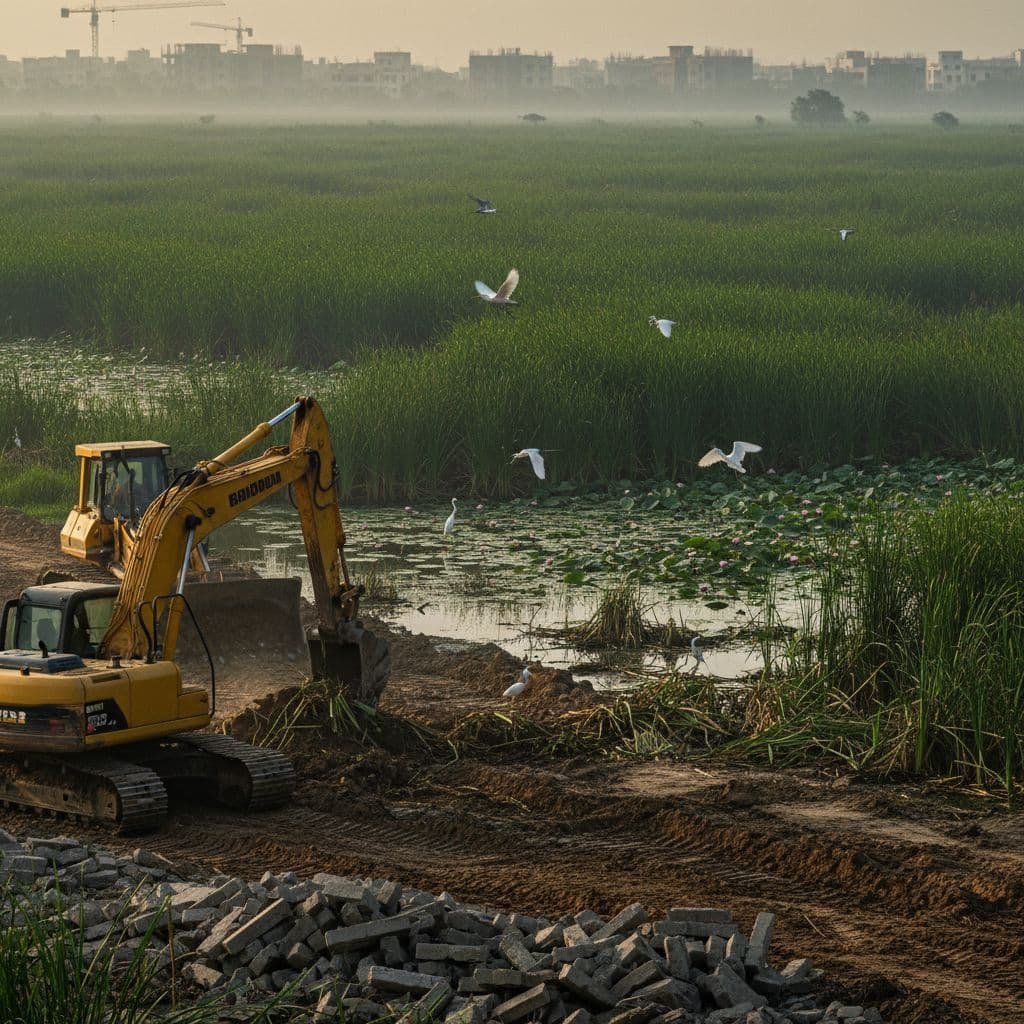
Deep dredging creates another problem. It can turn a lake into a more uniform water body with fewer depth gradients. That may sound harmless, but diversity in depth often supports diversity in life. Some species need warm shallows, some need cooler water, and some need intermittently exposed mud.
In many urban settings, this loss hits urban biodiversity harder than people expect. Cities already offer fragmented habitat. A lake wetland may be one of the last places where birds, amphibians, pollinators, and aquatic insects can still complete parts of their life cycle.
When those edge habitats vanish, nearby residents also lose something less visible but deeply human. Morning bird calls fade. Children see fewer frogs and dragonflies. Seasonal change becomes harder to read. That weakens public attachment to living systems, and it narrows the emotional base for long-term protection.
Concrete banks and deep dredging change the whole water body
Hard engineering often damages wetlands because water is supposed to move with some freedom. It spreads, slows, seeps, evaporates, and returns. Wetlands work by absorbing that motion rather than forcing it into a rigid shape.
Concrete embankments, straightened shorelines, and steep drop-offs interrupt that pattern. They reduce the soft transition between land and water. They also make it harder for plants to colonize the edge, harder for animals to move in and out, and harder for rainwater to infiltrate.
Water-level manipulation can be just as harmful. Some projects hold high water year-round to maintain a “full lake” look. Others drain or isolate parts of the system without thinking about seasonal cycles. Both choices can damage plant communities and breeding patterns that depend on monsoon pulses and dry spells.
The problem gets worse when pollution sources stay untouched. If sewage and nutrient-rich runoff keep entering the lake, desilting alone won’t solve much. Algal blooms can return. Dissolved oxygen can fall. Foul smell can come back. The lake may have a new wall and pathway, yet the underlying chemistry hasn’t improved.
This comparison makes the trade-off easier to see:
| Project priority | What usually follows | What wetland ecology needs |
|---|---|---|
| Open-water appearance | Marsh edges are cleared | Mixed habitats, including reeds and shallow shelves |
| Deepened basin | Habitat becomes more uniform | Varied depths and seasonal shallows |
| Concrete embankments | Infiltration and edge life decline | Gentle, vegetated banks |
| Fast civil works | Ecological surveys get skipped | Baseline data and long-term monitoring |
| Visible cleanup | Pollution inflows remain | Sewage interception and catchment repair |
A review of wetland restoration mechanisms points to the same lesson. Restoration works when it rebuilds ecosystem function, not when it stops at surface repair. That distinction is easy to miss because civil works are visible, while hydrology is not.
Ecological damage becomes a public problem
When a wetland loses function, the damage does not stay inside the waterline. It spills into everyday life. Flood peaks can rise because the marshy fringe no longer stores as much rain. Heat can feel harsher because wetland vegetation and open, living soil help cool local air. Odor and mosquito problems can persist if nutrient pollution continues.
There is also a social fairness issue here. Poorer neighborhoods often live closer to drains, low-lying land, and degraded water bodies. When wetland storage and filtering capacity shrink, those communities can face more flooding, worse smells, and fewer safe public spaces.
At the same time, cities lose quiet benefits that rarely show up in project brochures. Wetlands support pollinators, migratory birds, and insect predators. They give children real contact with nature. They build climate literacy because people can observe rain, heat, migration, and water cycles in a local, lived way.
That is why conservation has to move beyond feel-good cleanup drives. Systemic change means treating wetlands as public infrastructure, not leftover land. It also means funding sewage control, catchment protection, and biodiversity monitoring with the same seriousness given to roads or drains.
Community work still matters. Local stewardship can protect nesting areas, report illegal dumping, and demand better science from public agencies. If you want to support on-the-ground projects tied to urban biodiversity and climate literacy, Explore Our Active Missions. Tangible field work builds trust because it links ecological care to visible, accountable outcomes.
A city that damages its wetlands is not only losing habitat. It is weakening its own ability to handle heat, water stress, and public anxiety about the climate future.
Why the same design keeps coming back
If the risks are so clear, why do harmful designs keep returning? Part of the answer is political. Beautification is easy to photograph, quick to announce, and simple to sell. A concrete edge looks finished. A sewage interception plan looks like a budget line and years of maintenance.
Procurement also pushes projects in the wrong direction. Earth-moving, masonry, fencing, and landscaping fit neatly into contracts. Native vegetation recovery, catchment repair, species monitoring, and adaptive management do not. Those tasks need patience, trained staff, and public reporting over time.
Governance adds another layer of failure. One agency may handle the lake, another the drain network, another wastewater, and another urban development. When responsibilities are split, nobody owns the full hydrology of the site. As a result, a lake can be “restored” while polluted inflows keep arriving every day.
This is where sustainable business models matter. Cities need models that reward pollution prevention, treated water reuse, organic waste recovery, and long-term ecological maintenance. Without that shift, money keeps flowing to repeat civil works instead of durable repair.
A smarter approach would look more like a circular economy. Wastewater should not move through the city as a permanent contamination stream. Where safe and appropriate, it can be treated, reused, and managed upstream so lakes are not forced to play the role of dumping ground and park at the same time.
The deeper issue is accountability. Too many projects measure success by how a lake looks six months later, not by bird diversity, groundwater recharge, amphibian return, or nutrient load after two monsoons. That gap allows the same mistakes to repeat under the language of renewal.
What better restoration looks like in Indian cities
Good restoration starts with humility. No two wetlands behave the same way, because catchments, soils, inflows, land use, and species mix all differ. Still, sound projects tend to follow a few basic rules.
First, they start outside the lake. Pollution sources, stormwater paths, sewage entry points, and upstream land use shape the whole system. If those problems stay in place, work inside the lake only treats symptoms.
Second, they protect complexity. That means shallow gradients, native plant belts, mudflats where appropriate, low-disturbance zones for birds, and seasonal water variation rather than a permanently staged water level.
Third, they monitor life, not only water clarity. Fish, amphibians, aquatic insects, birds, and wetland plants tell you whether recovery is real. Public dashboards can help too, but they need ecological data, not only before-and-after photographs.
A Tamil Nadu wetland case study shows that recovery improves when science and community participation work together. That is a better model than a contractor-led cleanup with weak follow-up.

In practical terms, better restoration often includes:
- Sewage interception and treatment before water enters the wetland.
- Gentle, vegetated shorelines instead of hard retaining walls.
- Native wetland plants rather than ornamental lawns and shrubs.
- Multi-year ecological monitoring with public disclosure.
This is also where the language of a circular economy becomes useful in real, physical terms. Treated water can reduce pressure on freshwater demand. Nutrients can be managed rather than dumped. Organic biomass can be handled as part of a system, not as nuisance waste. Those choices reduce harm upstream and downstream.
Careful restoration does not promise a lake that looks spotless every day. It aims for a wetland that stays alive through seasons, supports species movement, and helps the city absorb climate stress.
A better public response than feel-good cleanups
Citizens still have a role, but it helps to be clear about the scale of that role. Weekend cleanups can remove trash. They cannot redesign stormwater, stop sewage inflows, or rebuild wetland hydrology. Personal action matters most when it feeds public pressure and informed oversight.
That is where values such as plant-based living and everyday mindfulness can fit honestly. They can sharpen your sense of connection to land, water, and non-human life. They can reduce some forms of ecological pressure. Yet they do not replace policy, budgets, and enforcement. A mindful city still needs drains fixed, wetlands mapped, and biodiversity monitored.
A stronger civic response asks better questions. Was there a baseline study before work began? Which native plants were protected or reintroduced? How will bird, amphibian, and insect life be tracked? Has the project addressed nutrient inflow, or only the lake bed? Will seasonal flooding space be preserved?
Young people, especially those carrying climate anxiety, deserve more than slogans. They need local examples of how water systems actually function. School visits, citizen bird counts, seasonal mapping, and open ecological data can build real climate literacy. That helps turn fear into public competence.
Most importantly, the public should resist the idea that any visible intervention counts as progress. Some projects do help. Others simply replace one damaged condition with a better-lit version of the same problem. The only fair test is whether life returns and stays, season after season.
Conclusion
A lake is not healthier because it looks tidier. In many cases, harmful lake rejuvenation in India strips away the shallow, messy, living edges that make wetland ecology work in the first place.
Better restoration protects function before form. It treats sewage, respects seasonal water movement, keeps native vegetation, and measures success through biodiversity and hydrology, not quick visuals.
If a project cannot support birds, insects, amphibians, flood storage, and nearby communities at the same time, it has missed the point of rejuvenation.