Why Indian Spice Testing Misses Heavy Metal Hotspots
 TBH Editorial
The most dangerous turmeric powder may not look suspicious. It can be bright, fragrant, neatly sealed, and sitting beside a clean lab report.
When people search for Indian spice heavy metals, they want a simple answer: which products are safe? But food contamination doesn’t behave that neatly. A test can clear one brand’s sample while missing heavy metal contamination elsewhere. That may include a grinding mill, a trader handling local market spices, or non-branded spices moving through a local supply chain.
The problem isn’t only whether testing happens. A credible health risk assessment for spice safety depends on where, when, and how frequently samples are collected. That context matters when readers are trying to avoid lead poisoning.
Key Takeaways
- Heavy metal contamination in Indian spices can cluster in specific farms, mills, traders, lots, or informal supply chains, so one clean sample cannot clear every product.
- Representative testing should follow the spice from farm and drying site through grinding, distribution, and retail, while recording the batch, date, location, metals measured, and concentrations with units.
- Lead, cadmium, arsenic, and chromium require separate analysis from ethylene oxide, Salmonella, pesticide residues, and aflatoxins. A test only answers the question it was designed to measure.
- Consumers can reduce uncertainty by choosing traceable batches, requesting a current certificate of analysis, avoiding mystery powders, and remembering that colour, “organic” claims, and home tests do not prove safety.
- Stronger public oversight depends on unannounced, risk-based testing, lot traceability, transparent recalls, and targeted Right to Information requests for inspection and laboratory records.
Why Indian spice heavy metals hide in hotspots
Heavy metal contamination in spices is rarely one uniform problem spread evenly across every farm and factory. It often sits in pockets. One village may have irrigation water containing toxic heavy metals. One processor may use dusty machinery. One trader may mix adulterated non-branded spices into an otherwise ordinary batch.
That is why a passing average result can create false comfort. A single clean sample says something about that sample. It does not automatically clear every lot sold under the same brand, every wholesaler, or every market pouch with a similar label.
Contamination can enter long before the kitchen
Spices move through a long chain: soil, water, harvesting, drying, storage, transport, grinding, blending, packing, and retail. Any weak point can introduce chemical contamination.
Lead, cadmium, arsenic, and chromium can enter through contaminated soil or irrigation water. Industrial emissions, mining activity, waste dumping, battery recycling, and polluted dust can leave metal residues in agricultural areas. A crop can then absorb part of that burden before it reaches a mill.
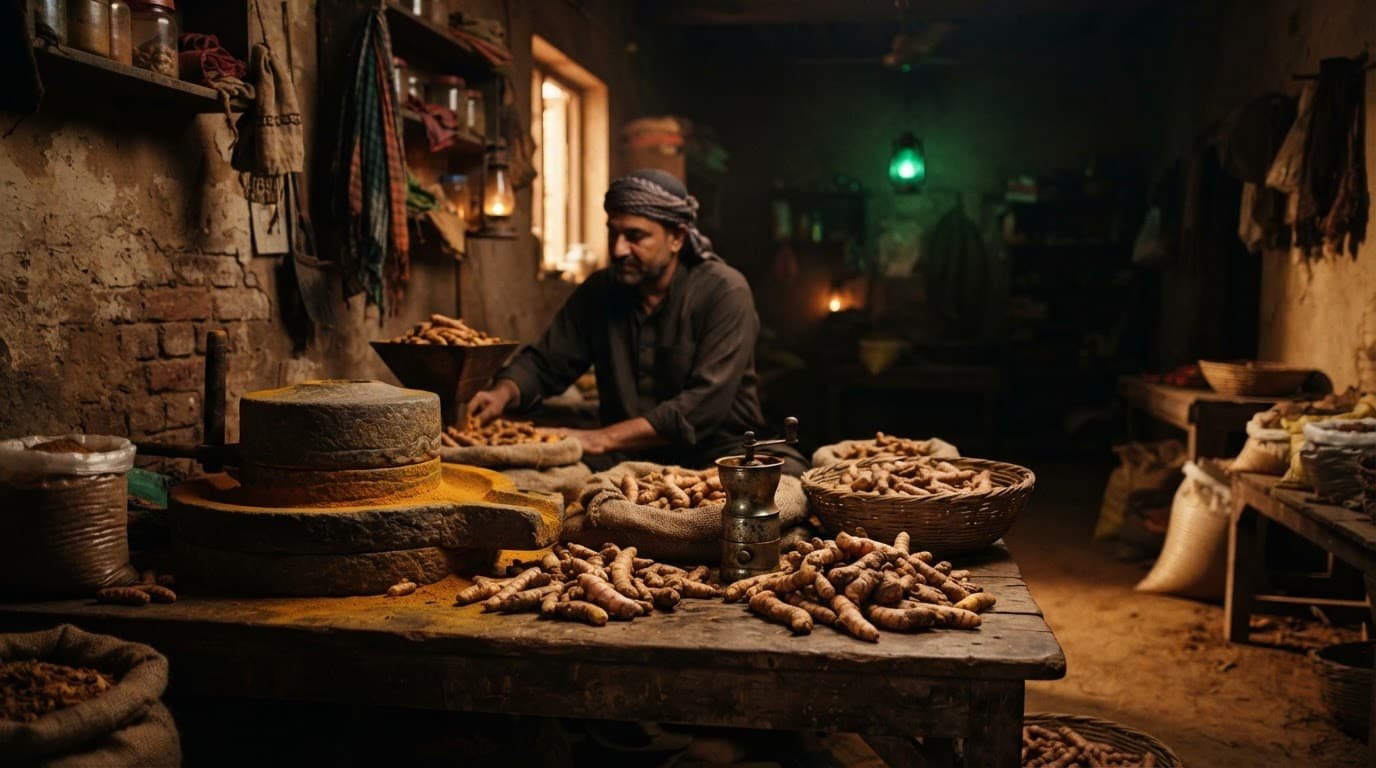
The second route is processing stage contamination. Spices are often dried outdoors, stored near roads, ground in shared machinery, or moved through busy markets. Dust from vehicles, construction, workshops, and poor waste handling can settle on raw material or equipment. The same logic applies to roadside air pollution: a citywide average cannot reveal what someone breathes beside a demolition gate. A national spice average cannot reveal what entered one local batch.
Then there is deliberate adulteration. Illegal additives, including lead chromate and lead oxide, can act as food colorings, making turmeric powder, chilli powder, and other products look more vivid. The practice is especially troubling because it can add both lead and chromium. Brighter yellow is not proof of adulteration, but colour alone is never a safety test.
A multi-country study found a maximum lead result of 6,504 mg/kg in one turmeric powder sample purchased in India. That extreme result does not describe all Indian spices. It does show why outliers matter in a published investigation of lead in consumer spices.
A health risk assessment must translate a measured result into an estimated daily intake. It must also consider the distinct carcinogenic risk associated with contaminants such as arsenic.
A contaminated spice supply does not need to be large to cause harm. Repeated exposure to a small lot can still contribute to lead poisoning when it reaches the same households over time.
A clean test result can still miss real exposure
Laboratories can detect metals with high precision. The weak link is often the sampling plan.
If officials collect one sealed retail packet from a large city, they may miss a problem at a small processor. If a company tests only export-ready lots bound for spice exports, it may learn little about domestic products. Informal channels may include non-branded spices.
If multiple samples are pooled into one composite, heavy metal contamination in one pocket can be diluted by cleaner material. A missed lot can remain in circulation, creating potential exposure that could contribute to lead poisoning. A total hazard quotient calculated from diluted data may understate risk.
The Indian spice heavy metals problem is not solved by a generic statement that “testing was conducted.” Representative samples provide better inputs for a health risk assessment. A useful result needs a place, date, lot number, and product form. It should also state the measured concentration with units and clearly list the chemicals measured.

A sample is evidence, not a map
Testing needs to follow the product’s actual route, not only the easiest place to collect a packet.
| Testing question | Weak approach | Hotspot-seeking approach |
|---|---|---|
| Where was the spice sampled? | One warehouse or supermarket | Farm, drying site, mill, distributor, and retail outlet |
| Which product was tested? | A pooled brand sample | Separate lots, dates, suppliers, and package sizes |
| What does the record identify? | Product name only | Batch number, origin, processor, collection date, and the heavy metal concentration with units |
| What happens after a failed result? | A vague assurance of action | Lot hold, trace-back, recall, public notice, and repeat testing |
A test programme that samples across these points can distinguish soil contamination from a problem introduced during grinding or blending. That distinction changes the response. Soil and water contamination need long-term remediation. Deliberate lead chromate adulteration needs enforcement, traceability, and criminal consequences.
Risk-based testing should follow warning signs
Testing every gram of every spice is impossible. That is not an excuse for lazy coverage.
High-risk points deserve more attention. These include turmeric powder and chilli powders with unusually intense colour. Suppliers with poor traceability and mills near industrial clusters also need scrutiny. So do lots linked to previous failures and products intended for young children.
Unannounced samples matter too. A pre-arranged visit can produce a clean packet that tells us nothing about ordinary operations.
Testing for these contaminants should also separate whole spices from powders. Whole spices are not automatically safe, but fewer grinding and blending steps can mean fewer chances for contamination to enter. Powdered spices have a larger surface area and often pass through more hands.
Don’t confuse the ethylene oxide scandal with a metals result
The 2024 controversy involving MDH and Everest put global spice exports under scrutiny. Hong Kong suspended sales of three MDH spice blends and one Everest fish curry mix over suspected ethylene oxide levels. Singapore recalled an Everest spice mix over the same concern. The U.S. Food and Drug Administration said it was gathering information, as reported by Reuters’ coverage of the MDH and Everest inquiry.
Ethylene oxide is not a heavy metal. It is a pesticide and fumigant residue with different health concerns, testing methods, and legal thresholds. Lead, cadmium, chromium, microbial contamination, pesticide residue, and aflatoxins each require separate analysis and a health risk assessment. Regulatory authorities may use different thresholds, recall rules, and import actions, even when international standards guide decisions.
That distinction matters because public fear can become a blur. A negative result for that fumigant does not prove that a spice is free from lead. A turmeric powder product may require separate tests for metals, residues, and pathogens. A heavy metals test cannot answer a Salmonella question, while some residues may raise a distinct carcinogenic risk question. A laboratory can do excellent work and still miss chemical contamination it was never asked to measure.
FSSAI later reported that 28 samples from the two brands showed no detectable fumigant residue. That was useful information about those samples, not a blanket verdict on every product in every market.
There was also a separate U.S. issue in 2023. The FDA issued a public health alert for recalled Everest and Maggi spices after laboratory findings showed Salmonella contamination. The agency placed the products under an import alert for detention without physical examination.
One brand name can appear in several food safety stories. That does not mean every story has the same cause.
Health risks depend on dose, chemical form, and who eats it
“Heavy metals” is a broad label covering toxic heavy metals with different toxicity profiles. A health risk assessment considers the substance, its heavy metal concentration, serving size, consumption frequency, and body weight.
Lead is a neurotoxin. Children under five are especially vulnerable because their bodies are smaller and their brains are developing rapidly. Repeated low-dose exposure can add up. Young children may also receive spice-containing foods relative to a lower body weight than adults, increasing the risk of lead poisoning. The CDC’s investigation of lead-contaminated spices shows how contaminated food products can become part of a wider childhood lead exposure picture.
Cadmium can accumulate in the body and is linked to kidney damage after long-term exposure. Arsenic has its own toxicity profile, and chronic exposure may increase carcinogenic risk depending on its form and dose. Cadmium and chromium need careful interpretation, especially because chromium’s chemical form matters. Trivalent chromium occurs naturally in food in small amounts, while hexavalent chromium is far more toxic and can point to industrial contamination. A total chromium number is a warning sign, but it cannot establish the carcinogenic risk of hexavalent chromium without speciation.
Risk assessors use Estimated Daily Intake to estimate how much of a contaminant a person may consume relative to body weight. This health risk assessment compares the estimated daily intake with a health-based reference value.
The Total Hazard Quotient, or THQ, is one such screening tool. It compares estimated exposure to a reference dose for non-cancer effects. A THQ below 1 is generally treated as lower concern for that individual exposure pathway. A value above 1 means the exposure deserves closer attention. When several metals are present, assessors may combine them into a Hazard Index.
These calculations are useful, but they are not magic. A total hazard quotient depends on the exposure pathway and cannot replace realistic consumption data or context. A household using a pinch of turmeric powder weekly has a different estimated daily intake and dietary exposure pattern from a family cooking heavily spiced meals every day.
What you can check before buying spices
You cannot laboratory-test every packet in your kitchen. You can refuse to reward opacity.
This is especially important for people committed to plant-based living. Spices are often central to lentils, vegetables, grains, teas, and home remedies. That makes food safety part of everyday nourishment, not a niche concern.

Look for proof that belongs to the batch
A polished package is not proof of safety. Even a sealed packet of turmeric powder can look reassuring while hiding gaps in traceability. Neither is a vague “lab tested” claim without a report you can examine.
- Choose brands that identify a batch or lot number, manufacturing date, source, and customer-contact channel.
- Ask whether a current certificate of analysis covers the exact batch, not an old sample or a different product.
- Look for reports that name the metals tested and report each heavy metal concentration in measurable units. They should identify a NABL-accredited or similarly accredited laboratory. A health risk assessment still depends on serving size and frequency.
- Prefer transparent sellers. Be cautious with local market spices and non-branded spices when producer details are missing, especially for turmeric powder and chilli powder.
- Remember that “organic,” “natural,” and “premium” are marketing terms. They do not prove a product is free from lead or cadmium.
Whole spices can be a sensible option when traceability is stronger, but they are not a shield against contaminated soil or water. Grinding at home may reduce one handling step, but it cannot remove metals already present in the crop. How often you use a spice and its serving size shape dietary exposure. An estimated daily intake can put repeated use in context.
Home lead swabs and colour-change tricks can also mislead. They may be useful as a rough warning, but they cannot identify all heavy metals or measure a safe concentration in food powder. If a child may have been exposed to lead-contaminated food, speak with a qualified healthcare professional about possible lead poisoning rather than relying on a kitchen test.
Everyday mindfulness has value here: check labels, avoid mystery powders, rotate suppliers, and report products that look or smell unusual. Still, private caution cannot replace public oversight. People should not have to become amateur toxicologists to cook dinner safely.
Systemic change begins with traceability and records
Systemic change means treating spice safety as a public-health duty built into procurement, farming support, milling practices, inspections, and enforcement budgets. Procurement and inspection priorities should follow a health risk assessment based on exposure and source data. The goal is to prevent public health risks, not stage a one-time raid after an international ban.
Sustainable business models should pay growers and processors enough to meet safety standards without cutting corners. They should fund soil and water testing near known industrial sources, keep lots separate, and clean equipment between runs. They should maintain procurement records for turmeric powder and non-branded spices, publish failures, and compensate suppliers fairly when contaminated crops must be rejected.
The ecological impact goes wider than one dinner plate. Contaminated soil, wastewater, dust, and poorly managed industrial waste can damage farms, rivers, workers, and urban biodiversity. When contaminants have established chronic hazards, remediation must address long-term exposure and carcinogenic risk. A circular economy has no moral value if hazardous residues are pushed onto informal workers or food-adjacent spaces.
Climate literacy should include this kind of pollution literacy. We need to ask where food comes from, whose water it used, who processed it, and who carries the health cost when oversight fails.
Use RTI to replace vague assurances with records
India’s Right to Information Act, 2005 gives citizens a practical way to ask for existing records held by public authorities. The strongest requests are narrow and factual.
Do not ask, “Why are spices unsafe in my area?” That invites an opinion. Ask for documents that should already exist.
- Request certified copies of food-sample collection reports and laboratory results for a named market, district, processor, or product category during a defined period.
- Ask for inspection reports, complaint-register entries, improvement notices, adjudication orders, recall records, and action-taken reports.
- Request the date, location, and laboratory used for samples linked to lead, chromium, cadmium, pesticide residue, or fumigant complaints.
- If no inspection occurred after a complaint, ask for the file noting or record that explains what happened.
A Public Information Officer normally has 30 days to respond. Start with the regulatory authorities most likely to hold the record, such as the State Food Safety Department, local Food Safety Officer, or FSSAI office. Keep the scope tight. One market, three months, and four document types will usually get farther than a sweeping request for “all records.”
We need the same discipline in food safety that we demand in clean air: test where people face the highest exposure, publish the evidence, and show what happened after failure. If you want to support grounded work that connects public accountability with climate literacy and urban biodiversity, Explore Our Active Missions.
Frequently Asked Questions
Why can a spice pass testing and still contain heavy metals?
A test result applies to the sample and lot that were examined, not automatically to every product sold under the same brand. If contamination is concentrated in a mill, trader, or local batch, a limited sampling plan can miss the hotspot.
Which heavy metals are most concerning in Indian spices?
Lead, cadmium, arsenic, and chromium can all present health concerns, but their risks differ. Lead is especially concerning for young children, while arsenic and cadmium require careful attention to chronic exposure and potential carcinogenic or organ effects.
Does a bright yellow turmeric powder prove adulteration?
No. Bright colour alone is not a safety test, although illegal additives such as lead chromate can make turmeric appear more vivid while adding lead and chromium. A reliable laboratory report is needed to identify and measure contamination.
Is ethylene oxide the same as heavy metal contamination?
No. Ethylene oxide is a pesticide and fumigant residue, not a heavy metal. Testing for ethylene oxide does not establish whether a spice is free from lead, cadmium, arsenic, or chromium.
What should consumers look for when buying spices?
Choose products with a batch or lot number, manufacturing date, source information, and a current certificate of analysis covering the exact batch. Prefer transparent sellers and be cautious with non-branded or mystery powders, especially turmeric and chilli powders with limited traceability.
A spice test should reveal more than a number
A clean result is useful. It is only one piece of a health risk assessment, not a permission slip to stop asking questions.
The strongest system tests high-risk lots without warning, traces failures to their source, and makes follow-up visible. Indian spice heavy metals will remain a source of public health risks when regulatory authorities accept reassuring averages instead of transparent follow-up on concentrated hotspots.
The food on your plate, including turmeric powder, deserves evidence that testing was representative, not a vague promise that action was taken.