Why Chemical Plants Need Emergency Siren Audits
 TBH Editorial
A siren can work perfectly in a vendor demonstration and still fail someone behind a pump house, near a loading bay, or outside the plant gate.
When someone searches for emergency siren audits India, they are not looking for another compliance document to file away. They are asking a harder question: if a fire, toxic release, or explosion begins, will every worker and neighbour hear the warning and know what to do?
The answer depends on more than a loudspeaker. It depends on clear signals, regular tests, backup power, honest records, and managers who verify coverage across the entire site, not just the control room.
Key Takeaways
- An emergency siren audit must verify audibility across the entire risk zone, including pump houses, loading bays, gates, nearby communities, and areas affected by machinery, weather, or hearing protection.
- Siren patterns must match the current approved emergency procedure and ERDMP codes, with workers trained to distinguish fire, disaster, weekly test, and All Clear signals.
- A serious audit follows the complete alarm path: siren control panel, field horns, cables, manual activation points, linked systems, battery backup, and emergency power changeover.
- Weekly tests, mock drills, fault records, and corrective actions provide evidence that the system works in practice rather than only appearing healthy in the control room.
- Cell broadcast and other public phone alerts can support wider community warnings, but they do not replace an on-site industrial siren system.
Emergency siren audits India: the whole risk zone matters
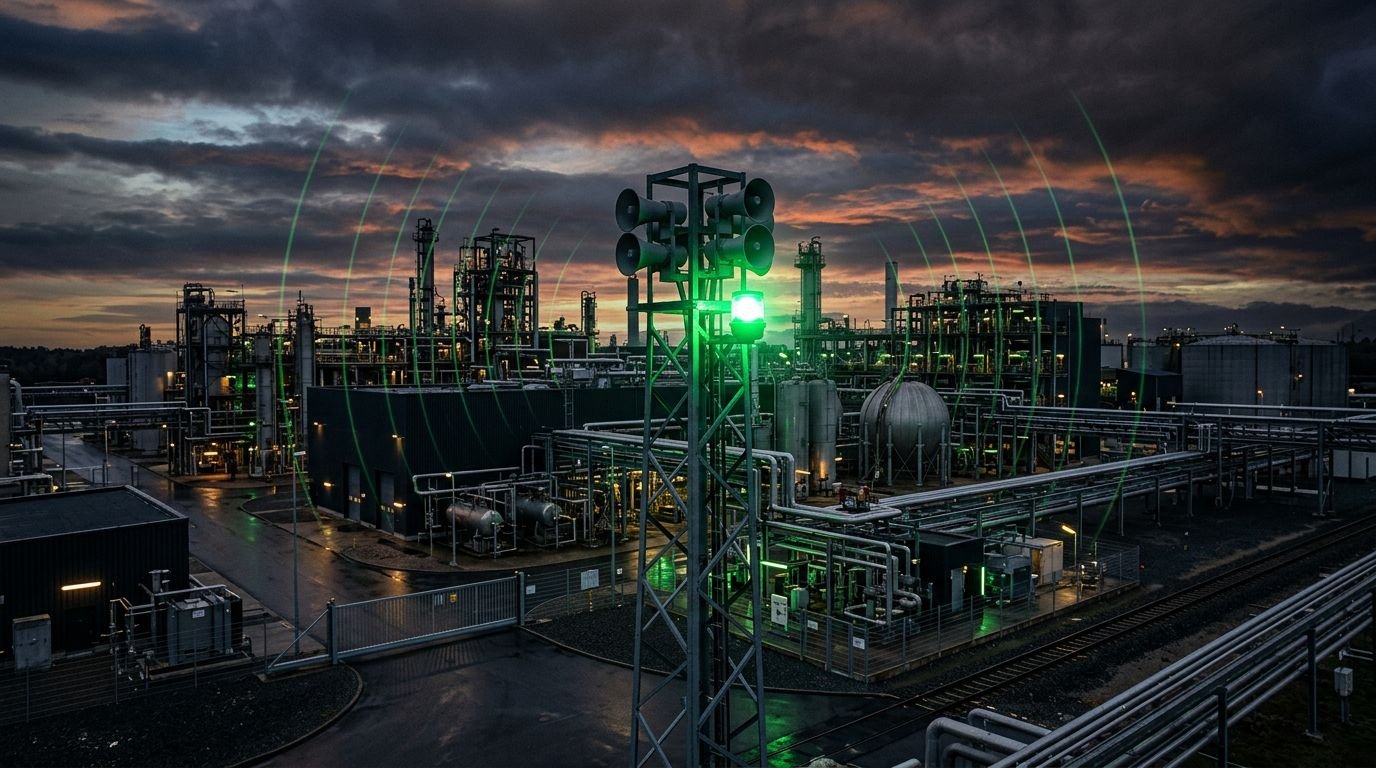
A chemical plant is not an island. Workers move between tank farms, warehouses, laboratories, gates, canteens, and maintenance areas. Around many facilities, there are homes, farms, roadside shops, schools, and informal settlements.
That is why an emergency siren system must be assessed where people actually work and move: can people hear and identify the warning where they actually spend time?
For petroleum depots and terminals, pipeline installations, and lube-oil facilities, OISD-STD-117 requires electric fire sirens to be audible at the farthest point of the installation and up to one kilometre beyond its boundary. It also calls for a hand operated siren in marked, strategic locations.
That requirement carries a blunt truth. A siren that reaches the front office but disappears behind a process unit creates an acoustic dead zone. A healthy siren control panel display cannot substitute for field verification.
Chemical plants outside OISD-117’s direct scope must still meet their own statutory approvals, on-site emergency plans, and local authority requirements. OISD-117 is not a universal shortcut. Still, its logic is useful everywhere: warning systems need to work during the worst conditions, not the easiest ones.
An audibility check should include shift changes, generator noise, rain, traffic, wind direction, and areas with heavy machinery. A worker wearing hearing protection near a compressor has a different experience from a manager in a quiet office.
A weekly siren test is not there to prove that equipment is loud. It is there to prove that every person knows what the sound means.
Emergency siren codes cannot be left to memory
Emergency siren codes deliver instructions at speed, not sounds people should be expected to remember informally. If workers confuse a weekly test with a fire alarm, or mistake an “All Clear” for another alert, fear spreads faster than useful action.
OISD-117 distinguishes the fire signal from the ordinary shift siren. Its commonly used code structure is simple:
| Situation | Expected siren pattern | What people should understand |
|---|---|---|
| Fire | Wailing tone for two minutes | A fire emergency needs immediate response under the site plan. |
| Disaster | Repeated wailing sequence | The approved DISASTER siren code requires escalation under the disaster plan. |
| All Clear | Straight, steady run for two minutes | All Clear termination means the immediate emergency signal has ended. |
| Weekly test | Straight, steady run for two minutes | A weekly test siren confirms recognition and is not a live fire alert. |
The disaster sequence must match the current approved emergency procedure and ERDMP siren codes. Secondary summaries of the standard differ on the gap between warning bursts. Validate the ERDMP siren codes, siren control panel settings, displayed codes, and event records against current approved settings. Don’t rely on someone’s memory, an old wall chart, or a copied vendor setting.
A credible emergency response and disaster management plan should also connect siren signals to its incident levels:
- FIRE Level I covers an event contained within the site by trained plant personnel and available equipment.
- Level II requires wider internal mobilisation and may call for mutual aid or support from nearby emergency services.
- Level III is a major disaster with possible off-site consequences and a broader public response.
The names matter less than the shared understanding. Who activates the alarm? Who informs district authorities? Which gate closes? Where do workers assemble? How are nearby communities warned?
A manager evaluating a plant should not leave with only a panel specification. They need proof that people recognise the sound, know their route, and trust the instruction that follows.
What a serious siren control panel audit checks
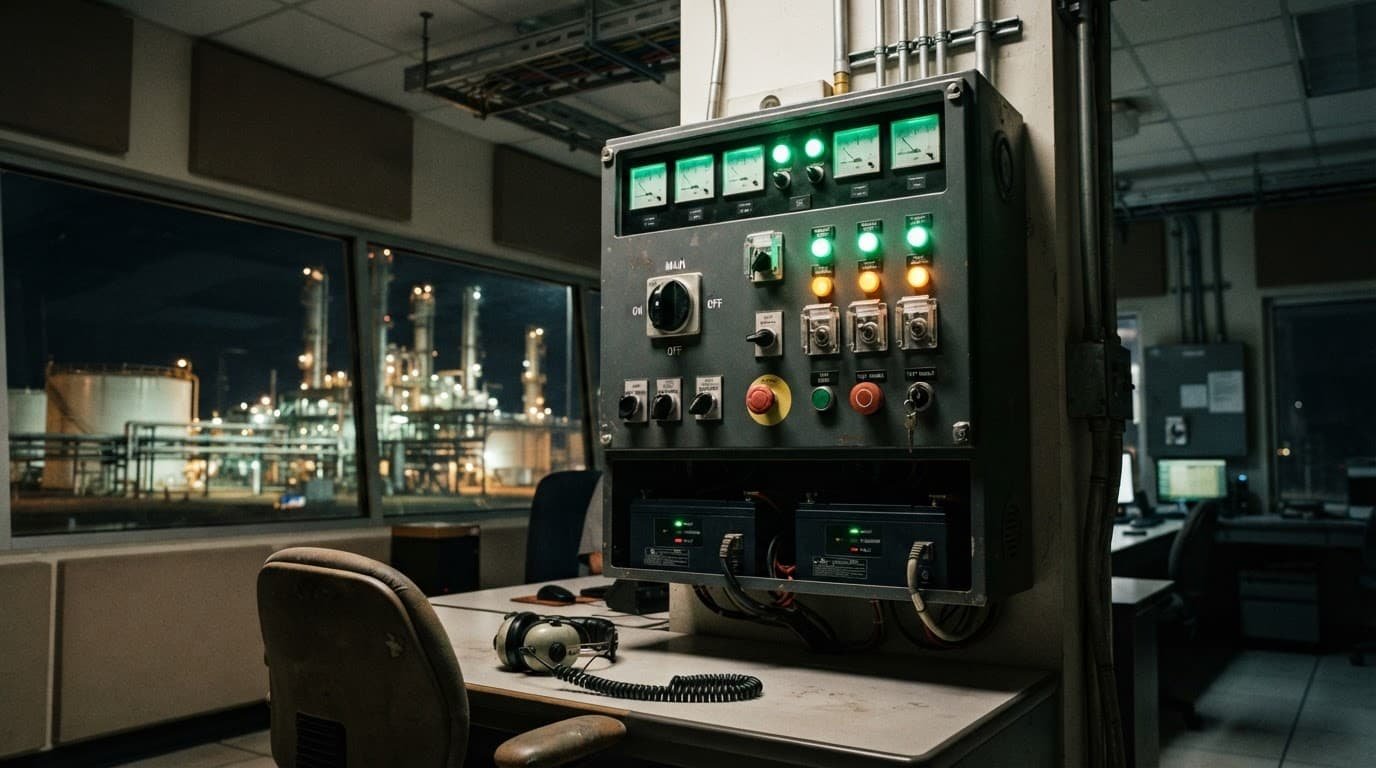
A siren control panel is the nerve centre, but it is not the whole nervous system. The audit begins there, but it must also cover every horn, cable, power source, and field location.
The audit should follow the signal from activation to sound. It should then test how the siren control panel responds when normal power disappears.
The basics are unglamorous. That is why they get missed.
A sound audit checks whether every horn activates, whether zones work as intended, and whether the configured pattern matches the approved code. Electrical activation is separate from an audibility check, which confirms that sound reaches the intended field locations. The alarm path should be traced through linked fire protection facilities, from detection inputs to field horns. Confirm that the fire siren is distinct from the shift siren, then check manual activation points and each hand operated siren.
The power audit matters just as much. For OISD-117 compliance, electric fire sirens need a feeder that maintains continuous supply during emergency shutdown. The battery backup, charger, wiring, and changeover arrangement must be tested during real loss-of-power conditions, not assumed to work because an indicator light is on.
For an advanced siren control panel, ask for evidence of:
- Separate, clearly identified emergency and test modes, with no chance of accidentally sending a wailing fire signal during a routine check.
- Manual override capability, fault indication, and an event record that shows activations, tests, and faults.
- Properly documented potential-free contacts for links to fire alarm panels, gas detection, public-address systems, or emergency shutdown circuits. Where approved, automatic actuation should include interlocks, authorization, and alignment with the current emergency procedure.
- A recorded battery backup test under realistic loss-of-power conditions, including charger, wiring, and changeover performance.
- A current layout showing siren locations, coverage gaps, cable routes, backup equipment, and responsible personnel.
The field-facing OISD-117 siren audit checklist works as a practical compliance checklist and highlights an ordinary failure with serious consequences: missing weekly logbook entries. If a test did not make it into the record, the plant has no defensible proof that it happened.
The failures that hide behind a tidy gate
Most siren failures are not mysterious. Safety auditors see them by spending ten minutes walking the site, rather than inspecting only the front gate or control room.
A horn may be blocked by a new warehouse, creating an acoustic dead zone where it was once audible. A corroded cable may sit exposed near a pipe rack. The battery backup may be past its replacement date. A remote unit may have been isolated during maintenance and never restored. A hand operated siren may be inaccessible when power fails. The logbook may show perfect weekly tests because nobody wants to record a fault.
Then there is the human failure. Workers may know that a sound is “important” without knowing whether to fight a fire, evacuate, shelter indoors, or wait for further instructions.
The straight, steady tone of the weekly test siren is mandatory for a reason. It teaches recognition without triggering the fear associated with a wailing fire signal. Changing approved emergency siren codes for dramatic effect is not creativity; it is a safety risk.
This is the same mistake we see in weak dust control. A green mesh around a demolition site can look responsible while fine particles escape above, below, and through gaps. A gleaming siren control panel can create the same false comfort.
Visible equipment is not proof of working protection.
OISD-117 compliance should include equipment integrity, records, drills, and corrective action, not a quick photograph beside a cabinet. A mock drill report should record attendance, observed response, communication failures, and corrective actions, rather than serve as paperwork alone. Where applicable or required by the facility’s approvals, a statutory OISD inspection should test whether those controls work. OISD compliance audit guidance is useful only when plant leaders treat gaps as work orders with owners and deadlines.
Public phone alerts and industrial sirens do different jobs
India’s Cell Broadcast Alert System, supported by the department of telecommunications and the National Disaster Management Authority through the SACHET platform, can send location-based warnings to compatible mobile phones in selected areas and languages.
That system isn’t the same as SMS.
An SMS is sent to individual phone numbers and can face delays when networks are congested. Cell broadcast uses geographical targeting to push one alert across mobile towers in a selected area. It doesn’t need a list of every recipient’s number, and it doesn’t depend on filling each person’s inbox one message at a time.
That makes it useful for cyclones, floods, heat alerts, and large public emergencies. It can also support a major industrial incident when authorities decide that people beyond a facility boundary face risk.
But a phone alert isn’t a replacement for an on-site emergency siren system. Phones may be switched off, outside network coverage, inaccessible to contract workers, or buried in lockers. Some people may also be unable to read a screen.
The stronger system uses both. The plant’s sirens guide immediate action inside and around the facility. Cell broadcast supports a real-time public warning system, helping authorities communicate with wider communities.
Industrial safety is also an ecological issue
Toxic smoke, chemical runoff, and emergency evacuation do not stop at a property line. They affect workers first, then neighbours, drains, soil, trees, birds, and small patches of urban biodiversity already under pressure.
That ecological impact is why audits cannot become a private paperwork exercise. Systemic change looks boring on inspection day: maintained equipment, trained people, mapped exposure zones, public coordination, and records that show what failed and what was repaired.
Climate literacy should include industrial hazards, not only recycling tips and carbon facts. Everyday mindfulness can mean noticing an unusual alarm or reporting a blocked evacuation route. Plant-based living and circular economy choices can reduce wider resource pressure, but neither excuses a facility that fails to warn its workers.
For people who want local accountability tied to climate literacy and urban biodiversity, Explore Our Active Missions connects concern with work that reaches communities on the ground.
Frequently Asked Questions
What is checked during an emergency siren audit in India?
An audit checks siren audibility, coverage gaps, approved alarm patterns, control panel operation, manual activation points, cables, power supply, and battery backup. It should also review weekly records, mock drills, worker recognition, and corrective actions.
Is a working siren control panel enough to prove compliance?
No. A healthy panel display does not prove that every field location receives an audible warning. Auditors must verify the sound at areas such as pump houses, loading bays, compressor zones, gates, and locations outside the plant boundary where applicable.
How should chemical plants distinguish emergency siren codes?
The plant should use the current approved emergency procedure and ERDMP siren codes for fire, disaster, All Clear, and weekly tests. Workers must know what each pattern means and what action follows, rather than relying on memory or outdated wall charts.
Why is battery backup important for an industrial siren system?
Emergency sirens must remain available when normal power is lost or the plant enters an emergency shutdown condition. The battery, charger, wiring, and changeover arrangement should therefore be tested under realistic loss-of-power conditions.
Can cell broadcast alerts replace industrial sirens?
No. Cell broadcast can warn wider communities through compatible mobile phones, but phones may be switched off, inaccessible, out of coverage, or unreadable. It should support—not replace—the plant’s on-site sirens and emergency communication procedures.
A siren audit is a promise people can hear
A warning system is a promise made to the worker beside the pump, the guard at the gate, and the family living downwind. It says that when danger comes, they won’t be left guessing.
The practical standard behind “emergency siren audits India” is simple: test the sound, inspect the siren control panel, verify battery backup, and review the records. Confirm that people understand emergency siren codes and the instruction that follows.
A plant that takes those tests seriously protects more than its licence. It protects human lives, public trust, and the living systems beyond its walls.