Why India’s Industrial Clusters Need Cumulative Pollution Monitoring
-
by
 TBH Editorial
 - No Comments on Why India’s Industrial Clusters Need Cumulative Pollution Monitoring
A factory can meet its own discharge limit and still help poison an entire neighbourhood. This reality highlights a critical gap in our current environmental policy framework, including the ongoing efforts under the National Clean Air Programme.
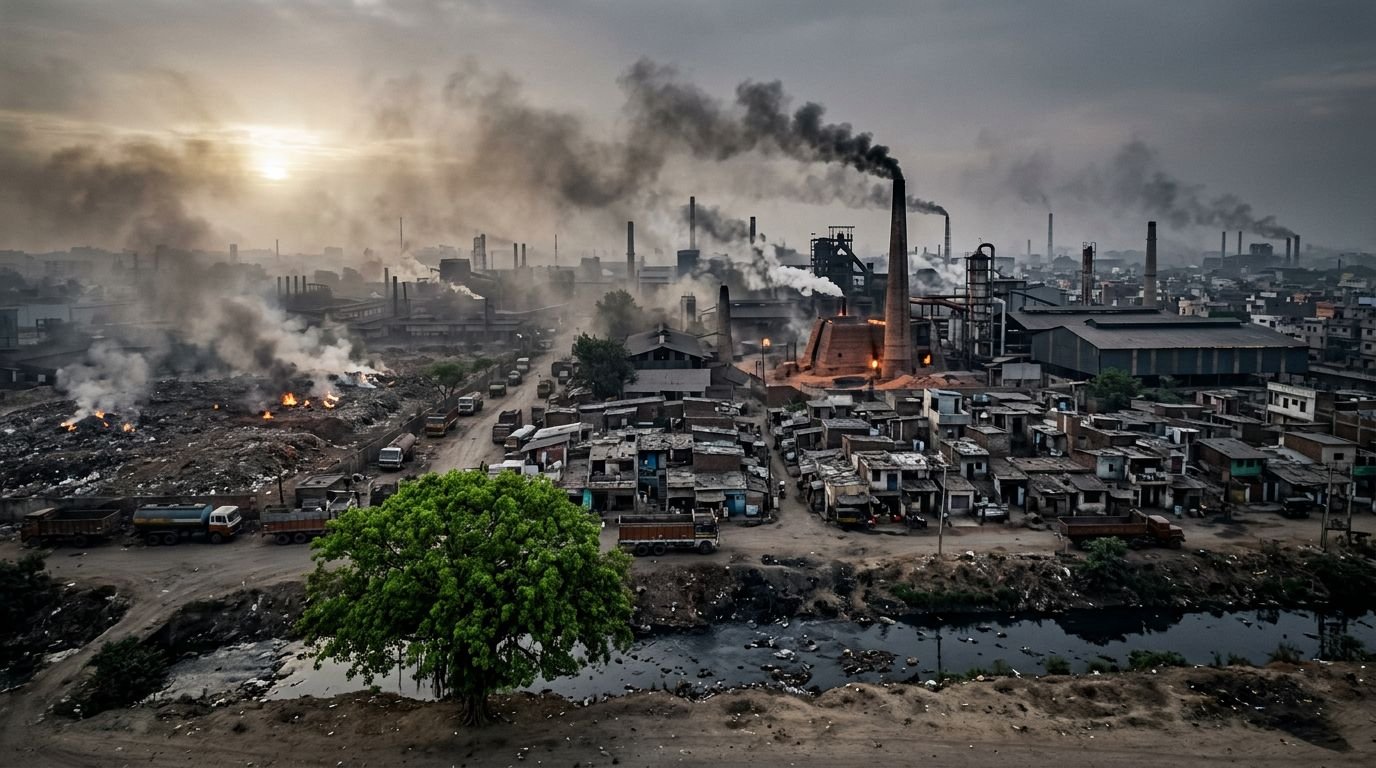
That sounds unfair until you stand near an industrial cluster at 7 am. One unit releases fumes. Another sends treated wastewater into a drain. Trucks grind dust into the road. A brick kiln, generator, warehouse, and burning waste pile add their share. Nobody owns the final air that people breathe.
India needs cumulative pollution monitoring in India because pollution does not arrive at a child’s lungs factory by factory. It arrives as a combined dose, repeated every day.
Key Takeaways
- Relying on industrial emission control at a single factory is insufficient because a clean compliance report cannot reflect the combined pollution load of an entire industrial cluster.
- A comprehensive approach to ambient air quality monitoring, alongside measurements for water, soil, road dust, waste burning, and truck traffic, must be integrated rather than analyzed in separate silos.
- Monitoring efforts must extend to worker settlements, schools, drains, farms, and roadside markets, rather than being restricted solely to factory gates.
- Public, timely data provides communities with the necessary evidence when pollution controls exist only on paper.
- Systemic change requires making cluster-wide pollution reduction a mandatory condition of industrial growth, rather than treating it as an afterthought.
One Chimney Is Not the Whole Story
Industrial pollution is often managed like a row of separate taps. Inspect one factory. Check one stack. Collect one wastewater sample. Issue one notice.
But a cluster is not a row of separate taps. It is a shared bathtub with many pipes running into it.
Consider what happens around a textile, chemical, metal, pharmaceutical, leather, or ceramic cluster. A unit may have an effluent treatment plant. Its neighbour may have one too. Yet the common drain can still carry a toxic load after both discharges mix. The local air monitor may record high particulate matter, but it may not show whether the main driver is furnace fuel, solvent vapour, road dust, diesel trucks, or open waste burning.
That gap is where accountability disappears.
India’s Comprehensive Environmental Pollution Index, or CEPI, was built to identify polluted industrial areas by looking at air, water, and land. The results have never been comforting. The Central Pollution Control Board, or CPCB, has used these assessments to flag critically and severely polluted areas across the country, including places such as Tarapur, Manali, Sanganer, Gurugram, Najafgarh, Mathura, and Bulandshahr-Khurja. These assessments also help determine if local environments meet the National Ambient Air Quality Standards, or NAAQS, which provide the necessary legal benchmarks for public health.
The pattern matters more than any one ranking. Pollution worsens when regulators measure sources separately while people live with their combined impact.
A research overview of industrial pollution monitoring in India points to the promise of continuous emissions monitoring systems, or CEMS. These systems are useful. They can show whether a chimney is operating within its permitted range. Still, a chimney reading cannot tell us what settles on a schoolbag two streets away.
Pollution control should measure what communities absorb, not only what individual units report.
Why Factory-by-Factory Compliance Misses Real Exposure
A legal limit can create a dangerous illusion. If each unit stays under its permitted cap, the cluster appears controlled. That only works if pollution stays inside a factory boundary. It does not.
Smoke travels. Contaminated drains join. Fine dust settles on roads, then rises again under tyres. Groundwater moves beneath property lines. Waste changes hands and reappears as ash, sludge, or smoke in a poorer settlement.
The person selling tea outside an industrial estate does not inhale an average. They inhale the combined effects of the morning shift change, idling trucks, a nearby boiler, and dust from an unpaved shoulder. The particulate matter concentration experienced by a worker cycling home is far higher than a static sensor suggests, especially as they pass the same exposure hotspots twice a day. Children breathe closer to exhaust pipes and roadside dust than adults do.
That is why location, time, and frequency matter.
A monitor on the roof of a municipal building may be useful for a city-level trend. It cannot show what a security guard breathes beside a solvent storage yard. Nor can it show whether a village downstream receives polluted water after rain flushes an industrial drain.
The country’s environmental monitoring network has expanded, but it remains uneven. Continuous ambient air-quality stations are concentrated in major cities, while smaller industrial towns and peri-urban belts, including many designated non-attainment cities, often remain data blind spots. That is a serious failure because industry is frequently built at the edges, where land is cheaper and public scrutiny is weaker.
The NCAER analysis on India’s air-pollution challenge makes an important point about water monitoring: upstream and downstream data can expose what industrial discharge does after it leaves the factory. We need the same seriousness across air, land, waste, and health exposure.
A compliance form is not a clean environment. If the nearby drain is black, the trees are coated in dust, and families report burning eyes, the paperwork has already failed the place it was meant to protect.
What Cumulative Monitoring in India Should Actually Measure
Cumulative monitoring does not mean placing one expensive machine in the middle of an industrial area and calling the job done. It means building a picture of pollution as it moves through a shared space.
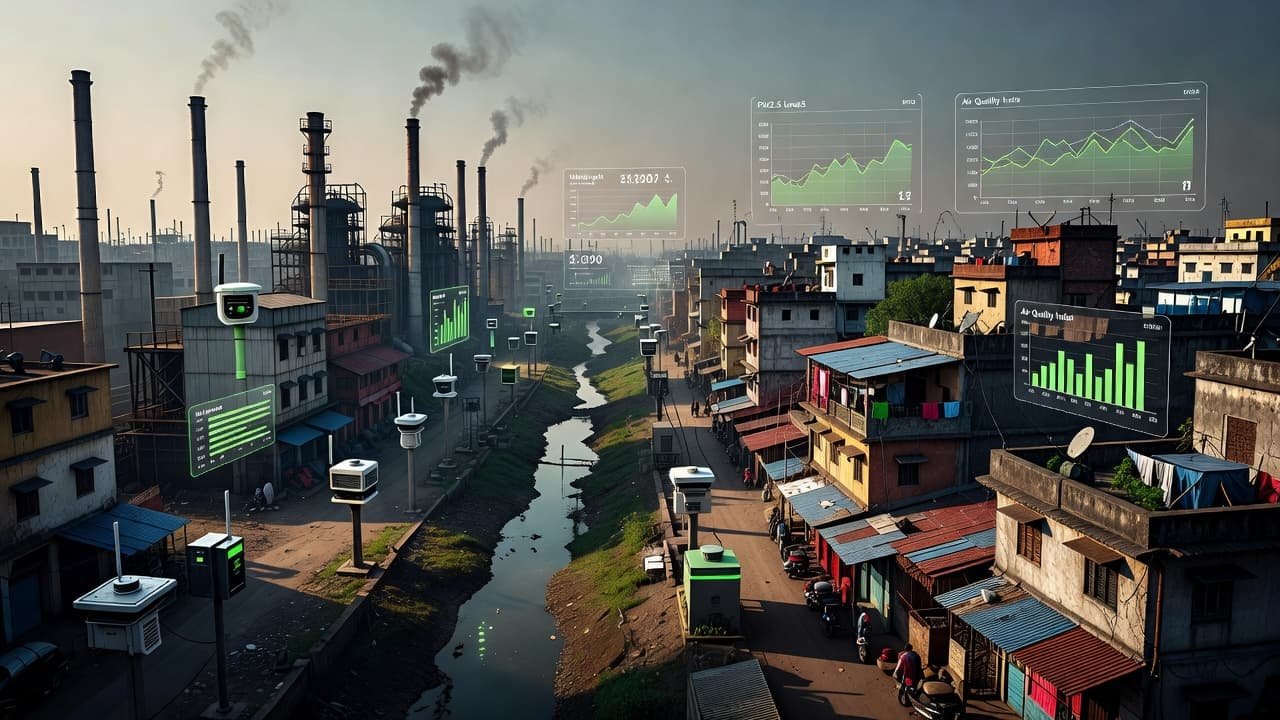
That picture requires multiple layers. CAAQMS, or Continuous Ambient Air Quality Monitoring Stations, provide reliable baseline data. However, they should be complemented by manual monitoring stations to ensure accuracy and verify findings. Calibrated low-cost sensors can extend coverage around roads, worker colonies, drains, farms, and schools, while satellite observations flag wider patterns. Field sampling can test the pollutants that sensors miss, including heavy metals in soil and PFAS in groundwater.
By integrating these tools, authorities can access the real-time air quality data necessary for rapid response. The network should measure pollution where people live, not only where companies prefer it to be measured.
| What needs tracking | Why it matters in an industrial cluster | Where monitoring belongs |
|---|---|---|
| PM2.5, PM10, Sulfur Dioxide, Nitrogen Dioxide and ozone | Captures combustion, dust, chemical reactions, and traffic pollution | Plant boundaries, homes, schools, freight corridors |
| Stack emissions and fuel use | Checks major point sources and suspicious gaps in operations | Chimneys, boilers, furnaces, captive power units |
| Effluent volume and water chemistry | Shows whether common drains and rivers receive a combined toxic load | Inlets, outlets, upstream and downstream points |
| Soil, road dust, and sediment | Reveals metals and persistent residues that move through daily life | Farms, playgrounds, drains, roadside shoulders |
| Waste handling and fires | Identifies pollution that escapes formal discharge systems | Scrap yards, landfill edges, transport routes |
| Health and complaint patterns | Connects technical readings with human harm | Clinics, worker settlements, local ward records |
The takeaway is simple. A cluster needs a pollution map, not a single number.
That map also needs time. A four-hour inspection window can miss a night-time discharge. A monthly sample can miss a rain event. An annual CEPI score can show deterioration, but it cannot protect someone from a bad evening of exposure.
Continuous data should sit alongside unannounced sampling. Both matter. Continuous monitoring systems can catch operational patterns, while independent samples can test whether the reported story matches the water, soil, and air outside the gate.
There is also a hard truth about low-cost sensors. They are not magic. Heat, humidity, dust loading, poor calibration, power cuts, and weak maintenance can distort readings. They should support reference-grade equipment, not replace it. A cheap sensor network with no calibration plan creates a new kind of blindness, one that comes with colourful dashboards.
Good monitoring asks practical questions:
- Are readings checked against reference equipment at regular intervals?
- Can the public see raw data, downtime, calibration records, and missing periods?
- Are sensors placed downwind and downstream, not only at neat administrative locations?
- Does the network record night-time, festival-period, and monsoon conditions?
- Are local communities able to report smoke, odour, ash, illness, fish deaths, or illegal dumping?
The final question often gets ignored. Residents notice patterns long before a committee meeting does. Their evidence should trigger sampling, not dismissal.
Data That Arrives Late Cannot Protect Anyone
Pollution data has political value. It can trigger inspections, compensation claims, court action, operating restrictions, and expensive upgrades. That is why public access matters.
A dashboard that publishes delayed averages after weeks of cleaning is not enough. Communities need plain-language, near-real-time readings that are as intuitive as a daily Air Quality Index. They also need the context behind those numbers: monitor location, pollutant type, safe thresholds, equipment downtime, and what authorities are doing when levels rise.
Numbers without response become another form of public theatre.
State Pollution Control Boards and the Central Pollution Control Board need clear cluster-level protocols. Aligned with the goals of the National Clean Air Programme, these protocols must ensure that when pollution rises across several sites, the response is not a stack of individual notices sent months later. Instead, authorities should trace sources, inspect shared infrastructure, audit fuel and waste flows, and publish deadlines for repair.
The Commission for Air Quality Management offers a useful lesson for the National Capital Region. Air moves across state borders, so regulation cannot stop at a district line. Industrial clusters need the same thinking. An airshed or river basin does not care which agency owns which file.
Public data also protects responsible businesses. A unit that invests in cleaner fuel, closed-loop water systems, leak detection, and high-quality pollution control equipment should not compete against a neighbour cutting costs by polluting at night. Honest monitoring exposes that unfair advantage.
This is where sustainable business models stop being a glossy annual-report phrase. They mean that the price of making a product includes safe treatment, worker protection, maintenance, and transparent reporting. If a company’s margin depends on hiding waste in a shared drain, it is not efficient. It is passing its bill to the public.
Pollution Is Also a Biodiversity and Labour Issue
Industrial pollution is often discussed through human health alone. That is necessary, but incomplete.
A contaminated drain enters a pond. The pond supports insects, fish, frogs, birds, and plants. Ash coats leaves beside a factory road. Dust blocks tiny soil spaces where water should soak in. Chemical runoff weakens the small green strips that cool an industrial town. The ecological impact spreads through systems that are already under pressure.
Urban biodiversity is not decoration around a factory gate. Trees, wetlands, pollinators, birds, and soil organisms are part of a living warning system. When they decline, people are usually breathing or drinking something they should not have to carry.
Research on industrial pollution in Odisha shows why air, water, and soil cannot be treated as separate environmental files. Heavy industry affects all three, and communities live at the intersection.
Workers carry a different burden. Contract labourers, drivers, waste pickers, security guards, street vendors, and residents in nearby informal settlements often experience a severe public health impact due to their proximity to pollution sources. The morning shift change creates a surge in vehicular emissions as trucks idle near factory gates, adding to the toxic load. These populations cannot buy a new air purifier for an open roadside stall, nor can they switch off contaminated groundwater or take an unpaid day off when the air quality is poor.
That is why cumulative monitoring must include health-linked signals without turning people into research subjects. Local clinics can track respiratory complaints. Schools can record absenteeism patterns. Worker groups can flag odour events, smoke episodes, and unsafe waste handling. The data should protect people, never expose them to retaliation.
A serious circular economy has the same duty. Recycling scrap, recovering solvents, reusing industrial water, and repairing equipment can reduce extraction and waste. But there is nothing circular about shifting hazardous dismantling, sludge, or contaminated materials onto unprotected workers.
What Accountability Looks Like on the Ground
We do not need another launch event with one sensor and a large banner. We need boring routines that hold up in rain, heat, night shifts, and election season.
Every major industrial cluster should operate under transparent Clean Air Action Plans. These frameworks should explicitly name the agencies responsible, identify pollution hotspots, set monitoring points, and publish the budget for maintenance. Under the guidance of the MoEFCC and the Central Pollution Control Board, these plans must clearly define the necessary interventions when pollution thresholds are crossed.
The strongest strategies prioritize a robust environmental monitoring network. While industry-funded monitoring can serve as a component of the system, it cannot be the sole witness to industrial impact. Universities, accredited laboratories, local bodies, and community representatives must hold a formal role in oversight to ensure data integrity.
There must also be real consequences for non-compliance. Repeat offenders should face escalating penalties, temporary production curbs, mandatory repairs, and clean-up obligations. Common effluent treatment plants need audits that test actual performance, rather than just capacity on paper. Furthermore, transporters carrying ash, chemicals, sand, or waste need to adhere to strict regulations involving covered loads and tracked routes.
Everyday mindfulness still has a place. You can notice dust on leaves, strange foam in a drain, repeated smoke after dark, and trucks dumping waste near a neighbourhood. You can document these patterns, support local reporting, and ask sharper questions at ward meetings.
However, individual caution has its limits. Plant-based living, lower-waste habits, public transport, and thoughtful consumption can reduce wider pressure on land and energy systems, but they cannot clean toxic water entering a village canal tonight. Telling families to shop better while a cluster keeps polluting is moral theatre.
We need climate literacy that tells the truth about power. Pollution is not only a personal lifestyle issue. It is a question of permits, budgets, inspection strength, land use, labour rights, and who gets believed when they say the air is making them sick.
Communities working on ecology and justice can build that public pressure. Explore Our Active Missions to see how direct action for ecosystems, education, and local resilience connects environmental concern with work that reaches the ground.
Frequently Asked Questions
Why is factory-by-factory compliance insufficient for industrial clusters?
Industrial pollution does not respect property lines, as emissions from various sources—such as chimneys, trucks, and waste piles—combine to create a shared toxic load. A single factory might meet its individual emission permit, but the cumulative impact on the surrounding community often far exceeds safe levels.
What does cumulative pollution monitoring entail?
It involves measuring pollution as it moves through a shared space, rather than just tracking isolated points of discharge. This approach integrates data from ambient air quality stations, soil and water sampling, and low-cost sensor networks to capture the total exposure experienced by people living and working nearby.
Can low-cost sensors replace regulatory-grade monitoring equipment?
No, low-cost sensors are intended to complement reference-grade equipment rather than replace it. While they can provide valuable spatial coverage around schools and neighborhoods, they require regular calibration and maintenance to avoid misleading data and ensure accuracy.
Why is public access to raw pollution data important?
Public access to transparent, real-time data allows communities to hold regulators and industries accountable for pollution levels. When citizens can see evidence of breaches in air or water quality, it becomes significantly harder for responsible parties to ignore or dismiss the health impacts on the local population.
Conclusion
An industrial cluster is a shared environment rather than a collection of isolated factories. Its smoke, dust, wastewater, waste routes, and traffic merge long before regulators file separate reports.
To address these systemic risks, shifting toward a robust ambient air quality monitoring strategy is essential for protecting public health. India must move beyond fragmented oversight and embrace comprehensive cumulative pollution monitoring in India to accurately reflect the reality of industrial impact. We need to measure the combined load, publish the evidence, protect the people closest to the sources, and make polluters pay for the harm they create.
Clean production is not proven at a single factory gate. It is proven by what the surrounding community can breathe, drink, grow, and live with every day.