
Why Construction Dust Screens Fail on Indian Building Sites
 TBH Editorial
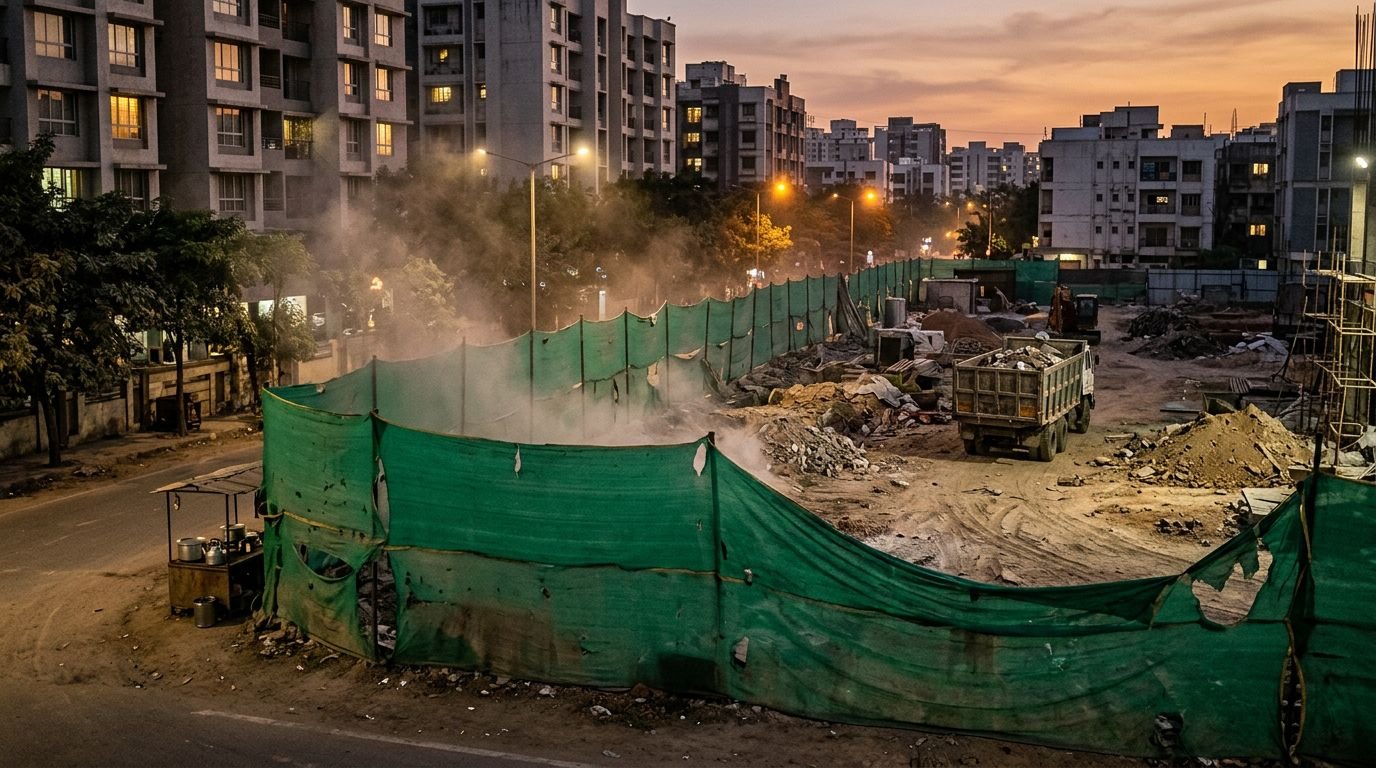
A green net flapping around a construction site can make a city feel safer. It can also hide a bad truth: dust is still leaving the site, settling on lungs, lunch carts, school bags, windows, and roadside trees.
Construction dust screens in India are often treated as the primary visual proof that a builder has acted responsibly. But a screen is only a boundary. It cannot fix uncovered debris, dry cutting, overloaded trucks, broken road shoulders, or workers sweeping fine dust into the gutter.
If we want cleaner streets, we have to stop judging a site by what it looks like from the road.
Key Takeaways
- Dust screens catch some large particles, but they fail when dust escapes above, below, and around the barrier.
- A screen without water control, effective dust control, covered transport, and safe material storage is often a compliance prop.
- Construction dust can contribute to respiratory issues for people outside the site, especially workers, children, street vendors, and nearby residents.
- Systemic change means making air pollution control part of contracts, inspections, road design, and project budgets.
- Cleaner construction is not a luxury. It is basic public-health accountability.
A Screen Is Not a Dust-Control Plan
A dust screen can help. That needs to be said plainly.
A properly fixed, well-maintained barrier at construction sites can reduce visible debris and slow some coarse particles near a site boundary. It may also stop loose packaging, cement bags, and lightweight waste from drifting into neighbouring streets.
The problem starts when the screen becomes the whole plan.
While many contractors rely on temporary fencing or scaffolding screens, these solutions often lack the efficiency required to manage airborne threats. Fine particulate matter does not behave like a plastic bag caught on a fence. PM10 and PM 2.5 particles can rise with vehicle movement, drilling, demolition, cutting, wind, and dry sweeping. A mesh barrier may catch what is large enough to see, while smaller particles pass through gaps or travel over the top.
Outdoor air is not a sealed room. It moves through unfinished floors, open gates, temporary access roads, and gaps beneath the fencing. One dry afternoon with a concrete cutter can undo a week of neat-looking site management.
A dust screen can soften the view from outside. It cannot clean the air that has already escaped.
That distinction matters in dense Indian neighbourhoods. Construction often sits beside homes, clinics, markets, bus stops, and schools. A child does not need to enter a site to breathe its dust. They only need to walk past the gate twice a day.
The World Health Organization’s guidance on ambient air pollution makes the health stakes clear. Fine particles can travel deep into the lungs and are linked to respiratory and cardiovascular harm. For people with asthma, older adults, children, and outdoor workers, exposure is not an abstract environmental concern.
Where Construction Dust Screens Break Down
Most failures are not mysterious. They are visible if someone takes ten minutes to walk around the site instead of looking at its front gate. Often, these failures occur because site managers ignore civic body regulations, treating dust management as a box-ticking exercise rather than a functional requirement.
A screen fails when it is too short for the work happening behind it. A five-storey building under demolition throws dust far above a low boundary mesh. Wind carries it across the street before it has any chance to settle. Furthermore, high-quality netting should offer 90% blockage to be effective; anything less simply allows particulate matter to drift through gaps.
It also fails when the bottom edge is loose or when the material is poorly secured. Frequently, this mesh is attached to a chain link fence without proper tension, creating gaps that negate the purpose of the barrier. Trucks pass through wide gates, and labourers drag material across open patches. Fine dust blows under the screen, then sits on the road until the next bus or motorcycle lifts it back to breathing height.
The common weak points are painfully ordinary:
- Open debris piles dry out under the sun and shed dust with every gust of wind.
- Uncovered trucks carry soil, broken concrete, and sand through public roads.
- Dry cutting and grinding create dense local clouds that a perimeter barrier cannot contain.
- Dirty vehicle tyres drag mud and dust from the site onto the road.
- Dry sweeping moves dust around rather than removing it safely.
- Damaged screens remain torn for weeks because no one owns the repair.
That last point tells us a lot. A screen does not fail because mesh is useless. It fails because dust control gets treated as a one-time purchase instead of daily work.
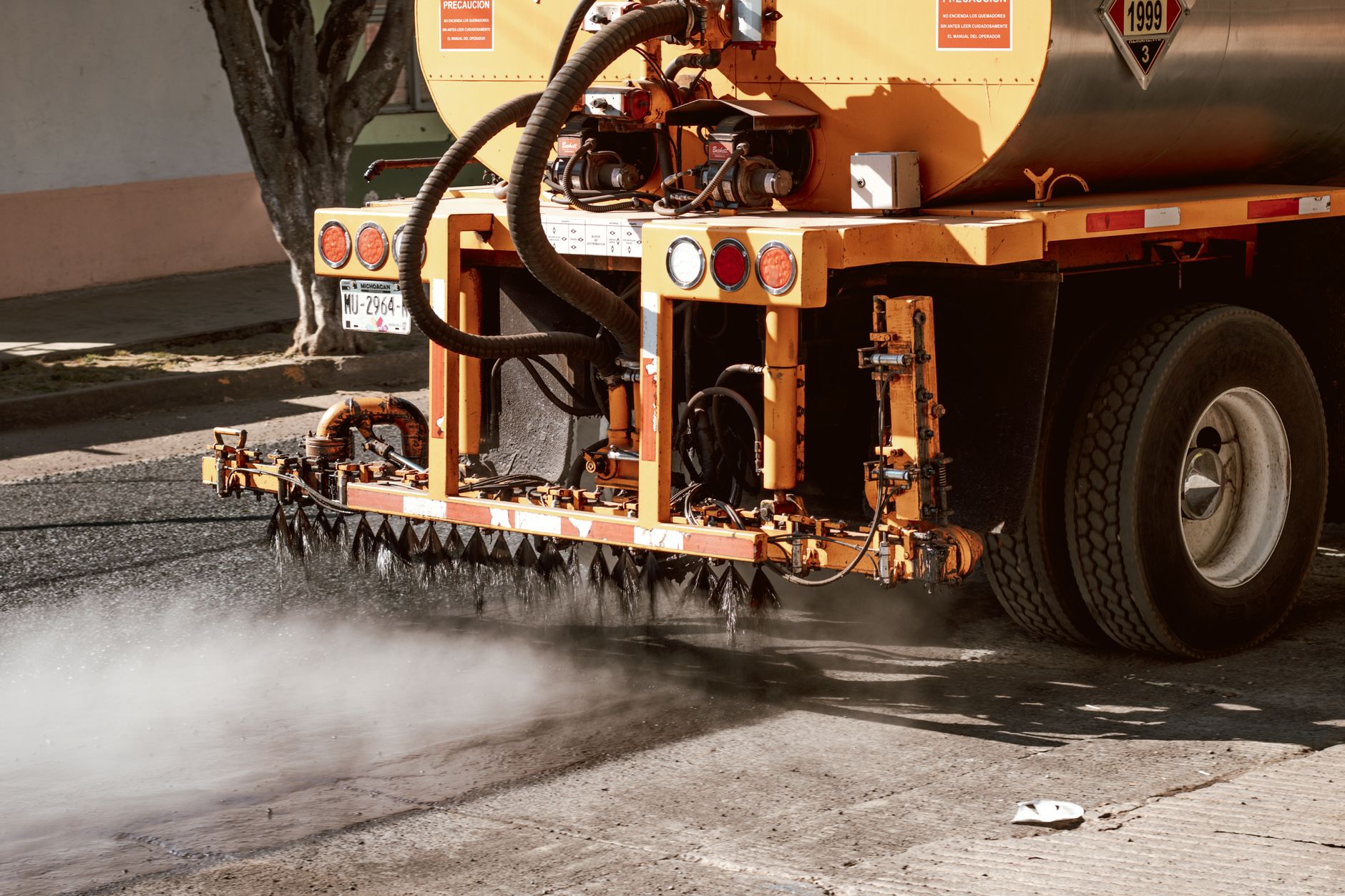
Photo by Juan Manuel Montejano Lopez
Water spraying can help, but it has limits too. A tanker making one quick round for an inspection is not dust suppression. Water must reach the active work zone at the right time without creating contaminated runoff that enters drains. Ultimately, consistent daily spray routines are essential pollution control measures that must be integrated into the workflow.
The Dust You Cannot See Often Does More Harm
Visible dust draws complaints. However, fine dust is often ignored simply because it does not create an obvious brown cloud.
That is a dangerous mistake. Exposure to these microscopic particles is a primary driver of chronic respiratory issues for vulnerable populations living and working near construction zones.
Construction activity releases coarse mineral dust, cement particles, silica-containing material, asbestos from ageing buildings, paint residue, diesel soot, and soil already mixed with traffic pollution. On crowded roads, these particles join tyre wear, brake dust, fly ash, and exhaust. The result is not simple dirt; it is a complex cocktail of pollutants.
A road may look clean after a quick wash, but that appearance is fleeting. As soon as cars, bikes, and trucks pass through, the settled material rises back into the air.
This is why construction sites should not be assessed only by a citywide air-quality average. A monitor located several kilometres away cannot show what a security guard, tea seller, or schoolchild breathes while standing beside an active gate. Real-world exposure depends on concentration, time, distance, and how often fresh dust enters the same street.
The Central Pollution Control Board publishes national pollution-control information, but genuine progress depends on how strictly construction companies adhere to environmental norms at the ward and worksite level. A rule that exists only in a tender document does not protect anyone standing beside a dusty road.
We also need to talk about the people carrying the greatest burden. Traffic police, delivery riders, sanitation workers, construction labourers, street vendors, and residents near freight corridors cannot simply close a window and wait for better air.
Their bodies become the filter when the system fails.
Compliance Often Stops at the Gate
Many sites are built around a familiar ritual. Install a green net. Put up a safety board. Arrange a water spray before a visit. Clear the entrance. Then continue as before.
That is not accountability. It is stage design.
A contractor may have a dust-control clause, yet subcontractors are paid by speed and volume. A truck driver may be told to cover a load, but no one checks after the truck leaves. Labourers may have no protected place to cut tiles or mix cement. The site manager may know the rules but lack the budget or authority to delay work.
The failure is structural.
| What looks compliant | What real control requires |
|---|---|
| Green mesh privacy fence screen with UV protection | Sealed edges, enough height, daily checks, and fast repairs |
| One water tanker | Regular wet suppression at active dust points |
| A clean entrance | Wheel washing and paved exit routes |
| A covered pile | Covered storage plus controlled loading and unloading |
| One inspection photo | Records, worker training, monitoring, and penalties for repeat failures |
The takeaway is simple: a screen only works as one layer in a wider system.
Builders also need to stop treating dust as somebody else’s problem after material leaves the site. Loose soil on a public road becomes everybody’s exposure. It gets crushed under tyres, carried by wind, and brought into shops and homes on shoes.
That has an ecological impact too. Without effective dust control, construction residue coats leaves, reduces plant health, clogs small urban green spaces, and places more pressure on already fragile urban biodiversity. A street tree cannot cool a neighbourhood well if its roots are sealed under concrete and its leaves are constantly coated with construction residue.
What Serious Construction Dust Control Looks Like
The better approach is not glamorous. It looks like boring routines done every day, even when no camera is present. When setting the standard, think of industrial dust screens as your performance benchmark rather than just a visual barrier.
First, dust has to be controlled where it starts. Cutting, crushing, drilling, and demolition need local suppression, enclosed work areas where possible, and methods that reduce dry airborne material. Material should not wait in loose piles beside an open gate.
Second, sites need clean movement to ensure effective contamination prevention. Vehicles should leave through paved routes, tyres should be cleaned before entering public roads, and trucks carrying loose material must be covered properly. Broken shoulders near the site should be repaired, not left as a permanent dust bank.
Third, waste needs a destination. Mixed debris often becomes a roadside pile because moving it costs money and coordination. That is where a real circular economy matters. Segregated concrete, metal, wood, soil, and packaging are easier to recover or process than one contaminated mound of everything. To manage this effectively, waste storage areas should maintain a dust-tight seal to prevent particles from escaping into the surrounding neighborhood.
This is also where sustainable business models need to grow up. A builder cannot claim environmental responsibility while pushing low-value debris, dust, and risk into nearby communities. You should aim for site standards that mirror the rigor found in clean manufacturing facilities, warehouse environments, or any live production environment. For high-rise projects, this often requires the use of floor-to-ceiling screens or heavy-duty PVC coated fabric barriers to fully contain the workspace. A project budget should include covered transport, safe storage, recovery systems, monitoring, and trained workers from day one to ensure a comprehensive dust control strategy.
For residents, the useful questions are direct:
- Is dust leaving through the gate or collecting on the road?
- Are trucks covered before they join public traffic?
- Is cutting happening dry in the open?
- Are screens intact on every side, not only the side facing the main road?
- Does the site have a way to receive and act on complaints?
You do not need technical language to notice unsafe conditions. A grey film on a window grill is evidence. So is dust on roadside fruit, parked scooters, and school uniforms.
Individual care still matters. Everyday mindfulness can mean checking local air conditions, closing windows during active demolition, cleaning settled dust with a damp cloth, and supporting public transport or plant-based living choices that reduce wider pollution pressures. But personal habits cannot replace a clean construction system.
That is why Explore Our Active Missions matters. Community work on climate literacy, local ecosystems, and public accountability gives people a way to connect daily exposure with the policies and projects shaping their neighbourhoods.
Frequently Asked Questions
Why do construction dust screens alone fail to contain air pollution?
Screens act only as a physical boundary and cannot address dust generated by dry cutting, uncovered transport, or loose debris. Because they are often poorly secured or incomplete, fine particulate matter easily escapes through gaps, over the top, or under the base.
What are the most critical components of an effective dust control plan?
An effective plan requires consistent wet suppression during active work, wheel-washing stations for exiting vehicles, and fully covered transport for waste materials. Real control involves daily operational routines rather than just installing a barrier for visual compliance.
How can residents identify if a construction site is failing to manage dust?
A visible layer of dust on parked vehicles, roadside fruit, or window grills is a strong indicator of inadequate control. Additionally, observing dry cutting in open areas, uncovered debris piles, or trucks exiting with loose soil reveals that the site’s dust management is likely performative rather than functional.
Build Better, Not Just Taller
Construction dust screens fail when they are asked to perform a job they were never built to do. They are a partial barrier, not a public-health strategy.
The real work is less photogenic: covered loads, wet methods, clean exits, repair budgets, worker training, debris recovery, and inspections that reach the back lane as well as the front gate. Forward-thinking construction sites must prioritize and budget for these essential measures to ensure the project remains safe and compliant.
A building should not leave a dirty road and damaged lungs as part of its foundation. Systemic change starts when air pollution control becomes a non-negotiable condition of construction, rather than just a green mesh added for the photograph. It is time for the industry to move beyond superficial fixes and understand that effective dust management requires more than just installing construction dust screens India sites rely on for appearances alone.