How Seawalls Make Beach Erosion Worse in India
 TBH Editorial
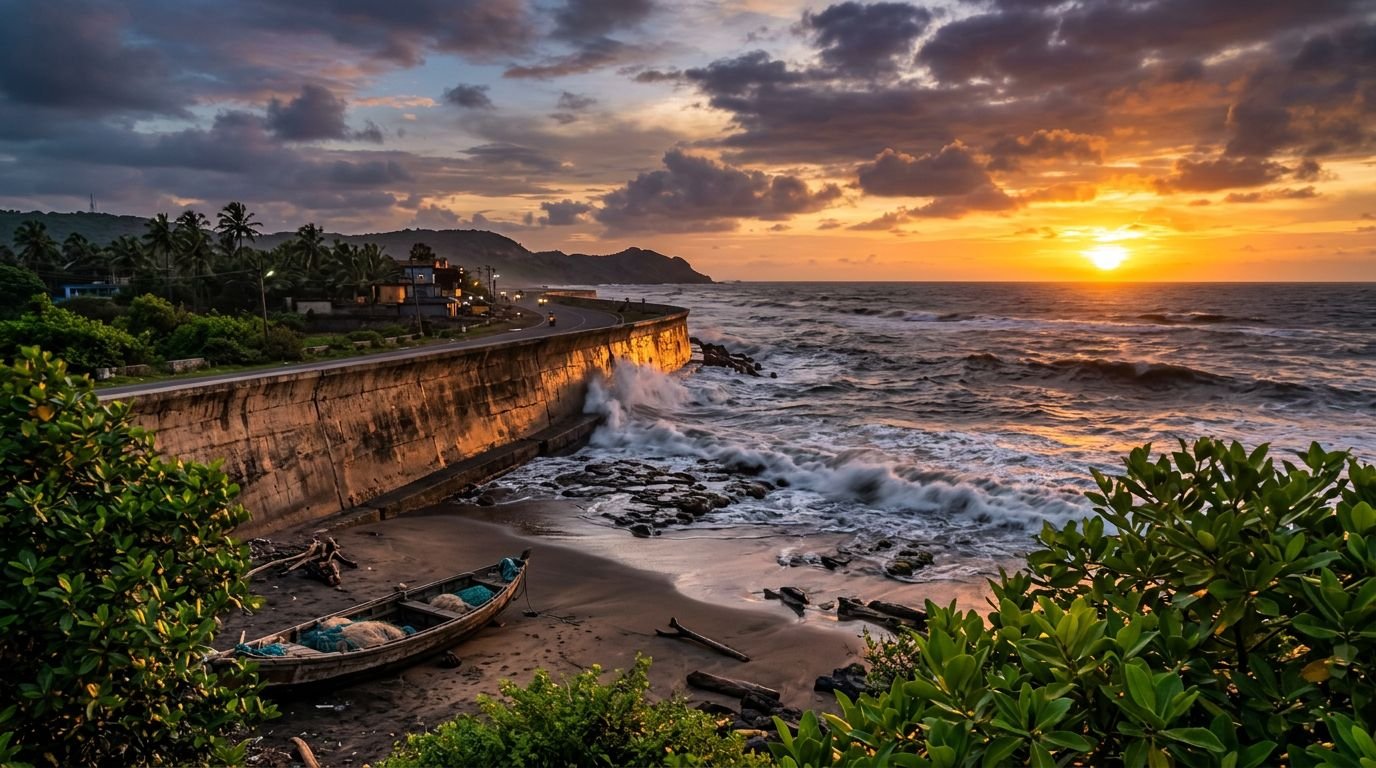
A seawall can save a road while simultaneously destroying a beach. This tension sits at the center of the debate regarding seawalls and beach erosion in India, where concrete structures often masquerade as safety until the surrounding sand begins to disappear.
If you care about the health of our coasts, the impacts of climate change, or the survival of local communities, this issue is critical. A beach is not simply spare land; it is a dynamic buffer, a workspace for fishers, a vital habitat, and frequently our first line of defense against coastal erosion. To understand why building hard walls can actually accelerate the loss of our shorelines, you must look beyond the initial construction and focus on how sand moves along the coast.
Key Takeaways
- The Paradox of Protection: Seawalls create a false sense of security by protecting specific assets while simultaneously accelerating the loss of the surrounding sandy beach through erosion and scour.
- Disruption of Natural Systems: By creating a rigid boundary, seawalls prevent beaches from naturally retreating during high tides and storms, a process that leads to the eventual total disappearance of the beach, known as coastal squeeze.
- Exporting Risk: The damage caused by seawalls rarely stays local; the reflection of wave energy and the blocking of natural sand movement often shift erosion to neighboring, unprotected shorelines.
- The Planning Failure: Current coastal management often prioritizes immediate, visible construction projects over long-term, systemic studies of sediment budgets, often resulting in fragmented policies that lack long-term sustainability.
- Nature-Based Alternatives: Effective coastal defense requires moving toward ‘soft’ solutions like beach nourishment, dune restoration, and strategic setbacks that work with, rather than against, natural tidal and sediment cycles.
Seawalls protect property first, not sand
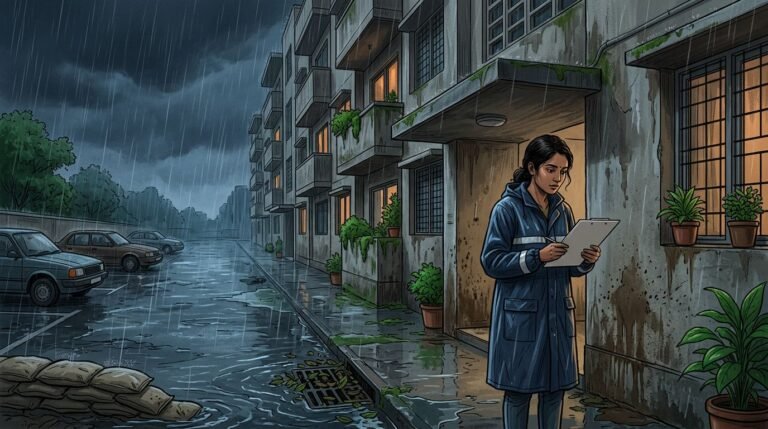
When waves threaten homes or vital highways, officials lack the time for long-term planning. Residents demand an immediate solution before the next monsoon season, and seawalls often serve as the first line of defense. These barriers create a rigid interface between land and sea, providing temporary relief by reducing direct wave energy against critical infrastructure.
This short-term gain is significant. Because roads, homes, hotels, shrines, and fishing harbors along the Indian coastline are often situated dangerously close to the surf, the constant threat of coastal flooding and cyclone damage makes inaction feel costly. In this climate, concrete infrastructure feels like a safer investment than long-term coastal management, and elected officials face immense pressure to approve visible, immediate results.
However, a beach is not merely static property waiting to be secured. It is a dynamic, moving system. Sandy beaches shift constantly in response to tidal cycles, storm events, sediment input from rivers, and seasonal currents. The dry beach that appears wide in March may be significantly stripped by July. Beaches naturally absorb, store, and redistribute wave energy over time, but hard structures cannot replicate this flexibility.
A seawall can pin the landward edge of the beach, but it cannot accommodate the natural motion of the shoreline. As the coast attempts to retreat, the sand in front of the wall is eventually squeezed out, leaving it no room to migrate. While the structure may protect a single parcel of land, it does not protect the natural coastal processes that kept that property resilient in the first place.
This is where the public discourse often falters. A project report may highlight the meters of road preserved, while local residents report the disappearance of sandy beaches, restricted access for fishing boats, and increased wave energy impacting neighboring properties. Both sets of data are accurate, yet only one is typically used to label a project a success.
Across much of India, this disconnect is particularly severe because densely populated communities share the same narrow coastal strip. Once seawalls are installed, the impact is no longer localized. These structures fundamentally alter how waves break, where sediment settles, and which community is forced to absorb the next round of environmental damage.
What happens when waves hit a hard wall
On a natural beach, sloping sand absorbs part of the wave energy. Water runs up the beach, slows down, and returns to the ocean. While the shape of the beach changes, the surface gives way and shifts to accommodate the water. A vertical or near-vertical wall behaves differently. It reflects much of that incoming energy back into the surf zone.
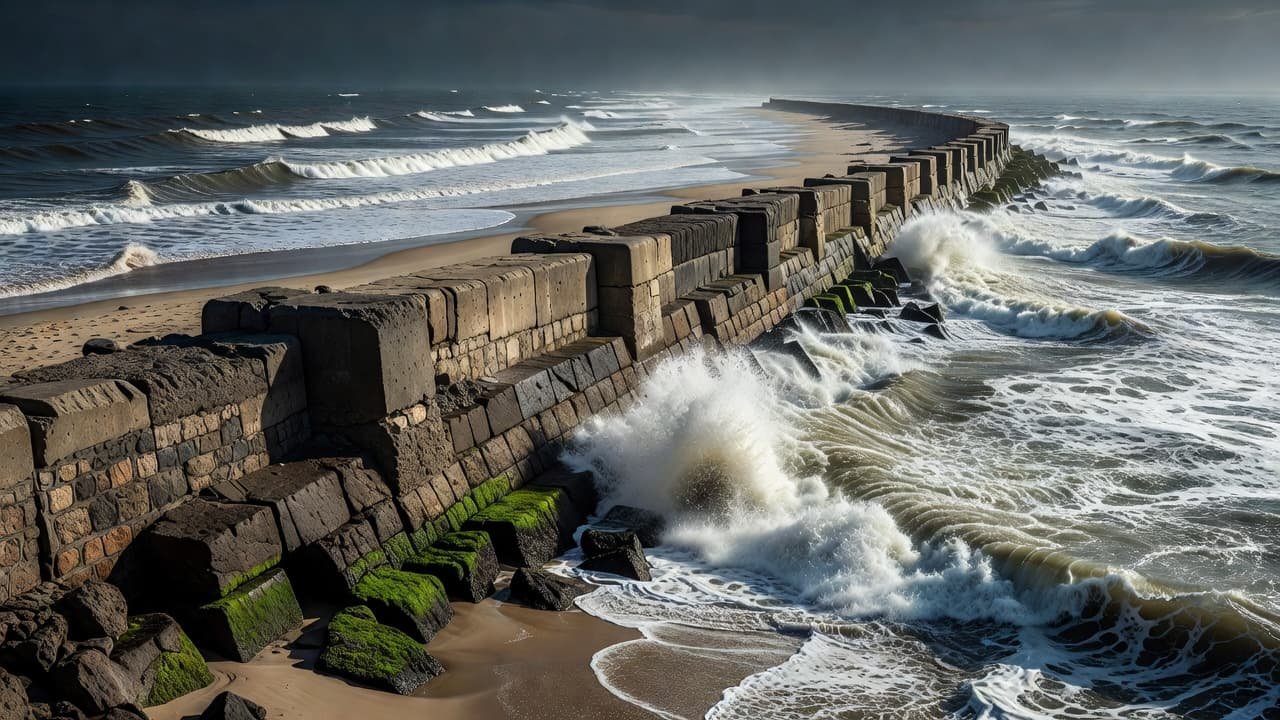
This wave reflection churns the water at the base of the structure. That intense turbulence causes scour, which removes sand, lowers the beach level, and creates a much steeper profile. Beachapedia’s summary of active erosion describes this process clearly. A coastal engineering study on seawall effects points to the same connected issues, including wave reflection, downward scour, and a reduced sediment supply from the armored shore.
Once the sand level drops, higher tides reach the wall more frequently. Each wave then hits concrete instead of the natural buffer provided by sandy beaches. This can trigger a destructive cycle; less sand leads to more wave force on the wall, and more force leads to even deeper scouring. Over time, the dry beach shrinks, and at some sites, it disappears for long periods of the tidal cycle.
This process is easy to miss if you only visit soon after construction. A new wall looks solid, and the first few months may even look calmer behind it. However, beaches respond over seasons and storms. Repeated high tides, monsoon waves, and storm surge expose the problem much faster.
A wall can hold a property line for a while, but it cannot replace a living beach.
Sea level rise makes the math much worse for these structures. Beaches usually respond to changing tides by moving inland. When a seawall blocks that natural retreat, the shore gets squeezed between rising water and fixed concrete. This phenomenon is known as coastal squeeze, and the result is plain to see. The public beach narrows until it eventually vanishes at high tide.
A second issue gets far less attention. Eroding dunes, bluffs, and backshore areas often feed sand to nearby stretches of the coast. A wall may stop that local input entirely. Consequently, the structure does not only react to erosion; it also interrupts the natural sediment exchange that helps beaches recover after major storms.
Why Indian shorelines pay a higher price
India possesses one coastline on a map, but it functions as many unique coastlines in practice. Factors like wave climate, sediment supply, river mouths, offshore bathymetry, and storm patterns vary significantly from state to state. For instance, the complex dynamics along the coast of Tamil Nadu illustrate how a design suitable for one pocket beach might trigger unintended consequences on a long, open shore. Copying one structural design from one district to another is inherently risky.
Many Indian shorelines already carry significant environmental stress. In some regions, ports, jetties, dredging, river engineering, and extensive shoreline construction have permanently altered natural sand movement. In other areas, the health of the beach depends on delicate seasonal replenishment cycles that can be disrupted by a single new obstacle. On many coasts, a beach that appears stable during one season is merely storing sand that another season will inevitably pull away.
When you add monsoon swells, frequent cyclone landfalls on the east coast, and rising sea levels, the margin for error becomes razor thin. Human pressure exacerbates these risks, as large populations reside in close proximity to the water. Fishing villages, apartment blocks, beach roads, tourism businesses, and public utilities often compete for space within the same narrow coastal belt.
As a result, coastal erosion has evolved into a frequent political emergency. The fastest response is usually the installation of hard structures, even when the coast demands a more comprehensive study first. Reports from organizations like the National Centre for Coastal Research have warned that hard structures are often deployed without sufficient analysis of local sediment transport or the potential impacts on neighboring villages. This report on planning failures along India’s coasts captures that tension well.
A wall may provide a sense of security in one hotspot while exporting risk further down the shore. This is where climate literacy becomes vital. Many people understand flooding solely in terms of water height, but the reality of seawalls and beach erosion in India depends on complex sediment budgets and movement patterns. A coast can lose its natural buffer even when the wall remains standing. This process is difficult to observe in a single season, but it becomes undeniable over several monsoons.
Addressing the issue of coastal erosion is not only an engineering challenge but a failure of planning. If the study area stops at the project boundary, the solution is fundamentally flawed before construction even begins.
Erosion spreads beyond the construction site
The damage from a seawall rarely stops at its footprint. Waves bend around the ends of hard structures, and currents adjust to the new shape. When these structures, including seawalls and groynes, block the natural movement of sand known as longshore drift, the shoreline is forced to adapt elsewhere. This often intensifies the attack on unprotected stretches beside the wall. Coastal engineers call these end effects. Nearby residents often describe it in plain terms: their beach started disappearing after someone else built a wall.
That shift matters because Indian coasts are lived-in spaces, not empty buffers. Fishers need room to land boats, pull nets, dry gear, and sort catch. Street vendors and local families use the shore as common ground. Children cross it to reach neighboring hamlets or launch small boats. When the beach narrows, access gets steeper, rougher, and more dangerous. During high tide, there may be no usable strip left at all.
A narrower beach can also hit local income. Visitors stop coming to some stretches when the shoreline turns into broken riprap and narrow high-tide water. Public value drops even where private assets remain protected.
The environmental impact is also larger than many project files admit. Narrow beaches leave less room for turtle nesting, ghost crabs, shorebirds, dune plants, and the small intertidal life that supports wider food webs. On urban coasts, beach loss also cuts into urban biodiversity. That matters in places where people already live with too little contact with functioning nature.
This contrast is easier to see side by side.
| What often gets counted | What often gets ignored |
|---|---|
| A road or wall segment protected today | Sand loss in front of the wall over time |
| Faster emergency construction | Higher erosion on adjacent shores |
| A fixed asset line on paper | Reduced access for fishers and residents |
| Initial project cost | Long-term maintenance and habitat loss |
The takeaway is blunt. A seawall can protect one asset while shifting costs onto public space, neighboring communities, and living systems that never sent an invoice.
That is why beach erosion around seawalls in India can become a justice issue. People with formal property records often receive the first defense, while people who rely on common beaches for work, food, and safe passage often bear the brunt of the side effects caused by these seawalls.
The policy problem is bigger than engineering
If seawalls can create so many problems, why do they keep winning bids and approvals? The answer is less about ignorance than about incentives. After storm damage, officials need something that reads as action before the next tide cycle and before public anger hardens. Concrete fits the moment. It can be surveyed, funded, tendered, and photographed. A healthier beach system is slower, less dramatic, and harder to explain in a press note.
Budgets also favor hard projects. They fit public works templates and contractor networks. Their benefits look local and immediate, while their losses are spread out in space and time. That bias can hide bad economics. Rebuilding a wall, repairing toe failure, and extending protection farther down the shore can lock governments into recurring maintenance costs for years.
In some places, poorly designed or undersized walls fail faster and deepen local scour, leading to sediment starvation as the natural exchange of sand is blocked. Governance adds another layer of complexity. Disaster management, fisheries, tourism, coastal zoning, ports, and urban development often work on separate tracks. Each office sees one slice of the coast, yet the beach suffers the combined result. Integrating these disparate departments into comprehensive shoreline management plans is essential to avoid the fragmented approach that currently dominates policy.
This is where systemic change has to enter the discussion. Coastal decisions should measure the whole sediment cell, the stretch of coast that shares sand movement, not a single parcel. They should price beach access, habitat, and downstream erosion into the appraisal rather than treating them as side notes. Even when legal bodies like the National Green Tribunal intervene in contentious construction disputes, the fundamental shift must be toward long term ecological planning.
A broader economic lens helps. A circular economy approach asks whether public money is being poured into repeated extraction, hauling, and repair with little lasting value. Coastal tourism, ports, insurers, and developers also need sustainable business models that stop treating beaches as expendable buffers for private assets.
The issue is accountability. When a wall moves risk out of view, someone still pays for it. Usually that someone is a village, a municipal budget, or a degraded coastline.
What works better than more concrete
Better coastal protection starts with a simple rule. Save people and essential infrastructure, but do not assume every eroding shoreline needs a hard edge. Many coasts respond better to nature-based solutions that work with natural sand movement. These include beach nourishment, dune repair, native vegetation, setbacks for new construction, mangrove restoration in suitable estuaries, and selective relocation where repeated defense no longer makes sense.
These options, often referred to as soft solutions, are not weak in the casual sense. They can be technically demanding, politically hard, and sometimes expensive upfront. Yet they address the real system. A nourished beach absorbs wave energy, dunes store sand and rebuild after storms, and mangroves slow water while protecting muddy or estuarine edges. Implementing living shorelines creates a dynamic buffer that is far more resilient than rigid concrete. Furthermore, setbacks keep tomorrow’s damage from being built into today’s approval.
Some shorelines also need honest no-build zones. When policy keeps approving new structures too close to the surf, it creates tomorrow’s demand for another wall. Prevention is less visible than repair, but it is often cheaper and fairer.
Hybrid plans can also work. Critical sites, such as a port facility or a dense settlement with no retreat space, may need engineered protection. But even there, walls should be the last line, not the whole plan. Design needs local wave data, seasonal monitoring, public access mapping, and open review of what happens beyond the project site.
Community knowledge matters too. Fishers, ferry workers, and coastal residents often know where the beach widens after monsoon, where currents bite, and which patches once held dunes or vegetation. Good planning treats that memory as data, not anecdote.
Transparent follow-up matters just as much. If a project claims success, the public should be able to see shoreline change, access conditions, and maintenance cost over time. The point is repair with evidence, not symbolic green branding.
If you want examples of grounded work that links mangroves, urban biodiversity, and climate literacy to public action, Explore Our Active Missions. Tangible local projects don’t replace national policy, but they help show what accountability can look like on the ground.
Personal values help, but public systems decide the coastline
For many readers, sustainability starts in daily life. You may care about plant-based living, low-waste routines, ethical work, or everyday mindfulness. Those choices matter because they shape demand, attention, and civic values. Still, no personal routine can offset a coastline planned with bad incentives and weak oversight. While you might try to reduce your individual footprint, these actions cannot stop the systemic risks of coastal flooding or the steady advance of coastal erosion.
That tension can feel frustrating. You sort waste, watch consumption, and support better food systems, yet a single shoreline project can erase public sand, damage habitat, and move risk to a poorer village. Personal ethics are still useful here. They train attention. They help you notice when a project, such as the construction of heavy seawalls, protects a private asset but strips away the commons.
Public understanding matters because real climate action is not only about carbon. It is also about land use, sediment, access, and whose losses get normalized. Climate literacy means you can spot the gap between a project that protects people and a project that only hides damage for a while.
You don’t need to be a coastal engineer to ask good questions. Has anyone studied adjacent erosion? What happens to the beach at high tide in five years? Who loses access? Is there room for dunes, nourishment, setback rules, or retreat instead of more concrete?
The broad lesson reaches beyond the shoreline. Sustainable places depend on rules that respect living systems. Personal habits help you see the problem. Public pressure changes whether the problem keeps getting poured in concrete.
Frequently Asked Questions
Why do seawalls make erosion worse?
Seawalls reflect wave energy back into the surf zone rather than absorbing it like a natural, sloping sandy beach. This creates intense turbulence at the base of the wall that scours away sand, leading to a steeper beach profile and deeper water, which in turn allows even more powerful waves to strike the structure.
Can we just build bigger seawalls to solve the problem?
Building larger or stronger walls does not solve the underlying issue of sediment starvation and coastal squeeze. Larger structures often result in higher maintenance costs and increased erosion on adjacent properties, essentially trading one problem for a larger, more expensive one down the road.
What are some examples of ‘soft’ coastal protection?
Soft solutions focus on natural resilience, such as planting native vegetation to stabilize dunes, artificially adding sand back to eroded areas through beach nourishment, and restoring mangrove forests that naturally slow water. These methods create dynamic, flexible buffers that can adapt to changing ocean conditions better than concrete.
How does the loss of a beach affect local communities?
Beaches are vital hubs for fishing, transport, and public recreation, so their loss significantly disrupts the daily livelihoods of coastal residents. When a public beach is replaced by a concrete wall, communities lose safe access to the water, valuable habitat for coastal wildlife, and a natural defense mechanism that helps protect their homes during storm surges.
Conclusion
Building seawalls can protect a specific structure while simultaneously accelerating beach loss. Along much of India, this occurs because these rigid barriers reflect wave energy, scour sand, block natural retreat, and push erosion onto adjacent shores.
Safer coasts require more thoughtful strategies. We must prioritize human safety, study the health of the entire shoreline, and stop treating our sands as disposable space in front of fixed assets. While a road may require defense, a healthy beach acts as a vital buffer that naturally dissipates wave energy.
If current policies continue to prioritize private property at the expense of our coastline, the environmental and economic costs will continue to mount with every passing monsoon.