
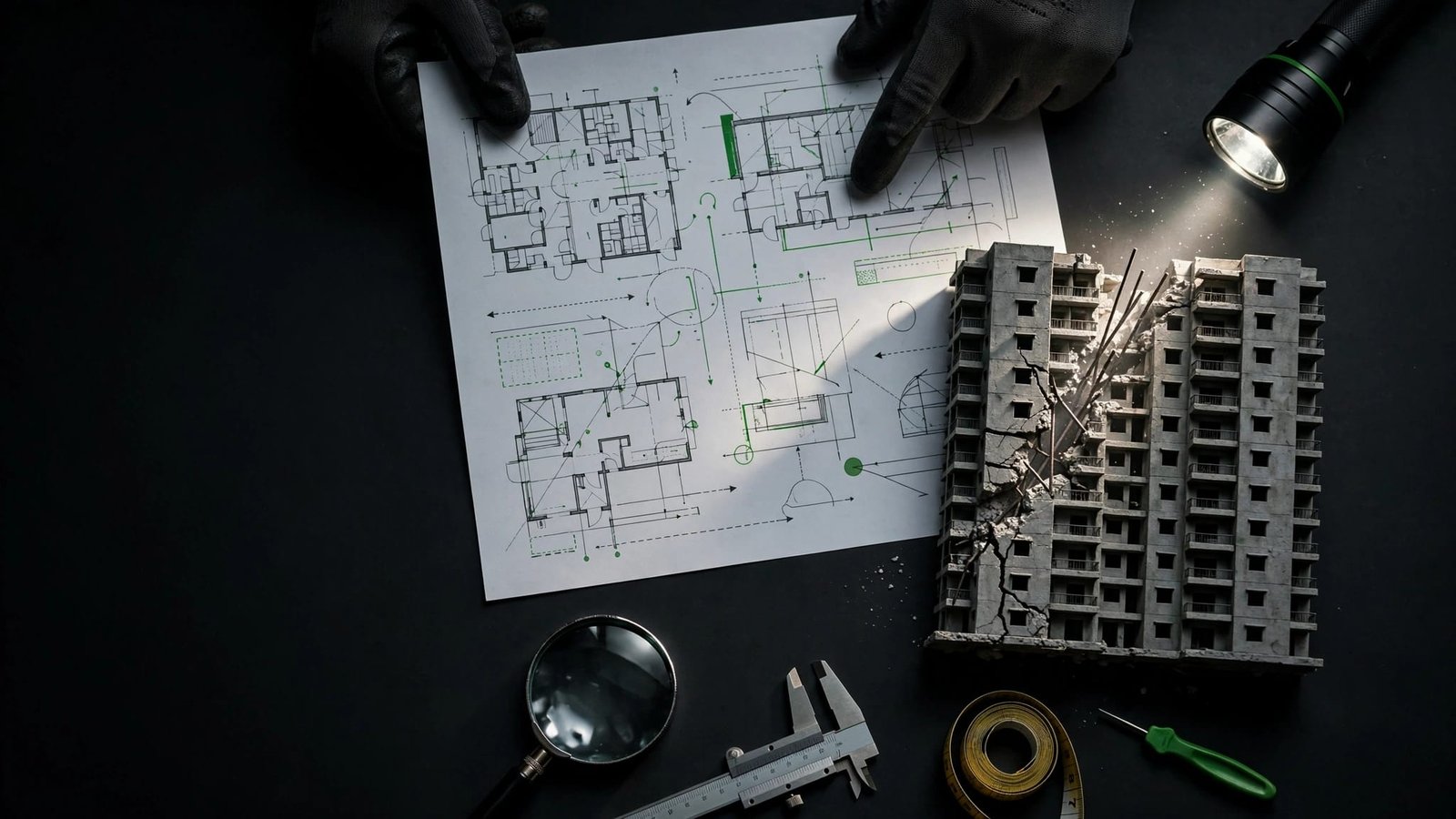
How to Read a Structural Audit Report Before Buying
 TBH Editorial
A fresh coat of paint can hide a crack. It can’t fix the reason that crack appeared.
Before you pay a booking amount, a structural audit report can tell you far more than a broker’s “everything is fine.” But only if you know what you’re reading, what is missing, and where the report stops being evidence.
Buying an apartment is also buying into years of decisions by a developer, contractor, managing committee, and local authority. Start with the documents, then make the building answer for itself.
Key takeaways before you sign
A structural audit is not a single national pass-or-fail certificate for every Indian apartment resale. Its value depends on the engineer’s independence, the tests performed, the report date, and whether the findings match the building you are buying.
Keep these points in front of you:
- The report must identify the exact tower, wing, address, plot or survey number, and inspection date.
- Check who signed it, their qualifications, registration details where applicable, and whether they were hired by the developer or society.
- Read the scope before trusting the conclusion. A visual inspection is not the same as an investigation using tests.
- Compare it with the sanctioned plan, Occupancy Certificate, repair records, and the building as it stands today.
- Don’t let a “satisfactory” conclusion erase listed defects, deferred repairs, seepage, corrosion, or missing evidence.
- If a serious concern is unclear, pay for an independent structural engineer before you pay for the flat.
A report can describe the condition seen on inspection day. It cannot make years of ignored maintenance disappear.
What a structural audit report can, and cannot, prove
A structural audit report reviews a building’s visible condition and, where included, test results, design records, and repair needs. It can flag distress in columns, slabs, beams, foundations, walls, balconies, and common areas.
It cannot promise that a building will never develop a defect. Nor can it replace legal due diligence, a title check, or a site visit in heavy rain.
An audit is different from an Occupancy Certificate
The Occupancy Certificate, or OC, is an approval document tied to habitability and required services. Buyers should verify the Occupancy Certificate through the relevant municipal authority and state RERA portal where records are available.
An OC matters. It is not proof that every waterproofing layer, expansion joint, or concealed reinforcement is perfect. Treat approvals and physical condition as two separate checks.
RERA records are useful, but not a substitute for inspection
A RERA page can help you confirm project registration, declared completion information, and promoter details. It will not tell you whether water has been entering a podium slab for three monsoons.
Ask for the audit because you need physical evidence. Ask for RERA, the OC, and the sanctioned plan because you also need the paper trail.
Verify the report’s identity and the engineer behind it
Start with the front page. It sounds boring. This is where sellers sometimes hand buyers a document for the wrong block, an earlier phase, or a report written before major alterations.
Match the building details line by line
The report should state the project name, tower or wing, postal address, plot or survey reference, and the date of inspection. Match those details with your agreement for sale and the sanctioned plan.
A report for Tower A does not automatically cover Tower C. A certificate that names the society but not the building may be too broad to help. If the project has a basement, podium, clubhouse, or parking structure shared across towers, ask what was included.
Also look for the construction year, OC date, latest audit date, and major repair history. There is no single India-wide age rule that makes one periodic audit schedule apply to every apartment building.
Check who signed and who paid
The signatory should be identifiable. Look for the engineer’s name, degree, firm, contact details, issue date, and professional registration information where available. Some reports reference credentials linked to bodies such as the Institution of Engineers (India) or IStructE.
Then ask the uncomfortable question: who commissioned the work?
A developer-funded report is not automatically false. Still, an engineer hired to sell a project has a different relationship to the outcome than one you appoint yourself. If the report avoids photographs, test locations, limitations, or repair estimates, that relationship deserves more scrutiny.
Read the technical basis before the conclusion
Most buyers turn straight to the last page. Don’t. The conclusion only has weight if the method beneath it is sound.
A short statement that says “structurally safe” may rest on a walk-through. A stronger report explains what was inspected, what was inaccessible, and what evidence supports its findings.
Check seismic design references and location
India’s seismic design standard, IS 1893 explained by IITK/NICEE, uses Zones II, III, IV, and V. Zone II is the least vulnerable category and Zone V is the most severe.
The report should identify the project’s location and the design basis used for the structure. That does not mean you need to become a seismic engineer. It means you should not accept vague phrases such as “earthquake resistant” without a code reference, design documents, or a clear statement of what was reviewed.
If the building has been altered, with removed walls, added loads, terrace structures, or converted parking space, ask whether those changes were assessed.
Look for test names, locations, and limits
A careful audit may use methods such as rebound-hammer testing to assess surface hardness, along with records of concrete grade, drawings, and repair history. It may also refer to foundation condition, waterproofing, corrosion, and drainage.
The important detail is not the test name alone. Ask:
- Which columns, beams, slabs, or walls were tested?
- Were test points chosen across the building or only in easy-to-reach areas?
- What limitations did the engineer record?
- Were further tests recommended, such as core testing or reinforcement assessment?
A rebound-hammer result cannot answer every question about concrete quality. It is one piece of evidence, not a magic verdict.
Compare the report with approvals and the real building
Documents must agree with each other. When they don’t, pause the purchase.
A structural report may assess a building as it exists. The sanctioned plan tells you what authorities approved. You need both.
Compare floors, setbacks, parking, and amenities
Walk the property with the sanctioned plan in hand, or ask a qualified architect or property lawyer to review it. Compare tower height, parking layouts, setbacks, terraces, podium areas, and advertised amenities.
An added floor, enclosed balcony, altered refuge area, or converted stilt parking space can affect approvals and loading. It can also create trouble long after possession, when residents face notices or costly corrections.
Guidance on structural safety and OC documentation can help frame the paperwork, but local rules and approval processes vary by city.
Confirm whether repairs followed the findings
A report that identifies defects is not bad news. A building with a repair plan may be safer than one that has never looked closely.
Ask for work orders, contractor invoices, engineer recommendations, photographs before and after work, and a completion certificate if available. Check whether repairs addressed the cause, not only the visible symptom.
For example, repainting a water-stained ceiling is cosmetic. Fixing terrace waterproofing, clogged rainwater pipes, and damaged concrete is a repair response.
Read defects without playing engineer
A crack does not automatically mean danger. It may be shrinkage in plaster, thermal movement, settlement, corrosion, water ingress, or structural distress. Your job is not to diagnose it from a sales visit.
Your job is to refuse a risk that nobody will explain in writing.
Treat patterns as more important than one mark
Look for repeating diagonal cracks, rust staining, exposed reinforcement, concrete that has broken away, sagging slabs, leaking ceilings, standing water, and doors that jam without an obvious reason.
Pay attention to common areas. Basement columns, parking slabs, staircases, external walls, terraces, and water tanks often reveal maintenance habits more honestly than a staged sample flat.
Ask whether each observation is cosmetic, monitorable, urgent, or in need of repair before occupation. A competent report should make that distinction plain.
Follow water, because water rarely stays put
Seepage is not only an aesthetic problem. Over time, recurring moisture can corrode steel reinforcement, damage finishes, weaken electrical safety, and create waste through repeated patch repairs.
This is where everyday mindfulness matters. Notice damp smells, salt deposits, fresh paint patches, drainage slopes, and water marks below bathrooms or terrace edges. Take dated photographs during your visit.
A building’s ecological impact also shows up in the repair cycle. Leaks waste water, destroy materials, increase cooling demand, and send more broken plaster, wiring, and finishes into landfill.
Ask for the maintenance story, not a glossy assurance
The structural report is a snapshot. Maintenance records show the pattern.
Ask the society or seller for recent meeting minutes, sinking-fund details, maintenance budgets, pending litigation related to defects, lift and fire-safety records, waterproofing work, plumbing failures, and major repair proposals.
Repair culture is part of a circular economy
A circular economy for housing means keeping sound buildings in service through timely maintenance, targeted repairs, and honest records. It does not mean painting over damage until the next owner inherits it.
This is systemic change in its least glamorous form: inspection logs, repair budgets, contractor accountability, and committee members who answer questions after the keys change hands.
Sustainable business models in housing should reward long-life materials, trained repair workers, and preventive maintenance. They should not profit from short-life fixes that create more rubble and risk.
Look beyond your flat’s front door
You may buy a 900-square-foot apartment, but you also depend on the roof, lifts, basement, drainage, fire stairs, water systems, and access road. A poor drainage design can flood parking, damage foundations, and push polluted runoff into nearby water bodies.
Even urban biodiversity belongs in this conversation. A compound with sealed soil, failing drains, and chemically maintained token landscaping gives little back to birds, insects, or people. Better housing treats water, shade, soil, and safety as shared infrastructure.
For practical examples of Miyawaki forests and urban biodiversity in India, look for projects that publish evidence, monitor outcomes, and admit their limits.
Red flags that should pause the purchase
Some issues need clarification. Others should stop the transaction until independent advice arrives.
Don’t accept missing, mismatched, or undated documents
Pause if the report has no engineer details, no inspection date, no scope, no photographs, or no clear building identity. Do the same if the OC address is almost correct, the sanctioned plan does not match the site, or the seller says the approval will arrive “next month.”
A local government reminder to check the property’s OC status is sensible, but use the issuing authority’s records for your final confirmation.
Never let a discounted price or expiring offer turn uncertainty into urgency.
Hire an independent engineer when the stakes rise
Bring in an independent structural engineer if the report mentions corrosion, spalling, settlement, major cracks, repeated seepage, load alterations, or repairs that were recommended but never completed.
Choose someone with no link to the seller, broker, developer, or society committee. Give them the audit, drawings, repair files, and access to common areas. Ask for plain answers: What is the concern? What evidence supports it? What must happen before you buy? What will repairs likely disrupt?
Climate literacy is not only knowing global temperature headlines. It is knowing how heat, rain, drainage, concrete, and maintenance shape the home you will live in.
FAQ
Is a structural audit mandatory before buying every apartment?
No single India-wide rule makes a structural audit mandatory for every apartment purchase. Requirements can depend on the city, the building’s age, redevelopment context, approval stage, and local authority rules.
Still, asking for the latest report is sensible due diligence, especially for an older building or one with visible defects.
Does an Occupancy Certificate prove the apartment is structurally safe?
No. An OC is an important approval linked to lawful occupation and municipal compliance. It does not guarantee that hidden defects, later alterations, poor maintenance, or water ingress do not exist.
Read the OC alongside the structural report, sanctioned plan, and repair history.
Should I walk away if the report mentions cracks?
Not automatically. The report should explain the crack type, location, likely cause, severity, and recommended action. A plaster crack and a pattern of structural distress are not the same thing.
If the language is vague, or the finding affects columns, beams, slabs, foundations, or retaining walls, get an independent opinion before signing.
Make the building earn your trust
A home should not become a lesson in ignored warnings. The strongest purchase decision comes from matching documents with what you can see, asking who will pay for repairs, and refusing vague answers.
Plant-based living and personal habits matter, but they cannot repair neglected concrete or unsafe drainage. Accountability begins when the truth about a building comes with the keys.