
Why Compensatory Afforestation in India Misses Habitat Loss
 TBH Editorial
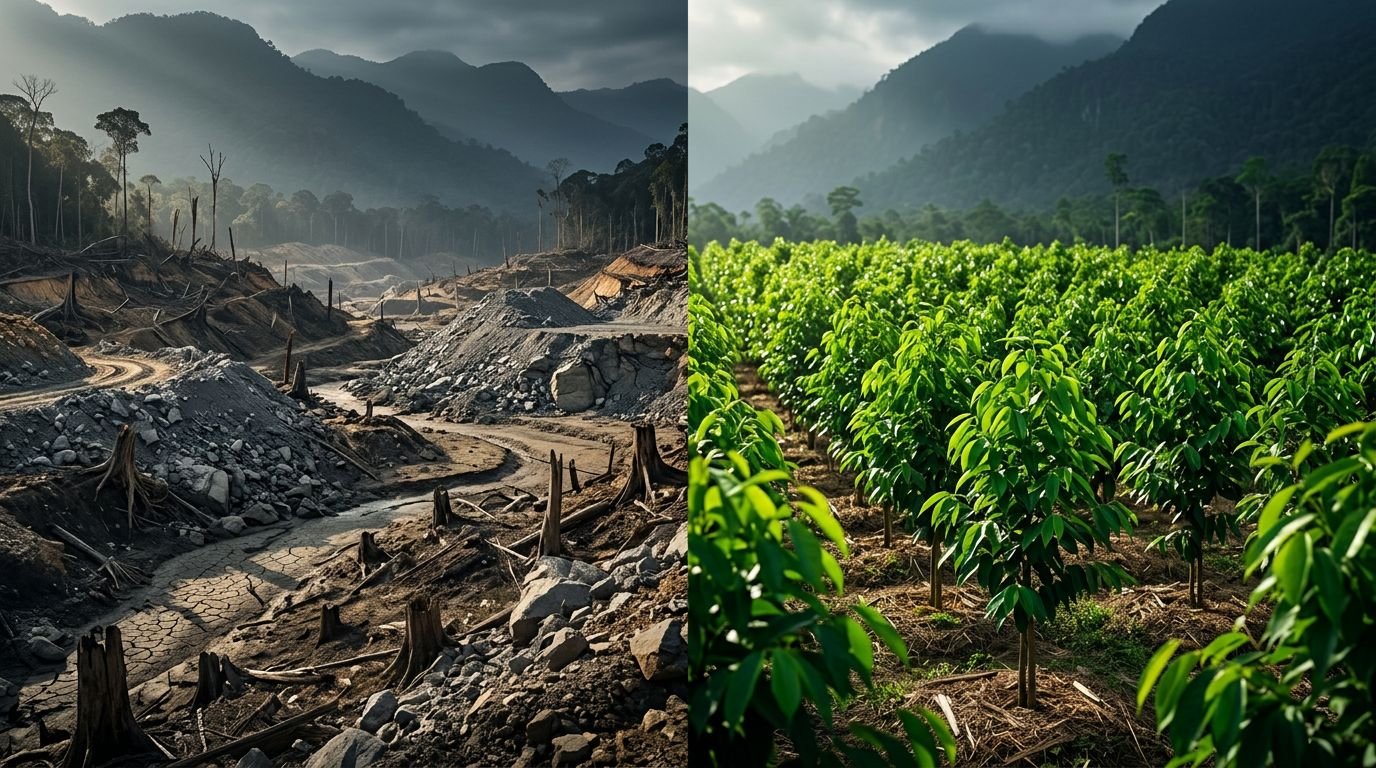
A forest cleared for a mine, road, dam, or township does not come back simply because saplings are planted somewhere else. Yet that is often how compensatory afforestation in India gets discussed, as if complex ecosystems can be balanced on a simple ledger. Under the framework established by the Forest Conservation Act 1980, which governs the diversion of forest land for non-forestry purposes, there is a legal requirement to compensate for these losses. However, the policy often reduces the rich, interconnected reality of a forest to a mere metric of acreage.
You see plantation drives, green counts, and official targets. What you rarely see is the missing stream shade, the lost nesting cavity, the broken animal path, or the village commons turned into a fenced plantation.
To judge this policy honestly, you have to ask a harder question: did the new planting restore the living system that was destroyed?
Key Takeaways
- Forests are not interchangeable: Natural forests represent complex, centuries-old ecosystems that cannot be replicated by planting young, uniform saplings elsewhere.
- The ‘Offset’ fallacy: Compensatory afforestation often treats forest loss as a simple accounting metric, ignoring the irreversible loss of specific wildlife habitats, soil health, and water cycles.
- Land rights and social impact: Many plantations are established on communal lands or grazing pastures, which often leads to the dispossession of local communities and the degradation of open ecosystems like grasslands.
- Prioritizing avoidance over compensation: True environmental protection requires treating forest diversion as a last resort rather than a manageable business cost, emphasizing that no amount of planting can fully replace an old-growth habitat.
A forest is more than tree cover
The first mistake is simple. We treat forest and trees as if they mean the same thing.
They do not. A real forest is layered. It has canopy, shrubs, grasses, leaf litter, fungi, insects, soil microbes, dead wood, water movement, and long-settled relations between species. These components work together to provide essential ecosystem services that sustain life. Age matters too. So does place. A sal forest, a mangrove patch, a dry deciduous woodland, and a natural grassland each hold different life.
That is why a plantation can increase green cover and still fail as habitat.
This quick comparison makes the gap easier to see:
| Feature | Natural forest | Compensatory plantation |
|---|---|---|
| Species mix | Diverse and site-specific | Often limited, sometimes single-species |
| Soil life | Built over decades or centuries | Disturbed, shallow, or newly altered |
| Wildlife support | Nesting, feeding, shelter, movement | Patchy support, often weak |
| Time value | Mature ecological relationships | Young saplings with uncertain survival |
A planted area may look tidy from a road or satellite image. However, life rarely thrives in tidy rows. Many plantations are designed for survival on paper, not for ecological richness on the ground. Because these areas lack the structural complexity required for robust biodiversity conservation, they often fail to replicate the functions of the original habitat.
A policy analysis of compensatory afforestation outcomes described recurring problems with unsuitable sites, hardy species choices, and poor restoration quality. That points to a larger truth. The issue is not whether trees are good. The issue is whether the replacement matches the lost habitat in structure, species, and function.
A forest loss is not canceled when saplings appear elsewhere. The living web that was cut needs its own measure.
If you care about the full ecological impact, tree counts alone won’t tell you much.
Why the offset logic breaks down
The legal idea behind compensatory planting sounds neat. When there is a diversion of forest land for a non-forest purpose, the project developer or user agency must pay a set fee known as the Net Present Value to fund compensatory afforestation elsewhere. On paper, this creates a tidy balance where loss and gain appear linked.
On the ground, that logic breaks fast.
A mature forest lost today cannot be replaced by two-year-old saplings tomorrow. Time is a fundamental part of a habitat. Some birds nest only in old cavities, some insects depend on specific understory plants, and many mammals use remembered routes. Once that web is cut, a new plantation elsewhere does not rewind the damage.
Location matters just as much. A forest next to a stream, village, or wildlife corridor is not equal to a plantation on dry, degraded land far away. Even if both areas measure the same in hectares, the ecological role is entirely different.
A JSTOR paper on compensatory afforestation has long noted that India’s approach runs into land rights and ecological mismatch. That mismatch is the core problem. The system often treats forests as interchangeable units when they are anything but interchangeable.
This is where climate literacy matters. Trees store carbon, and planting them can help in the right place. But carbon is only one part of a forest story. Habitat, hydrology, pollination, seasonal food webs, and local livelihoods all matter too. If public debate stays fixed on carbon alone, then a biologically poor plantation can get praised while a rich forest disappears.
The same mindset shows up in other environmental debates. A photogenic intervention can look active while the deeper system remains broken. Here, the deeper issue is the approval of forest diversion itself. Prevention should come before compensation, because no plantation can fully copy an old, living habitat.
The land problem often becomes a rights problem
Much of the challenge surrounding compensatory afforestation in India starts with a blunt fact: suitable land is hard to find.
A TERI study on implementation across states points to recurring difficulty in identifying non-forest land for these projects. When suitable areas are elusive, State CAMPA authorities often struggle to find viable sites for new plantations. To manage this, many states have created a land bank to earmark parcels for future projects. When that happens, the pressure shifts elsewhere. Common lands, grazing areas, scrub patches, and village-used spaces become primary targets because they appear available on government files.
But land that seems empty on a map is often busy in real life.
It may hold seasonal grasses, medicinal plants, vital water recharge zones, or bird habitat. Pastoral groups may depend on these areas, and forest-dependent families often rely on them to collect fuel, fodder, fruit, or leaves. Once that land is fenced, reclassified, or planted without local consent, the social cost falls on people with the least power to contest it.
This is where compensatory afforestation often collides with justice. The damage is not only biological. It can also weaken rights recognized under the Forest Rights Act and strain already fragile relations between communities and the agencies managing CAMPA funds.
The official classification of these areas as degraded forest land makes this dynamic worse. Many open habitats are treated as wastelands waiting for trees, even when they are already functioning, biodiverse ecosystems. Grasslands, scrublands, and wetlands are not blank spaces. Planting the wrong species in these regions can erase one unique habitat in the name of restoring another.
That is why accountability matters more than ceremony. A plantation drive with dignitaries, photo ops, and ambitious targets may still be a poor ecological decision if the land was never truly free for the taking.
A green plantation can still be poor habitat
Plantations often succeed at one thing. They create a visible sign that action happened.
That visibility has political value. Survival value is another matter.
Many compensatory sites rely on a narrow mix of species because they are easier to procure, plant, and manage. Sometimes the choice favors hardy or fast-growing trees. Sometimes the goal is simply to hit area targets before the monsoon window closes. Either way, uniformity replaces complexity.
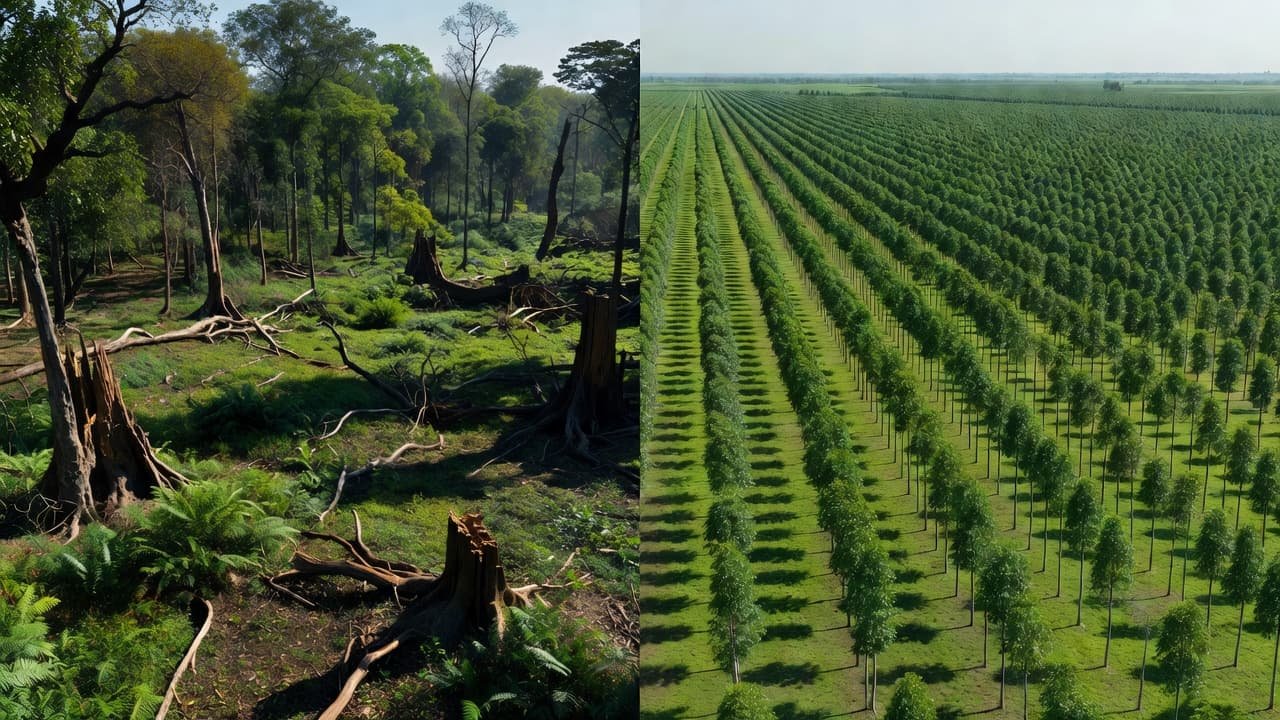
A plantation can add green cover without rebuilding the layered life of a natural forest.
Wildlife notices the difference. A monoculture patch does not feed, shelter, or connect species the way a mixed native forest does. It may offer little understory. It may dry out quickly. It may even block movement if planted across open habitats or community use routes, creating significant challenges for effective wildlife management.
Another problem is survival beyond the launch moment. Plantation survival rates are often lower than reported because saplings need protection from grazing, fire, drought, flooding, invasive growth, and neglect. Monitoring for one season is not enough. Five years gives a better picture. Ten years gives a more honest one. Yet public reporting often celebrates planting day and moves on.
This pattern also shapes urban biodiversity debates. Cities count ornamental greening or avenue planting as ecological gain, while pollinators, birds, and native shrubs remain afterthoughts. The same error appears in rural offsets. Green is counted; life is assumed.
The deeper flaw is that the system rewards what is easy to show. Straight rows photograph well. Survival audits, soil checks, and wildlife recovery are slower and less glamorous. Still, habitat recovery lives in those slower measures.
Numbers can rise while habitats keep falling
Large plantation figures can create comfort. They suggest balance, progress, and repair. Yet counting hectares planted is not the same as counting habitats restored.
Most official narratives focus on administrative inputs and outputs: land assigned, funds released, pits dug, saplings planted, and guards posted. These markers do not answer the ecological question. What species returned? Did water retention improve? Did local people retain access? Did pollinators, reptiles, birds, and small mammals recover? Did the site survive three bad summers?
Money adds another layer to this disconnect. The CAF Act 2016 provided a legislative framework for managing these resources, yet fund utilization remains a persistent challenge. Even with the structure provided by CAMPA, slow implementation and weak planning have often separated financial compliance from true ecological recovery. As a result, the Comptroller and Auditor General has frequently highlighted the mismatch between budget spending and actual ecological outcomes. A budget line can move while a habitat keeps shrinking.
This is why plantation data needs context. A district can report success while the original forest was older, richer, wetter, and tied to a corridor that no new site can replace. A state can show more trees while losing forest quality. A company can pay the required amount and still treat destruction as a manageable cost of business.
That accounting logic is dangerous because it normalizes loss.
It also confuses the public. Many people see planting as an automatic good, and often it is. But good planting is place based, native, monitored, and socially fair. Bad planting can drain money, seize commons, and produce weak habitat. Without climate literacy, those differences get flattened into one cheerful green story.
Plantation numbers therefore deserve the same skepticism you would bring to any other claim of repair. Ask what changed on the ground, not what looked good in a dashboard.
Real repair starts with systemic change
The strongest response to habitat loss is simple, even if it is politically hard: don’t clear high-value habitat unless there is a compelling, publicly tested reason.
That sounds obvious. Yet policy often treats compensatory planting as a fallback solution rather than the last resort after strict avoidance.
Real repair needs systemic change. It should begin before a forest is diverted, not after the trees are gone. It also needs better rules after diversion is approved, starting with the National Authority setting more rigorous standards for forest land use. A more credible model would include the following:
- Avoidance first, especially for old forests, wildlife corridors, wetlands, mangroves, and community-used commons.
- Ecological restoration wherever possible, rather than simple afforestation, by using native species suited to the local ecology.
- A requirement that the Annual Plan of Operations for each state prioritizes local biodiversity monitoring and long-term survival metrics, rather than just planting counts.
- Full protection of local tenure and consent under the CAF Act 2016, because communities are not obstacles to restoration but essential partners.
- Public data that lets citizens compare promised outcomes with field reality.
This approach also links to the wider economy. A stronger circular economy can reduce demand for fresh extraction, new land conversion, and wasteful infrastructure expansion. Better sustainable business models should price habitat loss, water stress, and community disruption into project decisions early, instead of treating afforestation payments as a cleanup fee later.
You can see the contrast in place-based work. Verified, local restoration tied to human well-being is far more credible than distant offsets on a spreadsheet. If you want examples of that kind of work, Explore Our Active Missions.
The point is not to reject planting. It is to stop using planting as a moral shortcut.
What people should ask when “green cover” is promised
Most readers do not approve forest diversion files. Still, public pressure shapes what gets tolerated.
A few simple questions can cut through the green fog. What habitat is being lost right now? Where is the replacement site? Is it the same ecosystem type? Who uses that land already? Which native species will be planted? Who will verify survival after five years? Will the data be public? You can seek answers to these queries by reviewing the CAF Rules 2018, which provide a framework for public data requirements and project transparency.
Those questions shift attention from spectacle to evidence. They also highlight the necessity of institutional accountability, particularly when examining how the National Authority manages funds and oversight. While the Supreme Court of India and the Central Empowered Committee have historically played vital roles in shaping the legal scrutiny of forestry diversion and the use of compensatory funds, the long-term success of CAMPA depends on more than just high-level oversight.
Personal values matter here too, but only when they stay connected to politics and place. Plant-based living can reduce pressure on land and emissions in parts of the food system. Everyday mindfulness can make you less numb to the small losses around you, the felled patch near a road widening, the fenced commons, the vanishing grove by a stream. Still, private virtue alone will not fix forest policy.
What helps more is informed attention. Read environmental clearances. Watch for language that treats all open land as empty land. Support local groups that defend commons, wetlands, native grasslands, and forests. Ask companies how they account for habitat fragmentation, not only tree planting.
This is also where community-rooted restoration matters. Work that starts with local ecology, local rights, and long-term care is slower, but it is far more honest. It grows trust as well as trees.
When public debate gets sharper, green promises have to get sharper too.
Frequently Asked Questions
Why is planting trees not the same as restoring a forest?
A natural forest is a complex, multi-layered system involving soil microbes, specific insect species, dead wood, and established animal corridors that develop over decades or centuries. A plantation, conversely, is often a monoculture or limited selection of saplings that lacks this structural complexity and fails to replicate the essential ecosystem services of the original habitat.
How does compensatory afforestation affect local communities?
Compensatory afforestation projects often target ‘wastelands’ that are actually essential communal lands used by local villagers for grazing, fuel, and medicinal plants. When these areas are fenced off and reforested without local consent, it disrupts traditional livelihoods and infringes upon rights protected under the Forest Rights Act.
Can compensatory afforestation effectively fight climate change?
While trees do sequester carbon, relying solely on plantations as a climate solution is misleading if it justifies the destruction of mature, biodiverse forests. Old-growth forests serve as much more stable carbon sinks and vital climate regulators, meaning the act of clearing them often creates an immediate, long-term net loss that new saplings cannot easily recover.
What can citizens do to ensure better outcomes for forest conservation?
Citizens can demand greater transparency by reviewing environmental clearance documents and questioning the specific ecological goals of local plantation projects. Supporting grassroots movements that defend biodiversity hotspots, wetlands, and community-managed lands is more effective than focusing solely on the total number of trees planted.
Conclusion
A lost forest is more than a missing patch of green. It represents lost shelter, lost movement, lost memory in soil and water, and often lost security for nearby people. The vital environmental services provided by old-growth forests, such as carbon sequestration and watershed regulation, remain fundamentally irreplaceable once a primary ecosystem is destroyed.
This is why compensatory afforestation in India continues to fall short when it is presented as a simple solution to complex ecological destruction. While planting can help in the right place with the right species, it cannot erase the damage of clearing a functioning habitat. True systemic change requires us to strictly define non-permissible activities within high-biodiversity areas, ensuring that these regions are shielded from industrial encroachment rather than being slated for later offset.
Moving forward, the administration of CAMPA funds must be held to a higher standard. We must shift our focus away from the optics of plantation numbers and toward the integrity of the landscape. The ultimate test is plain: we must protect what should not be cut, restore what can truly recover, and judge our environmental success by ecological reality rather than the promise of compensatory afforestation in India.