Why Tree Transplantation in India Fails on Road Projects
 TBH Editorial
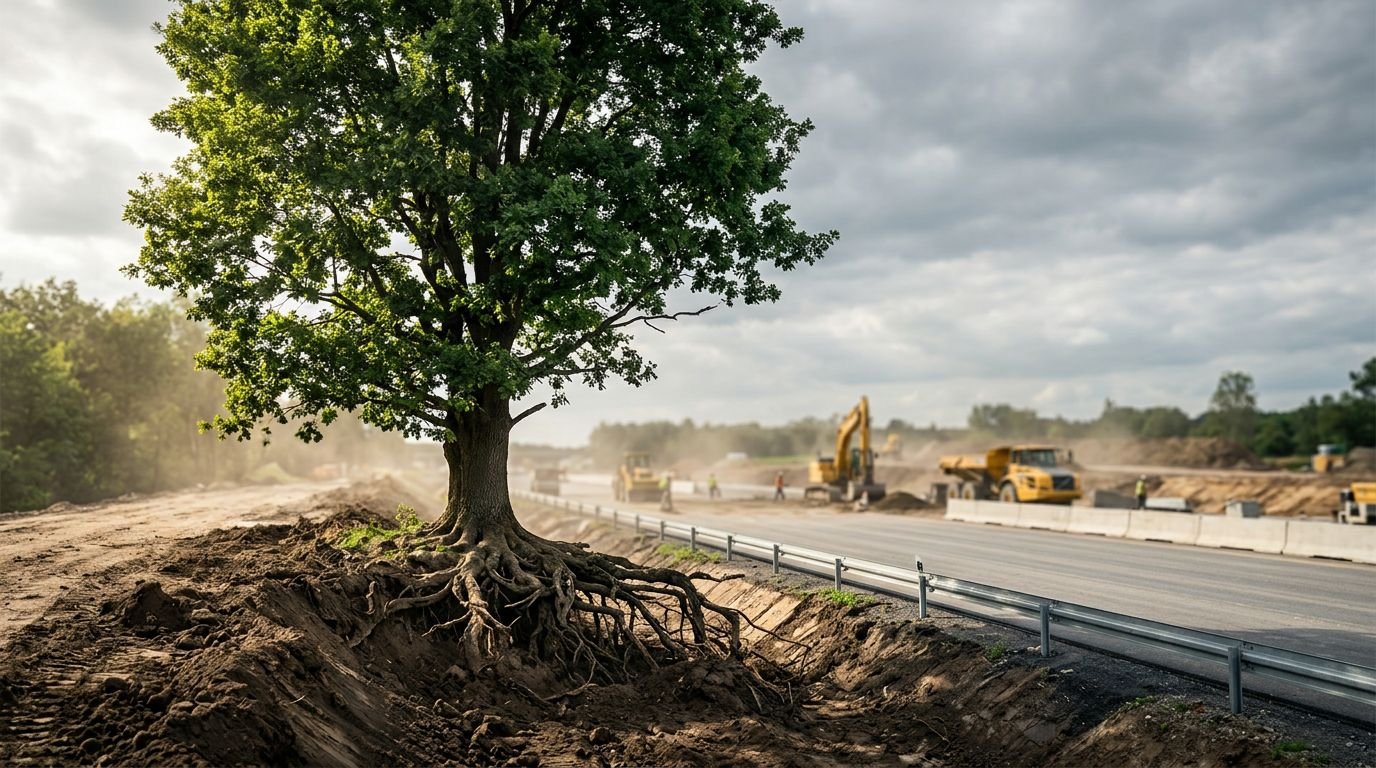
A transplanted roadside tree can stay green for weeks and still be dying.
That is the core problem with tree transplantation in India. On many road projects, relocation is shown as proof that development and ecology can coexist. Yet the biology, the contracts, and the monitoring rarely line up. By the time decline becomes visible, the project has already moved on.
To see why this keeps happening, look below the soil line and inside the project file.
A living system gets treated like movable street furniture
On paper, transplantation sounds humane. A road widens, a flyover lands, and the trees are “saved” by shifting them elsewhere. That story works well in press notes because it offers a clean compromise. Real trees do not work that way.
A mature roadside tree is not a nursery plant with a neat root ball. Its fine feeder roots can spread far beyond the trunk. Those thin roots pull in most of the water. When excavation cuts them, the tree loses the network that keeps leaves hydrated and cells alive. Root loss is not a side effect. It is the central injury.
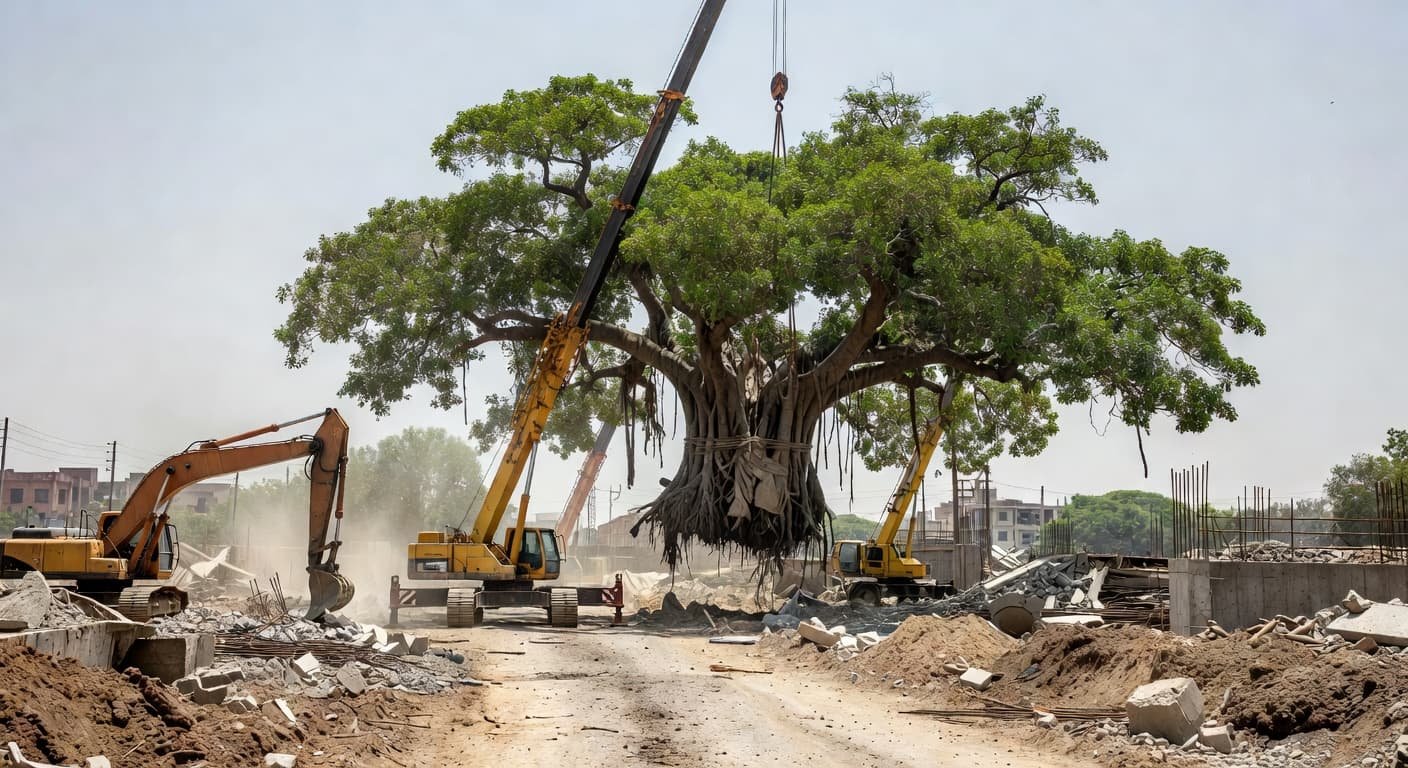
Road projects often move trees the way they move equipment, with machines, speed, and limited site patience.
Age makes this worse. Older trees carry more stored value, more shade, more nesting space, and more ecological memory. They also recover more slowly. Many species common on Indian roads, including neem and tamarind, do not tolerate rough relocation well. Even hardy species can fail when they are large, stressed, or moved at the wrong time.
Season matters too. Civil work often peaks in hot, dry months because rain slows construction. Trees need the opposite. They handle relocation better when moisture is higher and heat stress is lower. A recent Mongabay India explainer on tree transplantation highlights the same hard truth: moving a tree can be a short-term fix that hides long-term loss.
Leaves may stay green after the shift because the tree is living on reserves. That brief survival window fools officials and residents alike. What looks like recovery may be delayed collapse.
Road construction logic clashes with tree survival
A tree needs patience after relocation. A road project rewards speed, closure, and handover. That mismatch drives failure.
Most transplanted trees need months of planning before they are moved. Root pruning should happen in phases. The new pit needs the right depth, soil mix, drainage, and space. The trunk needs support without strangling the bark. Then comes watering, mulching, pest control, and canopy care for at least two growing seasons. On many Indian road sites, that chain breaks almost immediately.
The conflict is easy to see.
| Road project priority | What the tree needs | Where failure starts |
|---|---|---|
| Fast excavation | Months of root preparation | Roots are cut in one operation |
| Dry, open worksite | Cool, moist soil | Heat and dust raise stress |
| Contract closure | Two to three years of care | Aftercare ends early |
| Standard execution | Species-specific handling | One method gets used for all |
The table looks simple because the problem is simple. Trees die when a long biological process gets squeezed into a short engineering schedule.
Site conditions add more pressure. Freshly widened roads trap heat. Soil gets compacted by rollers and trucks. Utility trenches disturb the planting zone. Dust blocks leaf pores. In many cases, the “new home” for the tree is a narrow strip beside traffic, surrounded by concrete and poor drainage. That is not relocation. It is a slow exposure to stress.
Then comes the aftercare gap. One agency clears the road. Another handles the transplant. A third may be meant to water the tree. Once the project is inaugurated, nobody owns the outcome in a serious way. If irrigation lines fail, supports loosen, or termites attack the weakened trunk, the tree declines in public view and dies in bureaucratic fog.
A 2021 Forest Research Institute report on tree translocation makes a related point. The work is expensive and skill-heavy. Machines alone do not make it work. Arborists, species knowledge, and long follow-up matter more than the crane.
Survival rates look better on paper than on the ground
The public usually hears that trees were “transplanted successfully.” That phrase is slippery. It often means the tree was moved and replanted, not that it survived.
Early green leaves are a poor metric. A stressed tree can flush weak growth and still fail months later. Some die after one summer. Others hold on through one monsoon, then collapse when the next dry spell hits. If monitoring stops after planting, bad outcomes disappear from the record.
If survival is measured on planting day, the metric is almost useless.
This is why public claims around tree transplantation in India deserve close reading. IndiaSpend’s reporting on green cover loss and transplantation points to a basic policy gap: there is no uniform process across projects, and the penalty for failure is often too weak to change behavior.
That gap shapes how data is reported. Many cities do not publish species-wise survival after one year, two monsoons, and three summers. Few publish geo-tagged inventories with independent checks. Tags fall off, records become patchy, and responsibility shifts across departments. A dead tree then becomes a missing line item rather than an admitted ecological loss.
The result is a familiar illusion. A project file shows mitigation completed, the road opens on time, and compensatory numbers look respectable. Meanwhile, the street feels hotter, birds lose cover, and residents walk past a row of thinning crowns. On paper, the trees were moved. On the ground, the canopy is gone.
This is not a data problem alone. It is a political choice about what counts as success.
What cities lose when an old roadside tree dies
A mature avenue tree does far more than occupy space. It cools the street, slows runoff, filters dust, softens noise, stores carbon, and anchors habitat. That bundle of work is easy to ignore because it arrives daily and without invoice.
When a large roadside tree dies after relocation, the loss hits people first at street level. Walkers lose shade. Street vendors face harsher heat. Children wait for buses in direct sun. Older adults avoid stretches they once used on foot. The public health cost is not abstract. It shows up in hotter pavements, lower walkability, and more unequal access to comfort.
The ecological impact is wider still. Old bark holds insects. Branch structure supports nests. Roots partner with fungi and soil life. Canopies connect fragmented habitat in dense cities. That is why urban biodiversity depends on mature trees, not only new plantation drives. Ten saplings along a median may look green in a report, yet they cannot replace the cooling span or habitat value of a decades-old canopy in the near term.
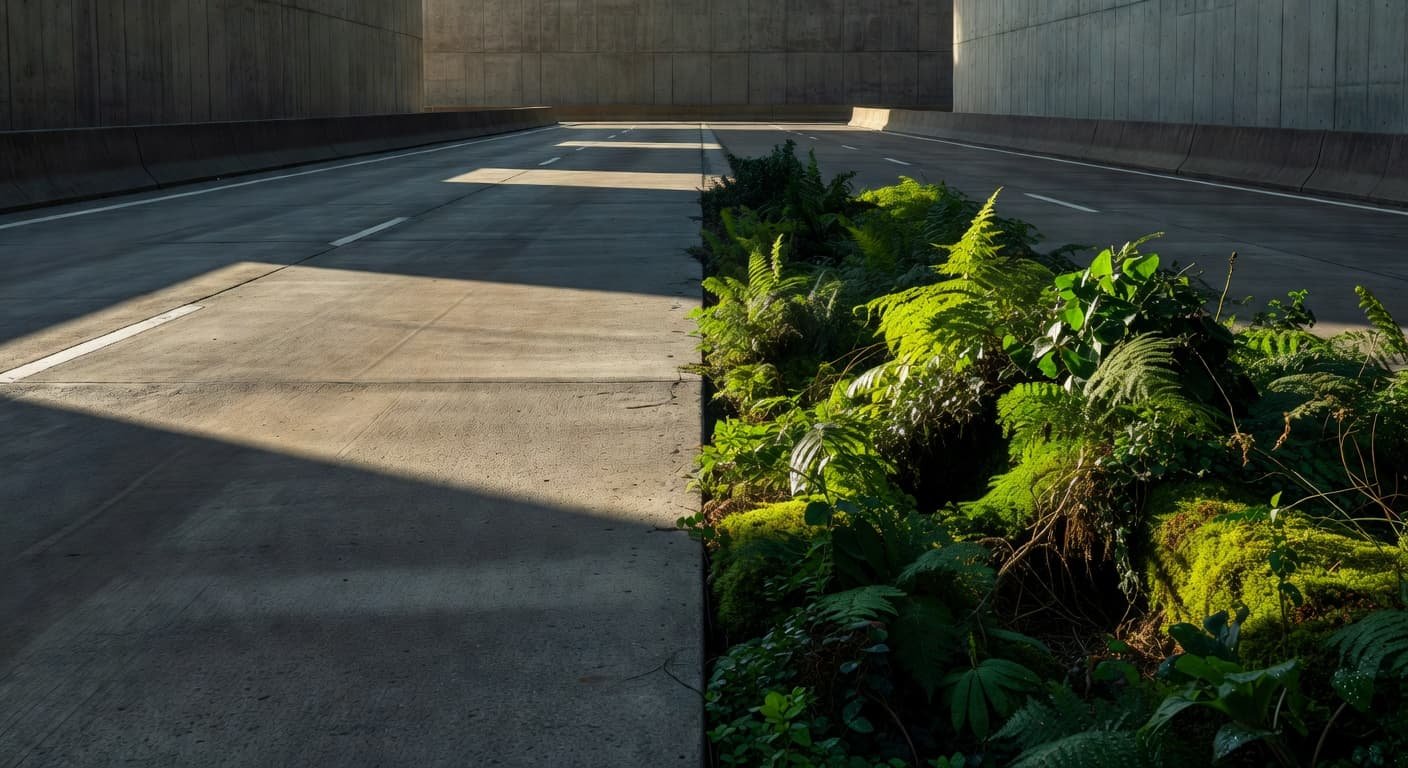
A wider road can move cars faster, but it often leaves a street harsher for every other form of life.
Road projects can also stack harms. The same infrastructure push that removes trees may add lighting, glass, and speed that raise risk for birds and pollinators. That broader pattern is visible in how glass facades impact urban birds, where design choices that look normal to planners become deadly in daily urban life.
A dead transplanted tree is not a failed object. It is a broken local system. Once you see it that way, the usual replacement logic starts to look thin.
The real problem is accountability, not only technique
Bad technique matters, but it is not the full story. Plenty of failures begin before the first spade hits the soil.
Many road projects treat transplantation as a clearance condition, not as a serious conservation duty. The goal becomes procedural compliance: show that the trees were moved, attach photographs, and continue construction. When that is the mindset, there is little incentive to redesign the road, reduce the footprint, or save mature trees in place.
That is why Systemic change matters more than cosmetic green claims. A city can buy larger cranes, write thicker manuals, and still fail if contracts reward relocation counts rather than survival. Contractors often get paid for execution, not for canopy retained after two or three years. Penalties for death are small compared with the value of keeping a project on schedule. In that setup, risk falls on the tree, not on the decision-maker.
A serious policy framework would treat old trees as long-term public assets. That fits the logic of a circular economy, where high-value assets stay in use for as long as possible instead of being discarded when they become inconvenient. Mature trees create more value with age, not less. They cool denser neighborhoods, support pollinators, and lower heat exposure where concrete keeps expanding.
Public procurement can also reward better behavior. Road agencies could require arborist-led planning, survival audits, and three-year maintenance bonds. Those are not fringe ideas. They are the kind of rules that push sustainable business models into the market, so firms profit by protecting living systems rather than by moving them fast and leaving.
Until that happens, transplantation will keep working as a public relations device. It will not work as reliable ecological protection.
What better road planning would look like
The first rule is simple: avoid moving mature trees unless there is no credible alternative. Road alignments can shift. Lane widths can be rethought. Medians, service roads, and utility corridors can be redesigned. Small design changes made early are cheaper than failed transplants later.
When relocation is unavoidable, the process must get slower and more honest. Species, age, trunk girth, health, and season should guide the decision. Some trees should not be moved at all. Others need staged root pruning months in advance, careful lifting, soil preparation, and steady watering after replanting. Survival should be checked after at least two monsoons and multiple dry periods, not after the inauguration photo.
Independent tracking matters too. Geo-tagged public inventories would help residents see which trees were moved, where they went, and whether they lived. That kind of verification is common sense. It should be standard on projects that claim ecological care.
There is also a civic lesson here for anyone trying to live with more intention. Plant-based living can cut personal harm. Everyday mindfulness can sharpen how you notice the living systems around you. Yet neither can rescue a badly planned avenue clearance on its own. Climate literacy means seeing where personal values meet public design, budget rules, and contract language.
That is where tangible community work matters. If you want to support on-the-ground efforts that connect urban biodiversity with youth climate literacy and verified local outcomes, Explore Our Active Missions. Projects that are tracked in the open build the kind of trust public tree protection also needs.
Better roads are possible. They just require cities to value living infrastructure before the chainsaws and cranes arrive.
Conclusion
A transplanted tree can look fine long after its survival chances have collapsed. That is why road projects in India keep calling relocation a success while streets lose shade, habitat, and cooling.
The strongest takeaway is plain: transplantation is not conservation when avoidance is ignored, aftercare is weak, and reporting stops at planting. Long-term survival is the only metric that matters.
Until contracts, monitoring, and design standards change, many relocated trees will remain green symbols of a decision that already failed.