
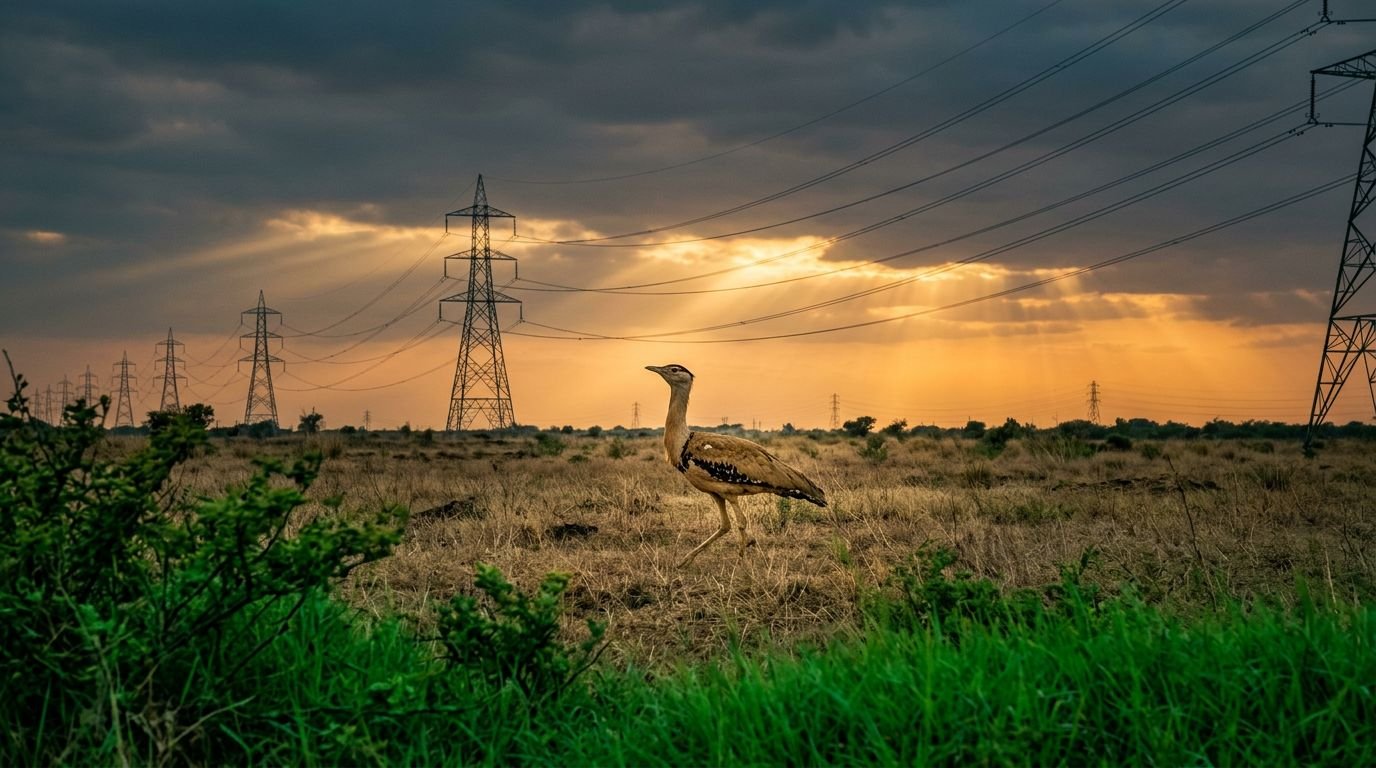
Why Transmission Lines Are Killing the Great Indian Bustard
 TBH Editorial
A single collision can erase years of recovery for the Great Indian Bustard. When a species is this rare, the wires above its grasslands are not a minor hazard, they are a daily gamble with brutal odds.
Many people hear about poaching or habitat loss first. Yet in western India’s bustard country, overhead power lines are often the sharper threat because the bird doesn’t see them in time. The conflict between bustards and transmission lines starts with biology, but it doesn’t end there.
A species that can’t absorb routine deaths
Some wildlife populations can survive a steady trickle of accidental deaths. The Great Indian Bustard can’t. Its surviving population is so small that even a few adult losses can bend the curve toward extinction.
That is why the transmission line issue is not a side note in conservation. It is a population-level threat. A peer-reviewed analysis of power-line mortality warned that the species faces imminent extinction if overhead cables keep killing birds at current rates.
One estimate from Rajasthan put annual deaths from collisions at about 18 bustards. For a common bird, that would still be troubling. For a Critically Endangered bird with so few individuals left, it is catastrophic.
The math is harsh, but the human meaning matters too. Every dead bustard reflects field teams, local communities, and public institutions that were asked to protect a species and failed to remove a known hazard. The loss is not random. These lines are planned, approved, financed, and built.
That point matters because it shifts the story away from bad luck. A collision with a transmission wire is often treated as an unfortunate side effect of growth. In bustard habitat, it is closer to a design failure that keeps repeating. If risk is predictable, then allowing it to continue is a policy choice.
You see the same pattern in other environmental fights. Harm looks small when each event is counted alone. Put those events together, and they become a system. For the bustard, “routine loss” is simply another name for slow extinction.
Why power lines are so deadly for bustards
The bird’s body makes the danger worse. Great Indian Bustards fly low over open ground, move with a heavy frame, and don’t turn sharply. They also have poor frontal vision, which means a thin wire straight ahead may not register until it is too late.
That detail is easy to miss if you picture a nimble bird weaving through obstacles. Bustards are built for grassland life, not for dodging cable arrays. When they travel between feeding and breeding areas, overhead lines often sit directly in their flight path.
A BNHS account of bustards and wires describes the problem with painful clarity. These birds see better to the side than straight ahead, and their large bodies make last-second avoidance hard. Thin high-tension cables also blend into glare, desert haze, and the visual clutter of open sky.
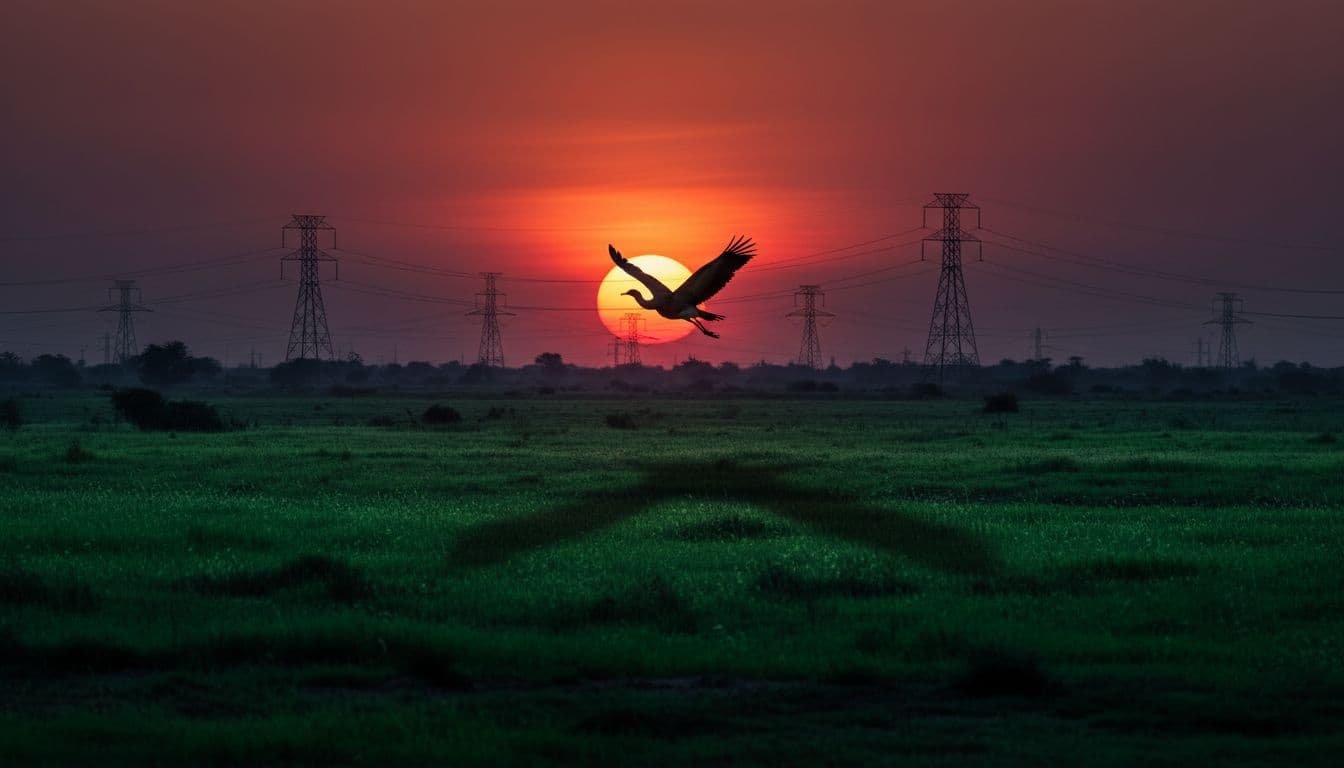
Low flight paths and hard-to-see wires create a dangerous overlap.
This is why the Great Indian Bustard transmission lines crisis is so stubborn. The threat is built into ordinary movement. A bird does not need to make a mistake in some unusual weather event. It only needs to fly through its own habitat.
Because the risk is physical and constant, awareness alone cannot solve it. The bird cannot learn its way around every new corridor. Meanwhile, each added stretch of cable multiplies the chances of collision. That makes overhead lines far more serious than a one-time disturbance. They turn the sky itself into fragmented habitat.
Grasslands look empty on a map, but they are full of life
Transmission lines become easier to justify when land is treated as empty. That has long been part of the bustard problem. Open grasslands and scrublands rarely get the same respect as forests, even though they support rich food webs, pastoral livelihoods, and species that need wide, unobstructed space.
Planning often treats these areas as available land. A route that avoids dense settlement and avoids forest paperwork can look efficient on paper. Yet the same route may cut through one of the last places where bustards still move, display, feed, and nest.
This is where the ecological story becomes political. A wire is not only a wire. It is a sign of which landscapes the state and market consider expendable. When enough projects follow that logic, the result is cumulative risk, not isolated damage.
Power lines also do more than kill on contact. They divide movement across habitat. A bird crossing one dangerous stretch may later face another, then another. In that sense, the problem is not one lethal point but a repeated barrier spread over a living landscape.
People who care about urban biodiversity already know that species survival depends on safe movement, shelter, and breeding space, not only on total land area. The same rule applies here, only at a larger scale. A grassland can still look open while its most vulnerable species face invisible obstacles at every turn.
The Thar and similar open-country habitats are not blank spaces between cities. They are working ecosystems. When transmission planning ignores that, the bustard pays first. Other birds, mammals, and insects pay too, even if they get less attention.
Clean energy still creates harm when biodiversity is treated as an afterthought
The bustard story unsettles people because it sits inside the energy transition. Western India has expanded renewable power fast, and that means more evacuation infrastructure, more substations, and more transmission corridors. Cleaner electricity matters. Yet cleaner electricity is not harmless by default.
A solar or wind project can cut carbon and still increase wildlife deaths if its associated power lines pass through critical habitat. That is not a reason to slow climate action. It is a reason to stop calling poor siting and poor mitigation acceptable collateral damage.
The BirdLife report on India’s power-line ruling captured this tension well. Courts and conservationists pushed for safer infrastructure because overhead lines had become the biggest immediate threat to the species.
This is where climate politics often falls short. It counts carbon carefully and counts species loss carelessly. A serious measure of ecological impact has to include both. Otherwise, one environmental gain gets financed by another environmental collapse.
A lower-carbon grid still fails if its hidden bill is extinction.
That lesson reaches beyond one bird. A real circular economy asks where damage gets pushed when a system looks efficient on the surface. The same standard should apply to energy. If risk is shifted onto last-chance habitat, the accounting is incomplete.
The same goes for sustainable business models. They cannot stop at clean output, investor language, or headline megawatts. They have to include route selection, retrofit budgets, independent monitoring, and hard limits in core habitat. Without that, “green growth” becomes a story that leaves dead birds off the balance sheet.
Why bird diverters and court orders haven’t solved the problem
Safer infrastructure is possible, but the current response is still too partial. Bird diverters can make lines more visible. Underground cabling can remove collision risk on some stretches. Court orders can push agencies to act. None of that is meaningless.
Still, partial action is not the same as adequate action. Diverters reduce risk, but they do not erase it. They also need correct placement and upkeep. Undergrounding is costly, yet in priority habitat it is often the most defensible option because it removes the hazard rather than decorating it.
Compliance is another weak point. A strong ruling or promising guideline can lose force if agencies move slowly, if companies seek exemptions, or if monitoring remains patchy. In practice, the difference between a life-saving policy and a symbolic one often comes down to timelines, maps, and public data.
The scale of the problem also reaches beyond the bustard alone. Current Conservation summarized research that estimated about 84,000 bird deaths a year across species in the region. The bustard stands out because it has so little room for error, but the underlying collision issue is much broader.
That should change how people view mitigation. This is not a matter of adding one technical fix and moving on. It is a matter of rebuilding a dangerous network in the places that matter most. When a species is already on the edge, “better than before” may still leave mortality too high.
The harder truth is that overhead lines in core bustard areas were never a low-risk choice. Once that is acknowledged, the policy response becomes clearer: prevent future exposure, remove or bury the worst stretches, and verify results in public.
What real systemic change would look like
Systemic change starts before a tower goes up. It begins when planners treat bustard habitat as a no-compromise factor, not as one concern to be balanced away late in the process.
That means route planning must use current species maps, seasonal movement data, and cumulative risk assessments. It also means the cheapest line on a spreadsheet should not win by default if its true cost includes irreversible biodiversity loss.
The main options are clear:
| Measure | What it can do | Main limit |
|---|---|---|
| Underground lines in core habitat | Removes collision risk on those stretches | Costs more and needs strict habitat mapping |
| Rerouting new transmission corridors | Prevents harm before it starts | Requires stronger early-stage planning |
| Bird diverters on existing lines | Makes wires easier to detect | Reduces risk but does not remove it |
| Independent monitoring | Shows whether mitigation works | Fails if data stays private |
| Time-bound compliance rules | Turns promises into deadlines | Needs penalties for missed targets |
The takeaway is simple. No single measure is enough, and the most effective ones must be targeted where bustards still live and move.
This is also where climate literacy matters. You can support decarbonization and still demand better transmission design. Those positions fit together. In fact, they have to fit together if climate policy is going to keep public trust.
Better planning also creates a wider benefit. Lines routed away from high-risk habitat protect other species, reduce conflict, and make environmental approvals more honest. That is how responsible infrastructure works. It does not wait for a court fight or a media cycle to notice preventable harm.
Why this matters even if you live far from bustard country
Most people will never see a Great Indian Bustard in the wild. Still, this case says something larger about how modern systems work. When harm is spread across distance, bureaucracy, and technical language, it becomes easy to treat preventable death as a background cost.
That should concern anyone who cares about public ethics. Electricity demand in cities is linked to infrastructure far away. So are the land decisions that shape who bears the risk. Rural habitat often absorbs damage that urban consumers never notice.
There is also a lesson here for personal sustainability. Plant-based living and everyday mindfulness can sharpen your sense of harm and reduce your own footprint. They matter. Yet the bustard’s future will not turn on private virtue alone. It turns on contracts, siting rules, environmental clearance, and public pressure for accountability.
That does not make individual action pointless. It makes it incomplete. Personal habits build moral attention; policy changes move the hazard. Both are useful, but only one can take a lethal wire out of the sky.
Readers who care about community-scale solutions can look for work that ties values to verified action. If you want examples of on-the-ground projects that connect urban biodiversity, local restoration, and youth climate literacy, Explore Our Active Missions.
The bustard reminds us that conservation is not only about affection for rare species. It is about whether society can build systems that stop sacrificing the vulnerable because the cost stayed off the invoice.
Conclusion
Transmission lines threaten the Great Indian Bustard because the danger is built into both the bird’s body and the way its habitat is planned. Low flight, poor frontal vision, and a dense network of overhead wires create a lethal mix.
Saving this bird does not require turning against clean energy. It requires honest accounting, safer routing, targeted undergrounding, and public rules with teeth. Until that happens, the Great Indian Bustard will keep paying for infrastructure that humans already know how to redesign.
The sky over bustard country does not need more sympathy. It needs fewer deadly wires.