
Why India’s Data Center Boom Is Becoming a Water Risk
 TBH Editorial
A building that stores your photos, payments, office files, and AI prompts can also drain a city’s water. That is the hidden edge of India’s digital expansion, and it deserves far more attention.
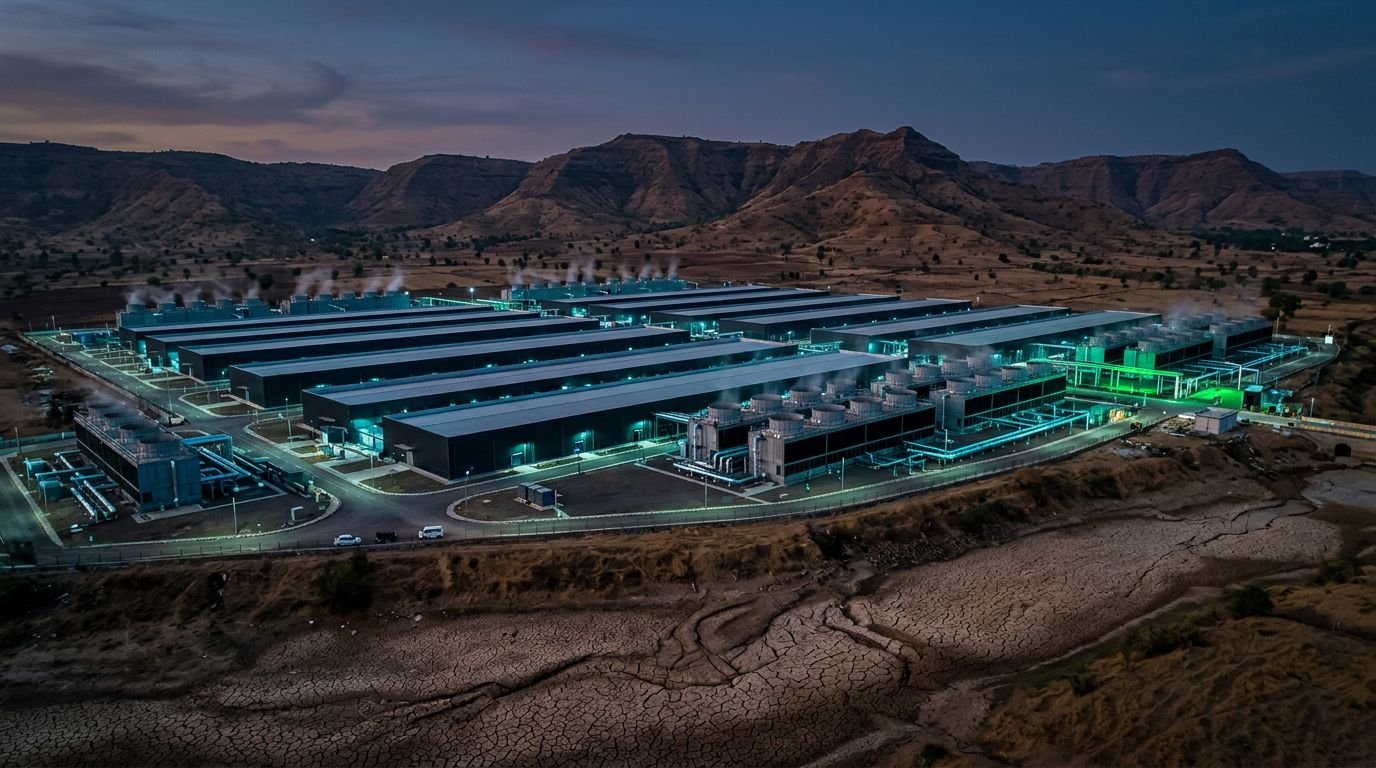
India wants more cloud capacity, more AI infrastructure, and more local data storage. Yet much of that buildout is landing in places where water is already under strain. To understand the country’s growing data center water risk, you have to look past the server racks and into the cooling systems, aquifers, and neighborhoods around them.
India’s digital expansion is landing in water-stressed regions
India’s data center market is growing because demand is real. Businesses need cloud services. AI tools need computing power. Public and private systems both want faster, local processing.
Yet the buildout is colliding with a hard limit: water.
A BBC report on India’s looming water challenge points to an S&P Global estimate that 60 to 80 percent of India’s data centres may face high water stress this decade. A CBC report on the environmental costs of India’s AI data centres highlights the same concern. Real-time reporting also shows that more than half of India’s data centers are already in water-stressed regions.

That matters because water shortages are local. A country may look stable on paper while one city, one ward, or one aquifer tips into stress. National totals can hide street-level damage.
A few figures make that easier to see.
| Signal | Current estimate | Why it matters |
|---|---|---|
| Large-site cooling demand | About 2 million liters a day for a 100 MW facility | Similar to the daily water use of about 6,500 households |
| Location risk | More than half of India’s data centers are in water-stressed regions | New demand lands where supply is already tight |
| Near-term exposure | 60 to 80 percent may face high water stress this decade | Future growth is colliding with limited water availability |
The pattern is simple. Data centers do not need to dominate India’s total water demand to become a serious problem. They only need to concentrate heavy demand in the wrong places.
That is why this issue is less about abstract national scarcity and more about local tradeoffs. When a high-value facility needs steady cooling water, someone else has to live with the new pressure.
Why cooling makes data centers thirsty
Most people picture data centers as warehouses full of silent machines. In practice, they are heat machines. Thousands of servers run all day, and that heat has to go somewhere.
Some facilities use air-based systems. Many also use water-based cooling because it can remove heat more efficiently, especially in hot conditions and dense computing environments. That is where the water burden starts.
A recent Earth Journalism Network investigation into water use in India argues that public transparency around this burden is still weak. Reported estimates suggest that a 100 MW data center may need about 2 million liters of water a day for cooling. Another industry estimate, in The Energy Pioneer’s report on AI data centres in water-scarce India, says even a smaller 1 MW site using traditional cooling can require about 26 million liters a year.
Those numbers are not fixed. Design choices matter. Weather matters too. Hotter days can increase cooling demand, and in India that often means peak water demand arrives when communities already need more water.
The tradeoff also gets lost in sustainability marketing. Water-based cooling may cut some electricity use compared with more energy-intensive options. But lower power draw does not erase local water stress. One environmental cost cannot excuse another.
This is why the language around efficiency needs care. A facility can post strong energy numbers and still place a serious load on local water systems. If a company reports carbon gains but keeps water data vague, the public sees only half the picture.
A data center can look clean on a corporate dashboard while shifting a real water cost onto the people living nearby.
That gap between digital convenience and physical resource use is where the water risk grows.
Local water stress turns into a community burden
When water gets tight, the problem is never shared evenly. High-income business districts, industrial campuses, and priority zones usually have more bargaining power than low-income neighborhoods. Formal contracts also tend to beat informal need.
That is why local shortages become social problems before they become boardroom metrics.
At the national level, data centers still use a small share of India’s total water demand. Yet a city cannot drink a national average. If one cluster of facilities draws heavily from a stressed basin, nearby residents may face lower pressure, rising tanker costs, or faster groundwater decline.
The ecological impact also reaches beyond taps. Urban lakes, wetlands, and recharge zones already struggle under construction pressure, sewage inflow, and heat. Additional demand can shrink the margin of safety around these systems. When groundwater falls, tree cover suffers. When lakes lose inflow or recharge, birds and insects lose habitat too. That is a direct hit to urban biodiversity, not a side issue.
Water politics often hides these links until the damage is hard to reverse. That is why local ecology deserves a place in infrastructure planning. A related example appears in the ecological impact of Indian lake restoration, where projects that sound green can still miss the science of living water systems.
The same logic applies here. A data center is not only a real estate project or a power consumer. It is also a water user with a footprint that lands on nearby residents, public systems, and local habitats.
National demand can look manageable while one city ward, one lake, or one aquifer absorbs the full cost.
Once you view data centers through that local lens, the risk stops looking theoretical. It becomes a question of whose water counts first.
India’s data center water risk is also a transparency problem
Water use is hard to govern when the public cannot see it clearly. That is one of the biggest failures in India’s current approach.
Many operators speak more openly about energy than water. They announce capacity, investment, and power sourcing. Far fewer disclose site-level water demand, seasonal fluctuations, or the exact mix of freshwater, treated wastewater, tanker supply, and recycled water. Without that detail, communities cannot judge the real burden.
The Earth Journalism Network report captures this problem well. Around major sites, public claims about recycling and sustainability often sit beside limited local clarity. That gap makes accountability weak.
It also makes planning weak. If officials approve projects one by one, without basin-wide water budgets, they miss the cumulative draw. Each project may look manageable alone. Together, they can push a stressed system closer to failure.
India needs much stronger climate literacy around digital infrastructure. That means public discussion has to move beyond power backup, jobs, and land deals. It must include where cooling water comes from, what happens in drought months, how much is reused, and who gets cut off first when supply tightens.
Site-level disclosure would not solve every conflict, but it would at least make tradeoffs visible. Right now, too much of the debate rests on broad sustainability claims and too little on local hydrology.
Without clear water data, consent is shallow and oversight is weak. A city cannot manage what it cannot measure.
What responsible growth would look like
Systemic change has to start with siting. If a region is already water-stressed, that should weigh heavily against approval for water-intensive cooling systems. Cheap land and grid access should not beat hydrological reality.
The next step is source choice. Freshwater should be the last option, not the default one. Treated wastewater can reduce pressure on drinking water systems if quality standards and monitoring are strict. In some coastal cases, non-freshwater options may help as well. Phased construction can also slow new demand so cities are not forced into sudden jumps in water allocation.
That kind of planning fits a circular economy approach. Water should move through reuse loops wherever possible, with clear accounting for losses and limits.

Technology choices matter too. Operators can invest in more efficient cooling systems, reduce unnecessary evaporative losses, and design facilities around local climate instead of applying the same template everywhere. Potable water should never be the invisible subsidy that makes a project pencil out.
Regulation needs to catch up as well. Water disclosure should be public, site-specific, and seasonal. Approvals should reflect basin-level limits, not only parcel-level permits. During drought periods, data centers should face clear operating rules tied to local conditions.
The industry also needs sustainable business models that stop treating water as close to free. If financing, land valuation, and project approvals ignore water stress, companies will keep building where digital demand is high and water is politically easier to secure than socially fair to allocate.
This is not anti-growth. It is a demand for honest accounting. India’s digital economy can expand without pretending that the cloud is weightless.
Better planning would also connect water, energy, and ecology instead of treating them as separate files. A low-carbon facility that worsens a city’s water stress is not a full success. A net-zero claim does not cancel local depletion.
Why this matters beyond the tech sector
For readers who care about plant-based living, everyday mindfulness, and lower-impact choices, data infrastructure may seem far away from daily life. It isn’t. Every search, stream, upload, and AI request sits on physical systems with land, power, and water footprints.
Personal choices still matter because they build awareness. Yet personal ethics alone will not fix industrial water demand. Better consumer habits need to sit beside public pressure, stronger local reporting, and tougher rules on disclosure and siting.
This is where community work matters. Cities need people who can connect abstract infrastructure to local ecosystems, school education, and neighborhood priorities. That is part of climate literacy too. If you want to link this issue to on-the-ground work in urban biodiversity and youth education, Explore Our Active Missions. Field-verified projects make environmental accountability easier to see.

The larger point is simple. Digital growth should not outrank public water security by default. The gains of AI, cloud storage, and data localization are real, but so is the burden on lakes, groundwater, and municipal supply when planning ignores local limits.
A more honest public debate would ask harder questions before construction begins. How much water will this site use in May, not only in annual averages? What source will it draw from in a drought year? What is the backup plan if city supply tightens? Who monitors compliance after the ribbon-cutting?
Those are not fringe questions. They are the minimum standard for responsible infrastructure in a warming country.
Conclusion
India’s data center boom has a real water risk, and it is local before it is national. Cooling demand, poor disclosure, and weak siting rules can push stress onto the same communities and ecosystems that already live close to the edge.
The cloud still has a physical address. In India, it also has a water bill.
If the next phase of digital growth treats freshwater as an invisible input, the cost will not stay inside server walls. It will show up at taps, in tankers, around shrinking lakes, and across the fragile living systems cities depend on.