Why Floating Solar in India Can Damage Reservoir Ecology
 TBH Editorial
A solar plant on a reservoir can look like a smart compromise. It saves land, cuts evaporation, and adds low-carbon power.
But water is not spare real estate. In India, many reservoirs are living freshwater systems that feed people, support fish, shelter birds, and carry stress long before a project arrives.
That is why floating solar in India needs harder questions, not easier applause. Once you look below the panels, the trade-offs become impossible to ignore.
The promise is real, but the blind spot is bigger
Floating solar has a clear appeal. Large solar parks can trigger land conflict, especially near farms, forests, and villages. Reservoirs seem to offer open space without the same political fight. In some cases, shading can also reduce evaporation and limit harmful surface blooms.
Those benefits matter. Still, they can hide a bigger problem. A reservoir is not an empty platform for infrastructure. A recent review of floating solar environmental impacts groups the risks around shading, altered water-air exchange, disrupted water movement, habitat change, and material pollution.
It helps to compare the sales pitch with the ecological reality.
| Common claim | What can be missed |
|---|---|
| It saves land | It still occupies habitat, only on water |
| It reduces evaporation | It can also cut light and change oxygen levels |
| It controls algae | It may also suppress useful photosynthesis |
| It delivers clean power | It can still damage a shared freshwater system |
The key point is simple. Moving energy infrastructure from land to water does not make the impact disappear. It changes where the impact lands, and who notices it first.
In India, that shift matters because public reservoirs often carry more than one job at once. They store water, support fisheries, cool local microclimates, and hold food webs that are easy to miss from the shore. If planning counts only megawatts and water savings, the climate math is incomplete from the start.
Reservoirs are living systems, not empty surfaces
A dam may be human-made, but the reservoir behind it is still an ecosystem. Sunlight fuels microscopic life near the surface. Plankton feed insect larvae and small fish. Shoreline plants stabilize sediment. Birds feed along edges and shallow zones. Microbes in the water and mud help shape nutrient cycling every day.
That living structure does not disappear because a project looks neat on a map. In fact, artificial reservoirs often become important habitat over time, especially where natural wetlands have already shrunk.
This matters in India because reservoirs are rarely single-purpose spaces. One waterbody may support irrigation, drinking water, washing access, small-scale fishing, cattle movement near the margins, and bird life through different seasons. Around expanding towns, these water bodies also influence local heat and hold fragments of urban biodiversity that survive nowhere else nearby.
Clean energy that weakens a freshwater system is still a planning failure.
When planners describe a reservoir as “available surface area,” they erase that complexity. They also erase the people who know the water best. Fishers, farmers, and local residents often notice change early. They see breeding grounds shift, birds thin out, or familiar fishing zones stop producing.
That is where the real ecological impact comes into view. The question is not whether a floating solar plant looks efficient from above. The question is whether the reservoir below can absorb the disturbance without losing functions that people and wildlife rely on.
Shade changes oxygen, temperature, and water mixing
Light is not decoration in freshwater. It is fuel. When floating solar blocks too much sunlight, photosynthesis falls under the array. Aquatic plants and algae may decline. That can sound useful if you care only about surface greening. Yet the same process can also reduce oxygen production in the water.
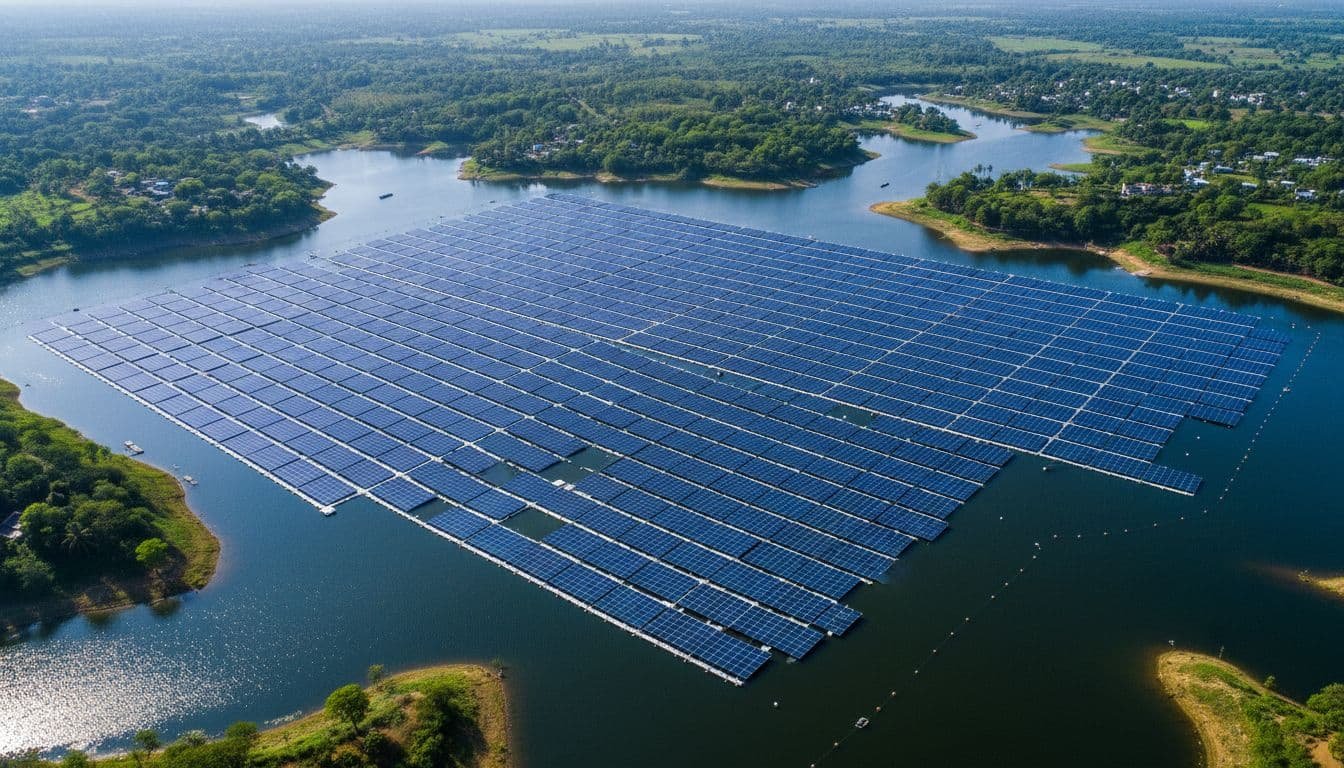
Large floating arrays change more than the view. They can alter light, oxygen, and habitat quality.
An open-access assessment of floating photovoltaic plants notes that floating systems can affect water temperature, stratification, and gas exchange. Current research summaries also warn that dissolved oxygen may fall under dense coverage. For fish and invertebrates, that is not an abstract concern. It is direct stress.
Temperature shifts are not always simple, either. Shade can cool the surface, which sounds helpful in hot conditions. However, if the array also reduces wind-driven mixing, deeper water may hold less oxygen for longer. In nutrient-rich reservoirs, that can worsen conditions in stagnant arms and coves.
Coverage size changes everything. A smaller layout with open gaps behaves differently from a dense, continuous sheet of panels. Gaps allow more light, more air exchange, and more room for habitat movement. Large uninterrupted coverage creates a new physical ceiling over the water.
This is why floating solar in India cannot be judged by technology alone. The layout, density, and season all shape how much damage is likely.
Water-saving benefits can hide ecological loss
Lower evaporation is one of the strongest arguments for floating solar. In a hot country with water stress, that promise carries weight. Yet a reservoir is not a storage tank with no life inside it. A water-saving metric tells you almost nothing about food webs, oxygen stress, or fish habitat.
The same confusion shows up with algae. Reduced light may suppress some blooms, and that can help in troubled waters. But not all algae are harmful. Many microscopic producers sit at the base of freshwater food webs. When you cut light across a large area, you are not only reducing nuisance growth. You may also be reducing the energy that supports the rest of the system.
Public debate often gets trapped in a single number, megawatts generated, land avoided, litres saved. Those numbers are easy to present and easy to celebrate. Ecology is slower and harder to summarize. Harm can build through small shifts that only show up over time, especially when no one measured the baseline well.
That is why a project can perform well on paper and still leave the reservoir worse off. A narrow benefit does not cancel a broader loss.
Food webs, fish, and birds feel the shift first
When light and oxygen change, the food web changes with them. Plankton communities may shift first. That affects zooplankton, then small fish, then larger fish and the birds that feed on them. Freshwater ecosystems can handle some disturbance. They struggle when several pressures hit at once.
A study on floating solar in freshwater systems frames these projects as techno-ecological trade-offs. That wording is useful because it places electricity generation inside the ecosystem, not above it. The array becomes part of the habitat story.
Fish do not use a reservoir evenly. They rely on temperature bands, shallow margins, plant cover, open-water feeding zones, and seasonal movement corridors. If floating structures occupy the wrong places, they can disrupt spawning, reduce feeding access, or force fish into warmer or less oxygen-rich water. Small fishers may feel that change in their catch long before any environmental report catches up.
Birds face a similar problem. Open water is not just scenic space. It is feeding ground, resting ground, and flight path. Maintenance traffic, cables, and altered surface use can push birds away from zones they have used for years. Around peri-urban lakes and reservoirs, that can also weaken urban biodiversity where wetland habitat is already fragmented.
Communities tend to see these changes in plain terms. Fewer fish show up in familiar zones. A flock stops visiting a shoreline. Water smells different in late summer. The science matters, but so do those lived observations.
Materials, moorings, and maintenance bring their own risks
The panels are only part of the structure. Floating solar also means plastic pontoons, metal parts, cables, anchors, chains, and service equipment. Over years of heat, UV exposure, and rough weather, those materials age. If quality is poor, they can release chemicals, metals, or microplastics into the water.
That risk is not the loudest part of the debate, but it should be. Research reviews keep returning to material safety because freshwater systems are sensitive to chronic low-level contamination. Problems may start small and stay invisible until damage spreads through sediment, plankton, or fish tissue.
Anchoring systems can also disturb the reservoir bed or scrape sensitive shoreline zones. Installation and cleaning may require boats, which add fuel and spill risk. Storm damage creates another layer of trouble. Broken components do not vanish neatly when they fail over water.
This is where the circular economy needs to become more than branding. If floating solar is going to expand on public reservoirs, developers should face clear rules on tested materials, end-of-life retrieval, and long-term monitoring for degradation. Without that discipline, a low-carbon project can quietly build a waste problem inside a freshwater system.
Why the Indian context raises the stakes
India’s case is harder than a generic global summary suggests. Heat, long dry spells, monsoon shifts, nutrient loading, and sharp seasonal water-level changes create a demanding setting for any floating structure. Conditions can swing fast. Water that looks calm in one month may become turbulent, exposed, shallow, or oxygen-stressed in another.
Many reservoirs also sit inside layered social pressure. They may hold drinking water for towns, support irrigation networks, buffer industrial zones, and sustain fishers with narrow margins. Some already face runoff, sewage inflow, or thermal stress from nearby development. Floating solar then arrives on top of a system that is not starting from ecological health.
That is one reason floating solar in India can damage reservoir ecology even when the power output looks successful. The engineering target may be met while the public water system absorbs the cost. Shrinking fish habitat, reduced oxygen, and disturbed bird use do not show up in a ribbon-cutting photo.
India does need more renewable power. That part is not in doubt. Land conflicts around utility-scale solar are also real. But those truths should push planning to become smarter, not laxer. Public reservoirs are shared ecological assets. They are not blank blue shapes waiting for industrial use.
Better rules for floating solar in India
The fix is not to reject all floating solar. The fix is to stop treating ecology as a side issue that can be patched later. Better projects need baseline studies before installation, then public monitoring after commissioning. Water quality, dissolved oxygen, temperature, bird use, fish movement, and material wear should all be tracked across seasons.
Developers also need design rules with teeth. Surface coverage should stay limited enough to preserve open-water corridors for light, wind, and wildlife movement. Inlets, shallow nursery zones, and high-use bird areas should stay off-limits. Shoreline access for local communities should not disappear behind infrastructure.
A few standards deserve to be normal:
- seasonal ecological surveys before approval
- public water-quality data after installation
- strict material testing and retrieval plans
- community input that carries real weight
These are not anti-solar demands. They are the minimum for sustainable business models built on public trust. Companies that profit from shared reservoirs should also pay for long-term monitoring and restoration if damage appears.
This is also where climate literacy matters. Mature climate politics can hold two truths at once. Solar power is necessary, and poorly planned solar can still harm living systems. Once that becomes normal public understanding, weak projects lose their moral cover.
Real improvement also requires Systemic change. Energy ministries, water authorities, biodiversity boards, local governments, and nearby communities need one planning table, not five disconnected approvals. That is slower at the start, but much safer over the life of the project.
If you want grounded examples of environmental work tied to real people and place-based accountability, Explore Our Active Missions. Work rooted in habitat repair, youth learning, and local monitoring often protects ecosystems more honestly than glossy sustainability claims.
Personal choices still matter, but they cannot do this alone
Private action has value. Plant-based living can reduce pressure on land and water systems. Everyday mindfulness can also make you more alert to the gap between green branding and ecological reality.
Still, personal habits cannot monitor dissolved oxygen under a solar array. They cannot force a developer to release fish data or retrieve degraded plastic floats. That is why climate-anxious people, especially younger readers, need a politics that goes beyond lifestyle.
Use personal action to sharpen judgment, not to replace public accountability. Demand fast decarbonisation, and demand freshwater protection at the same time. Those two goals belong together.
Conclusion
A solar array on water can look elegant from the air. Reservoir ecology does not look elegant when oxygen drops, habitat shrinks, and local users pay the price.
The strongest lesson is clear. Floating solar is only as clean as its siting, coverage, materials, and oversight. When floating solar in India ignores those limits, the damage is not surprising. It is built into the decision to treat living water as empty space.
Real climate progress needs ecological accountability alongside renewable growth. Anything less asks freshwater systems to carry costs that planners refused to count.