Plastic Mulch Is Piling Up on Indian Farms
 TBH Editorial
A plastic sheet can save a crop and still leave a problem behind for years.
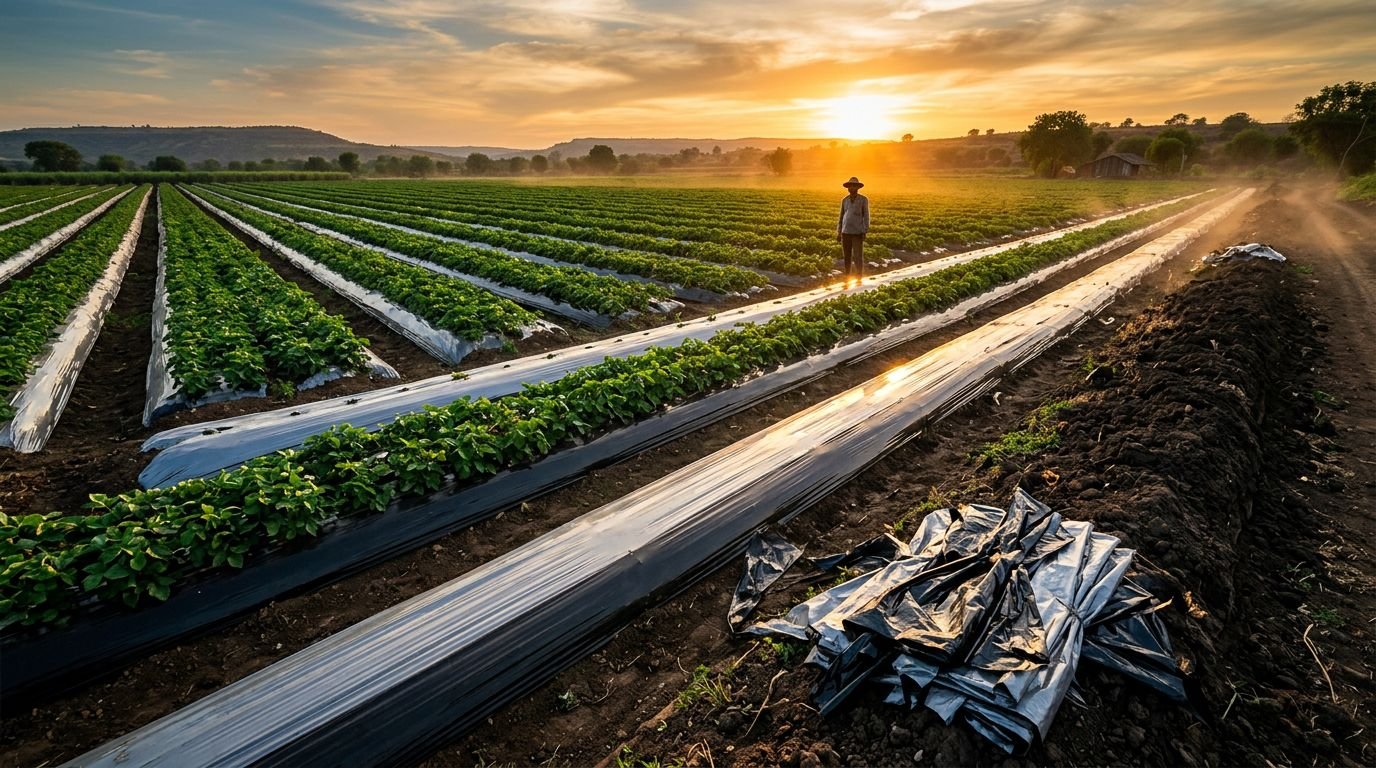
Across India, black and silver mulch films are now common in vegetable plots, orchards, flower farms, and fields utilizing drip irrigation. They suppress weeds, aid in water conservation, regulate soil temperature in cooler months, and make high-value crops look more orderly. For a farmer facing erratic rain, rising labour costs, and a tight planting window, that promise is hard to ignore.
But plastic mulch on Indian farmland doesn’t disappear when the crop is harvested. It tears, gathers soil, gets buried at field edges, burns in small piles, or waits for the next monsoon to carry fragments into drains and soil.
Key Takeaways
- Plastic mulch helps farmers manage weeds and water, but its short working life creates a growing waste problem.
- Soil-stained mulch film is difficult and expensive to collect or recycle through formal channels.
- Burning or burying agricultural plastic shifts pollution into air, soil, water, and food systems.
- Farmers should not carry this burden alone when manufacturers, subsidy schemes, buyers, and regulators shape the market.
- Systemic change means designing collection, reuse, and accountability into plasticulture to prevent it from becoming another problematic single-use plastic before the film reaches a field.
Why farmers use mulch film in the first place
It would be easy to call mulch film a bad idea and walk away. That would miss the reality of farming.
A farmer growing tomato, watermelon, chilli, strawberry, cucumber, or marigold often works under pressure. Unchecked weed growth competes for water and nutrients. Labour for hand weeding costs money. Heat can dry exposed soil quickly. A delayed harvest can wreck the price a grower expected.
Plastic mulch offers a practical answer to several problems at once.
A dark film blocks sunlight from reaching weeds. Utilizing black and silver mulch can reflect light upward, which may help with some pest management practices. The sheet also improves moisture retention and aids in evaporation control, especially when paired with drip irrigation.
For horticulture crops, those gains can be real. Less weeding means fewer days of hard manual work, and stable soil conditions contribute to a higher crop yield. More stable soil moisture can help a crop survive hot spells. Clean fruit is easier to sell than fruit lying directly on wet mud.
Government subsidy and horticulture schemes have also helped expand plasticulture. Subsidies for drip systems, mulch films, protected cultivation, and micro-irrigation have made these materials more accessible in several states. Maharashtra, Karnataka, Gujarat, Andhra Pradesh, Telangana, Punjab, Haryana, and parts of Himachal Pradesh all have strong markets where plastic mulch is familiar.
The problem isn’t that farmers use a tool that works. The problem is that the system sells a short-life product without building a reliable end-of-life route.
A mulch sheet may protect soil moisture for one season. If nobody collects it afterward, the field carries the cost.
That gap becomes sharper when plastic mulch is promoted as modern farming while its disposal is treated as an afterthought.
The field does not stay clean after harvest
Fresh mulch looks neat. It sits tight across raised beds, with holes cut around seedlings. After weeks of sun, wind, drip irrigation, foot traffic, and harvest activity, it becomes something else.
The polyethylene mulch stretches. It catches on tools. It tears where workers step between rows. Soil clings to both sides. Roots grow through holes. Drip lines get tangled beneath it. By the end of the season, lifting the sheet can feel like pulling wet paper from the ground.
That matters because recycling systems need material that is reasonably clean, sorted, and worth transporting.
A bale of clean mulching sheet has some value. A pile of mulch film mixed with mud, roots, pesticide residue, and stones has far less. Washing it uses water. Separating it takes labour. Transporting a low-value, dirty material across rural distances can cost more than the recycler earns.
So the waste stays near the field.
Some farmers stack it beside a shed. Some bury it in a corner. Some hand it to local scrap dealers if someone is willing to take it. Others burn it because there is no collection point, no storage space, and no clear alternative.
None of those choices should surprise us. A grower cannot be asked to act like a waste-management company after a difficult harvest.
The material also does not always leave in one piece. Thin films of a low micron thickness fragment easily. Small strips remain under soil clods. A cultivator can chop old plastic into smaller pieces. Rain carries loose fragments into drainage channels. Wind lifts them into hedges, ponds, and neighbouring plots.
The field may look cleared from a distance. Up close, the plastic remains.
Soil health suffers when plastic becomes dust
Plastic mulch is often sold as a soil-saving input because it reduces evaporation, prevents erosion, and provides effective weed suppression. That claim has a narrow truth. Covering bare ground can protect moisture during a crop cycle.
But a soil-saving practice becomes harder to defend when the covering breaks into the soil itself.
Microplastics are small plastic particles, usually defined as pieces under five millimetres. They can enter farmland through mulch film, irrigation water, compost contaminated with plastic, sewage sludge, packaging waste, and tyre dust carried by wind. Mulch film is one direct and visible source.
Once fragments enter soil, removing them is almost impossible at field scale.
Researchers are still working through the full effects of agricultural microplastics. What is already clear is that soil is not an empty storage box. It is a living system of fungi, bacteria, insects, roots, worms, water channels, and organic matter.
Plastic fragments can change soil structure. They may affect how water moves through the ground and can degrade the quality of the root zone environment. They can also alter microbial activity and interact with fertilisers, pesticide residues, and metals already present in the soil.
That should worry anyone who cares about food security. India cannot keep asking soil to produce more while filling it with materials designed to outlive the crop.
The question also reaches beyond the farm gate. During heavy rain, loose film and fragments move into canals, village ponds, and rivers. Livestock can chew discarded sheets. Birds may use scraps in nests. Grazing animals can swallow plastic mixed with crop residue.
This is not only a waste issue. It is an ecological impact that moves through water, soil, animals, and food.
Small farm ecosystems matter too. Earthworms, pollinators, frogs, insects, and soil organisms are not decorative extras around agriculture. They support nutrient cycles, pest balance, and water retention. When plastic waste spreads through rural land and water, it also weakens urban biodiversity downstream in lakes, wetlands, and green corridors that receive agricultural runoff.
The plasticulture market has an accountability gap
Agricultural plastic is often discussed as if farmers alone create the problem. That is unfair.
The company makes the film. Dealers sell it. Agricultural departments may subsidise it. Crop buyers reward uniform produce. Consumers expect cheap vegetables with few blemishes. Yet the farmer is often left holding a muddy pile of waste with nowhere to send it.
That is not responsibility. It is risk transfer.
India’s Plastic Waste Management Rules have focused heavily on packaging through extended producer responsibility, often called EPR. While packaging needs attention, agricultural plastics, which are essential components of modern precision agriculture, present unique challenges. Mulch films, nursery trays, drip pipes, greenhouse covers, fertiliser bags, and pesticide containers do not move through the same collection routes as household bottles or food wrappers.
A village may have a scrap buyer for metal, cardboard, and hard plastic. It may have no dependable buyer for soil-covered mulch film.
The table below shows why farm plastics need their own recovery system.
| Material | Typical farm use | Main disposal difficulty |
|---|---|---|
| Mulch film | Weed control and moisture retention | Thin, soil-covered, torn after use |
| Drip irrigation lines | Water delivery | Mixed parts and seasonal replacement |
| Greenhouse film | Protected cultivation | Large sheets, weather damage, transport costs |
| Seedling trays | Nursery production | Often reusable, but break over time |
| Pesticide containers | Crop protection inputs | Chemical residue and safety risks |
The hardest materials are often the least profitable. That is exactly why public rules and producer responsibility matter.
A serious collection model would not stop at a poster telling farmers not to burn plastic. It would include local aggregation points, transport support, transparent pricing, material-specific recycling, and manufacturer-funded systems for returning the used mulching sheet.
Companies also need to stop treating disposal as someone else’s problem. If a product is sold for one crop cycle but lasts decades in the environment, its retail price is hiding part of the cost.
Burning mulch film is not a harmless shortcut
You can understand why burning happens without pretending it is safe.
A pile of torn mulch takes space, and it smells bad when wet. Because farmers often opt for film with a lower micron thickness to reduce costs, the material is prone to tearing, making it difficult to collect and dispose of properly. Nobody wants this waste near fodder or equipment, and transport is costly. Consequently, burning looks like a quick fix.
The smoke tells a different story.
Most mulch film is made from polyethylene-based plastics. When dirty agricultural plastic burns in the open air, combustion is incomplete and poorly controlled. It releases particulate matter, carbon monoxide, volatile organic compounds, and toxic additives or contaminants trapped in the film.
The smoke does not stay above the field. It moves through homes, animal sheds, roadside stalls, and schools. Ash settles onto soil and water, while workers standing near the fire take the first hit.
This is painfully familiar in other waste streams. The same pattern appears when wires are burned to recover copper or when mixed waste catches fire at a dump. Convenience for the system becomes exposure for the people with the least protection.
Farm workers, women sorting crop residue, children playing nearby, and older people with respiratory illness do not get to opt out of that air.
There is another blind spot here. Plastic mulch may carry pesticide residues from a season of crop spraying. Burning it combines agricultural chemical exposure with plastic smoke. We should not pretend that makes a clean fire.
A farmer needs a real alternative, not a lecture.
Biodegradable mulch is promising, but labels need scrutiny
Transitioning to biodegradable mulch film sounds like the obvious fix for the current waste crisis. While it can be part of the solution, the term biodegradable has been used so loosely that buyers must ask better questions before making the switch.
A film may break into smaller pieces without fully breaking down into water, carbon dioxide, and biomass under real field conditions. Some products are marketed as compostable agriculture mulch but actually require industrial composting facilities that farms do not possess. Furthermore, farmers should prioritize materials that are CPCB certified to ensure they meet authentic environmental safety standards for Indian soils, temperatures, and monsoon cycles.
Farmers should not have to test marketing claims with their own land. Before switching, buyers should ask:
- Is the mulch certified for soil biodegradation, rather than just industrial composting?
- Does the supplier provide test details, thickness, expected field life, and crop suitability?
- What happens if the film does not fully degrade after harvest?
- Is the product compatible with local soil conditions and irrigation practices?
- Who is responsible if fragments remain in the field?
Natural mulches also deserve more attention. Straw, dry leaves, crop residue, sugarcane trash, coconut husk, and composted organic matter can suppress weeds and reduce moisture loss in suitable crops. They are not perfect, as organic mulch can carry weed seeds, attract pests, or require more labour. Still, they return carbon to the soil instead of leaving synthetic fragments behind.
This is where plant-based living connects with farming in a practical way. A food system built around plants still needs healthy soil, clean water, and fair conditions for the people growing those crops. Eating more plants means little if their production leaves farmers surrounded by plastic waste.
Better farming cannot mean more disposable inputs
We need to stop treating every farm problem as a market for another disposable sheet, bottle, tray, or tube. While some systems are starting to shift toward sustainable alternatives for weed suppression, we must remain critical of how these products move through the landscape.
A good agricultural input should earn its place. It should improve yields or reduce hardship without creating a larger burden later. Plastic mulch can meet that test in certain crops and regions, especially where water stress and weed pressure are severe. But its use must come with recovery plans that work outside pilot projects.
That calls for sustainable business models, not charity drives after the damage is done.
Manufacturers could charge a small deposit that farmers recover when they return used mulch. Dealers could bundle collection into the purchase price. Farmer producer organisations could aggregate material across villages and negotiate directly with recyclers. District horticulture offices could tie subsidies to documented take-back arrangements.
The point is simple. If public money helps put mulch into fields, public systems should help bring it back out.
A real circular economy does not mean calling every plastic product recyclable. It means designing the route before production begins. Who collects it? Who pays? Where does it go? What happens to the contaminated fraction that cannot be recycled?
Without those answers, “circular” becomes a nicer label for a one-way system.
We also need better data. India has broad plastic waste estimates, but farm-level records on mulch film use, recovery, burning, burial, and leakage remain patchy. States should map major horticulture belts, track agricultural plastic sales, and publish recovery figures district by district.
What gets counted is harder to ignore.
What farmers, consumers, and local groups can do now
The biggest duty sits with producers and regulators. Still, communities can push the system in a better direction.
Farmers using mulch can store removed film separately from crop residue and soil where possible. Keeping it dry and reducing contamination improves the chance that a recycler or aggregator will accept it. When farmers manage plastic waste effectively, they can better protect their long-term crop yield and support consistent water conservation efforts. Shared collection days through farmer producer organisations can also reduce transport costs.
Buyers can ask dealers one awkward question before purchasing: “Where does this go after harvest?” If nobody has an answer, that is useful information. It tells you the product’s price excludes its real disposal cost.
Local schools, resident groups, and climate organisations can build climate literacy around agriculture without blaming farmers. The people buying vegetables in cities are connected to what happens in fields. Cheap produce, cosmetic standards, and ignored waste do not exist in separate worlds.
Everyday mindfulness can begin with noticing that connection. Food is not only a meal on a plate. It carries soil, labour, water, transport, packaging, and often plastic waste that someone else has to handle.
Community action also matters where it is specific. A district campaign can ask horticulture departments to publish agricultural plastic collection points. A village panchayat can prevent open burning near homes and water bodies. A farmer group can demand take-back terms from suppliers before placing a bulk order.
For people who want to connect climate concern with visible work on the ground, Explore Our Active Missions and support projects that link environmental care with public accountability.
Frequently Asked Questions
Why is it difficult to recycle plastic mulch from Indian farms?
Plastic mulch is rarely collected for recycling because it is typically covered in soil, roots, and pesticide residues after a harvest. This contamination, combined with the high cost of transporting lightweight, bulky waste from rural areas to processing centers, makes it financially unviable for most recyclers.
Does burning mulch film harm the local environment?
Burning agricultural plastic is a significant source of air pollution, releasing toxic smoke, volatile organic compounds, and particulate matter directly into the atmosphere. This practice exposes farm workers and nearby communities to hazardous substances while contaminating the immediate soil and water with toxic ash residues.
Can farmers safely switch to biodegradable alternatives?
Biodegradable mulch can be an effective solution, but it requires careful vetting to ensure the film actually degrades into biomass under specific local soil conditions. Farmers should prioritize materials that carry official certifications like CPCB approval, rather than relying on loose marketing terms that may result in plastic fragments remaining in their fields.
How can consumers help reduce the agricultural plastic crisis?
Consumers can influence the system by recognizing that cheap produce often comes at the hidden cost of environmental degradation and unmanaged farm waste. By supporting sustainable farming advocacy and demanding greater transparency regarding supply chains, urban buyers can pressure regulators and manufacturers to adopt mandatory producer responsibility and better collection infrastructure.
Plastic mulch needs a system, not a guilt campaign
Plastic mulch did not spread across Indian agriculture because farmers were careless. It spread because it solved immediate problems in a system that rarely gives growers enough time, money, labor, or water.
But leaving that film in the soil, burning it at field edges, or sending it into drains is not progress. It is deferred damage with a green and black surface. Responsible disposal and recycling of these materials are essential, as they ensure better moisture retention for future seasons and protect the long-term productivity of the soil.
Systemic change means making the producer, dealer, subsidy program, recycler, and regulator share responsibility before the plasticulture products reach the field. Until that happens, every neat vegetable bed across plastic mulch Indian farmland may hide a waste problem waiting for the next harvest.