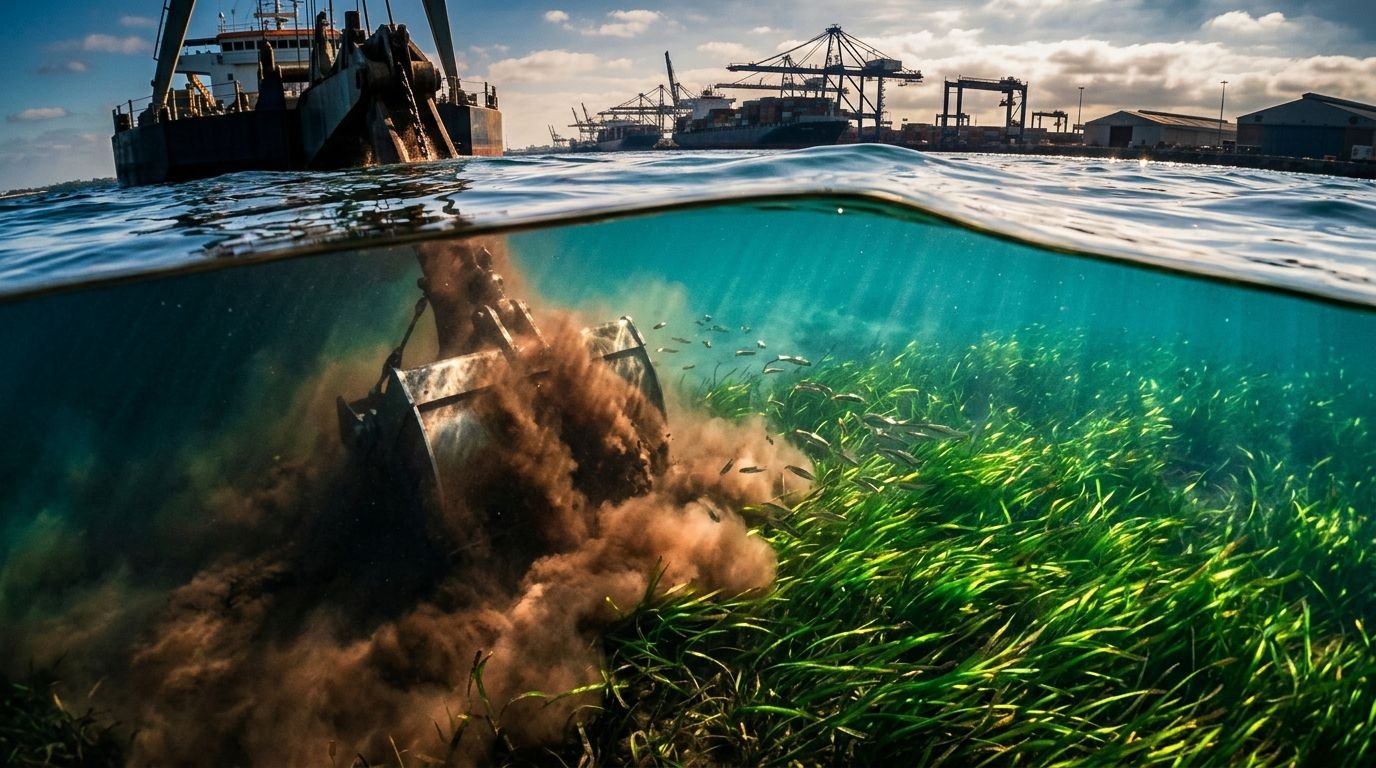
Port Dredging in India Is Harming Seagrass and Fisheries
 TBH Editorial
A deeper port can mean a poorer coast. In India, dredging is often sold as a clean trade story, promising more cargo, bigger ships, and faster economic growth. What gets buried in that pitch is the living seabed, often sacrificed under the banner of the Sagarmala programme and various port modernization projects aimed at industrial expansion.
If you care about food security, local jobs, or honest climate action, look below the waterline. Port dredging India is not only an engineering choice, it is a choice about whose losses count and whose do not. By prioritizing massive infrastructure shifts, these activities frequently overlook the ecological value of the marine environments that sustain coastal communities.
Key Takeaways
- Seagrass meadows are fish nurseries, sediment stabilizers, and carbon stores, rather than spare underwater weeds.
- Both capital dredging for new port berths and recurring maintenance dredging for existing channels harm seagrass through direct removal, burial, turbidity, and spoil disposal, and fisheries feel the hit fast.
- Fishing communities often detect damage before official reports do, because they live the loss in fuel costs, catch declines, and closed landing spaces.
- Systemic change matters more than one-off mitigation, because recurring dredging and weak monitoring keep repeating the damage.
- Better port planning needs public data, fisher-led monitoring, and business models that stop offloading ecological costs onto coastal communities.
Seagrass is not scenery, it’s essential marine infrastructure
A seagrass meadow is easy to miss. It does not rise like a forest canopy, and it does not photograph well from a ribbon-cutting stage. Underwater, however, it acts as vital marine infrastructure that performs the slow work of keeping our coasts alive.
These meadows shelter juvenile fish, prawns, crabs, and shellfish. They slow currents and help sediment settle. Their roots hold the seabed together. In parts of India, including the Gulf of Mannar, Palk Bay, Lakshadweep, and the Andaman and Nicobar Islands, seagrass also supports wider marine food webs and stores carbon in coastal sediments.
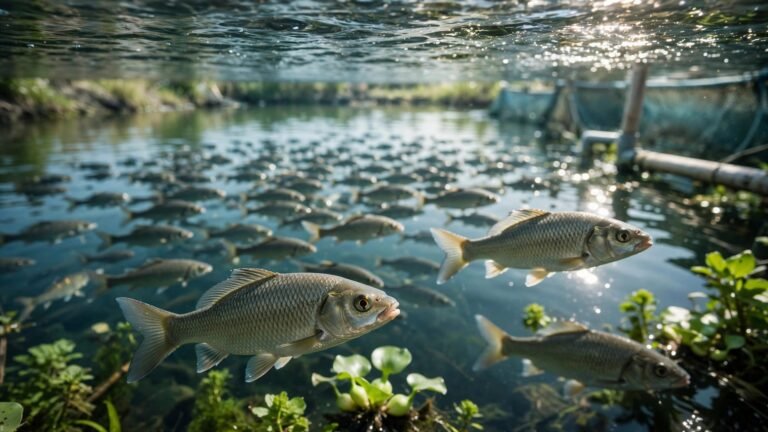
That matters for fisheries because young fish do not grow in abstract policy documents. They grow where they can hide, feed, and avoid strong currents. Seagrass gives them that start. Strip the meadow out, and the catch you hoped to land months later may never mature.
This is also bigger than wildlife. When coastal habitat weakens, nearby markets, landing centers, drying yards, and households feel it. Women’s work in sorting and selling fish feels it. Bird habitat feels it. Even urban biodiversity in port cities takes a hit when estuaries, mudflats, and nearshore meadows are treated like blank space between industry and the sea. As projects like the proposed Vadhvan Port or the massive expansions managed by Adani Ports and Special Economic Zone continue to move forward, the overlap between industrial development and critical coastal habitats becomes increasingly difficult to ignore.
I think we need to say this plainly: a port that damages its nursery grounds is not building prosperity on stable terms. It is liquidating a living asset and calling it development.
What dredging does underwater, even when the sea looks calm
The damage starts in ordinary mechanics. A trailing suction hopper dredger or a cutter suction dredger cuts, sucks, and stirs the seafloor to deepen a channel or basin. These powerful hydraulic dredgers move massive volumes of material, and depending on the hopper capacity of the vessel, the scale of sediment removal can be immense. This process directly removes seagrass while simultaneously burying nearby plants under fresh sediment or sending suspended particles drifting into surrounding water.
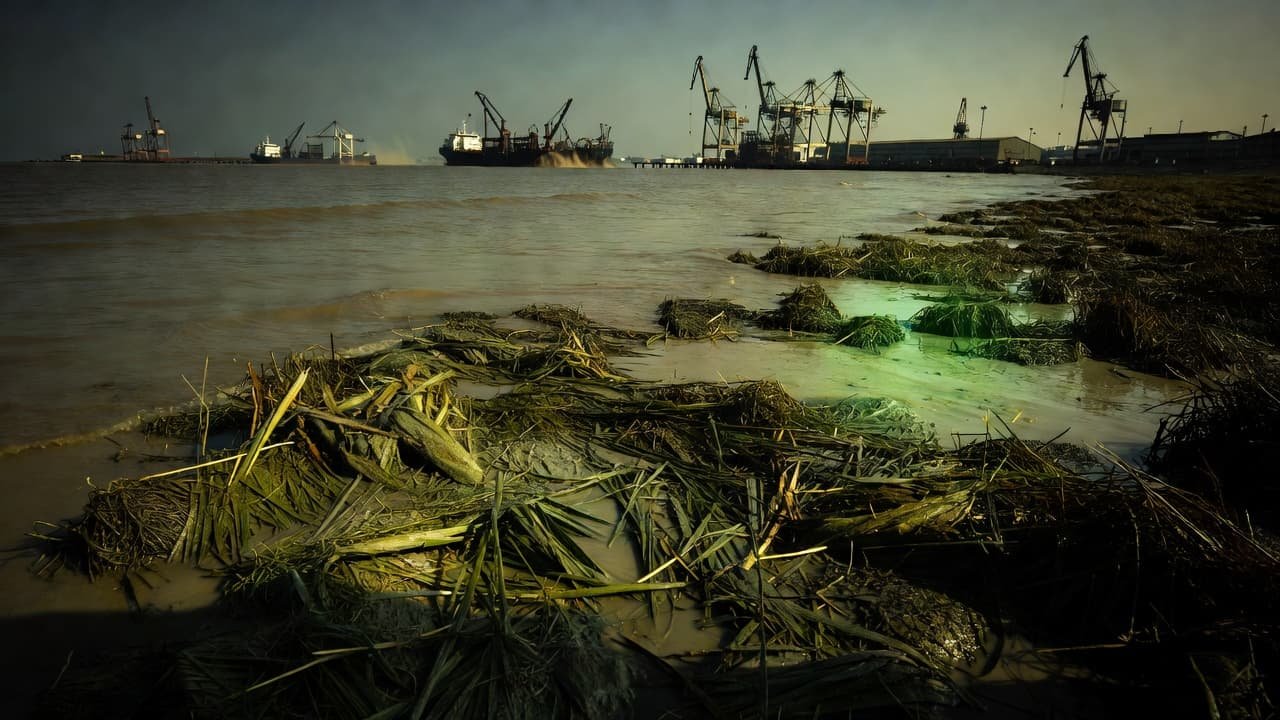
The part many people miss is turbidity. When the water turns murky due to the sediment plumes generated by these operations, light penetration drops significantly. Seagrass needs sunlight to photosynthesize; without adequate light, the plants cannot generate the energy required for survival or recovery.
If sunlight can’t reach the blade, the meadow can’t feed itself.
A large body of research keeps landing on the same conclusion. A review of dredging impacts on seagrasses explains how suspended sediment and burial reduce growth and survival. A before-after seagrass impact experiment found that disturbance can cut shoot density and increase patchiness even where total loss does not happen at once.
This quick comparison shows why the effects spread beyond the dredger itself.
| What dredging changes | What happens to seagrass | What fisheries lose |
|---|---|---|
| Seabed is cut or scraped | Shoots and roots are removed | Nursery habitat shrinks |
| Sediment plume clouds water | Light falls, growth weakens | Juvenile fish disperse or die |
| Spoil settles on nearby beds | Leaves are smothered | Shellfish and bait grounds degrade |
| Repeated maintenance dredging | Recovery keeps getting interrupted | Catch reliability drops |
The global picture is not small. A review cited in current reporting compiled 45 case studies and recorded 21,023 hectares of seagrass loss linked to dredging. A recent ship-channel dredging study also showed how spoil deposition and post-dredging disturbance can reshape meadow condition across a large impact area.
Some seagrass species bounce back faster than others. Smaller, opportunistic species may recolonize quickly, but slower-growing species often do not. That uneven recovery matters because the meadow that eventually returns may not function like the complex ecosystem that was lost.
Why fishers feel the loss before the data does
A fisher does not experience dredging as a line in an environmental clearance file. They meet it in muddy nets, longer fuel bills, altered currents, smaller landings, and the sudden disappearance of a reliable fishing patch.
That is why coastal communities are often the first real monitoring system. They know when a creek mouth shifts. They know when mussels stop attaching well. They know when juvenile fish vanish from the nearshore water. They do not need a glossy dashboard to tell them something is broken.
Mundra is one of the hardest examples to ignore. A widely cited assessment linked port expansion by Adani Ports and Special Economic Zone in Kutch to the loss of mangroves, creeks, and coral associated areas, estimating that 1,015 fisher households were affected. Jarpara and Navinal bandars were shut, and some fishing families reported traveling five times farther to find a reasonable catch.
Kerala shows a related pattern. Around Vizhinjam, fishing communities and watchdog reporting have tied dredging and offshore reclamation to shoreline erosion, transport disruption, and the loss of mussel habitat. More maritime traffic adds another layer of pressure after the dredger leaves. Similarly, in Maharashtra, the proposed Vadhvan Port has raised significant concerns, as local fishing communities fear that massive construction will result in long term habitat loss and the displacement of traditional livelihoods.
As of July 2026, the west coast is in the Ministry of Fisheries 61 day monsoon fishing ban. That seasonal closure is a management decision. Habitat loss is not. When dredging damage stacks on top of weather risk, fuel prices, and regulatory downtime, the squeeze on fishers becomes brutal.
The pain also spreads through shore based work. Less fish landing means less sorting, less drying, less vending, and less household cash flow. Children see it in school choices. Families see it in debt.
A port can deepen its channel while shallowing a fishing community’s future. That sentence sounds harsh until you stand where the catch used to be.
Why India’s port politics keeps missing the seabed
The trouble with India’s dredging push is not only the digging. It is the incentive system designed by the Ministry of Ports, Shipping and Waterways, which consistently prioritizes expansion over ecological stability.
Capital budgets favor visible assets, such as breakwaters, berths, access roads, turning circles, and land reclamation. In this landscape, the Hybrid Annuity Model has become a dominant financial mechanism for marine infrastructure. While this model accelerates construction, it often prioritizes rapid project delivery over the long term monitoring requirements that should be overseen by the Inland Waterways Authority of India. A dredging contract can certify cubic meters moved in weeks, but a damaged meadow may take years to recover, if it recovers at all.
That mismatch creates a familiar illusion. The project file looks active, but the coast keeps getting poorer.
Monitoring is often part of the problem. Broad water quality averages can hide local harm. Sampling points may sit where reporting is easy, not where people fish, launch, collect shellfish, or track juvenile catch. If surveys miss the nearshore hotspot, the damage stays politically invisible.
When monitoring tracks cargo tonnage better than seagrass survival, the loss is already priced in.
Follow the money and the pattern gets clearer. India’s dredging market is expected to grow, with maintenance dredging making up a large share of demand in 2026. The Dredging Corporation of India is central to this trajectory, with ambitious growth targets that include a significant fleet expansion and a plan to more than double turnover to Rs 3,000 crore over the next five years. Growth itself is not the problem. The problem is growth with weak ecological accounting.
Muthalapozhi shows the recurring cost side of this story. Kerala allocated Rs 1 crore for sand removal and Rs 10 crore for a sand bypassing method, while the Central Water and Power Research Station studied sediment movement and 30 diving experts from fishing communities were deployed. Once coastal sediment systems are pushed out of balance, dredging stops looking like a one time intervention and starts looking like a standing bill.
What real accountability would look like on the coast
We don’t need a fantasy where every port disappears. We need honesty about trade-offs, hard limits, and public costs.
Systemic change starts before the first cut into the seabed. That means baseline seagrass maps must be created before approval, not after protest. It means cumulative impact assessments across the whole coastal stretch rather than focusing on a single lease boundary. This is particularly vital for inland waterways development, such as the ongoing work on National Waterway 1 under the Jal Marg Vikas Project, where sediment movement and fishing cycles are deeply interconnected. Project appraisal has to match that reality.
Timing matters too. If dredging cannot be avoided, work should stay clear of spawning windows and sensitive migration periods. Turbidity thresholds should trigger mandatory pauses, a standard that is critical for massive developments like the Vadhvan Port. EPC contractors should be required to provide ecological land reclamation solutions that move beyond simple spoil disposal; instead, these firms must ensure that debris is kept far away from living meadows and shellfish grounds. Furthermore, monitoring data should be public, frequent, and easy to read.
The business side needs a reset as well. Ports, contractors, and shipping-linked firms need sustainable business models that count habitat disruption, shoreline repair, landing-site support, and livelihood loss as project costs rather than afterthoughts. A real circular economy does not dump ecological debt into the sea and call the job complete. It asks whether material movement, shoreline alteration, and maintenance cycles are creating repeated waste that ecosystems and communities are forced to absorb.
This is where climate literacy matters. If citizens only see ports as cargo infrastructure, the ecological bill stays hidden. Once you understand that a dredged channel can damage food systems, carbon-rich sediments, and coastal protection at the same time, the conversation changes.
We have seen better coastal thinking when people and ecosystems are treated as one story, not two separate files. That is why grounded work like how Mission S.E.E.D. protects coastlines and students matters. It ties human security to living shorelines instead of pretending the coast is only a logistics corridor.
What you can do, without pretending personal virtue is enough
Let’s be honest. You cannot compost, recycle, or meditate your way out of a bad port clearance. Personal choices matter, but public systems decide the coastline.
Still, personal action has a role when it sharpens pressure. Everyday mindfulness starts with better questions. Where is the spoil going? Did the project map seagrass properly? Which fishing villages lose access first? What does compensation look like after the headlines fade?
A few habits are worth keeping:
- Read the summary documents for coastal projects and look for seagrass mapping, turbidity limits, and fisher compensation. If those sections are thin, the ecological impact is probably undercounted.
- Research whether coastal shipping routes were planned with habitat protection in mind or if they simply prioritize speed over the seabed.
- Scrutinize the use of a mechanical dredger in your region, as these machines often cause severe localized damage that environmental reports fail to capture.
- Follow fishworker unions, local researchers, and coastal reporting, not only press releases from project promoters.
- If plant-based living is part of your ethics, keep it grounded. Lowering pressure on stressed marine food webs can help, but the point is not purity. The point is a fairer food system and less pressure on damaged coasts.
- Back work that connects community well-being with habitat repair. If you want to see verified, on-the-ground urban biodiversity and climate literacy projects, Explore Our Active Missions.
The goal is not consumer guilt. The goal is sharper attention, better public pressure, and less room for harm to hide under technical language.
Frequently Asked Questions
How does dredging directly impact seagrass meadows?
Dredging harms seagrass through physical removal by cutting machines and by burying plants under disturbed sediment. Additionally, the process creates turbidity plumes that block essential sunlight, preventing these plants from photosynthesizing and causing them to wither.
Why do fishing communities feel the impact before it is officially recorded?
Fishers live and work directly on the water, allowing them to notice immediate declines in catch, the disappearance of juvenile fish, and shifts in creek morphology long before official surveys are conducted. They experience the degradation of marine ecosystems through increased fuel costs and the loss of traditional fishing grounds that government data often overlooks.
Is maintenance dredging less harmful than initial capital dredging?
Both types of dredging present significant risks to the marine environment. While capital dredging involves massive initial excavation, recurring maintenance dredging creates a cycle of persistent disturbance that prevents seagrass and local fisheries from recovering, keeping the ecosystem in a permanent state of stress.
Can port expansion and environmental conservation coexist in India?
Coexistence is only possible if port planning shifts from prioritizing rapid industrial throughput to incorporating mandatory ecological accounting and public transparency. This requires setting strictly enforced limits on dredging during sensitive spawning seasons and ensuring that the real costs of habitat loss are integrated into the financial models of port projects.
The coast keeps the real books
A deeper channel can move more cargo. It can also erase the meadow that steadied sediment, fed juvenile fish, and buffered coastal life. When it comes to port dredging India, the nation is paying that second bill later through weaker fisheries, angrier shorelines, and families pushed farther out to sea for less catch.
If port planning is going to be honest, seagrass and fisheries must be valued as essential marine infrastructure rather than collateral damage. While port depth maintenance remains a technical priority for logistics, it should never supersede ecological safety. We must measure the loss where communities actually live it and price the environmental damage before the dredger ever starts its work.
Ask harder questions before the next expansion is approved. That is how genuine concern turns into lasting protection for our coastlines.