Cemented Tree Bases Are Killing Urban Trees in India
 TBH Editorial
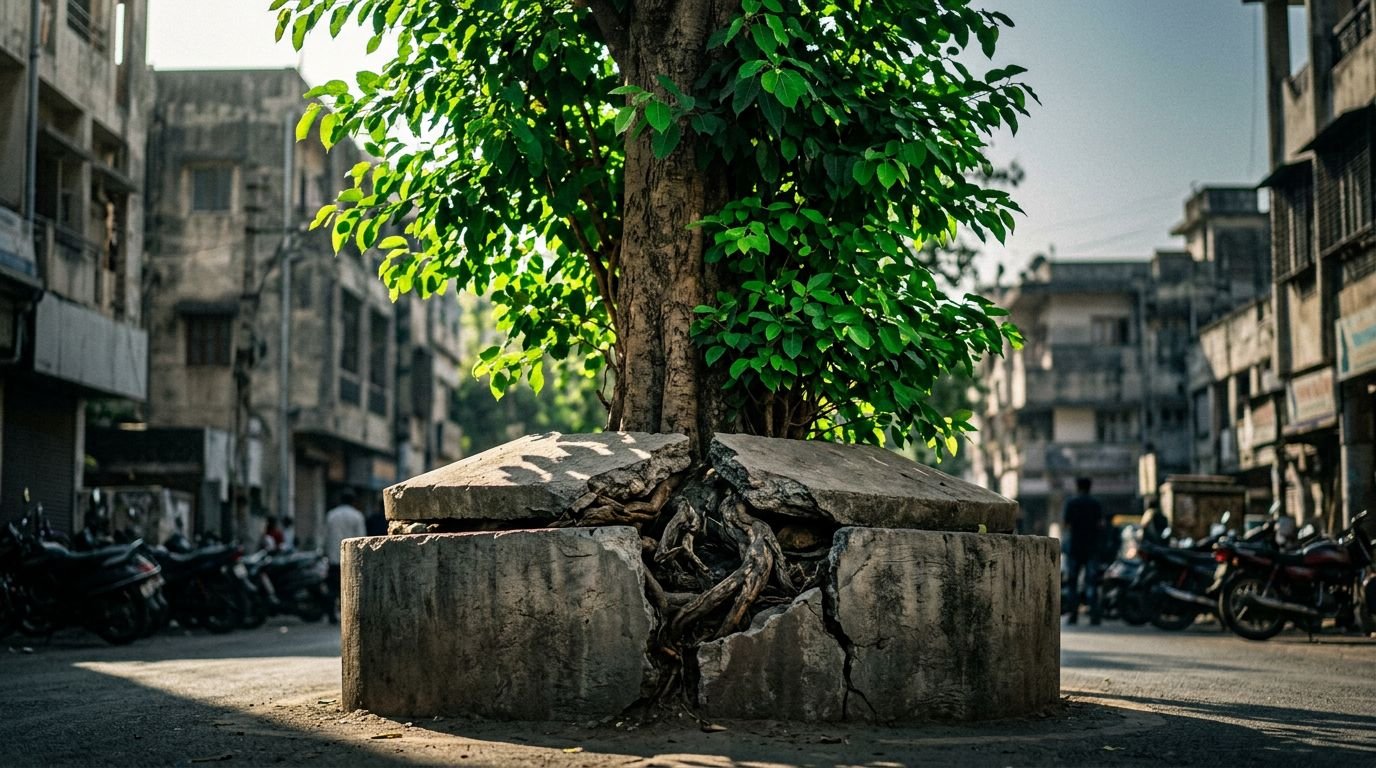
Have you ever looked at a roadside tree trapped inside a perfect ring of cement and thought it looked protected? I used to.
Then you learn what that neat concrete finish does below ground. In many Indian cities, cemented tree bases are not protection at all. They are slow suffocation dressed up as beautification.
If we want cooler streets, stronger shade, and healthier neighborhoods, we need to stop admiring the wrong detail. Start at the tree pit to prioritize long-term tree health.
Key Takeaways
- The Illusion of Protection: Cemented tree bases are often perceived as neat and protective, but they actually act as “concrete coffins” by restricting the essential exchange of air and water.
- Slow Suffocation: Concrete seals prevent soil aeration and water infiltration, leading to root rot, nutrient deficiency, and a slow, steady decline in tree health that is often invisible until it is too late.
- The Impact of Urban Heat: By trapping heat and preventing proper root expansion, paved-in tree pits intensify the negative effects of the urban heat island, reducing the shade and cooling benefits trees provide to pedestrians.
- Prioritizing Infrastructure over Aesthetics: To support healthy urban canopies, municipal designs must move away from short-term visual beautification and toward permeable, mulched, and engineered soil systems that treat trees as living infrastructure.
A neat ring of cement is a slow chokehold
The tree base is not leftover sidewalk space. It is living ground.
That small patch of soil is where tree roots pull in water, exchange gases through the soil, and spread far enough to support the crown above. Seal that surface with cement, and you shut down the access to the basics the plant needs every day. We often treat urban greenery like a static object, essentially mounting a living thing into a rigid Christmas tree stand of concrete that ignores its biological reality.
Urban trees already live under stress. They deal with compacted soil, heat radiating from asphalt, trenching for utilities, foot traffic, parked scooters, and polluted runoff. A tight concrete collar pressed directly against the tree trunk takes a hard life and makes it harsher.
Some designers abroad have started calling these bad pits concrete coffins. The phrase is blunt, and it fits. UWE Bristol’s discussion of urban tree pits uses it to describe designs that look tidy above ground while creating poor conditions below it.
Local campaigns in India have been saying the same thing in simpler words. Mission Green Mumbai’s tree-base removal campaign pushes for the removal of concrete because plants need access to air and water, not decorative sealing.
An unpaved tree base is not dead space to tile over. It is the breathing space the tree needs at street level.
There is an important nuance here. Paving near trees is not automatically fatal. A tree can live beside a footpath if the design leaves enough open, permeable space and protects the critical root zone from encroachment. What kills trees is the common shortcut: a tiny pit, concrete pressed close to the bark, and compacted soil boxed in from every side.
That is why these failures confuse people. Trees do not collapse the day the cement dries. They decline slowly. Leaves thin out. Branches die back. Growth stalls. By the time the damage becomes visible, the design error is old news and the paperwork says the street was improved.
What happens below the footpath
Roots need oxygen, not a sealed lid
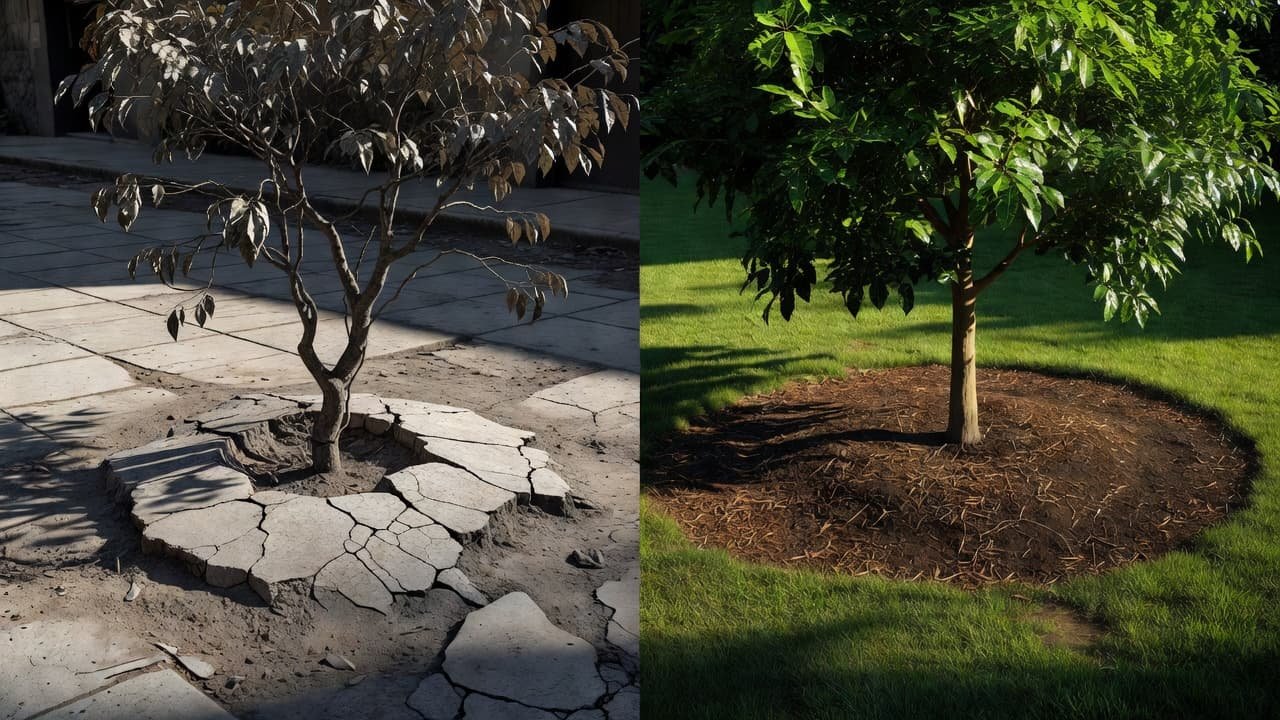
Tree roots do not breathe like we do, but they still need oxygen in the soil. Healthy soil has tiny pores filled with air and water. Concrete at the surface, plus repeated soil compaction from traffic and paving work, squeezes those pores down and limits the necessary aeration for survival.
Once that happens, tree roots weaken. Fine roots die first. Those are the parts that do most of the work of absorbing moisture and nutrients. If the pit then holds stagnant water after rain, the soil can turn anaerobic, which means oxygen levels drop so low that tree roots begin to fail.
This is one reason cemented bases are so deceptive. People see a standing tree and assume it is coping. The struggle is often underground.
Water either runs away or gets trapped
A good tree pit lets rain infiltrate the soil and move through it, particularly reaching the drip edge where water infiltration is most vital for the root system. Concrete disrupts that balance.
On some streets, water simply races off the hard surface and into drains, leaving the root zone too dry. On others, a shallow depression forms around a sealed pit and water collects with nowhere to drain properly. Both situations can damage roots. One starves the tree, and the other drowns it.
The answer is not constant watering from a tanker or hose. The answer is better soil, better infiltration, and proper drainage.
Heat and hard soil finish the job
Concrete and asphalt store heat. Anyone who has crossed a bare Indian footpath in May already knows this with their skin.
That heat reaches the root zone. Meanwhile, compacted soil blocks root expansion and reduces water movement. The tree cannot easily grow outward, cannot cool itself well, and cannot anchor properly.
Practice notes and research cited in 2026 all point in the same direction: standard concrete basins raise mortality because they limit root volume, worsen compaction, and block normal air and water exchange. That is why free-draining loam, mulch, and generous soil access matter so much more than a polished edge.
Indian streets make a bad design harsher
A sealed tree base is harmful anywhere. In Indian cities, the surrounding concrete surfaces make the situation much worse.
Think about where many street trees stand. They are located beside depots, along ring roads, outside schools, near bus stops, around markets, and at industrial edges. These are not quiet botanical zones. They are heat-exposed, traffic-loaded spaces where people spend time at breathing height and walking speed.
When a tree fails there, the loss is immediate. Shade disappears from the exact places where children wait in uniform, vendors stand for hours, and commuters absorb the full blast of afternoon pavement heat. Because tree health is directly tied to the shade it provides, residents suffer when these canopies decline. People do not experience climate at city averages. They feel it at the curb.
Summer and monsoon add their own stress. In dry months, hard surfaces intensify heat and suck moisture from already limited soil. In heavy rain, runoff shoots across pavements instead of sinking into the ground around roots. The tree gets punished in both seasons.
The ecological impact is wider than one trunk. Street trees support urban biodiversity in plain, practical ways. They cool surfaces, buffer dust, hold rainfall, host insects, and offer perches and nesting value for birds. When rows of trees weaken together, neighborhoods lose more than greenery. They lose canopy continuity, habitat, and comfort.
That is why sturdy, mature trees matter so much. A sapling planted for a photo cannot replace the function of a 20-year-old street tree. It cannot cool the same sidewalk, it cannot intercept the same rain, and it cannot shelter the same daily life.
Some local conversations have already connected this damage to broader tree decline. A widely shared Pune Mirror discussion on tree loss and cement around trunks captured a point cities still ignore: a tree can look upright while being weakened from the inside.
If your climate literacy stops at carbon charts, you miss the street-level truth. A living canopy is public health infrastructure.
Why cities keep cementing around trunks
Because neatness is easy to sell.
A sealed tree base looks finished. It matches the paving blocks and reduces loose soil on the surface. It allows a contractor to provide a quick handover, often using fast setting concrete to ensure the job is done by the end of the day. This creates an immediate, tidy result that gives officials a street that photographs well after completion.
But a polished street is not the same thing as a healthy one.
This is where accountability matters more than spectacle. The right question is not whether a tree base looks clean on day one, but whether it helps the tree survive year after year. In most cases, a base sealed with a thick concrete mix fails that test. When a tree is boxed in, even a bucket of water poured by a concerned passerby cannot penetrate the sealed surface to reach the roots. While some installations include a small PVC pipe as a makeshift irrigation solution, it rarely provides the deep hydration a mature tree requires.
The incentives are part of the problem. Capital budgets reward visible works. Maintenance budgets for soil care, mulching, pruning, watering, and monitoring are easier to cut. Survival is slow work, while pouring cement is a fast invoice.
That creates a warped logic. A city saves a little on upkeep or surface tidiness, then pays later through tree decline, repeated replanting, broken pavements from misdirected roots, hotter streets, and poorer stormwater performance. The short-term gain is small. The long-term loss is public.
I think we need to say this plainly: systemic change matters more than plantation drives and beautification launches. Tender documents should reward tree survival after three summers, not how many pits were sealed in one quarter. Landscape contracts and nursery procurement need sustainable business models tied to canopy health, not only installation counts.
A little everyday mindfulness helps residents notice the problem. Look down on your next walk. Can rain enter the soil? Is the trunk boxed in? Is there any mulch? That habit matters.
Still, private noticing is not enough. Cities need better standards, better audits, and a maintenance culture that treats a tree pit like living infrastructure, not spare space to decorate.
What a healthy tree pit looks like instead
The good news is that this is not a mystery. Better tree pits already exist, and they are far less exotic than people assume.
Start with the basics. Leave a wide open soil area around the trunk. Keep it permeable. Add 2 to 3 inches of organic mulch, but do not pile mulch against the bark. If the soil is heavily compacted, loosen it and test it. In some urban settings, biochar can help improve aeration and water retention by creating more pore space in the soil.
Below ground, the tree needs real rooting volume. That point gets missed all the time. A tiny visible opening does not help if the soil underneath is cramped, sealed, or full of debris. Reference standards used in bioretention systems often call for deep planting zones, sometimes around 4 feet, because tree roots need room, not symbolism. For areas with high foot traffic, reinforced concrete root bridges can protect the area while ensuring that tree roots have the space they need to thrive beneath the walkway.
Root barriers can help too, but only when used well. Ribbed HDPE barriers, often installed at about 12 inches deep, can guide roots downward so they are less likely to push into the nearest slab. That works best when there is good soil below for the roots to actually grow into.
This quick comparison makes the choice clearer:
| Tree-base design | What happens below ground | What the street gets later |
|---|---|---|
| Concrete sealed to the tree base | Low oxygen, compaction, poor infiltration | Weak canopy, early decline, hotter pavement |
| Small open pit in hard soil | Some air and water, but limited root volume | Short-term survival, long-term stress |
| Wide soil ring with mulch | Better aeration, cooler soil, steadier moisture | Healthier growth, fewer replacements |
| Engineered bioretention pit | Large soil volume, drainage, stormwater capture | Better survival and less runoff |
Permeable grates can also work where footfall is heavy, but only if the below-ground design is generous. A metal grate over a tiny pit is still a bad pit.
Technical guidance like GreenBlue’s urban tree design recommendations keeps returning to the same basics: free-draining soil, air access, soil volume, and maintenance that expects roots to grow.
There is also a city-planning benefit here. Better pits can manage water, not only support trees. Stormwater references cited in current practice show that an 880-cubic-foot bio-engineered tree pit can attenuate more than 1,400 gallons of runoff. When coupled with efficient irrigation systems, these designs help manage urban heat and moisture effectively. A medium-sized tree can hold or intercept up to 2,380 gallons of rain in a year. That is not ornamental planting. That is climate adaptation you can walk past.
A good pit also fits a circular economy better than a sealed one. Leaf litter and trimmed biomass can become compost or mulch instead of waste to burn, bag, or dump. The loop is simple, local, and useful.
What residents, RWAs, businesses, and cities can do now
You do not need a forestry degree to spot a bad tree pit. On your next walk, look at the ground before you admire the canopy. Can water enter the soil? Is there a tight ring of cement pressed against the trunk? Is the opening smaller than a doormat? Those are warning signs.
That simple habit is where everyday mindfulness becomes civic awareness. Once you notice the pattern, you see it everywhere.
If you are part of an RWA, school, hospital, campus, office park, or retail complex, a few practical moves can change a lot:
- Remove barriers from existing trees to create an unpaved tree base where it can be done without damaging nearby utilities.
- Specify open soil, mulch, and permeable designs in all new landscape and footpath work to prevent soil compaction.
- Track survival after monsoon and after peak summer, not only on planting day.
- Stop burning leaf litter. Turn it into mulch or compost for pits and beds nearby.
- Ask contractors to maintain trees for multiple seasons, not for a single handover cycle.
Businesses have a role too. If a property markets itself as green while its parking edge trees are boxed into concrete, the branding is ahead of the reality. Real sustainability is not only about lobby plants, ESG slides, or cafeteria choices. It is about whether the site lets living systems function to support long-term tree health.
That is where I think our sustainability culture needs a small correction. Plant-based living matters. Recycling habits matter. Personal choices matter. But if public trees keep dying in sealed pits, the shared city still gets hotter and meaner. Private virtue cannot substitute for public design.
For municipal bodies, the next step is clear. Ban sealing concrete against trunks in standard drawings. Rewrite footpath manuals, streetscape templates, school-front upgrades, market refurbishments, and metro-area beautification plans so tree pits stay permeable and wide enough to work.
If you want to back work that treats urban biodiversity and climate literacy as lived community issues, not slogans, Explore Our Active Missions. The strongest environmental work is not abstract. It changes what people, birds, and trees experience on the ground.
Frequently Asked Questions
Why does pouring cement around a tree base harm it?
Cement creates an impermeable seal that blocks oxygen from reaching the root zone and prevents rainwater from infiltrating the soil. This forces roots to struggle for resources, eventually causing the tree to weaken or die prematurely due to lack of breathability and hydration.
Can’t trees just grow through the space provided in the pit?
While trees may look fine initially, they require significant space for root expansion and gaseous exchange to maintain their health as they mature. Small, confined pits lead to soil compaction and thermal stress, which severely limits a tree’s ability to anchor itself or regulate its internal temperature.
How can I tell if a tree in my neighborhood is suffering?
Look for signs such as a thin, sparse canopy, dead branches, or a lack of new growth despite the season. If the trunk is tightly ringed by concrete with no exposed soil, mulch, or room for the roots to breathe, the tree is likely in long-term decline.
What is the best alternative to a sealed concrete base?
An ideal tree pit should be as wide as possible, left unpaved, and covered with 2 to 3 inches of organic mulch to keep the soil cool and moist. For areas with heavy foot traffic, planners should use permeable pavers, open grates, or structural soil cells that protect the roots while allowing for necessary air and water movement.
Conclusion
The next time a concrete ring around a tree looks neat, do not mistake it for care. In too many Indian streets, it is a slow form of damage that cuts off air, disrupts water flow, hardens soil, and shortens the life of the very trees cities claim to value.
A healthy street tree is not decoration. It is shade, stormwater control, habitat, and relief. By removing these barriers, we allow our urban forests to grow sturdy and thrive for generations.
Start with one simple act of attention. Look down at the next roadside tree you pass, then ask whether the cemented tree bases you see are helping it live or quietly helping it die.