
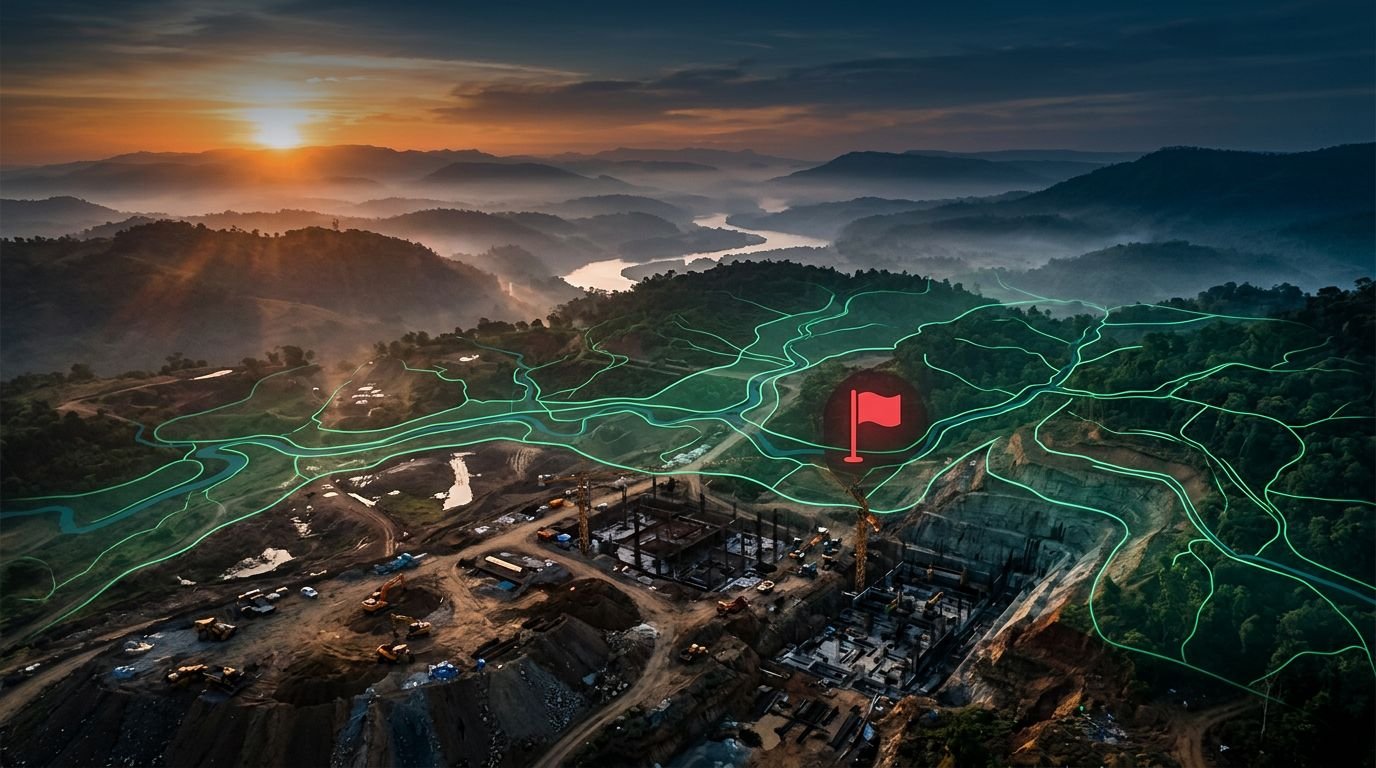
EIA in India: 10 Red Flags Citizens Can Spot
 TBH Editorial
A thick EIA India report can look reassuring, especially when it comes with maps, charts, and polished language. That is often the point of an Environmental Impact Assessment, which is designed to present a comprehensive view of a project’s footprint.
If you are reading an Environmental Impact Assessment for the first time, do not start by asking whether the document looks professional. Instead, treat the report as a primary decision-making tool meant to reveal development risks, not hide them behind technical comfort. Once you understand the common shortcomings found in these assessments, it becomes much easier to scrutinize the document and identify where the analysis might be failing to protect local interests.
A polished assessment can still contain thin science, selective data, and weak public accountability.
Key Takeaways
- Go beyond the summary: Do not be swayed by professional branding; treat Environmental Impact Assessments as technical tools meant to reveal risks rather than hide them behind polished language.
- Cross-reference project data: Always check for consistency across project documents, including land area, capacity, and coordinates, to ensure the project footprint hasn’t shifted between sections.
- Scrutinize the baseline: Check if baseline data on air, water, and biodiversity is seasonal, outdated, or spatially biased to avoid ‘disappearing’ environmental damage.
- Insist on cumulative impacts: Reject reports that study projects in isolation; ensure the document accounts for surrounding industries, transport routes, and infrastructure to provide a realistic environmental view.
- Demand accountability in planning: Ensure Environmental Management Plans include specific budgets, timelines, and named authorities rather than relying on vague promises of ‘best practices.’
Start with the legal frame, not the glossy summary
In India, an environmental impact assessment sits inside a legal process, not a branding exercise. The operative framework remains the EIA Notification 2006, enacted under the Environment Protection Act 1986, along with its subsequent amendments. Category A projects are reviewed at the central level by the MoEFCC and its Expert Appraisal Committee, while many Category B projects move through their respective state-level authorities, known as the SEIAA. Draft and final documents, hearing records, and clearance papers are usually available on the PARIVESH 2.0 portal, and public consultation rules remain a core part of the process.
That matters because the first red flags often appear before you read a single impact claim. A good citizen reading of an EIA in India begins with the project identity, category, location, and attached approvals.
This quick reference helps you scan faster:
| Red flag | What to check first |
|---|---|
| 1. Shifting project identity | Capacity, land area, coordinates, project phase |
| 2. Fuzzy legal status | Category, Terms of Reference, forest or coastal permissions |
| 3. Thin baseline period | Season covered, age of data, monitoring duration |
| 4. Copy-paste science | Repeated text, generic species lists, odd numbers |
| 5. Selective monitoring points | Missing schools, settlements, drains, fishing areas |
| 6. Checklist ecology | No movement routes, breeding seasons, habitat links |
| 7. No cumulative impact view | Ignores nearby mines, roads, ports, power lines |
| 8. Weak social baseline | Poor data on workers, health, access, livelihoods |
| 9. Hollow public consultation | Unanswered objections, poor translations, weak access |
| 10. Vague mitigation and monitoring | No budget, no timeline, no clear accountability |
- The project keeps changing shape. Compare the executive summary, Form 1, annexures, and maps. If the land area changes between chapters, or the capacity quietly grows in one appendix, treat that seriously. A project cannot be assessed honestly if its own footprint is slippery.
- The legal pathway looks blurred. Check whether the report states the correct category, Terms of Reference, and need for public consultation. Also see whether it stays silent on other approvals, such as forest clearance, coastal regulation, wildlife permissions, or groundwater extraction. When a report behaves as if environmental clearance is the only gate that matters, it often shrinks the real regulatory picture.
If you want a plain-language refresher before going deeper, the CSE guide on understanding EIA is useful. It helps because many weak reports count on readers giving up early.
Weak baseline data can make damage disappear
Baseline Data Collection serves as the foundational starting point for any environmental report. If this foundation is weak, every subsequent prediction will appear far cleaner than the actual reality on the ground.

3. The study window is too short, too old, or oddly timed. Air, water, noise, and biodiversity do not behave the same way in every season. A river in late summer is not the same river during the monsoon. A bird survey conducted outside of migration or breeding periods can easily overlook major usage of the area. If the baseline rests on a narrow season, or on data that feels stale for a fast-changing site, the resulting Impact Analysis may understate the true ecological impact from the very start.
4. The science reads like it was pasted in. Watch for identical paragraphs across unrelated chapters, broad claims with no local detail, or species lists that feel detached from the actual terrain. Every document should be prepared by a qualified EIA Consultant who maintains current NABET accreditation to ensure professional standards are met. Sometimes reports mention common flora and fauna without showing where, when, and how they were recorded. At times, the numbers themselves look odd, with too much neatness or no relationship to local conditions. When the field reality disappears into template language, the report stops being a site study and becomes mere paperwork.
5. Monitoring points avoid where people actually live and breathe. A project can show acceptable readings if sampling stations sit far from schools, roadside settlements, drainage channels, fishing zones, or farm edges. This matters in urban and peri-urban environmental assessments especially. Road dust, tire wear, brake particles, diesel backup, and construction debris do not spread evenly. They build up in hotspots, often at child height and beside busy corridors. If the sampling map looks conveniently sparse, the report may be measuring the least inconvenient parts of the landscape.
Good environmental assessments do not fear messy local reality. Weak ones smooth it out.
Ecology can’t be reduced to a species checklist
Many reports treat ecology like attendance-taking. They count species, mention green cover, and move on. That isn’t enough.

6. The biodiversity chapter ignores movement, timing, and habitat links. Real ecology is dynamic. Birds cross corridors, grassland species avoid wires poorly, wetlands expand and contract, and roadside light can alter insect and bird behavior. An honest report asks whether infrastructure development adds collision risks, fragments habitat, changes drainage, increases roadkill, or pushes dust and noise into already stressed areas. This is where urban biodiversity often gets dismissed as minor, even though city edges, scrub patches, ponds, and tree lines still support life that can be damaged by roads, glass, lighting, substations, or transmission lines.
A species list alone won’t tell you whether the project blocks movement or adds predictable mortality. That gap matters. India has seen how infrastructure hazards, when normalized, can become a long-term threat to already vulnerable wildlife.
7. The report studies the project alone, as if the surrounding region doesn’t exist. This is one of the biggest red flags in large infrastructure proposals. A port isn’t only a port; it can bring dredging, roads, worker housing, power lines, water demand, and waste streams. Similarly, mining projects can trigger rail links, blasting corridors, dust plumes, and new settlements. If the report isolates each piece and avoids combined effects, it understates the real burden on the environment.
The public debate around Great Nicobar shows how serious this can get. This critique of the Great Nicobar EIA is worth reading because it shows how community concerns, the Coastal Regulation Zone (CRZ) mandates, and cumulative risks can slip behind development language. When planners ignore regional impacts, they compromise sustainable development goals. Once that happens, a manageable impact on paper can become a broad regional shift on the ground.
People are often counted badly, or not at all
A weak EIA often treats affected people as a number in a table, rather than as individuals with routines, incomes, exposures, and rights. This failure of impact analysis obscures the true cost of industrial development on local livelihoods.
8. The social baseline is thin, selective, or strangely abstract. Check who is visible in the report and who disappears. Does it count only formal landowners, while leaving out tenant farmers, fishers, waste pickers, forest users, migrant workers, roadside vendors, or schoolchildren near haul routes? Does it discuss health only in broad terms, while ignoring repeated exposure to dust, noise, traffic, smoke, or hazardous materials?
This matters because the burden of pollution is uneven. People outdoors for long hours often face the highest risk. Near roads, for example, exposure isn’t only about tailpipes; it can include metal-rich dust from brake wear, tyre fragments, and resuspended debris. Near waste and recycling facilities, the danger can include fire, toxic smoke, and unsafe handling of batteries or e-waste. An EIA that talks about jobs but skips these realities is not measuring community impact honestly.
Personal values still matter. Plant-based living and everyday mindfulness can shape a gentler life. Yet permit decisions operate at a larger scale, because land use, traffic, water extraction, and waste flows affect whole neighborhoods at once. That is why climate literacy has to include reading clearance documents, not only changing private habits. If you want to connect that awareness to verified, local action, you can Explore Our Active Missions.
9. The public consultation section looks procedural, not responsive. In India, a Public Hearing is not merely a decorative formality. The State Pollution Control Board is responsible for publishing project summaries in English and the local language before the event, and written objections should feed back directly into the final assessment. So, read the hearing record closely. Are objections summarized properly? Are repeated concerns answered with detail, or brushed aside with generic assurances? Was the venue accessible? Did affected hamlets actually receive information in time?
A report that records participation but avoids engagement is warning you about the rest of the document.
Follow the mitigation money and the monitoring trail
The last pages of an Environmental Management Plan often sound comforting. Mitigation Measures like filters, green belts, rainwater harvesting, CSR, zero discharge, skill training, traffic control, and safety systems are common. The words come easily, but delivery is harder.
10. The Environmental Management Plan is full of promises but thin on mechanics. A credible document should name actions, timelines, budgets, locations, responsible officers, and monitoring frequency. If the report says regular monitoring will be done without saying by whom, how often, and against which threshold, the promise is weak. The same goes for vague claims about best practices or green development. A professional EIA Consultant is responsible for ensuring these plans are specific rather than generic. Furthermore, the Screening and Scoping process should have already identified these critical areas to ensure the management plan covers every relevant impact.
This is where you should test whether the project story holds up. If a company markets itself through sustainable business models or a circular economy narrative, the EIA should show the physical details. Where will waste go? How will hazardous material be stored? What is the fire plan? Who handles damaged batteries? How are workers protected? What happens to wastewater, ash, sludge, or scrap? A report that celebrates recovery and reuse but ignores rough handling, toxic exposure, or accident response is skipping the hardest part.
Also check whether the report mentions post-clearance compliance. In India, many projects must file half-yearly compliance reports. If the document does not prepare you to track future performance, it limits public oversight to the approval stage. That keeps citizens reactive, not informed.
The politics behind this matters too. This analysis of the 2020 EIA bill debate is useful because it shows why procedure is never mere procedure. Recent updates like the EIA Amendment Rules 2024 highlight how regulatory shifts can alter the landscape of compliance. A shorter notice period, weaker consultation, or broader exemptions can tilt the whole process away from scrutiny. A wider essay on development indicators and India’s EIA regime makes a related point: when growth metrics dominate, ecology and public consent can get treated as friction.
If you spot several of these red flags, act methodically.
- Note the exact page, annexure, map, or table where the issue appears.
- Compare it with the ToR, hearing record, and project maps on PARIVESH.
- Send a precise written submission to the SPCB, SEIAA, MoEFCC, or local authority involved.
That kind of attention is slow work. Still, Systemic change rarely begins with a slogan. It often begins with someone reading the fine print and refusing to let convenient omissions pass as science.
Frequently Asked Questions
Where can I find official EIA documents for projects in India?
Official documents, including draft and final EIA reports, public hearing records, and environmental clearance statuses, are centralized on the PARIVESH 2.0 portal. This government platform is the primary source for verifying project-specific data and regulatory filings.
What should I look for in the social baseline data of a report?
A robust social baseline should identify all affected groups, including tenant farmers, fishers, and migrant workers, rather than just formal landowners. It must also address specific health risks like dust, noise, and toxic exposure rather than offering abstract, generalized claims about community well-being.
Are Public Hearings in India legally binding for project proponents?
Public Hearings are a mandatory legal requirement, not a decorative formality. While they provide a platform for citizens to voice objections, the quality of these hearings depends on whether the authorities properly record, address, and incorporate these concerns into the final environmental assessment process.
Why is a ‘seasonal’ baseline data collection important?
Environmental conditions change significantly across different seasons, and a report based on a single timeframe can overlook ecological shifts. If biodiversity surveys or pollution monitoring occur outside of critical periods like migration, breeding seasons, or the monsoon, the assessment will fail to accurately reflect the true environmental impact.
Conclusion
Reading an Environmental Impact Assessment is not just a specialist hobby. It is public accountability in document form. Ultimately, a thorough and transparent assessment is the only valid path to receiving an Environmental Clearance within the framework of EIA India.
Once you know these ten red flags, the report stops feeling mysterious. You can see whether it measures real air, real water, real habitats, and real lives, or whether it mostly protects the project narrative.
This is where climate literacy grows up. It moves beyond personal intention and into civic attention. By scrutinizing these reports, citizens ensure that sustainable development remains a tangible reality rather than just a buzzword. Staying vigilant is essential, because the most significant environmental decisions are often buried in annexures, maps, and conditional approvals long before the actual damage becomes visible.