
India’s Coal Ash Ponds Need Groundwater Monitoring
 TBH Editorial
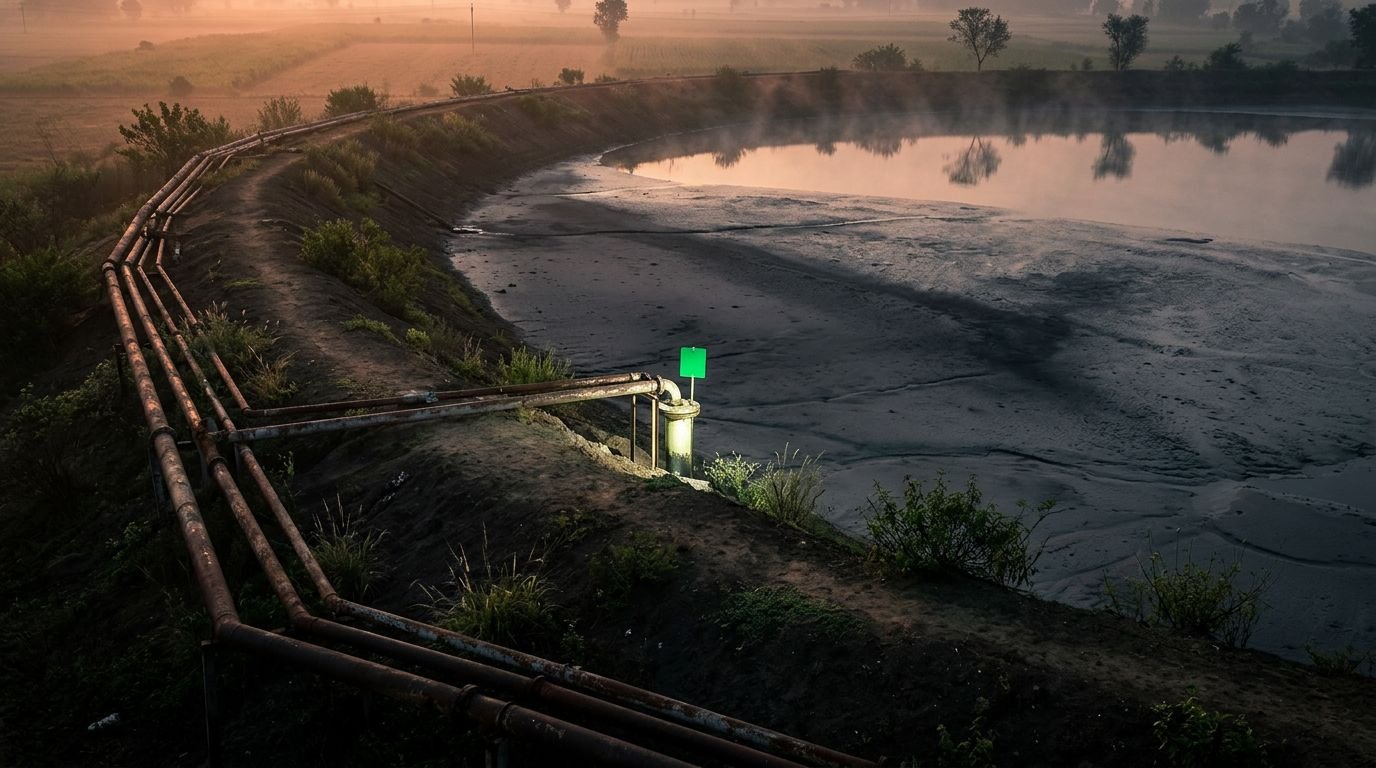
A coal ash pond containing toxic waste can look dull and still be dangerous. The grey water sits behind an embankment, the pipes keep moving, and daily life goes on nearby. Yet, the bigger risk often stays underground, where coal ash seepage can travel long before anyone sees a cracked dyke or a dead patch of grass across these coal ash ponds.
That is why groundwater monitoring matters so much in coal ash ponds across India. If you only track coal ash utilization, dust control, or greenbelt planting, you miss the place where groundwater contamination can spread quietly into wells, drains, ponds, and fields.
Key Takeaways
- Beyond Surface Appearance: While ash ponds may look stable, their most significant risk often lies in invisible, long-term groundwater contamination caused by seepage of heavy metals into local aquifers.
- Limits of Utilization: Increased coal ash utilization for construction and infrastructure does not automatically resolve the threat posed by legacy ash deposits that continue to leach pollutants into the environment.
- Need for Robust Monitoring: Current regulatory frameworks, while improved, require more rigorous, transparent, and seasonal groundwater testing—supported by independent audits and public data access—to ensure community safety.
- Systemic Transparency: True environmental accountability requires shifting from internal corporate reporting to public-facing data that identifies specific risks to nearby households, farms, and local water bodies.
Coal ash ponds in India still cover a huge footprint
When people hear “fly ash,” they often think of cement bags, bricks, or highway embankments. That is only part of the picture. India still stores massive volumes of coal ash in ponds and dykes attached to thermal power plants, and the physical footprint is hard to ignore.
Government-linked 2026 updates put coal ash generation in FY 2024-25 at 326.8 million tonnes. More than 40,000 hectares of land is occupied by ash ponds. Much of that disposal still happens as slurry, because pumping wet coal ash into unlined ponds is cheaper than handling every tonne through a tightly managed dry chain. These surface impoundments remain a primary method for managing waste from thermal power plants.
The policy framework has moved. The Ash Utilization Notification, 2021, pushed plants toward 100 percent utilization over a defined period and gave legacy ash roughly a decade, which points toward 2032, for clearance. Plants that miss targets can face environmental compensation of Rs1,000 per tonne. That sounds firm on paper.
Still, a utilization target is not the same as aquifer safety. A plant can improve dispatch figures and still sit on old ash deposits that continue to leach. A district can report progress and still have households drawing water from shallow wells nearby. In Nagpur, storage pressure around plants such as Koradi and Khaperkheda keeps the issue current, because legacy ash does not disappear when a new annual target is announced.
This is why the phrase coal ash ponds india should make people think beyond disposal acreage. These sites are not empty industrial corners. Many lie near villages, plant townships, farms, canals, roads, and small water bodies. Once you see that map clearly, groundwater leak monitoring stops looking like a technical add-on. It becomes basic public protection.
Why groundwater leaks stay invisible for years
Coal ash carries trace contaminants that do not stay politely in one place. Depending on the ash chemistry and local geology, groundwater contamination can move heavy metals such as arsenic, selenium, chromium, lead, boron, mercury, molybdenum, lithium, and cadmium, along with salts and other pollutants into surrounding soil and water. The danger is not only one dramatic failure. Slow groundwater contamination is often the more stubborn problem.
Groundwater makes this harder because it is invisible in daily life. You can smell smoke. You can see dusty runoff after rain. You usually cannot see a contaminant plume moving through soil below a village handpump. By the time illness patterns, crop stress, or taste complaints become obvious, the exposure may have been building for years.
Seasonal weather complicates the picture. Dry months can leave ash surfaces dusty, and wind can push that material onto leaves, roofs, shopfronts, and roadside food. Then the monsoon shifts the burden. Rain suppresses some dust, but it can also carry dissolved contaminants sideways through soil, drains, and shallow aquifers. The pollution moves; it does not simply vanish.
Global evidence should end any complacency. A broad global review of coal combustion residue disposal found that groundwater pollution is commonly detected near coal ash disposal sites. In the United States, the Environmental Integrity Project’s coal ash report analyzed data against EPA standards, finding unsafe contamination at most monitored ash ponds and many ash landfills. India does not yet publish a similarly clear national contamination percentage, but that lack of public granularity is a warning in itself, not a comfort.
The burden also lands unevenly. Workers, nearby residents, informal settlements, and people who spend long hours outdoors often face higher exposure. A dirty industrial edge is never equally dirty for everyone. As with road dust near traffic, the people with the least shelter from contamination usually pay the highest health cost.
India’s rules are stronger now, but leak tracking still needs teeth
India is not starting from zero. The Ministry of Environment, Forest and Climate Change set a firmer framework with the 2021 notification, representing a significant step forward in environmental regulation for the power sector. While India develops its own path, international frameworks like the CCR Rule in the United States offer a comparative benchmark for pond management and seepage control. The CPCB and CEA followed with June 2023 guidelines on design, construction, operation, maintenance, and annual certification of coal ash ponds. Those guidelines also call for greenbelt development around operational ponds to improve stability and prevent an ash dike breach. Then, on 30 January 2026, the Ministry of Power revised ash utilization rules again, asking thermal plants to declare annual issuable ash quantities more transparently and reserve some ash for local users and MSMEs within 100 kilometers.
Oversight is also shared. The CPCB, State Pollution Control Boards, and District Magistrates all have roles, and plants are expected to submit regular data through a web portal. That is a stronger structure than the old habit of treating ash disposal as a background utility problem.
But rules do not protect water unless the monitoring culture is real. The gap is not only whether samples are collected. The gap is whether the public can see where monitoring wells sit, whether the data includes time-series trends, whether sampling happens before and after monsoon shifts, whether an independent lab verifies results, and whether trigger levels force action instead of quiet filing.
This comparison makes the gap easier to see:
| Existing framework | What it improves | What still needs work |
|---|---|---|
| Ash Utilization Notification, 2021 | Pushes plants toward full ash use and penalizes shortfalls | Utilization figures do not prove nearby groundwater is safe |
| CPCB and CEA pond guidelines, 2023 | Improves pond design, O&M, certification, and greenbelt planning | Green cover and paperwork cannot detect contaminant plumes |
| Revised ash guidelines, 2026 | Adds transparency on issuable ash and local allocation | Public access to leak data still needs location-level clarity |
A tree belt may catch some dust and stabilize a slope. It cannot tell a family when contaminants start moving through groundwater.
That matters because visible fixes can distract from hidden risks. A well-maintained embankment, a fresh plantation strip, or a polished utilization number may look reassuring. Yet none of those tells you what is happening below the surface.
Ash reuse helps, but it does not erase the pond
Ash utilization matters, and India should keep improving its approach to beneficial re-use. Cement plants, brick makers, road builders, and other industries can reduce the need for new disposal when the material is handled properly. In that sense, finding new applications for this industrial waste stream can support a more practical circular economy. It can also create room for sustainable business models that waste less land and reduce the pressure to keep expanding ponds.
The 2026 revisions reflect that push. They ask plants to disclose how much fly ash, bottom ash, and pond ash is available, and they reserve volumes for local users before broader distribution. That can help smaller enterprises gain access instead of watching large players capture the entire stream.
Yet reuse should not become a moral shield. A facility may sell fresh ash into cement while an old ash pond keeps leaching. A state may celebrate high utilization percentages for coal ash while legacy storage at power plants remains poorly mapped. Even agricultural use, which accounted for about 4 million tonnes, or 1.2 percent, of ash in FY 2024-25, only fits under controlled soil testing protocols. That is not permission for loose spreading.
India also has remediation ideas worth watching. CSIR-NEERI has promoted eco-rejuvenation methods, including bamboo and site-specific planting, to stabilize dumps and improve surface conditions. Those efforts may reduce erosion and help some habitats recover. Still, they do not replace hydrogeological monitoring. Roots are helpful, but piezometers are still necessary.
This is where systemic change comes in. A circular material story is only honest when it covers the full waste chain, including legacy ponds, seepage risks, and long-term cleanup duties. Otherwise, reuse becomes public relations, while groundwater carries the unpaid part of the bill.
Communities and urban biodiversity pay first
A coal ash pond is often discussed as an engineering unit, but for nearby residents, it is a fixture of the neighborhood. The leak path can pass under farms, school routes, worker housing, or small commercial strips. The dust path settles on windowsills, food stalls, laundry, and leaves. Because runoff often enters drains that connect to local water bodies, these sites represent a significant issue of environmental justice. Protecting the security of local drinking water is essential, yet too often, the safety of village handpumps and wells remains unverified while the contamination spreads.
This human geography changes the moral question. A contamination issue is not only about compliance reports; it is about whose water gets tested first, whose illness counts, and whose land value quietly drops while a plant continues operating. Public health burdens rarely spread evenly, which is why transparency regarding groundwater contamination is so vital.
The ecological impact is wider than many monitoring plans admit. Ash-laden runoff can stress reeds, shallow wetlands, canal banks, and pond margins. Fine particles can coat leaves and reduce plant health, while trace metals move into sediments. In peri-urban plant belts, that affects insects, birds, amphibians, and fish long before a site looks dead. If the surrounding landscape includes town lakes, scrub patches, or roadside tree belts, the pressure reaches urban biodiversity too.
This is why community-facing transparency matters. People living near industrial waste sites need more than corporate dashboards written for investors. They need clear maps, sample dates, test parameters, and plain-language summaries. That is also where climate literacy should grow up a bit. Carbon targets matter, but waste legacies matter too. A low-carbon transition that ignores toxic byproducts stays incomplete.
If you care about proof-based environmental work in real places, Explore Our Active Missions. Grounded climate action becomes more trustworthy when communities can see what changed on the ground, not only what was promised in a report.
What serious groundwater leak monitoring should include
A credible monitoring system is not mysterious. India already has enough institutional structure to build one. The missing piece is consistent execution, independent verification, and public visibility.
First, every ash pond needs a clear baseline hydrogeological map. Regulators and operators should identify aquifers, nearby wells, drainage lines, flood-prone zones, and the likely direction of groundwater flow. Without that, even frequent sampling can miss the real leak path.
Second, each site needs upgradient and downgradient monitoring wells. If you only sample one side, you cannot tell background water quality from plant-linked contamination. A proper network should also reflect local conditions, because an alluvial river belt behaves differently from hard-rock terrain.
Third, monitoring has to capture seasonal change. Pre-monsoon and post-monsoon data should be routine, not optional, because seepage and dilution patterns shift with rainfall. Monthly reporting sounds strong, but it only helps if the parameters, methods, and dates are consistent and publicly visible.
Fourth, the test menu should go beyond a bare minimum. Water level, pH, conductivity, sulfate, chlorides, boron, and heavy metals should be part of the record wherever site risk justifies it. If the chemistry shows movement, response steps to mitigate groundwater contamination should trigger automatically, including extra sampling, containment work, alternate water supply, and cleanup orders.
Fifth, results should be published in plain form. A scanned PDF hidden deep in a portal is not meaningful transparency. Residents need maps, charts, and simple explanations of whether levels are rising, stable, or unsafe.
A serious program also needs social design, not only lab design:
- Nearby household wells should be tested on a predictable schedule, not only after complaints.
- Independent laboratories should audit a share of samples every year.
- Emergency drinking water plans should exist before contamination is confirmed.
- District authorities should hold public review meetings with readable data summaries.
- Repeat violators should face financial and operational penalties that are hard to bury.
Personal values still matter, but they have limits here. Plant-based living can lower part of your climate footprint, just as local environmental stewardship can mitigate the impact of coal ash. Everyday mindfulness can help you notice dust, runoff stains, or odd changes around power plants and local water bodies. Neither one can substitute for a monitoring well, a transparent dashboard, or a regulator willing to act.
Frequently Asked Questions
Why is groundwater monitoring more critical than just tracking ash utilization?
While increasing the use of coal ash in industries like cement is beneficial, it does not clean up existing, unlined ponds. Groundwater monitoring is essential because it tracks the hidden, long-term movement of toxic contaminants into the water sources that nearby communities rely on for drinking and irrigation.
How does the changing weather affect coal ash contamination?
Seasonal shifts play a significant role in how pollutants spread. Dry months increase the risk of airborne dust, while the monsoon season can drive dissolved contaminants through the soil and into shallow aquifers, making consistent, year-round monitoring a necessity.
Are there regulations currently in place to manage these risks?
Yes, India has strengthened its oversight through the 2021 Ash Utilization Notification and subsequent 2023 and 2026 guidelines from the CPCB and Ministry of Power. These rules require better pond management and transparency, though experts argue that public access to leak data and consistent enforcement remain the primary areas for improvement.
What should a reliable monitoring system include for local communities?
An effective monitoring system should feature a network of upgradient and downgradient wells, regular seasonal testing by independent labs, and clear communication of results. This data must be provided to local residents in plain language, detailing whether nearby wells are safe and what actions are being taken if contamination levels rise.
Conclusion
Coal ash ponds in India do not become safe simply because they look quiet or because annual utilization numbers improve. The real test is whether nearby water sources remain clean and whether the public has access to transparent data. Addressing the risks of coal ash ponds is essential to prevent long term groundwater contamination that threatens local safety.
India already has stronger environmental regulations than it had a few years ago. What the country needs now is monitoring that people can trust, with frequent seasonal sampling, independent checks, accessible data, and clear consequences when leaks appear.
A nation that tracks every tonne of industrial waste should also track every sign of seepage with the same level of seriousness. That is how public health, ecological repair, and industrial accountability will finally align to protect our vital water resources.