
Why River Desilting in India Often Raises Flood Risk
 TBH Editorial
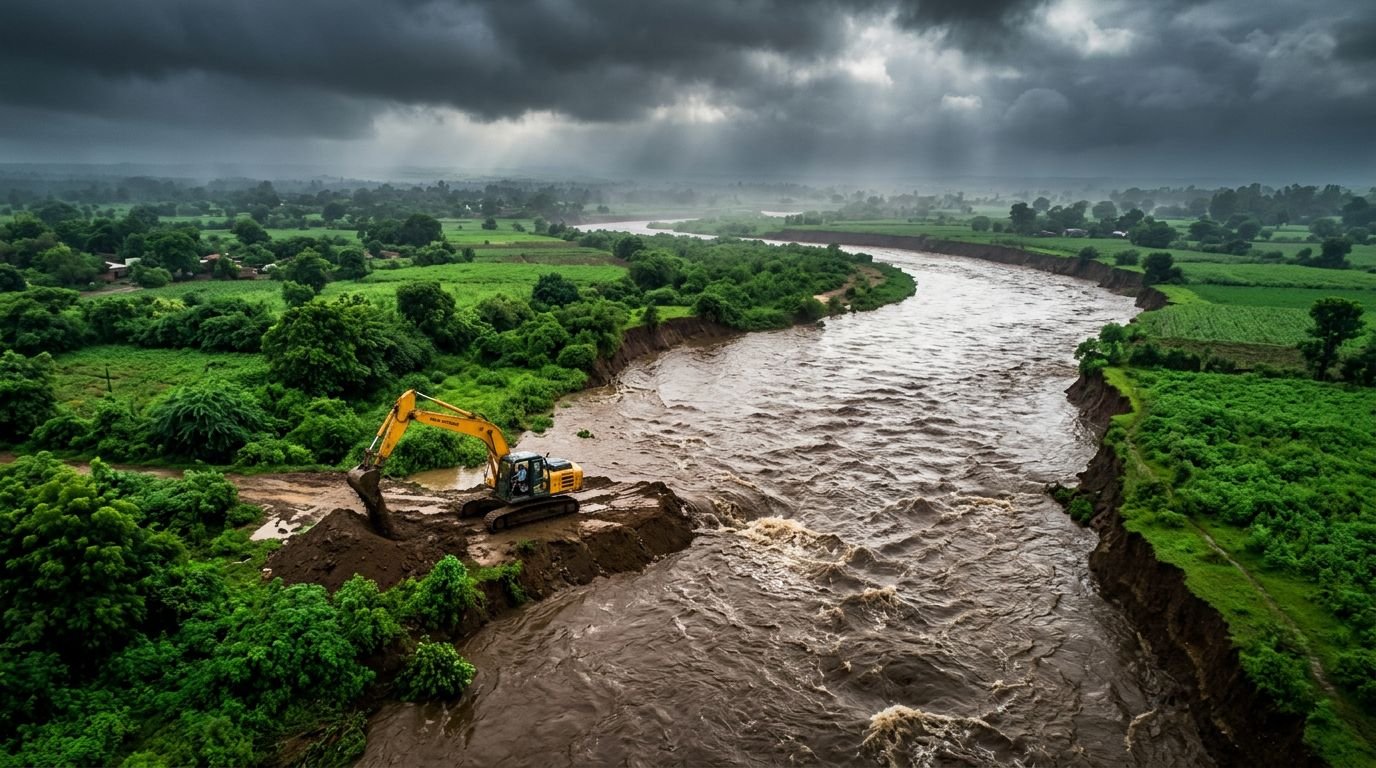
A deeper river channel can look like common sense. After a flood, excavators on the riverbed offer a clear image of action, and that image travels fast.
But a river is not a clogged pipe. In many parts of India, repeated desilting brings brief relief, pushes water faster downstream, damages river life, and leaves the real flood drivers untouched. To see why, you have to look at how Indian rivers move water, sediment, and risk during the monsoon.
Desilting sounds logical until the monsoon arrives
In debates on river desilting in India, one idea keeps coming back. If silt has made the channel shallow, remove the silt and the river will carry more water. That sounds neat on paper, yet rivers don’t behave like storage tanks that stay fixed after excavation.
Sediment is part of how a river works. Many Indian rivers, especially alluvial rivers in the plains, carry heavy loads during the monsoon. When upstream slopes erode because of road cuts, sand mining, bare soil, or poor catchment care, fresh material moves back into the channel. A reach that was deepened before the rains can partially fill again in weeks.

That doesn’t mean all sediment removal is pointless. A blocked culvert, a choked urban drain, or a silted intake near a structure may need targeted clearing. Local accounts after Punjab floods, such as this discussion of clogged seasonal streams, point to a narrower truth: maintenance of small channels can matter.
The trouble starts when that narrow truth becomes a blanket policy for living rivers. India-WRIS treats dredging and desilting as limited tools because they are costly, temporary, and full of side effects. Yet after every flood season, the old promise returns. Dig deeper, move more water, fix the problem. Most of the time, that promise doesn’t survive contact with the next storm.
Faster flow can create bigger floods downstream
A deeper, smoother channel can move water faster. That may lower water levels for a short stretch, for a short time. However, the same change can send a larger pulse downstream, sooner than before.
That matters because rivers don’t flood in empty landscapes. They flood through bridges, embankments, encroachments, barrages, road crossings, and city edges with poor drainage. When water arrives faster at those choke points, flood peaks can rise where people least expect them.
A river that moves water faster is not always a river that lowers flood risk.
This is one reason river desilting in India often disappoints even where it appears to “work” locally. One district may report better flow, while another gets a sharper flood wave, higher bank pressure, or longer waterlogging because drains cannot discharge into a swollen river.
Embankments add another layer of risk. A confined river can carry more energy, and a breach in that setting is brutal. Water spreads into fields and settlements with force, carrying debris and freshly disturbed sediment. Low-income households on the edge of floodplains usually absorb the first hit, because they live where land is cheapest and state protection is weakest.
Hydrology rarely respects district boundaries. But flood management often does. As a result, one agency deepens a reach to show action, while another agency downstream deals with the damage. The work looks local, yet the risk moves through the whole basin.
Most flood damage in India starts outside the river channel
A lot of flood loss in India has little to do with the riverbed depth. In cities, the problem is often pluvial flooding, heavy rain falling faster than streets, drains, culverts, and low-lying land can handle. In peri-urban areas, wetlands are filled, ponds are cut off, and floodplains are built over. Water then has nowhere to pause.
A review of urban pluvial floods in India links repeated flood events to extreme rainfall, urban development, topography, and drainage failure. That pattern matters because it breaks the easy story that silt alone is the main villain.
The gap between headline and reality is easier to see side by side.
| Common flood driver | Why desilting misses it |
|---|---|
| Extreme rain over paved land | Water still overwhelms roads and drains before it reaches the river |
| Wetland and lake loss | Natural storage stays lost, even if a channel is deeper |
| Floodplain construction | Homes and assets remain in the path of spread water |
| Choked culverts and storm drains | Backflow and waterlogging continue inside neighborhoods |
| Embankment failure or backwater effects | Faster river flow can raise pressure elsewhere |
The takeaway is simple. A city can spend heavily on excavating a river and still flood because the actual bottleneck sits in storm drains, blocked outfalls, lost marshes, or reckless land use.
This is why the language of “desilting” often confuses people. It bundles together drain cleaning, pond restoration, canal maintenance, and large river dredging, even though those are very different jobs. Clearing a drain before the monsoon can reduce neighborhood flooding. Dredging a whole river reach without basin-scale study can make another place less safe.
The ecological cost doesn’t stay in the water
Dredging is often sold as technical work, almost neutral by default. In practice, it can tear up breeding grounds, destabilize banks, and stir fine sediment into the water column. That suspended material lowers light, reduces oxygen, and stresses fish, insects, and aquatic plants.
The ecological impact also reaches people. Fishers lose habitat. Farmers near unstable banks face erosion. Villages along the river watch the edge of their land fall away after heavy machinery undercuts the toe of the bank. Then more eroded soil enters the river, and the silt problem partly recreates itself.
Urban residents often meet rivers only through flood news. Yet river corridors support urban biodiversity, cool nearby neighborhoods, recharge groundwater, and link wetlands to larger habitats. When management treats the riverbed as spoil to be scraped every year, those functions disappear from policy, even though they matter for public health and long-term safety.
This matters for more than wildlife counts. A damaged river is a poorer flood buffer. Vegetated edges slow water, hold soil, and create roughness that spreads energy across space and time. Remove that structure carelessly, and the river turns harsher. It may look cleaner to the eye, while behaving worse during the next high-flow event.
The social cost is also uneven. Wealthier districts can absorb repair bills. Informal settlements near drains, embankments, and low banks cannot. So the harm from bad desilting policy lands hardest where political voice is already thin.
Why the policy keeps coming back
If the evidence is weak, why does large-scale desilting remain so popular? One reason is optics. Excavators, trucks, and spoil heaps are visible. Wetland protection, floodplain zoning, and upstream soil care are slower, less dramatic, and harder to photograph.
Another reason is how governments measure work. Excavated cubic meters are easy to count. Reduced flood risk is harder to prove, especially if the benefits depend on land-use control, drainage upgrades, and cross-district planning. A contract can certify removal volumes in days. Real flood prevention may take years.
That is why Systemic change keeps losing to mechanical action. River basins are split across departments. One office handles irrigation, another handles stormwater, another approves land conversion, and yet another manages wetlands or roads. When no single body owns the whole problem, digging becomes the default response because one agency can order it quickly.
There is also a money question that rarely gets public attention. Many cities still lack sustainable business models for wetland upkeep, decentralized stormwater systems, riverbank restoration, and routine drain maintenance. One-off excavation fits annual budgets better than long-term care. It feels cheaper in the moment, even when repeat dredging costs more over time.
A different economic lens would ask harder questions. If sediment removal is proposed, what outcome is being bought, and for how long? If material is removed, can a circular economy approach safely reuse clean sediment nearby instead of dumping it badly? Those questions matter. Yet they only come after the first one: was removal needed at all?
What lowers flood risk more than repeated desilting
A safer flood strategy starts upstream and spreads across the whole basin. It looks at sediment budgets, slope stability, wetland storage, floodplain encroachment, stormwater outfalls, and where water needs room during peak flow. That work is less theatrical, but it is far more honest.
In some places, targeted sediment removal still has a role. Areas near bridge piers, barrages, intake structures, or sharply clogged urban outfalls may need it. The key word is targeted. The decision should come from local hydraulics, seasonal monitoring, and downstream impact assessment, not from a generic promise that deeper always means safer.
The stronger approach is broader. Restore wetlands and side channels. Protect floodplains from new construction. Repair storm drains before the monsoon. Reconnect lakes and ponds that once stored runoff. Reduce upstream erosion through better slope management and land cover. Build warning systems that people trust, and publish post-project monitoring instead of press photos.
This is where climate literacy matters. People need to understand that flood risk is shaped by rainfall, land, drainage, and governance, not only by river depth. Once that clicks, public pressure changes. Communities start asking for hydrology, maps, maintenance records, and floodplain discipline instead of annual digging rituals.
Community-scale work matters too. Projects that protect habitats, rebuild local trust, and strengthen public understanding often do more for long-term safety than another round of symbolic excavation. If you want to back verified, on-the-ground efforts tied to urban biodiversity and public awareness, Explore Our Active Missions.
For readers drawn to plant-based living and everyday mindfulness, there is a hard truth here. Personal choices reduce your footprint and shape your values. Still, private ethics can’t compensate for bad river governance. Flood safety depends on public systems, land rules, and river science that treats communities as more than collateral.
Questions every community should ask before a desilting drive
The smartest response to a new desilting proposal is not instant support or instant rejection. It is better public questioning. That is where accountability begins.
Before any major excavation, communities should ask:
- What evidence shows sediment is the main cause of flooding here, rather than blocked drainage, lost wetlands, or floodplain encroachment?
- Where will the faster water go downstream, and has that risk been modeled across district boundaries?
- How quickly is this reach likely to fill again during the next monsoon?
- What happens to fish habitat, bank stability, and nearby livelihoods after the work?
- How will removed material be tested, stored, or reused, and who will publish results after one flood season?
These are not technical distractions. They are democratic basics. A good project can answer them in plain language. A weak project usually hides behind urgency, visuals, and vague claims about “increased capacity.”
This is also where climate literacy becomes practical. It is not only about carbon, heat, or energy choices. It is also the ability to read a flood-control promise and spot whether it deals with causes or only with appearances.
A safer river starts with honesty
The hard truth is simple. A river cut deeper in one place can put someone else underwater faster.
India does need better flood management, but repeated digging is often the wrong symbol of progress. Real safety comes from respecting how rivers carry silt, how cities block water, and how ecology shapes risk.
Until flood policy treats rivers as living systems instead of channels to be scraped on repeat, flood risk will keep moving rather than shrinking.