
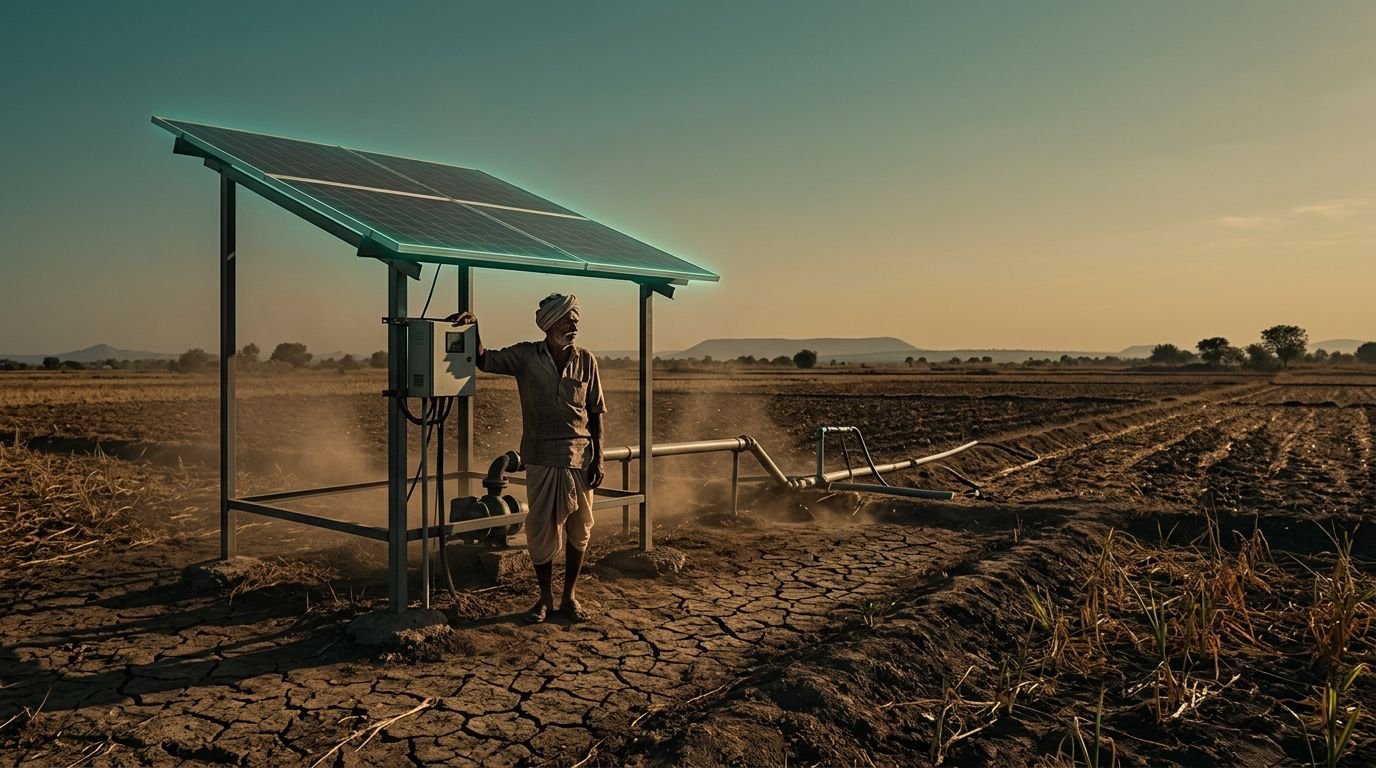
Why Solar Pumps Can Accelerate Groundwater Depletion in India
 TBH Editorial
The transition to solar irrigation pumps is often viewed as a symbol of clean progress. It represents a shift toward renewable energy, helping farmers move away from expensive fossil fuels while lowering costs and providing a reliable alternative to erratic power grids. Yet in large parts of India, this technology can inadvertently lead to solar pumps groundwater depletion.
The reason for this is simple, and uncomfortable. When energy becomes cheap and water remains weakly regulated, the intensity of pumping increases. If you care about climate action, this is a difficult reality that must be addressed, because a clean technology can still deepen the existing crisis of groundwater depletion.
Key Takeaways
- The Zero-Marginal-Cost Trap: Once solar pumps are installed, the cost of pumping water drops to near zero, incentivizing farmers to extract more water than they would under diesel or grid-powered systems.
- Technological Efficiency Isn’t Enough: While drip irrigation and efficient motors improve water usage per unit, they often lead to a ‘rebound effect’ where farmers expand their total land area or switch to thirstier crops, resulting in higher overall groundwater consumption.
- Policy Misalignment: Current subsidies often treat energy access and groundwater conservation as separate issues; failing to link solar benefits to water-table health inadvertently accelerates the depletion of critical aquifers.
- Systemic Solutions Required: Effective water management requires integrated policies, such as allowing farmers to sell surplus solar power back to the grid, which provides a financial incentive to conserve water rather than extract it.
Cheap energy changes water use faster than most people expect
Solar irrigation pumps solve a real problem. Small-scale farmers need reliable power, and many do not have it. Diesel-powered pumps are expensive to operate. Grid electricity is often patchy, delayed, or politically distorted. A solar pump removes those barriers in one move, providing a cleaner alternative for those who rely on the land.
That is also where the risk begins.
With diesel-powered pumps, every extra hour of operation costs money. With grid supply, access is often restricted by outages or utility schedules. A system powered by solar panels changes the daily math. Once the hardware is installed, the marginal cost of pumping falls close to zero during sunny hours. Water that felt expensive yesterday can feel free today.
The link between solar pumps and groundwater depletion is not mysterious. It is economic. When the price signal disappears, restraint often disappears with it.
A widely read Yale Environment 360 report described this pattern across agricultural irrigation zones where cheap solar irrigation expanded faster than water governance. Farmers were not acting irresponsibly in some moral sense. They were responding to incentives that policy created.
That distinction matters. Blaming small-scale farmers misses the point. Most people use the tools that help them survive volatile weather, debt, and uncertain markets. If a solar irrigation pump allows them to water one more crop cycle, protect their yield, or reduce fuel costs, they will use it.
Cheap power helps farmers, but cheap pumping without water limits can drain an aquifer faster than any awareness campaign can fix.
The danger is easy to miss because solar feels clean at the surface. Solar panels do not smoke, and the motor runs quietly. The farm looks more modern. Yet the aquifer below may be falling faster, especially where recharge is poor and borewells are already deep.
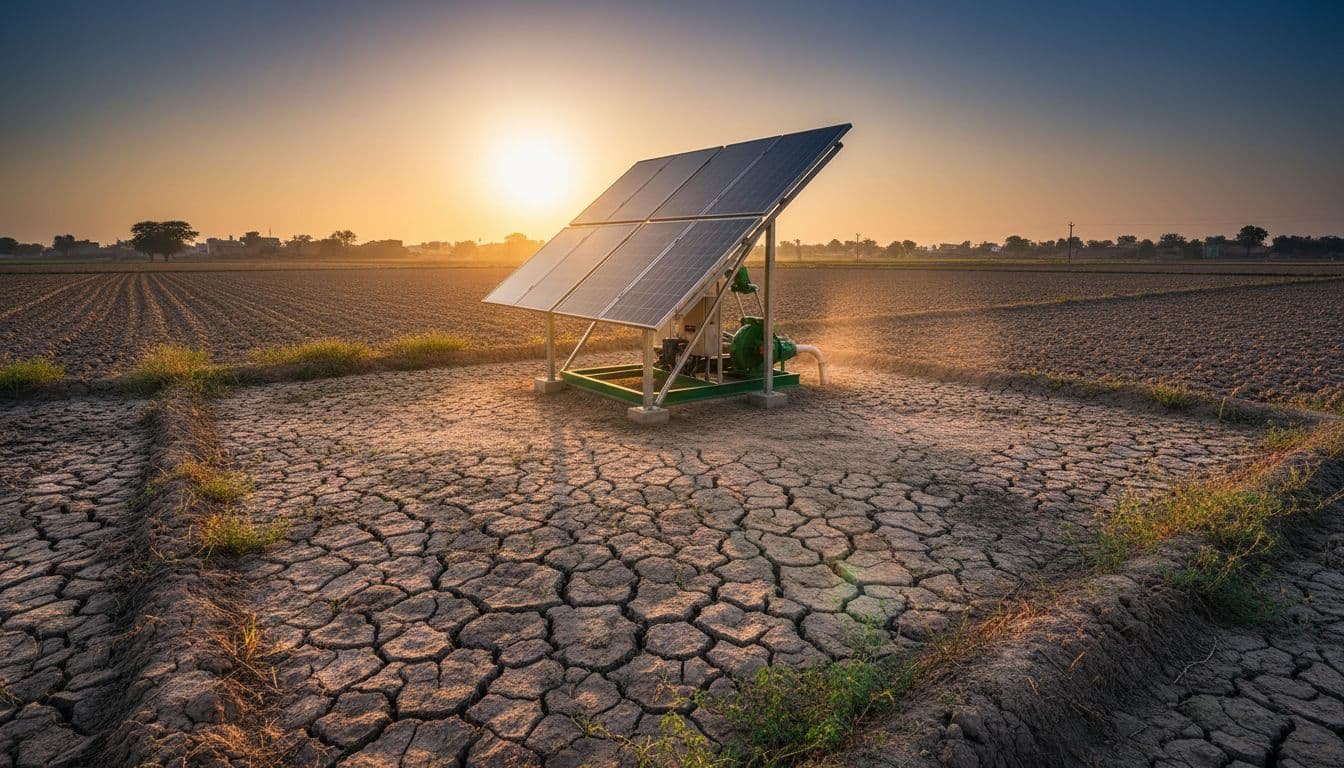
Lower-emission irrigation can still hide rising pressure on groundwater.
India’s aquifers were already under strain before solar arrived
Solar did not create the groundwater crisis in India. It entered a system that was already stretched, and the country’s water-stressed regions are particularly vulnerable to the rapid expansion of PV pumps.
Across many states, farming depends on tube wells because canals are unreliable, rainfall is uneven, and monsoon timing is less predictable than it used to be. In dry years, groundwater becomes the backup plan; in some regions, it is the primary source of irrigation. Solar technology often draws directly from these deep underground water reserves, which are already struggling to recover.
That history matters because solar enters places where aquifers are already fragile. A new pump does not tap an untouched reserve. It often taps a declining one. An IFPRI analysis of solar-powered irrigation risks warned years ago that pushing solar pumps into water-scarce parts of South Asia could worsen depletion. That warning has held up. Real-time reporting and recent field summaries in 2026 still show the same pattern, where cheap and reliable pumping can increase groundwater extraction in areas where recharge cannot keep pace.
The effect is uneven, which makes the issue harder to govern. A shallow aquifer in one village may recover after a good monsoon. A deeper hard-rock aquifer nearby may not. Some farmers still get water, while others must drill deeper or watch their wells fail earlier in the season as local water tables continue to drop. Averages often blur these critical differences.
There is also a timing problem. Aquifer decline is not always visible right away. A farmer may see higher incomes in the first few seasons after adopting solar. The losses come later, in falling water tables, higher well-deepening costs, and weaker access for households with less money.

Meanwhile, public debate often treats clean energy and water security as separate files. They are not. The pump, the crop, the subsidy, and the aquifer are part of one system. If policy celebrates the energy gain while ignoring the water loss, the accounting is incomplete from the start.
Subsidy design can turn a climate solution into a water extraction problem
The hardest part of this story is that the problem often sits inside well-meaning policy.
Governments support solar pumps for good reasons, such as those promoted through the PM-KUSUM scheme. These programs aim to cut diesel use, reduce farm energy costs, and expand rural energy access. However, when capital subsidies are generous and water rules are weak, the state can inadvertently finance faster extraction.
This comparison helps explain why:
| Pump type | Cost of each extra hour of pumping | What the farmer feels | Likely pressure on groundwater |
|---|---|---|---|
| Diesel pump | High | Fuel is expensive, so pumping is rationed | Lower than solar, though still damaging |
| Grid-powered pump | Often hidden or flat | Power may be cheap or limited by supply | High where supply is reliable |
| Off-grid solar pump | Very low after installation | Daytime pumping feels almost free | Often highest without controls |
| Grid-connected solar pump | Low; potential to earn revenue | Incentive to sell back excess power | Variable depending on policy design |
The problem is not the technology, but the incentive structure around it. By failing to account for the food-energy-water nexus, policymakers risk overlooking how lower energy costs directly influence land-use decisions.
A farmer who cannot sell unused solar electricity back to the grid has one obvious way to capture value: pump more irrigation water. That can mean irrigating longer, expanding the cropped area, or shifting to thirstier crops where market returns are strong. When energy becomes essentially free, groundwater often becomes the buffer that absorbs the extra demand. This dynamic is a classic tragedy of the commons, where individual farmers maximize their short-term gains, leading to the rapid depletion of a shared resource that nobody has a direct incentive to conserve.
This is why systemic change matters more than product enthusiasm. A hardware rollout is not a water policy. Subsidies for equipment do not replace aquifer governance, and a green label does not cancel out harmful extraction.
The same lesson shows up in other sustainability debates. Sustainable business models work only when the hidden costs are counted. A circular economy is not real if one part of the cycle keeps drawing down a resource that nature cannot replace fast enough.
India’s solar pump push often treats irrigation water as if it were a free input waiting below the farm. In stressed districts, that assumption is false.
Efficient pumps and drip systems do not solve the whole problem
Many people hear this critique and reply with a familiar line: use better technology. Add efficient motors. Add drip irrigation. Add smart controls. Those tools can help, but they do not erase the core risk.
Efficiency often lowers the cost of using a resource. That can reduce waste per hour, but it can also increase total use over time. Because the primary drivers for these policies are reducing greenhouse gas emissions and addressing climate change, officials often view efficiency as a win-win. However, efficiency without extraction limits cannot solve water scarcity alone.
A farmer who saves water with drip systems may use those gains to expand acreage to boost agricultural productivity. Another may switch to a crop with higher returns and higher water demand. A third may use these systems for agricultural irrigation more often because the process now feels affordable and precise. This is a known rebound effect, and water policy ignores it at its peril.
A recent panel study on solar-powered groundwater irrigation found that solar adoption can raise groundwater use through greater pump operation and larger irrigated area. That does not mean efficiency is useless. It means efficiency without extraction limits can simply reorganize demand.
The same is true for digital monitoring. Sensors can tell you how much water moved, but they do not decide whether that amount is safe. Governance does.
This is where public discussion often slips into feel-good language. People assume that if something lowers emissions, it must also lower all other forms of harm. But climate policy cannot skip resource politics. Water, land, and power are linked. You cannot manage them in silos and expect a fair result.
That is also why climate literacy needs to mature. The public should understand that decarbonization is not a magic shield. A solar pump may cut carbon and still worsen local depletion. Both facts can be true at the same time.
For readers who care about personal choices, that tension is worth sitting with. Everyday mindfulness matters, but household thrift alone cannot offset a policy design that rewards unlimited extraction.
The ecological impact reaches villages, towns, and city edges
Groundwater decline is often framed as a farm issue, but the consequences are much broader. When water tables drop, wealthier farmers can deepen wells or invest in new boreholes, but small-scale farmers often lack the capital to keep pace. This disparity threatens food security for rural communities, where landless workers have even less protection against systemic shocks. Consequently, water stress creates a ripple effect, moving through wages, debt, migration patterns, and local food prices.
The ecological impact also extends far beyond crops. The over-extraction of water reduces base flows to streams, shrinks ponds, and weakens wetlands that depend on seasonal recharge. That degradation affects birds, pollinators, and the wider web of life around farms and peri-urban land. In other words, a pump installed to support livelihoods can also chip away at urban biodiversity on the edges of expanding towns where wetlands and green patches already face significant pressure.
This rural-urban link receives too little attention in policy circles. Cities often draw food, labor, and hidden water from distant landscapes. When those landscapes suffer from groundwater depletion, urban residents still feel the effects through food volatility, ecosystem loss, and hotter, drier surroundings. Water does not respect district boundaries, and the health of the urban supply chain is tethered to the health of rural aquifers.
Lifestyle debates belong here too, but they require a degree of humility. Plant-based living can reduce pressure from water-intensive feed and livestock systems in some contexts, and smarter diets can certainly help. Yet consumer ethics alone will not repair an aquifer if procurement policy still rewards thirsty crops in dry regions.
That is why the conversation needs accountability, not moral theater. People should know where water risk sits in supply chains, who gains from extraction, and who pays when wells run dry. Clean energy that shifts costs onto poorer households or damaged ecosystems is not a full success. It is a partial fix with a hidden bill that our current food systems cannot afford to pay.
Better policy can keep the solar benefits and reduce the water damage
The answer is not to abandon solar pumps. India still needs low-carbon irrigation to reduce fossil fuel emissions. Farmers still need reliable energy. The real task is to stop treating energy access and groundwater protection as separate goals.
Some of the most promising designs already point the way. Grid-connected solar pumps allow farmers to sell unused solar power back to the grid, giving them a clear financial incentive to conserve water rather than pump it excessively. In several field cases, this approach has limited or even avoided higher extraction because electricity itself becomes the cash crop, rather than the yield gained from extra water use.
A better policy package would include several linked moves:
- Tie solar pump support to groundwater conditions at the block or aquifer level, rather than just farmer demand.
- Pay farmers for exporting surplus power, so that conservation of irrigation water provides a clear financial reward.
- Shift crop procurement and insurance toward less water-intensive crops in stressed zones.
- Invest in groundwater recharge, pond construction, tank restoration, and watershed work alongside pump deployment.
- Publish simple local water data so communities can track depletion before wells fail.
That mix is less flashy than mass distribution targets, but it is far more honest.
It also creates space for broader sustainable business models in sustainable agriculture. Buyers, insurers, food companies, and state agencies can reward crops and practices that fit local hydrology instead of fighting against it. A real circular economy for water would value recharge, reuse, and watershed health, not only extraction efficiency.

Community work matters here as well. Pond repair, recharge structures, wetland revival, and local monitoring can improve resilience when they are tied to clear water rules. These are not side projects. They are part of the same system. They show why systemic change must include land, water management, crop markets, and public finance together.
For people who want to support grounded climate action, the lesson is clear. Look for projects that connect resource protection with local accountability, not only good branding. Strong climate literacy grows when public action is linked to measurable outcomes in the real world.
Frequently Asked Questions
Why do solar pumps cause more groundwater depletion than diesel pumps?
Diesel pumps have a high operating cost for every hour they run, which naturally causes farmers to limit their water use. Solar pumps have virtually no operating cost once installed, removing the economic ‘brake’ on pumping and leading to increased water extraction.
Can more efficient irrigation technology solve this problem?
Efficiency tools like drip irrigation help, but they cannot solve the problem in isolation. Without strict water extraction limits, efficiency often leads to a rebound effect where farmers use the saved water to irrigate more land or grow more water-intensive crops.
Should we stop using solar irrigation pumps entirely?
No, solar pumps are a vital tool for reducing greenhouse gas emissions and providing farmers with reliable energy. The goal should be to reform policy—such as incentivizing electricity sales back to the grid—to ensure that clean energy production does not come at the cost of water security.
Does groundwater depletion only affect farmers?
No, the impact is broad and affects rural and urban areas alike. Declining water tables can cause local wells to fail, increase food price volatility, and degrade ecosystems like wetlands, which creates long-term challenges for entire communities and local food chains.
Conclusion
A solar pump can cut emissions and still drain an aquifer faster. That is the central truth India must face regarding solar pumps groundwater depletion.
The issue is not whether solar technology is good or bad. The issue is whether policy treats our water resources as a living limit or as an invisible subsidy. When power is essentially free and extraction remains weakly governed, accelerated groundwater depletion is the inevitable result.
If this debate leads anywhere useful, it should push us past simple gadget optimism and toward systemic accountability. Clean energy only becomes durable progress when it protects the water beneath it. Effectively managing these technologies is essential for building long-term resilience against the mounting pressures of climate change.