Why Lithium Battery Fires Are Rising in India’s Waste Stream
 TBH Editorial
A dead phone or toy battery does not become harmless when you throw it away. In many Indian cities, it becomes significantly more dangerous once it enters mixed garbage, where pressure, heat, metal scraps, and dry waste can turn discarded lithium-ion battery fires into a common hazard for urban sanitation systems.
That is why lithium battery fires in India are showing up more often in bins, garbage trucks, sorting sheds, scrapyards, and dump sites. The problem is not only about technology. It is about how products are sold, collected, dismantled, and ignored, often leaving volatile lithium-ion cells to be crushed or punctured in the waste stream.
To understand the rise, you have to follow the battery through the waste chain.
Key Takeaways
- The Hidden Trigger: Lithium-ion battery fires often originate from physical damage like crushing or puncturing that occurs long before the visible blaze, frequently during routine waste collection and sorting.
- Design and Disposal Mismatch: Many modern products feature non-removable batteries and fragile casings that make safe disposal difficult, forcing volatile cells into mixed municipal waste streams where they become extreme fire hazards.
- Labor Vulnerability: Waste pickers and informal scrap workers face the highest risks from these fires; without proper training, protective gear, or formal safety protocols, they are frequently injured or lose their livelihoods to sudden combustion events.
- Systemic Gaps: While India has legal frameworks like the 2022 Battery Waste Management Rules, the system struggles due to low economic incentives for safe recycling, a lack of accessible take-back points, and insufficient infrastructure for hazardous waste handling.
The danger starts in mixed household trash
Phones are obvious, and the fear of an e-scooter explosion keeps the headlines buzzing. Yet, many fires begin with smaller batteries people barely notice, such as those found in earbuds, toys, trimmers, power banks, LED lights, and disposable vapes. India is using more electric mobility devices every year, so an increasing number of cells are entering homes, offices, shops, and, later, waste bins.
Most households still throw these items out with mixed garbage. Once that happens, the battery disappears into food scraps, paper, cloth, plastic, and metal odds and ends. Sorters often cannot spot these items in time, especially when the cell is sealed inside a cheap product. Small devices like vapes are often overlooked, but they can easily lead to lithium-ion battery fires if handled improperly during disposal.
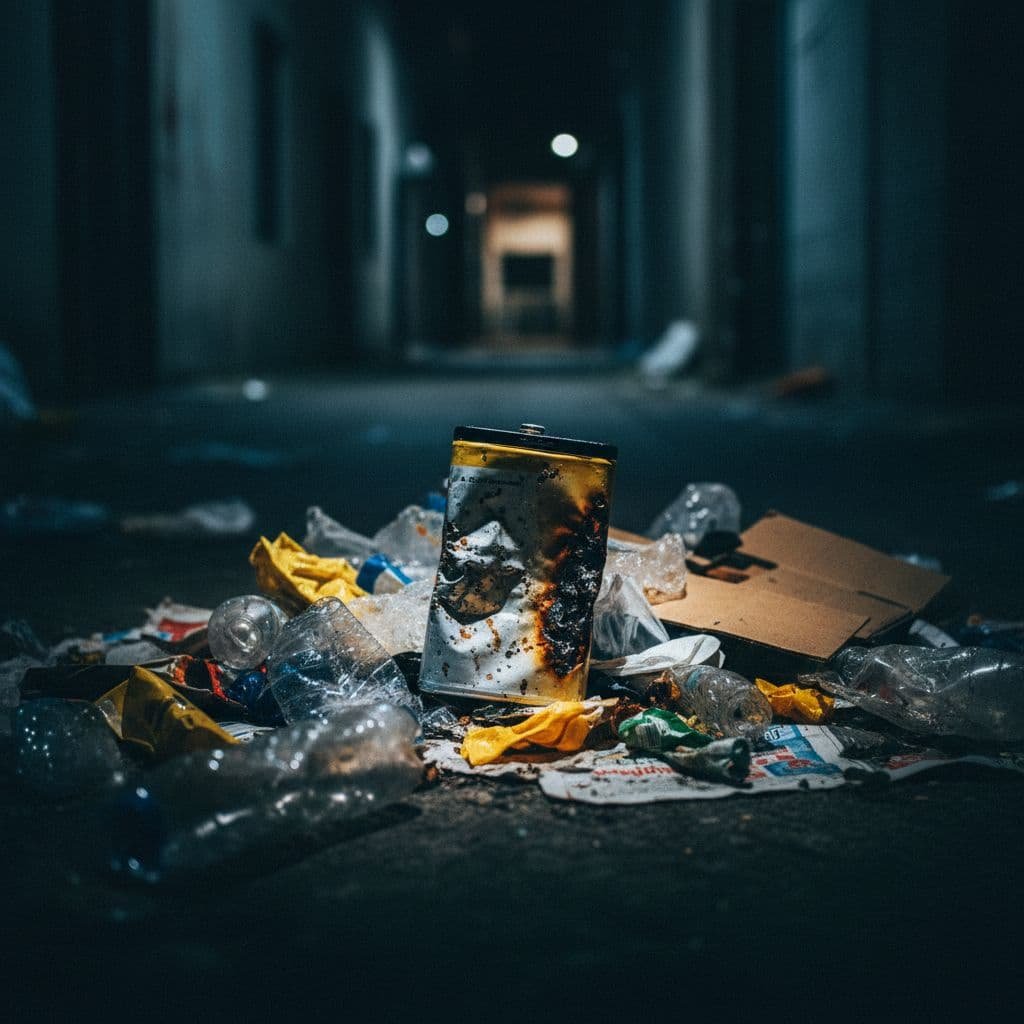
A damaged lithium battery can fail fast. If it suffers physical damage such as being punctured, bent, crushed, or overheated, it can enter thermal runaway. This means the battery heats itself, vents hazardous fumes, and may ignite nearby waste. Paper, foam, cloth, multilayer plastic, and dry leaves then help the fire spread rapidly.
A battery that looks dead can still hold enough charge to spark a fire after crushing.
This is why the rise in waste fires is not a mystery. More batteries are moving through a collection system that was built for mixed municipal waste, not for energy-dense devices. The gap between those two facts is where many fires begin.
The harsh truth is simple. A battery is not ordinary trash, but it still travels through ordinary trash routes. That mismatch sits at the core of the problem.
Why Indian waste streams are easy tinder
India’s waste system is not one tidy network. It is a patchwork of households, municipal crews, informal collectors, neighborhood scrap dealers, transfer points, trucks, godowns, sorting spaces, and dump sites. That patchwork recovers a lot of material, but it also creates many points where a damaged battery can slip through.
Mixed waste is the first weakness. When wet waste, dry waste, metal scraps, old electronics, and broken plastic all land in one bin, the chance of hidden damage rises. Compactor trucks then add pressure. Manual sorting adds blade cuts, drops, and friction. Small batteries can also rub against coins, wires, foil, or other metal pieces, which can lead to an internal short circuit that triggers a fire.
Heat matters too, although it is rarely the only trigger. Poor storage in hot sheds, crowded scrap rooms, or sun-exposed piles leads to high temperatures that reduce safety margins. Dry waste nearby turns a battery failure into a broader blaze. Then, because lithium-ion cells can reignite, a fire that seems controlled can flare up again later.
Low public awareness adds another layer. Many people know a large car battery needs care. Fewer know that a trimmer, speaker, vape, or smart toy may contain a lithium cell that should never go into household garbage. Built-in batteries make things worse, because disposal looks simple even when it isn’t.
The issue also reflects design choices. Cheap products often hide batteries inside glued or fragile casings, sometimes involving manufacturing defects that compromise the integrity of the device. When disposal is hard and take-back is rare, the waste stream absorbs the risk. Households did not create that design problem, but they live with its consequences.
Fires can start at five points in the chain
Battery fires rarely begin in one dramatic moment. They usually start during routine handling, then grow because the surrounding waste provides ample fuel. This quick view shows where trouble often begins, keeping in mind that physical damage is often the invisible trigger behind these events.
| Stage in the waste chain | What happens | Why fire risk rises |
|---|---|---|
| Home or office bin | Loose cells or battery-powered items are tossed into mixed waste | Terminals touch metal, items crack, and the hidden heat release rate climbs |
| Collection truck | Waste is lifted, pressed, and compacted | Crushing can puncture cells or deform separators inside them |
| Sorting shed or conveyor | Workers pull recyclables by hand or feed mixed waste through machinery | Batteries are missed, cut, or broken during manual or mechanical handling |
| Scrap warehouse or informal unit | Items are piled, stripped, or opened with basic tools | Rough storage and unsafe dismantling can trigger dangerous short circuits |
| Dumpsite or landfill edge | Old batteries sit in heat and dry waste, sometimes after earlier damage | Delayed ignition and ongoing reignition risk can spread fire through the pile |
The takeaway is blunt: the same battery can be damaged more than once before anyone sees smoke. By then, the trigger point may be buried under other waste, which makes control much harder.
This is also why incident reports regarding lithium-ion battery fires often sound vague. Workers may only notice flames in the truck, at the shed, or at the dump, even though the structural damage occurred earlier in a bin or during loading. In other words, the visible fire is often the final step in a longer chain of poor handling.
That matters for policy and accountability. If cities only focus on what burned, they miss the root causes of why it ignited. Prevention must begin much earlier, before the battery becomes anonymous and volatile inside the waste stream.
The rules exist, but the system still leaks
India is not starting from zero. The 2022 Battery Waste Management Rules brought extended producer responsibility, or EPR, into the battery sector. In theory, producers must finance collection and recycling, helping the country transition toward a credible circular economy for energy storage systems and improved battery recycling.
In practice, the chain is still weak. A WRI India review of battery circularity rules points to gaps in reverse logistics, enforcement, and market readiness. That means the legal framework exists, but the physical system needed to collect, store, transport, and process batteries safely is still thin in many places.
Money is part of the problem. As The Hindu’s analysis of India’s battery waste gap argues, the EPR floor price can be too low to support safe handling. Safe recycling is expensive. It requires trained labor, compliant storage, fire hazard mitigation, specialized packaging, secure transport, and proper downstream processing. When the economics do not cover those basics, corners get cut.
Product design also matters more than public debate admits. A 2026 Springer review on lithium-ion battery recycling in India highlights the lack of mandatory design-for-recycling standards. Glued casings, hidden screws, mixed chemistries, and hard-to-remove lithium-ion cells make safe disassembly slower and more dangerous.
This is where sustainable business models become more than a buzzword. If safe recovery loses money, unsafe recovery will keep finding buyers. Real reform needs collection systems that work in neighborhoods, not only on paper. It also needs products designed for safe removal, not only for low retail price.
The people closest to the waste carry the heaviest risk
When lithium-ion battery fires happen in waste streams, the danger does not fall evenly. It lands first on waste pickers, scrap sorters, small aggregators, loaders, and dismantlers. These workers keep material circulating through the economy, yet the system often offloads hidden battery risk onto them.
That point gets lost in clean policy language. Informal recovery networks are often treated as a problem to replace, but in reality, they are already doing the collection and sorting work that cities rely on. The issue is not that informal workers exist. The issue is that they handle volatile lithium-ion cells without enough protection, training, stable pricing, or safe infrastructure. Because these workers often operate in unregulated spaces, the risk of toxic gas emission during a breach is a constant threat, and the lack of protocols regarding lithium-ion battery fires leaves them vulnerable to accidents they are not equipped to manage.
An Outlook Business report on India’s lithium recycling strategy notes that many informal or small-scale units still rely on crude methods, including basic heat tools, which can create toxic emissions and fire hazards. That is a labor safety issue, a public health issue, and a market design failure.
A fire in a scrap lane can wipe out a day’s income or a family’s stock overnight. Smoke inhalation, burns, and the long-term effects of breathing hazardous fumes rarely appear in glossy recycling narratives. Neither do nearby residents who breathe the smoke when a warehouse catches fire in a dense settlement.
If India wants cleaner material loops, it cannot treat the people doing the dirtiest work as invisible. Safer battery handling has to include fair payments, protective gear, training in battery identification, safer storage rules, and routes into formal systems that do not destroy livelihoods. Without that, the transition stays selective. Materials get recovered, but the risk stays with the poor.
The ecological impact reaches beyond the dump
A battery fire is not a neat flame. It burns inside a messy mix of plastics, foams, textiles, food residue, and electronic parts. The resulting flashover, where the sudden ignition of these surrounding materials causes the fire to intensify rapidly, creates a complex chemical load. The exact composition of this smoke and ash depends on both the battery chemistry and the surrounding debris.
This makes the ecological impact broader than a single burnt scrap pile. When lithium-ion battery fires occur near drains, vacant lots, or water channels, they spread contaminated runoff during rain. Ash settles on soil, roofs, and local vegetation, affecting birds, insects, and urban plant life. These events reveal a significant failure in our environmental protections; improper waste management often bypasses the rigorous fire safety codes and standards outlined in the National Building Code. By failing to integrate waste storage into these urban safety frameworks, cities become more vulnerable to recurring toxic fire events.
This is where waste management meets urban biodiversity. A city cannot protect nesting habitats, roadside trees, or pollinators on one side while allowing preventable fires to repeat on the other. The systems are deeply connected. When dump fires flare near peri-urban edges, the harm moves across species and neighborhoods alike.
The social layer is just as critical. Schools, clinics, and homes often sit near waste routes or scrap clusters. Because children and older adults breathe the same air, promoting climate literacy becomes a practical necessity rather than an abstract goal. Community members need to understand how a discarded power bank, vape, or toy battery can transform into a local air quality crisis. Education empowers people to recognize these risks and advocate for better handling practices.
If you care about that link between waste, habitat, and community well-being, Explore Our Active Missions to see how local urban biodiversity and climate literacy projects can connect environmental concern with on-the-ground action.
What real change looks like on the ground
Systemic change is the only honest answer. Personal care matters, but no amount of careful households can fix bad product design, weak take-back systems, and unsafe recycling economics on their own.
Still, individual habits are part of the chain. For many readers, plant-based living and everyday mindfulness are already part of a lower-impact life. Battery disposal belongs in that same daily ethic. A dead device should not vanish into mixed trash simply because it is small or inconvenient. Furthermore, preventing hazards begins long before disposal; avoiding overcharging batteries and never charging overnight are critical safety steps for every household to adopt.

Photo by Julia Krasnoperova
A few basic household steps reduce risk right away:
- Keep used batteries separate from regular trash, in a dry non-metal container.
- Tape the terminals of loose cells so they do not touch metal.
- Hand battery-powered gadgets to an e-waste or take-back point, especially if the battery is built in.
- Isolate swollen or damaged batteries and do not puncture, crush, or stockpile them.
But the larger shift has to come from producers, retailers, cities, and regulators. Producers need visible take-back channels, not fine print. Retailers selling battery-heavy products should collect them back. Municipal staff and scrap workers need training to identify and isolate damaged cells. Transfer stations and sorting sheds require robust fire detection, safer storage zones, and advanced fire suppression technology. Facilities should be equipped with specific suppression agents, such as Hydrated Mica Suspension, to effectively manage a high-intensity class L fire. Furthermore, regulators must ensure that every scrap warehouse maintains a valid fire NOC to operate legally and safely. Incident logs should track battery-related fires instead of hiding them inside general waste numbers.
India also needs better price signals. If EPR payments stay low, safe recycling will struggle to compete with rough handling. A real battery circular economy has to reward safe collection and safe disassembly, not only metal recovery at the end. That is where policy, finance, and product design meet.
The rise in battery fires is often framed as a consumer awareness problem. It is that, but it is also a design problem, a labor problem, and a governance problem. Treating it only as public carelessness protects the wrong actors.
Frequently Asked Questions
Why do batteries in my trash start fires even if they look undamaged?
Batteries are often crushed or punctured by the weight of other waste, the pressure of collection trucks, or by metal tools during the sorting process. Once the internal structure of a lithium-ion cell is compromised, it can enter a state of thermal runaway, leading to spontaneous ignition even hours or days after the initial damage occurred.
Can I throw away old electronic toys or vapes with my regular household garbage?
No, you should never discard electronics, vapes, or any battery-powered devices in mixed waste. These items contain energy-dense cells that pose a high risk to sanitation workers; instead, they should be taken to designated e-waste collection centers or manufacturer take-back points.
What should I do if I have a swollen or damaged lithium-ion battery?
Do not attempt to puncture, crush, or place a damaged battery in your regular bin. Isolate the battery in a non-flammable container—such as a sand-filled bucket or a ceramic jar—away from other flammable materials, and contact your local e-waste disposal agency for specialized pickup instructions.
Why is the fire risk higher for workers in the informal waste sector?
Informal workers often handle large volumes of unsorted waste using basic tools and lack access to fire suppression technology or formal training on identifying lithium-ion risks. Because they work in densely packed, unregulated spaces, a single battery ignition can lead to a catastrophic fire that destroys their workspace and releases toxic fumes into the local community.
Conclusion
A battery fire in a waste pile often appears sudden, yet the buildup is slow. It begins with product design, weak take-back programs, mixed garbage, and labor systems that hide risks until something ignites.
Ultimately, systemic change matters more than personal guilt. While individual care helps, real progress requires safer collection methods, fair recycling economics, design standards, and improved public climate literacy to move in unison. As India expands its infrastructure for electric vehicles and increases the number of EV charging stations, the management of energy storage systems becomes critical. These units rely on a sophisticated battery management system to ensure safety during operation, but that protection vanishes once a unit enters the mixed waste stream.
If India wants cleaner cities and a functioning circular economy, we must ensure that dead batteries do not remain invisible once they leave our hands. Addressing these hazards is the only way to effectively reduce the rising frequency of lithium-ion battery fires and protect the workers on the front lines of waste management.