Broiler Chicken Welfare in India: The Cost of Fast Growth
 TBH Editorial
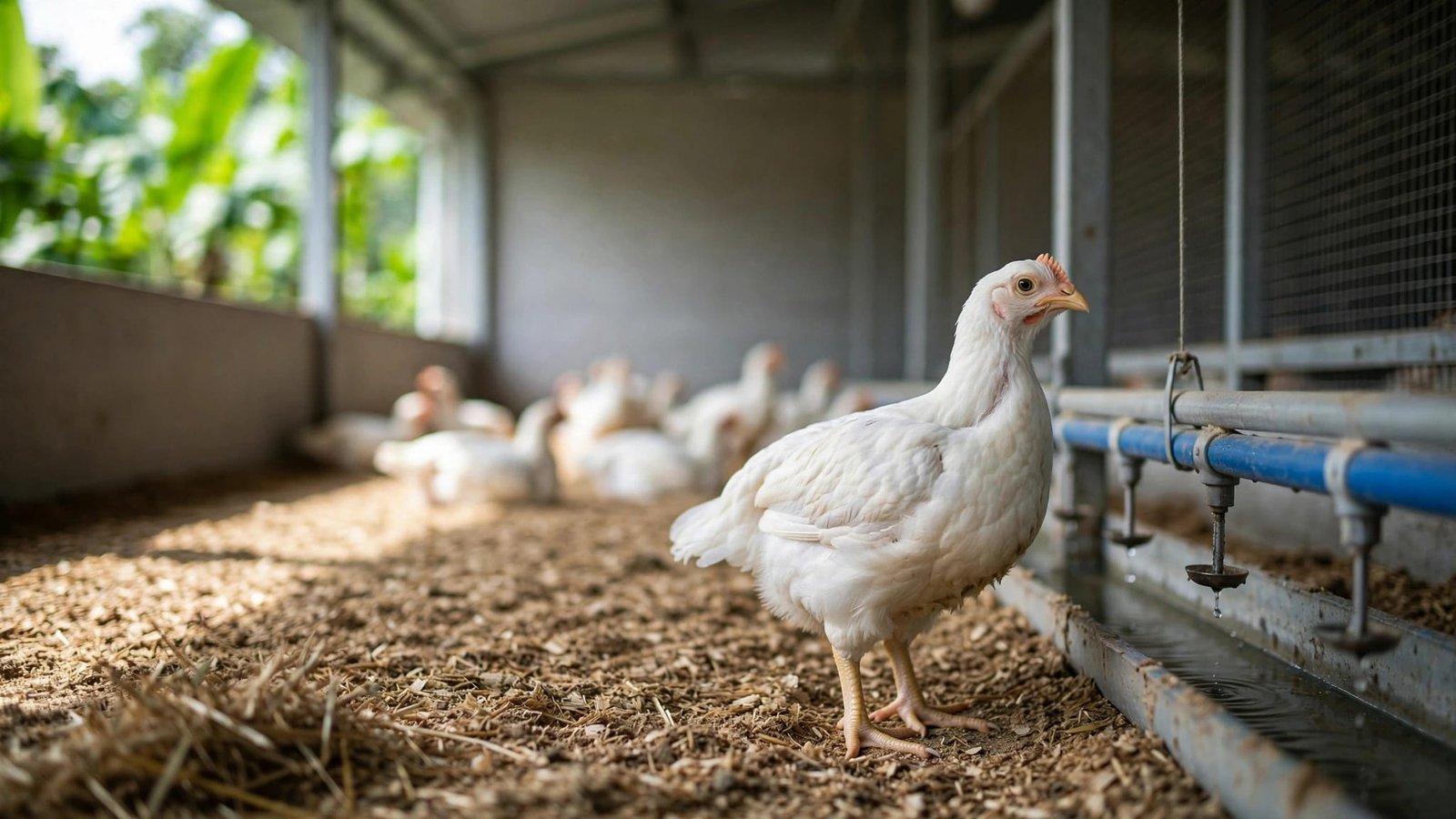
Some broiler chickens can reach market weight while struggling to walk to water.
That’s the uncomfortable starting point for broiler chicken welfare in India: efficient production doesn’t automatically mean a healthy life. When you’re trying to make responsible food choices, reassuring labels rarely tell you enough about what the bird experiences.
We need to examine breeding, farm conditions and the contracts behind them, because responsibility can’t stop with the farmer.
Key Takeaways
- Fast-growth breeding can increase mobility and health problems. Better housing helps, but can’t remove every genetic risk.
- The Five Domains Model frames animal welfare evidence such as walking ability, footpad injuries, behaviour, mortality and handling.
- Indian contract farming can reduce farmers’ exposure to market prices. Buyers must also fund welfare improvements, veterinary support and safe waste management.
What Fast-Growth Breeds Mean for Broiler Welfare
Broilers are chickens raised for meat. Commercial breeding has prioritised rapid growth, breast-meat yield and efficient feed conversion.
A 2022 Financial Express report described Indian contract broilers reaching about 2 kg in 35 to 38 days. That production timetable matters when we examine their physical development.
Growth can outpace comfortable movement
Heavy bodies place demands on developing legs and joints. Fast-growing birds face risks including lameness, skeletal problems and cardiovascular disorders.
A bird that struggles to stand may spend longer sitting on litter. If that litter is wet, prolonged contact adds skin damage to an existing mobility problem.
Feed conversion measures how efficiently feed becomes body weight. It doesn’t tell us whether walking hurts or whether a bird can explore its surroundings.
We should treat mobility as a welfare outcome, rather than assume that weight gain proves good health.
Slower growth helps, but management still matters
Slower-growing strains can show better walking ability and more activity. However, changing the breed doesn’t fix dirty litter, overcrowding or unreliable drinking systems.
The comparison also needs environmental honesty. Longer rearing periods can increase feed and resource requirements per bird, depending on the strain and production system.
A responsible transition measures animal welfare and ecological impact separately. Lower resource use per kilogram of meat can’t establish that a bird lived comfortably. Equally, a welfare improvement doesn’t automatically prove lower emissions.
Broiler Chicken Welfare in India Starts Inside the Shed
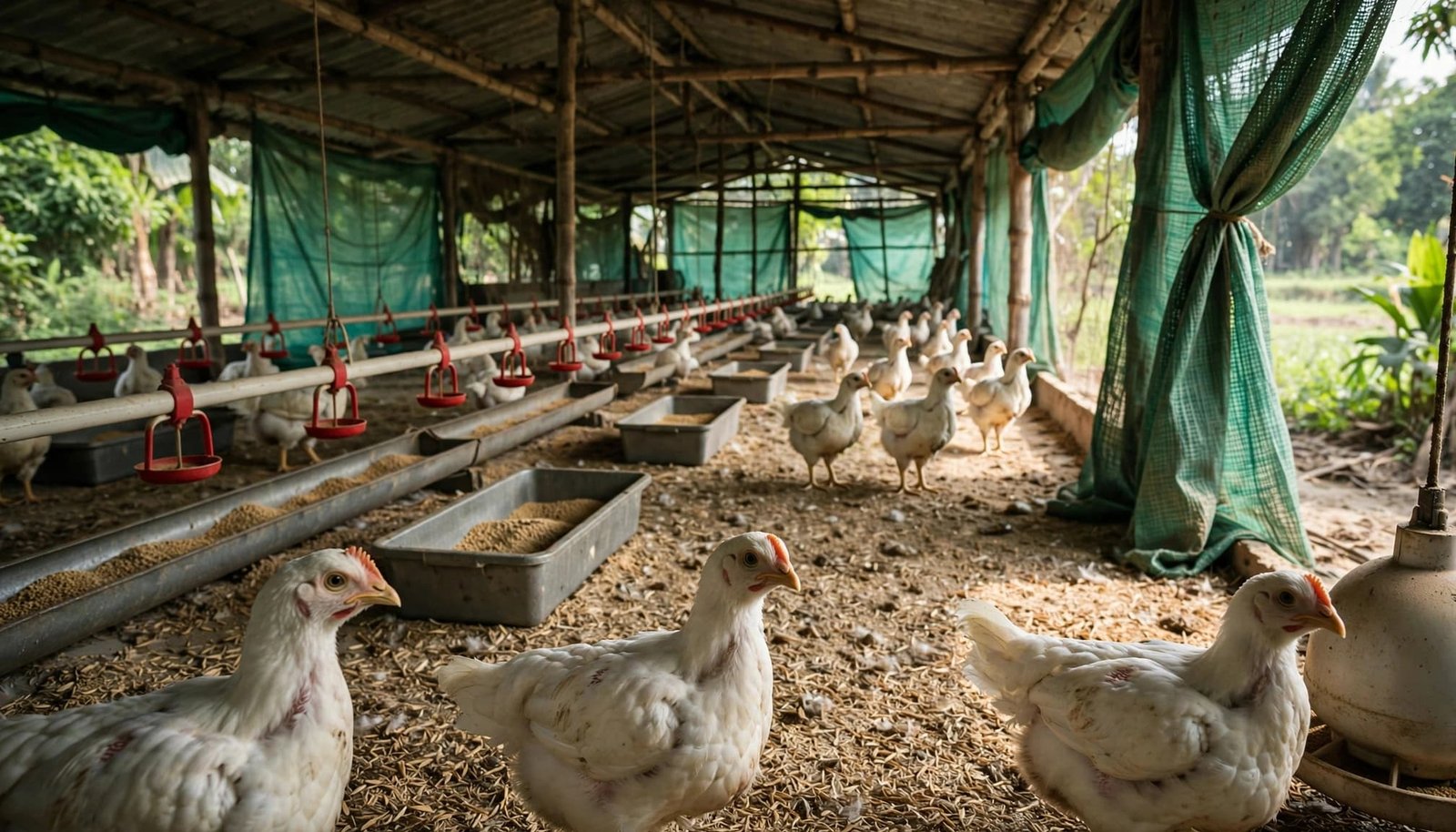
Wet litter, leaking drinkers and poor ventilation create avoidable suffering. Ammonia can irritate eyes and airways. Damp, contaminated litter contributes to painful footpad lesions and hock burns.
High stocking densities can restrict movement and make heat management harder, which may increase heat stress. Meaningful density records use kilograms of live bird weight per square metre, because the same bird count creates different pressures as chickens grow.
Practical inspections should examine walking ability, litter condition and footpad damage. Virginia Tech’s broiler welfare auditing guidance explains how animal-based indicators complement checks on buildings and management.
Lighting should support activity and adequate rest. Barren sheds limit opportunities to forage, explore and interact. Enrichment must remain accessible to birds whose mobility is already compromised.
Handling matters too. Rough catching, dragging or poorly supported lifting can cause fear and injury.
Beak trimming, toe clipping and de-spurring are painful poultry practices, but they aren’t routine procedures for every meat-broiler flock. Some concerns relate more to breeder birds or other poultry systems. Audits should identify which birds undergo which procedures, rather than blur them together.
How the Five Domains Assess a Chicken’s Life
The Five Domains Model assesses broiler welfare across nutrition, physical surroundings, health, behaviour and mental state.
David Mellor and colleagues updated it in 2020. It goes beyond the suffering-focused Five Freedoms approach widely used during the 1990s, though that older framework remains influential.
Each domain asks a different welfare question.
| Domain | What matters for broilers |
|---|---|
| Nutrition | Accessible feed and water, without prolonged hunger or thirst. |
| Physical environment | Suitable temperature, ventilation, lighting and dry litter. |
| Health | Mobility, injuries, disease and timely treatment. |
| Behavioural interactions | Opportunities to explore, forage, rest and interact without fear. |
| Mental state | The likely experience of pain, distress, comfort or positive engagement. |
The key shift is attention to positive experiences, alongside preventing suffering.
A chicken’s mental state can’t be read directly. It is assessed through evidence about health, behaviour and circumstances.
Low mortality can coexist with poor welfare. Birds may survive while experiencing painful walking, skin lesions or restricted behaviour.
What a Credible Broiler Welfare Audit Measures
An audit needs to connect written procedures with what happens to birds.
The NCC’s Key Welfare Indicators
The US National Chicken Council developed its NCC Broiler Welfare Guidelines and audit checklist in 1999 and reviews them annually. Its 2023 update added Key Welfare Indicators.
These include paw and footpad health, gait scoring, effective processing parameters, and minimising leg and wing injuries.
The NCC’s updated welfare guidelines emphasise measurable outcomes, including mobility and insensibility at slaughter. Scores from the NCC Broiler Welfare Guidelines can complement the Five Domains Model, but they don’t replace a broader welfare assessment.
These are US industry guidelines, not Indian law. They offer assessment tools, but shouldn’t be presented as a complete ethical verdict on fast-growth production.
Accountability beyond the inspection day
The NCC approach includes whistleblower protection and updated scoring guidance from the American Association of Avian Pathologists. Its audit tool has certification from the Professional Animal Auditor Certification Organization, or PAACO.
That certification doesn’t mean every Indian supplier, farm or flock is independently certified.
Credible reporting identifies the facilities covered, sampling method, failures and corrective action. It also examines repeated flock records and bird-based welfare outcomes.
A prepared shed can look convincing during one visit. Recurring footpad damage, injuries or unexplained mortality tell a different story.
Indian Rules and Contract Farming Shape What Farmers Can Change
Keep legal scopes separate
The Prevention of Cruelty to Animals Act, 1960 establishes India’s general anti-cruelty framework. The Transport of Animals Rules, 1978, as amended, include poultry transport provisions.
Neither a food-business licence nor a food-safety test establishes good on-farm welfare.
India’s 2023 Egg Laying Hens Rules concern laying hens. They shouldn’t be treated as a comprehensive broiler welfare standard.
Scope matters elsewhere too. The government’s 2020 CPCSEA poultry-facility guidelines cover research and testing settings. Their numerical housing limits shouldn’t be repackaged as nationwide commercial-broiler requirements.
Our discussion of cage-free egg claims in India examines the same problem: evidence answering one question can be mistaken for proof of another.
Contract farming reduces some risks, not every risk
Some growers in rural India contract with integrators such as IB Group. The integrators supply day-old chicks, feed and technical support, then arrange collection and marketing. Farmers provide housing, labour and daily care.
This reduces exposure to fluctuating chicken prices and can make income more predictable. It doesn’t guarantee profitability.
A 2024 Indian Express report described one IB-linked farmer receiving a minimum growing charge of ₹10 per kilogram. His two environmentally controlled sheds cost ₹90 lakh.
These are reported examples, not universal rates.
Farmers carrying infrastructure debt need contracts that fund welfare improvements. Sustainable business models should reward healthy birds and responsible management, alongside production efficiency.
Welfare Risks Continue During Transport and Slaughter
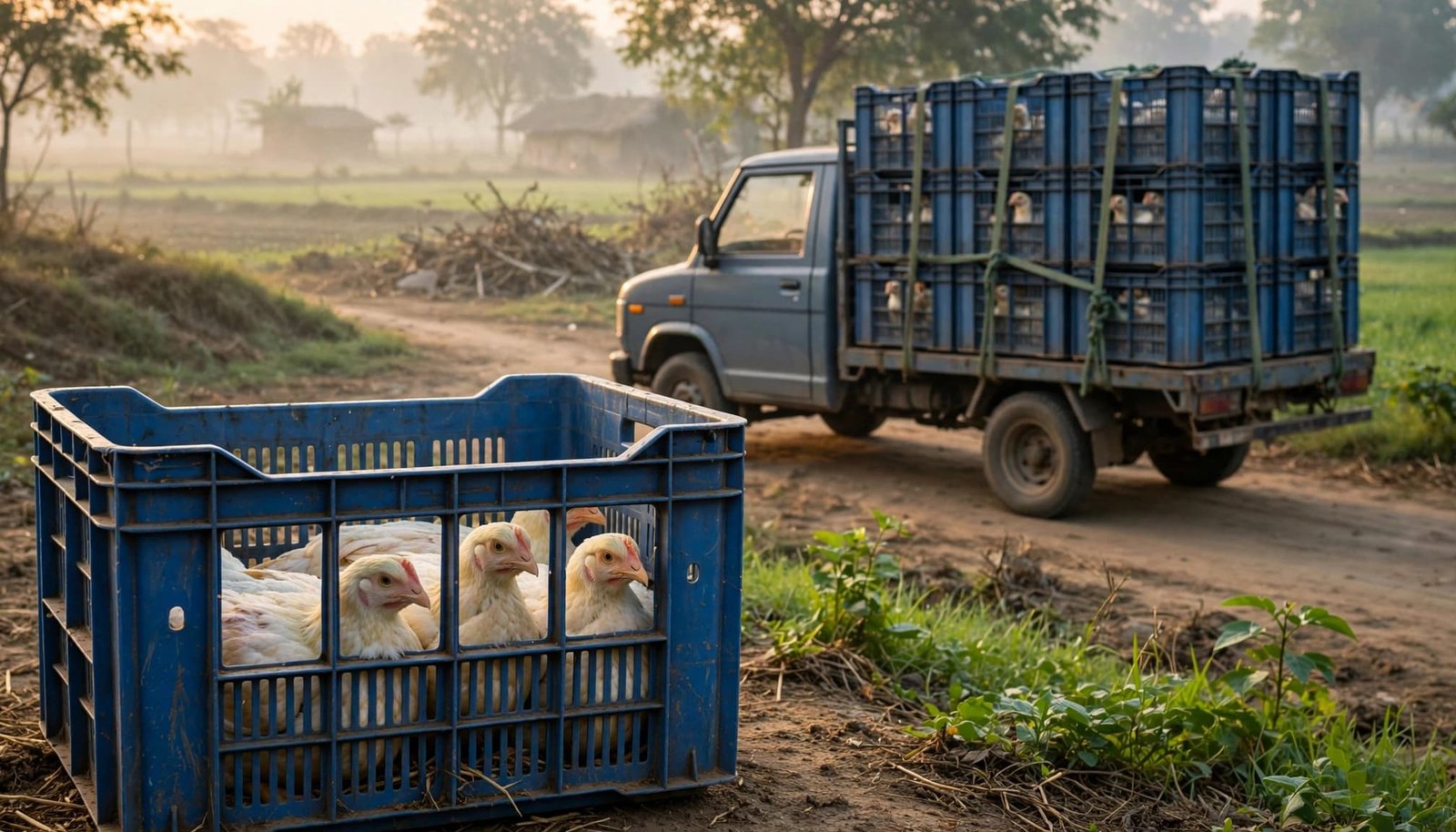
Road transport can expose birds to overcrowding, heat stress, injuries and long periods without feed or water. Stationary vehicles and unloading delays can increase heat exposure.
Crate density, journey duration, weather and catching methods all matter. A transport plan needs to account for each bird’s condition before loading.
Records should include deaths on arrival and injuries linked to catching and transit.
At slaughter, welfare assessment must examine handling and, where stunning is used, its effectiveness. Birds must remain insensible until death.
A farm-only certificate leaves this part of the supply chain unanswered. Buyers need to know whether the assessment covers hatcheries, transport and processing.
Antibiotics and Farm Waste Connect Welfare With Public Health
Disease prevention needs more than medication
Antibiotics used for growth promotion or routine disease prevention can select for resistant bacteria. Improper use and failure to observe withdrawal periods can also leave residues in meat.
Antibiotic resistance and drug residues are separate concerns. A product that meets residue limits can still come from a system with poor antimicrobial stewardship.
A 2025 Frontiers in Veterinary Science study surveyed 39 commercial broiler farms in Gujarat. About 79% of respondents had low awareness of antimicrobial resistance. This limited local sample isn’t a national estimate.
High bird density, weak sanitation and poor biosecurity can increase disease spread and zoonotic risks that affect public health. Withholding necessary treatment harms sick birds. Research on antibiotic-free broiler production highlights why health and welfare need joint attention.
Resource recovery needs safeguards
Environmentally controlled sheds need electricity and water for cooling, cleaning and maintaining bird conditions. Assessments should document local water stress, especially where farms are near communities in rural India.
Poorly managed manure and wastewater can pollute soil and water. Runoff affects neighbours, downstream farms and aquatic life. Near cities, polluted waterways also threaten urban biodiversity.
A circular economy requires documented treatment, nutrient management and safe application. Calling manure “fertiliser” doesn’t establish that it was handled safely.
Useful ecological data include water use, energy consumption, manure quantities and discharge destinations, alongside production output.
Systemic Change Means Buyers Share Responsibility
Climate literacy should include knowing the limits of an emissions claim. A smaller carbon footprint doesn’t establish humane treatment or safe local water.
Institutional buyers can put breed information, welfare outcomes, antimicrobial stewardship, and waste requirements into procurement contracts. Buyers also share responsibility for antimicrobial stewardship as a public health concern. They should fund training and infrastructure instead of transferring every cost to growers.
Published audit summaries should show failures and remedies, rather than only a certificate.
Everyday mindfulness can begin with one purchasing decision you can explain. It can also extend to practical ecological work in your community. To connect awareness with on-the-ground action, Explore Our Active Missions.
Frequently Asked Questions
Is country chicken healthier than broiler chicken?
The label alone doesn’t establish nutritional superiority, safer meat or better welfare. Feed, handling, veterinary practices and cooking all matter. Welfare, nutrition and food safety need separate evidence.
Does plant-based living avoid these welfare questions?
Replacing chicken meals with pulses, beans or tofu reduces your reliance on broiler production. Plant-based foods still have environmental impacts, but those choices avoid the breeding, confinement and slaughter concerns discussed here. Affordable substitutions can be practical without requiring a premium welfare label.
Put the Bird Back Into the Assessment
Bird welfare in India depends on breeding decisions, daily care and contracts that determine what farmers can afford.
We need measurable accountability across the supply chain. A bird’s ability to walk, rest and reach water deserves attention alongside its market weight.
Ask your food supplier for the breed and latest report of welfare outcomes. That request makes your concern harder to dismiss as another preference on a marketing survey.