
How Sand Mining in India Empties Rivers of Life
 TBH Editorial
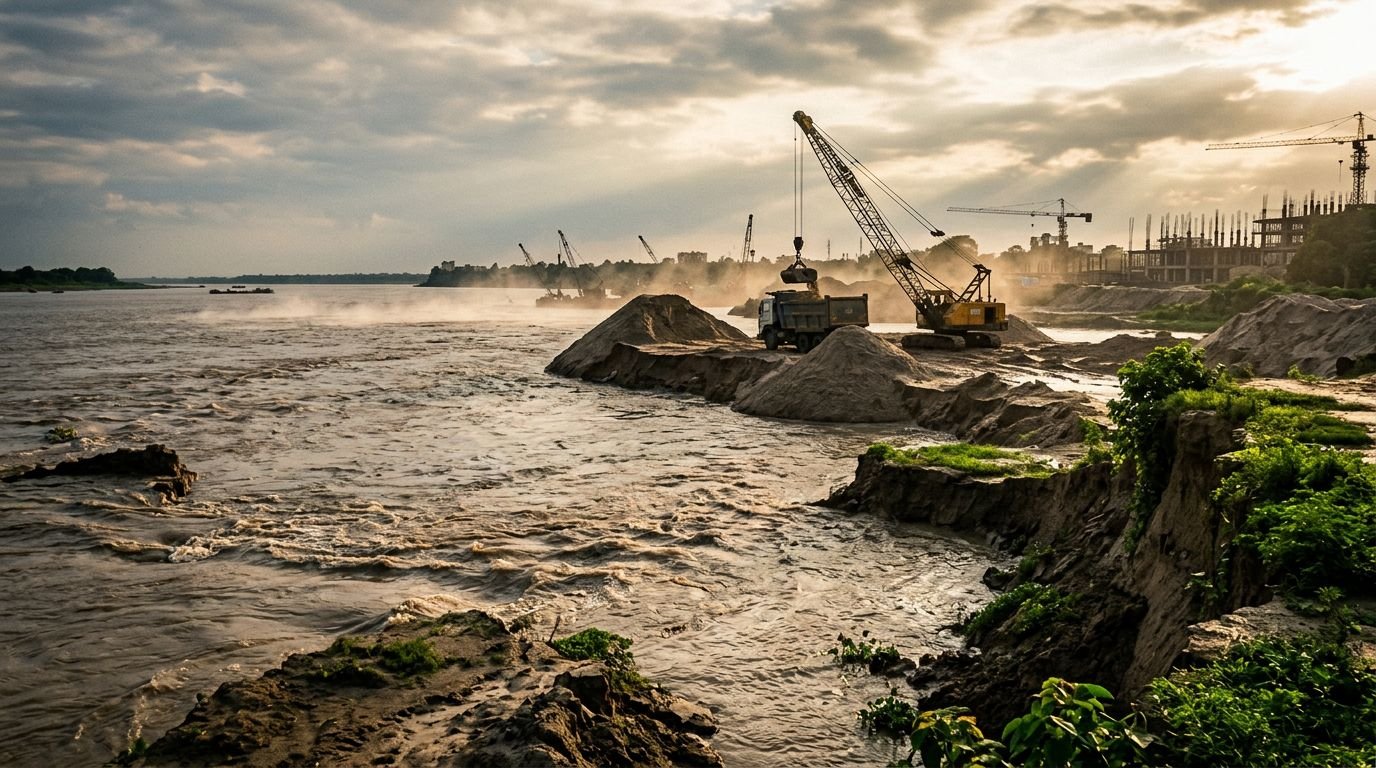
A river can look full and still be dying. When sand is removed faster than a channel can rebuild itself, the damage spreads through water, soil, fish nurseries, farms, and village wells.
Across India, sand feeds homes, roads, towers, and public works. Yet the price is often hidden in broken riverbanks, cloudy water, and lost livelihoods.
If you want to understand why this keeps happening, follow the sand from the construction boom back to the river.
Why river sand became so valuable
Sand mining in India is tied to one blunt fact: construction eats material at a staggering pace. Concrete, mortar, road base, and land filling all need aggregates. River sand became attractive because it was close, cheap to move, and easy to sell into fast-moving local markets.
That demand grew faster than regulation. Legal leases exist, and some extraction is permitted under rules and surveys. Yet rivers don’t experience “legal” and “illegal” mining in separate ways. They experience volume, timing, and damage. When too much sand leaves a riverbed, the system starts to unravel.
River sand also has a market advantage. Builders often trust it because it is familiar, fine-grained, and easy to work with. That preference can keep demand high even where alternatives exist. Meanwhile, enforcement is uneven across states and districts. A mined stretch can change quickly, especially when machines enter during low-flow seasons.
As of 2026, stronger court pressure and public scrutiny still haven’t stopped excessive extraction in many places. Field reporting continues to flag river stretches in eastern India, including the Damodar, Ajay, Subarnarekha, and Mahanadi, where mechanized removal has altered channels and water quality.
The deeper problem is not one bad truck or one corrupt permit. It is a supply chain that treats living riverbeds as raw stock. That is why Systemic change matters more than one-off raids. If demand stays high, monitoring stays weak, and cheap sand stays profitable, the river keeps losing.
What sand does inside a living river
Sand is not dead filler sitting at the bottom of a river. It shapes flow, slows erosion, stores water, supports insects, shelters eggs, and helps connect the river to groundwater. Remove too much of it, and the river stops behaving like a balanced system.
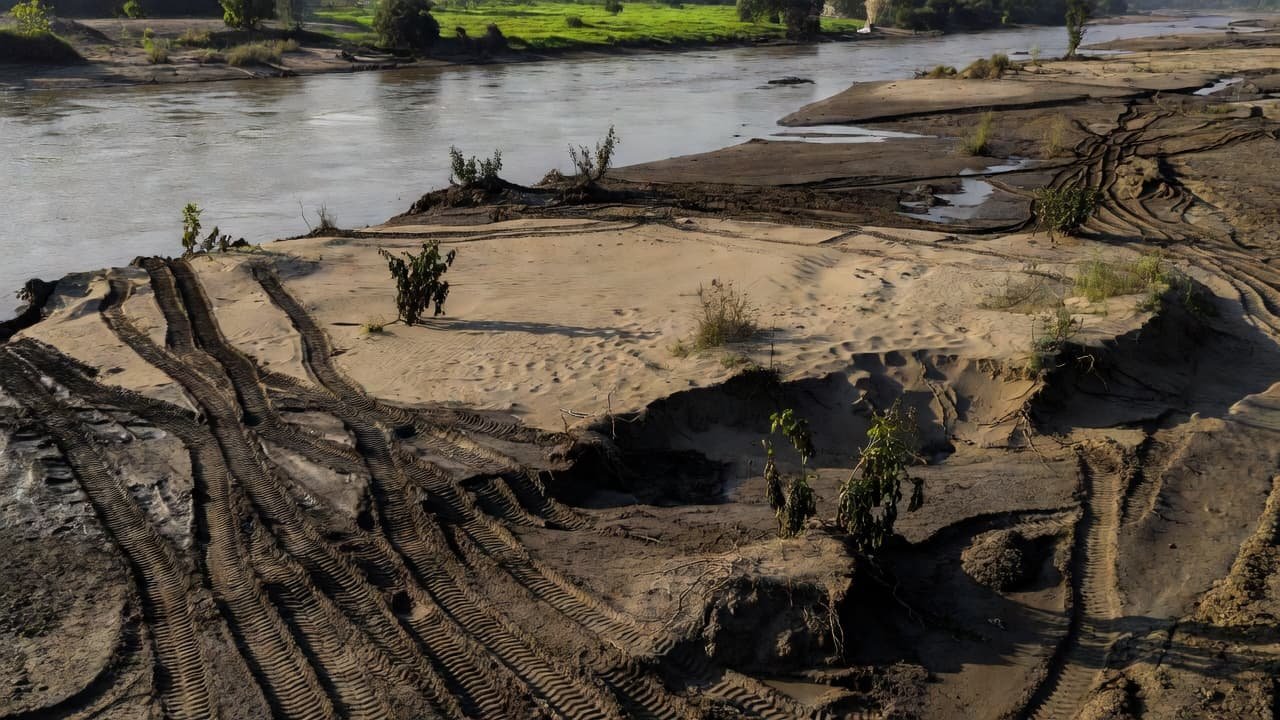
When mining cuts deep pits into the bed, water no longer moves in a natural pattern. Some stretches become over-deepened. Others fragment into disconnected pools. Banks turn unstable, so the channel starts biting into nearby land. During monsoon flows, weakened banks can collapse faster.
The ecological impact shows up in water quality too. Recent field monitoring in mined river stretches in eastern India has found suspended sediment levels around 150 to 350 mg/L, with some excavation pools crossing 500 mg/L. That kind of turbidity blocks light, lowers oxygen, and makes feeding harder for fish and aquatic insects.
A mined river does not fail all at once. It loses depth in the wrong places, flow in the wrong seasons, and life in the spaces most people never see.
The harm is wider than fish deaths. Turtles lose nesting areas. Riverbank plants struggle to hold soil. Birds that depend on shallow edges and exposed bars lose feeding ground. A broad review of river sand mining impacts shows that extraction can disrupt physical, chemical, and biological conditions at the same time.
Groundwater suffers as well. A stable sandy bed helps rivers recharge nearby aquifers. Lower that bed too far, and wells near the floodplain can weaken or dry earlier in the year. This is why a river can seem “open” for business while becoming less able to support life.
The damage does not stop at the waterline
People who live near mined rivers feel the loss first. Fishers face lower catches because breeding grounds disappear. Farmers see banks slump into fields. Families that rely on hand pumps or shallow wells may find the water table dropping. Roadside settlements deal with truck dust, noise, and damaged local roads.
These are not side effects. They are part of the cost of extraction. Yet they rarely appear in the price of a truckload of sand. Public money then pays twice, first by allowing the river to degrade, and again by repairing embankments, bridges, roads, and water systems.
This is also why the debate cannot stay stuck in the language of “development versus environment.” A damaged river is not anti-development in theory. It is a direct hit to food, water security, and local income. When a river becomes deeper in some places and unstable in others, nearby land users inherit the risk.
In many regions, distrust grows because communities can see the change with their own eyes while paperwork still says operations are controlled. Fresh tracks appear at dawn. Banks vanish one season at a time. Water turns opaque, then normalizes after rain, then clouds again. The pattern becomes familiar.
The phrase “sand mafia” remains in public discussion for a reason. Excessive profits, local protection networks, and weak enforcement can combine into a trade that is hard to challenge. Ordinary people then carry the burden of speaking up against actors who often have better access to money and influence.
So when people talk about sand mining in India as a technical resource issue, something important gets lost. This is also a governance issue and a social justice issue.
Why bans and permits often fail on the ground
India has rules for sand extraction. Mining needs permits, lease boundaries, surveys, and environmental safeguards. On paper, that sounds workable. On the ground, several things break.
First, local demand can outpace legal supply. Contractors still need material, and projects rarely pause because a river stretch needs recovery. That gap between demand and lawful availability creates room for illicit mining.
Second, monitoring often misses timing and scale. A district may approve limited removal, but a river can be stripped at night, across lease edges, or below the allowed depth. By the time officials inspect the site, the sand is already in trucks, depots, and construction sites.

Photo by Lana Kravchenko
Third, enforcement often targets transport more than extraction logic. Seizing a few trucks can create headlines. It does less when procurement systems still reward the cheapest supply and when traceability remains weak. Research from CEGA on India’s sand mining bans points to the need for better measurement and policy design, because blanket restrictions can push the trade into more hidden routes without fixing root incentives.
Bans can still help in overstressed stretches. Some river reaches need strict no-mining periods or full protection. But a ban without surveillance, public disclosure, and demand-side reform is often temporary relief. The sand market shifts, prices rise, and extraction reappears elsewhere.
That is why enforcement cannot rely on morality plays about “good” and “bad” actors alone. It needs clear hydrological limits, real-time tracking, public procurement reform, and accountability that survives election cycles.
Better answers than simply chasing trucks
A workable response has to reduce demand for fresh river sand and tighten control where extraction still occurs. The fix is not one policy. It is a material shift plus a governance shift.
Build less demand for fresh river sand
Construction does not need virgin river sand for every use. Manufactured sand from crushed rock can replace natural sand in many applications when grading and quality control are strong. Recycled aggregates from construction and demolition waste can also take pressure off rivers, especially in fast-growing urban corridors.
That is where the circular economy matters. Cities generate enormous volumes of concrete rubble, brick waste, and excavated material. When those streams are sorted, processed, and certified well, they become substitutes rather than landfill. This is slower work than filling trucks from a riverbank, but it is smarter work.
It also opens room for sustainable business models. Suppliers can build value around recycled inputs, quality assurance, and transparent sourcing instead of betting on cheap extraction. Public agencies have leverage here through tenders, building standards, and procurement rules. If state contracts keep buying the cheapest unmanaged sand, the market keeps learning the wrong lesson.
This quick comparison shows where progress often stalls.
| Response | What it helps fix | What still needs work |
|---|---|---|
| Manufactured sand | Cuts demand for river sand | Dust, quarry siting, quality control |
| Recycled C&D waste | Keeps material in use | Sorting, certification, buyer trust |
| Transparent procurement | Reduces hidden illegal supply | Audits and contractor compliance |
| River stretch zoning | Protects sensitive habitats | Consistent enforcement |
The takeaway is simple: alternatives exist, but they only scale when pricing, standards, and public buying all move together.
Make extraction transparent where mining continues
Some sand mining will continue. The question is whether it happens within ecological limits. That means stretch-by-stretch assessments, seasonal restrictions, depth limits, habitat mapping, and public data on what was removed and from where.
Remote sensing can help. Satellite imagery, drone surveys, GPS-tagged transport permits, and geotagged inspection records make it harder to hide excavation patterns. Yet monitoring tools only matter when data is open enough for communities, courts, and journalists to scrutinize.
A wider view also matters. The global picture of sand demand and environmental risks shows that river extraction is tied to how countries build cities. India cannot police its way out of the problem if it keeps treating riverbeds as the cheapest input for growth.
What responsible attention looks like now
If you are an ordinary reader, it is easy to feel powerless here. An excavator in a river at midnight seems far removed from daily life in a city apartment or office. Yet the concrete under a new tower, the fill under a road, and the pace of urban expansion all connect back to extraction somewhere.
That is why climate literacy needs to include materials, not only carbon. People who track emissions, support renewables, or care about heat stress should also care about where building sand comes from. River health is part of climate adaptation because stable channels, wetlands, and recharge zones help communities handle flood and drought stress.
Personal values still matter, but they work best when they sharpen public attention. everyday mindfulness can mean noticing construction demand, asking for recycled material in projects where you have influence, and supporting transparent local planning. Many readers already care about plant-based living or low-waste habits. Those choices lower pressure in other systems. They do not replace mining reform, but they belong to the same ethic of taking extraction seriously.
The river-city link is stronger than it looks. Lost floodplain health can hurt urban biodiversity downstream by degrading wetlands, bird habitat, and small aquatic food webs that support city edge ecosystems. If you want to support grounded work that links river awareness, urban biodiversity, and youth-facing climate literacy, Explore Our Active Missions.
Most of all, don’t let this issue stay invisible because sand looks ordinary. Ordinary materials can carry extraordinary damage when regulation is weak and demand is treated as untouchable. Public pressure works best when it asks precise questions: Where did this material come from? Was the river stretch assessed? Who monitors extraction volume? Who pays when the bank fails?
Conclusion
A river can look calm while its living base is being hauled away truck by truck. That is the clearest lesson from sand mining across India.
The strongest response is not symbolic concern. It is Systemic change in how cities build, how states monitor, and how markets price damage that rivers and communities should never have to absorb. Until sand is treated as ecological infrastructure, not cheap cargo, rivers will keep losing life faster than they can recover.