

How to Audit Supplier Climate Claims Before You Sign
 TBH Editorial
Green promises are cheap. Signed supplier agreements aren’t.
If a vendor says it’s “net zero”, “carbon neutral”, or aligned with 1.5C, you need more than a polished slide. Once supplier climate claims enter your procurement file, they can become your risk too, commercial, legal, and reputational.
A proper audit isn’t about catching people out. It’s about finding out what is real, what is planned, and what is pure marketing before you commit spend.
TL;DR: Don’t sign on slogans. Ask for the boundary, the baseline, the method, the interim plan, and the proof. If a climate claim can’t survive a basic audit trail, treat it as marketing, not evidence.
First, pin down what the claim actually says
Most climate claims from suppliers bundle together three different things, a current result, a future target, and a broad intention. Those are not the same thing. Treat them as the same, and weak claims stroll straight through procurement.
Start by rewriting the claim in plain English. “We are net zero” becomes, “Which legal entity says it is net zero, for which operations, across which emissions, from which date, using what method?” If the supplier can’t answer that cleanly, stop there.
Next, pin down the boundary. Ask whether the claim covers the parent group or only one subsidiary. Ask whether it includes Scope 1 and 2 only, or Scope 3 as well. Ask whether it’s company-wide, site-specific, or tied to one product line. For electricity claims, ask whether figures are location-based, market-based, or both.
Then check the metric. A 40 per cent cut in emissions intensity is not the same as a 40 per cent cut in absolute emissions. If output drops, intensity can improve whilst total emissions barely move. The headline can look healthy even when the atmosphere sees little difference.
This first pass sounds basic because it is. Most bad supplier climate claims break on definition, boundary, or maths long before you need a specialist review. If the words are fuzzy, the evidence usually is too.
Ask for evidence you can trace, not a glossy deck
A strong claim lets you move from headline to source data without too much guesswork. A weak claim keeps the proof one layer out of reach, always “available later”, always sitting with a consultant, always trapped in head office.
At minimum, request the emissions inventory, the baseline year, the organisational boundary, the calculation method, and the latest assurance statement if one exists. If the supplier says a target is science-based, ask whether the Science Based Targets initiative has validated it. If they rely on renewable electricity or offsets, ask for the certificate or registry record, not a summary line.
This quick comparison sorts solid evidence from soft substitutes:
| Evidence | What good looks like | What should worry you |
|---|---|---|
| Baseline inventory | Year stated, scopes defined, method named | “We’ve reduced a lot since 2019” |
| Boundary note | Legal entities, sites, exclusions listed | Group claim pasted into a local bid |
| Reduction plan | Interim targets and named actions | A distant net-zero date with no near-term steps |
| Offsets or certificates | Volumes, vintage, registry, retirements | “Carbon neutral” with no project detail |
The takeaway is simple. If the proof is always one step away, treat the claim as unverified.
For product-level claims, go one step further. Ask how emissions were allocated across shared materials, transport, packaging, and end-of-life assumptions. Product footprints can move a lot on small modelling choices. If the supplier can’t explain those choices in plain language, don’t rely on the number in a tender response or contract schedule.
A practical audit you can run before procurement signs
You don’t need a six-month programme to screen a supplier’s climate story. A disciplined one-week audit is often enough to separate evidence from aspiration.
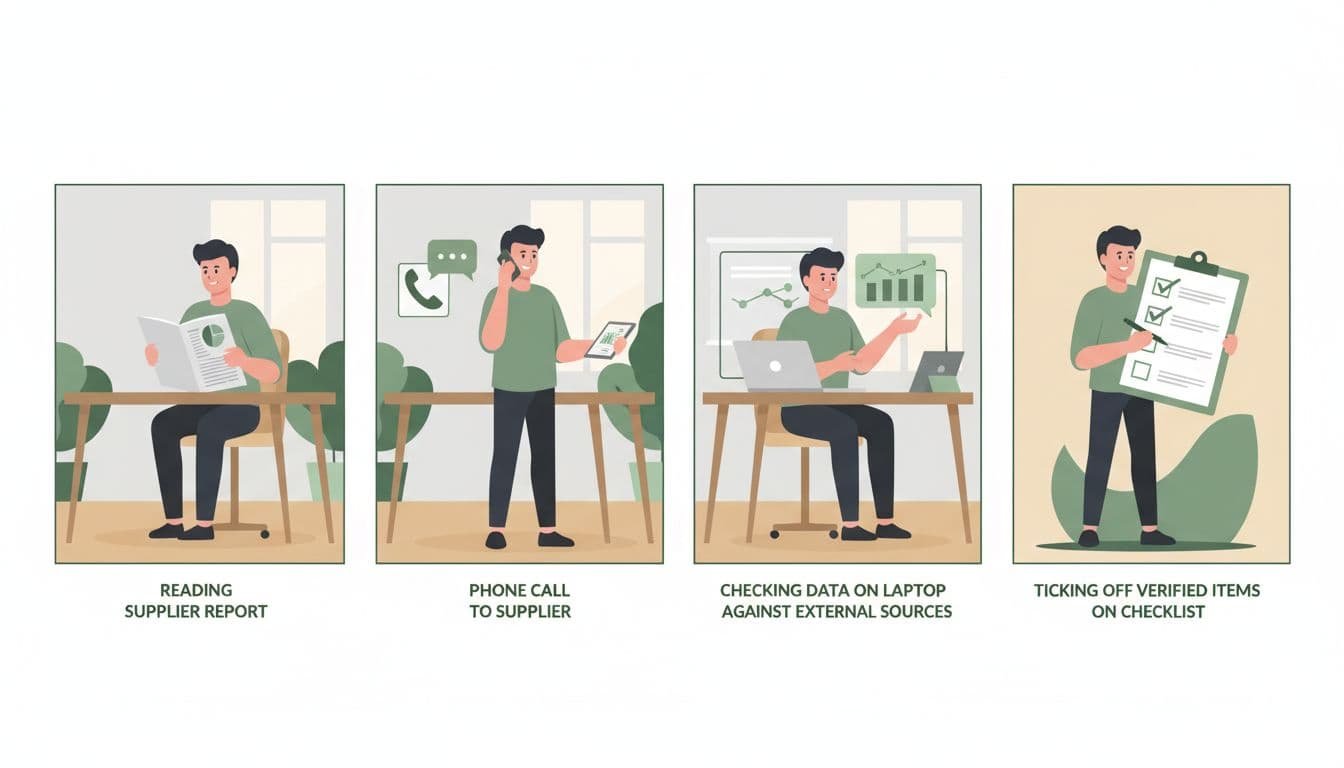
Run the review in this order:
- Write the exact claim in one sentence, with the entity, scope, metric, and date.
- Trace two important numbers back to source data.
- Recalculate a basic sense check using activity data you can understand.
- Test whether the target matches real actions, budget, and ownership.
- Record your confidence level, the gaps, and any contract conditions.
Pick one emissions number and one activity number, then follow them backwards. If electricity emissions fell, look for meter data, invoices, contracts, or site changes. If logistics emissions dropped, ask what changed, route design, load factor, transport mode, or only the emission factor used in the model.
Then test the future story. A supplier may promise a huge cut by 2030, but what is happening this year? Is there capital spend? Are there energy projects? Has anyone changed fleet policy, refrigerants, materials, or supplier standards? A target with no owner and no budget is not a plan. It’s a wish dressed for a meeting.
Cross-check with sustainability, procurement, finance, and legal. You’re not hunting perfection. You’re asking whether a reasonable person can see a defensible audit trail. If the trail breaks in two places, don’t sign off the claim.
Red flags in supplier climate claims that should slow the deal
Some warning signs are obvious. Others wear a respectable suit.

Watch for claims built on soft verbs, “supporting”, “enabling”, “aspiring”, “partnering”, “exploring”. Those words have their place. They are not proof. The same goes for shiny percentages with no baseline year, no scope, and no statement of method.
Another red flag is selective assurance. A supplier may say its emissions are externally assured, but only for Scope 1 and 2, or only for one division. That isn’t useless, but it is nowhere near the same as a full-company claim. The detail matters.
Be wary when offsets do most of the work. Offsets can have a role, but they do not erase ongoing operational emissions. A supplier cutting 5 per cent and offsetting the rest should not present that in the same way as a supplier that has changed energy use, logistics, design, and materials.
If the supplier can explain the ambition in one slide but not the data in one spreadsheet, slow the deal down.
Also question claims copied from a parent website into a local bid. If the contracting entity isn’t the one covered by the claim, you have a mismatch, not proof. The same problem shows up when a supplier quotes a group target but provides no path for the site, factory, or product you are buying.
Check outside the supplier pack, then lock it into the contract
A supplier deck is only one side of the story. Before renewal or award, look outside it.
Useful checks outside the supplier’s own material
Use public sources where they exist. Review annual reports, published transition plans, product environmental declarations, carbon credit registries, and CDP disclosures if the supplier shares them. If a target is said to be science-based, check its status with the Science Based Targets initiative. Compare dates, boundaries, and wording.
Private companies won’t always publish much. Fine. That doesn’t give them a free pass. Ask for confidential evidence under NDA. Serious suppliers usually prefer that to being lumped in with greenwashers.

Contract terms worth adding
Then write the contract like the climate claim matters, because it does. A few plain clauses can save a lot of grief later:
- The supplier must provide supporting data, methodology notes, and updated assurance on request.
- Material changes to targets, boundaries, or assurance status must be disclosed during the contract term.
- Climate claims used in proposals, reports, or joint marketing must be accurate and attributable to the contracting entity.
- Repeated or material misstatements trigger a corrective plan, and if needed, termination rights.
This is not about punishment. It’s about keeping the claim honest after signature, when shiny promises often get harder to trace. If you may repeat a supplier’s claim in your own reporting, bid documents, or product communications, get the wording right in the contract before anyone hits send.
Final thought
Procurement’s job is not to reward the best climate story. It’s to separate claims that can survive an audit trail from claims that can’t.
The strongest claims are boring in the best possible way. Clear boundary. Clear data. Honest gaps. No smoke, no halo, no “trust us”.
And if you want climate action with a short proof chain, Contribute to Active Missions backs field work such as bird nests and mangrove planting, with 100% of funds going to the ground. That’s a useful standard to keep in mind before you sign anything labelled green.