
Why India’s Air Quality Index Misses Toxic Exposure
 TBH Editorial
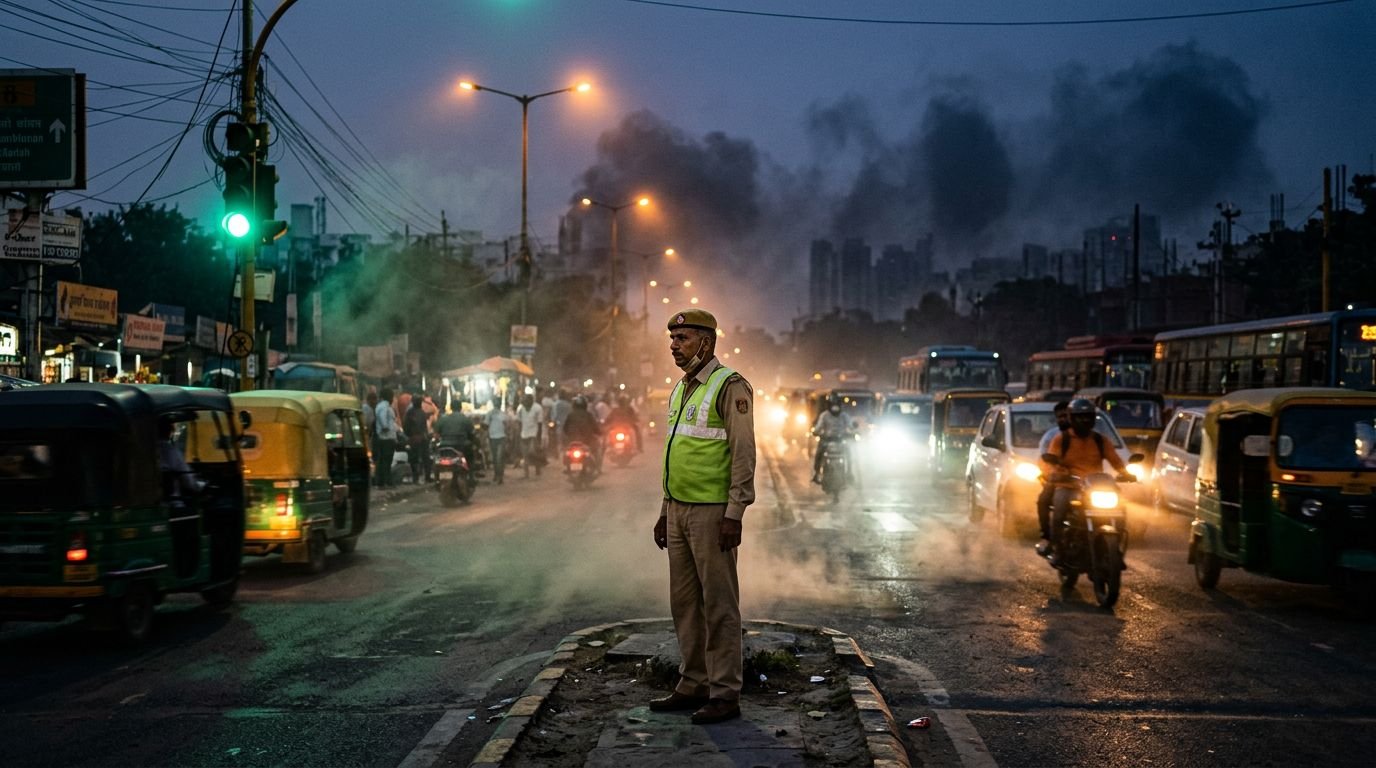
A city can show a moderate air quality reading while a traffic police officer spends eight hours breathing brake dust, diesel soot, and metal-laced road grit at a busy junction. This highlights the hidden reality of air pollution in India, where localized dangers often persist despite general citywide reporting.
That is the uncomfortable limit of the India air quality index. It provides an important warning signal, but it cannot tell the full story of what enters a person’s lungs, settles on their skin, or follows them home on their shoes and clothes.
If we treat one color-coded number as the whole truth, the people with the highest daily exposure disappear from view.
Key Takeaways
- While the India air quality index is a useful tool for public health alerts, it does not serve as a complete measure of individual toxic exposure.
- A citywide average often hides dangerous pollution hotspots near busy roads, industrial zones, school gates, and construction sites.
- Understanding air quality requires looking beyond mass measurements like PM2.5 and PM10 to consider the health impacts of black carbon, ultrafine particles, heavy metals, and chemical composition.
- Actual exposure depends on where you are, how long you stay there, and which specific pollution sources are nearby.
- Systemic change requires cutting pollution at the source rather than asking citizens to simply survive the current conditions.
The India Air Quality Index Is a Warning Light, Not a Health Diary
The India air quality index turns complicated monitoring data into a number that people can understand quickly. The system uses pollutants such as PM2.5, PM10, Nitrogen Dioxide, Sulfur Dioxide, Ozone, Carbon Monoxide, ammonia, and lead where data is available.
That simplicity has value. A parent in New Delhi can decide whether a child should play outside. A school can pause sports. A person with asthma can carry medication or avoid a long run beside traffic.
The Central Pollution Control Board’s AQI platform gives the public a shared language for bad-air days. We need that.
But an AQI is not a personal exposure report.
It does not know whether you spent your morning inside a clean office, rode behind a smoky bus trapped in heavy vehicular emissions for 50 minutes, or sold tea beside an intersection where trucks idle all day. It cannot see the dust kicked up each time a motorcycle cuts across an unpaved shoulder.
The number also works by identifying the pollutant with the worst sub-index. That makes it easier to communicate risk, but it can flatten a messy reality. Air pollution is not one villain at a time. A person may breathe fine particles, nitrogen dioxide, soot, tyre fragments, and volatile chemicals in the same hour.
A clean-looking city average can sit beside a dirty breathing zone.
That gap matters because health is shaped by dose. Dose means concentration, time, frequency, and distance from the source. Someone standing beside traffic for six hours does not experience air pollution like someone checking an AQI app from home.
The India air quality index tells us whether the alarm is ringing. It does not always show who is standing closest to the fire.
What the AQI Measures, and What It Leaves Outside the Frame
Particulate matter remains central to India’s air pollution conversation. PM2.5 can travel deep into the lungs, while PM10 irritates airways and often rises sharply near dust-heavy roads, demolition sites, and construction dust from uncovered material.
Yet particles are not identical simply because they share a size category.
A gram of roadside dust can contain soil, cement, tyre debris, brake material, black carbon, fly ash, and traces of metals. The total mass might look similar on a monitor, but the chemical burden can be very different.
Here is where the AQI gives a partial picture.
| Exposure issue | What AQI can show | What it may miss |
|---|---|---|
| PM2.5 and PM10 | Overall particle concentration | What those particles contain |
| Nitrogen Dioxide | Traffic and combustion influence | Street-level peaks near engines |
| Ozone | Secondary pollution risk | Individual time spent outdoors |
| Lead | Risk where monitored | Other metal mixtures in road dust |
| Carbon Monoxide | Combustion exposure | Combined effects with soot and particles |
| Daily air quality | Broad public conditions | Personal exposure across a workday |
The missing detail is not academic. Brake wear can release particles containing copper, iron, antimony, and other metals. Tyres shed synthetic rubber and zinc-containing fragments. Diesel exhaust adds black carbon, while construction dust sends loose mineral particles into the same air. While the National Clean Air Programme provides a framework for tracking these pollutants, local action often stalls when cities focus solely on a headline AQI score rather than the specific toxicity within the mix.
A road may look harmless after a quick sweep. Then buses, cars, and delivery bikes pass through. Fine material rises again, straight back to breathing height.
Ultrafine particles create another blind spot. They are smaller than PM2.5 and can come from combustion sources, especially vehicle exhaust. Their tiny size can make them biologically active in ways that simple mass measurements of PM10 do not fully capture.
The World Health Organization air pollution guidance is clear on the wider health burden of ambient pollution. But local action gets weak when cities only chase a headline AQI score and ignore what sits inside the particulate mix.
We should not throw away the AQI. We should stop asking it to do a job it was never built to do.
Roadside Exposure Is Where the Official Number Breaks Down
A commuter does not breathe an urban average.
They breathe beside a school boundary wall. They stand behind an autorickshaw while being subjected to direct vehicular emissions. They wait near a generator during a power cut, or at a bus stop where vehicles crawl forward in a long, coughing line. They breathe while crossing a road under repair, where loose dirt and cement powder have nowhere to go, often resulting in air quality that reaches hazardous levels.
This is why an air-quality reading from a station several kilometres away can feel disconnected from life on the pavement.
The people most exposed are often the people with the least control over their environment. Traffic police, sanitation workers, delivery riders, street vendors, construction workers, bus conductors, and people living near freight corridors cannot simply stay indoors when the index rises.
Children carry a different burden. Their lungs are still developing, and they face a significantly higher risk of developing chronic respiratory diseases. Their breathing rate is higher relative to body size, and their exposure often happens at lower heights, closer to vehicle exhaust and resuspended dust.
Road dust also follows people indoors, which contributes to the growing challenge of indoor air pollution as these particles settle on shop counters, lunch boxes, window grills, school bags, fruit stalls, and the floor where children play. Dry sweeping can lift these pollutants again. A damp cloth and wet mopping may reduce re-suspension, but no household routine can fix a road that keeps producing toxic grit.
The same pollution damages more than lungs. Soot coats leaves. Dust blocks soil pores. Runoff moves contaminated material into drains and water bodies after rain. The ecological impact reaches trees, insects, roadside birds, and small green spaces that are already under pressure.
That is why urban biodiversity belongs in the air-quality conversation. A city with poisoned soil, dusty leaves, dead tree pits, and dirty drains is not healthy simply because one dashboard turns yellow instead of red.
Monitoring Stations Cannot See Every Breathing Zone
Monitoring stations have become more numerous across India, and that expansion is a vital step forward. A growing network of sensors creates a better public record than silence ever could.
Still, a monitoring network is not a net thrown over every lane.
One station may cover a large urban area with wildly different conditions. A quiet residential pocket, an industrial edge, a ring road, and a market street can sit within the same city boundary but produce different pollution profiles. When industrial emissions drift with the wind, the data captured at a central point often fails to reflect the reality of the surrounding blocks. In cities like New Delhi, monitoring density varies significantly across different wards, meaning some neighborhoods remain invisible to the official data stream.
Weather adds another layer of complexity. Wind direction can move pollutants across neighborhoods, while temperature inversions hold contaminants close to the ground. A rain shower may clear airborne dust for a time, only to push contaminated runoff into the soil. These data gaps highlight an urgent need for real-time air pollution tracking that can capture localized spikes.
The gaps get sharper in informal settlements, peri-urban villages, and roads where people walk because pavements do not exist. These places are often visible only after a crisis, not during routine planning.
Low-cost sensors can help fill local gaps if they are calibrated, maintained, and placed with care. Community groups, schools, ward offices, and researchers can use them to identify recurring hotspots near bus depots, waste-burning sites, construction corridors, and school gates.
But sensor maps alone will not clean the air. Numbers without enforcement can become another polished report sitting on a shelf.
Cities need monitoring that answers practical questions:
- Which junctions have the worst rush-hour exposure?
- Where does road dust contain metal-rich particles?
- Which schools sit beside heavy vehicle corridors?
- Which construction sites repeatedly release dust beyond their boundaries?
- Which wards face the highest pollution burden after dark?
That is climate literacy in its useful form. It is not about memorizing environmental terms, but reading the conditions that shape daily health and demanding better decisions.
Toxic Exposure Is Also an Inequality Problem
Air pollution is often discussed as a shared crisis. In one sense, it is, because nobody has a private atmosphere.
But the health cost is not shared evenly.
A professional with flexible work, air conditioning, filtered indoor space, and a car has options. A person selling vegetables beside a road does not. A child walking to a government school near a truck route does not. A waste worker sorting mixed garbage near a smouldering pile does not.
This is not about blaming individuals for where they live or work. It is about naming who carries the risk created by planning failures, weak enforcement, cheap logistics, and public infrastructure that treats some neighbourhoods as disposable.
Consider the health implications of poor air quality, which fall disproportionately on vulnerable communities. This is evident during instances of biomass burning, where an AQI reading may show a citywide condition, but it cannot explain the toxic smoke entering one settlement after plastic, fabric, food waste, and electronics catch fire nearby. The people nearest that smoke breathe the first dose.
The same is true of informal e-waste work. A phone or battery thrown into mixed waste does not disappear. It may enter unsafe dismantling routes, where workers face metal dust, toxic fumes, and fire risk. A real circular economy keeps products in use longer, supports repair, and protects the people handling damaged materials.
A city cannot claim progress while outsourcing its dirtiest work to those with the fewest protections.
This is why sustainable business models matter. Fleet operators can move toward cleaner vehicles, which helps reduce greenhouse gas emissions while simultaneously cutting toxic exposure for those living near transit corridors. Construction firms can cover loads, install wheel-wash systems, and control dust at exits. Manufacturers can build products with replaceable batteries and available spare parts. Retailers can make take-back easy instead of hiding it in fine print.
Those are ordinary decisions. Repeated across a city, they change exposure far more than a photo-op purifier beside one landmark road.
Why Smog Towers and Street Washing Miss the Point
A giant machine that appears to clean the sky makes for a good press photograph. It also gives politicians something visible to unveil, often as part of the public response during the implementation of the Graded Response Action Plan.
The trouble is scale.
Most polluted cities often turn to these technical fixes instead of addressing root-cause solutions. Outdoor air is not a sealed room with one purifier in the corner. It moves through streets, around towers, across flyovers, and between neighbourhoods. New emissions keep entering from engines, construction sites, industrial stacks, diesel generators, open burning, tyres, brakes, and damaged road edges.
A smog tower may reduce particles in a small area close to the machine. It cannot process enough moving air to protect an entire city. It also needs electricity, maintenance, filters, land, staff, and money that could support far more useful work.
Street washing has a similar limit. A clean road can become dusty again by afternoon if trucks spill material, construction sites leave exits uncovered, and broken shoulders keep feeding loose soil into traffic.
The question is not whether a tower or a sweeper can remove some dirt. Of course they can.
The question is whether they change what people breathe every day in the places where exposure is highest. Usually, they don’t.
Systemic change starts at the source:
- Cleaner buses and freight fleets cut exhaust along entire routes.
- Dust rules at construction sites stop material before it spreads.
- Paved shoulders, covered trucks, and working drainage reduce road-dust build-up.
- Industrial controls reduce pollution before it reaches homes downwind.
- Shade, healthy soil, and protected tree pits cool streets and support local life.
Why smog towers cannot clean whole cities is not a case against every technology. It is a case against confusing a narrow technical fix with public-health protection.
A Better Air-Quality System Would Track Exposure, Not Only Averages
India needs an evolution of the India air quality index that stays simple enough for the public, while the wider system gets more honest about personal exposure.
That means maintaining the familiar colour-coded alert while adding neighbourhood-level information about traffic, road dust, industrial activity, construction, and open burning. It means publishing monitoring gaps instead of pretending each city is fully mapped.
Source apportionment studies should guide spending. If a district’s particle burden comes mainly from road dust, construction, or crop residue burning, money should go to shoulders, site controls, vacuum sweeping, and enforcement. If freight exhaust dominates, move on cleaner vehicles, routes, and inspection.
Public reporting on ambient air quality should also include the places people care about: school gates, hospitals, bus depots, markets, worker housing, industrial boundaries, and major walking routes.
Businesses have a role that goes beyond annual sustainability slides. In the most polluted cities, companies can provide shaded rest areas for outdoor workers, stop diesel idling, track delivery emissions, and support safer repair and collection systems to help reduce premature deaths. Plant-based living can lower climate pressure over time, but it cannot substitute for clean transport, strong regulation, or safe streets.
Personal choices still matter at the margins. Everyday mindfulness can mean checking local readings before a run, taking a quieter route when possible, using a damp cloth on indoor dust, and keeping children away from active demolition areas.
But we need to say this plainly: people cannot mindfulness their way out of a toxic road corridor.
For people who want local work that connects public health with living systems, Explore Our Active Missions to support practical urban biodiversity and climate literacy projects.
Frequently Asked Questions
Why does the official air quality index often feel disconnected from my daily experience?
The air quality index provides a citywide average based on fixed monitoring stations, which cannot capture localized pollution hotspots. When you are standing in heavy traffic or near a construction site, the air you breathe may be significantly more toxic than the number reported for the entire city.
Is the air quality index still useful if it doesn’t measure personal exposure?
Yes, the index serves as an essential warning system that alerts the public to general pollution trends and helps people make safer daily decisions. While it is not a complete health diary for your individual exposure, it provides a vital shared language for understanding when ambient pollution levels reach hazardous thresholds.
What are the main limitations of focusing only on PM2.5 and PM10 measurements?
These metrics focus on particle size and concentration but ignore the chemical composition of the pollutants, such as heavy metals, tyre fragments, and black carbon. By focusing solely on mass, the system often overlooks the specific toxicity of different types of dust and exhaust that vary greatly depending on your location.
How can cities better protect vulnerable people like street vendors and outdoor workers?
Cities should move beyond headline numbers to focus on systemic source controls, such as enforcing construction dust regulations, cleaning road shoulders, and transitioning to cleaner vehicle fleets. Providing shade and safer environments in high-exposure zones is a necessary step to address the inequality of health risks that marginalized workers currently face.
The Number Should Start the Conversation, Not End It
The India air quality index provides a useful signal for the public. It serves as a necessary warning when pollution reaches dangerous levels, and it makes an invisible crisis visible enough to prompt national discussion.
However, the index cannot measure every toxic particle, every roadside hotspot, or the cumulative hours a worker spends breathing in exhaust and dust. Air pollution in India is a pervasive threat that creates conditions often labeled as Hazardous. Even when official readings are merely Unhealthy for sensitive groups, the index fails to capture how exposure is personal, uneven, and shaped by public choices.
The real test is not whether a city improves one dashboard number. It is whether children, workers, and families can breathe cleaner air where life actually happens.