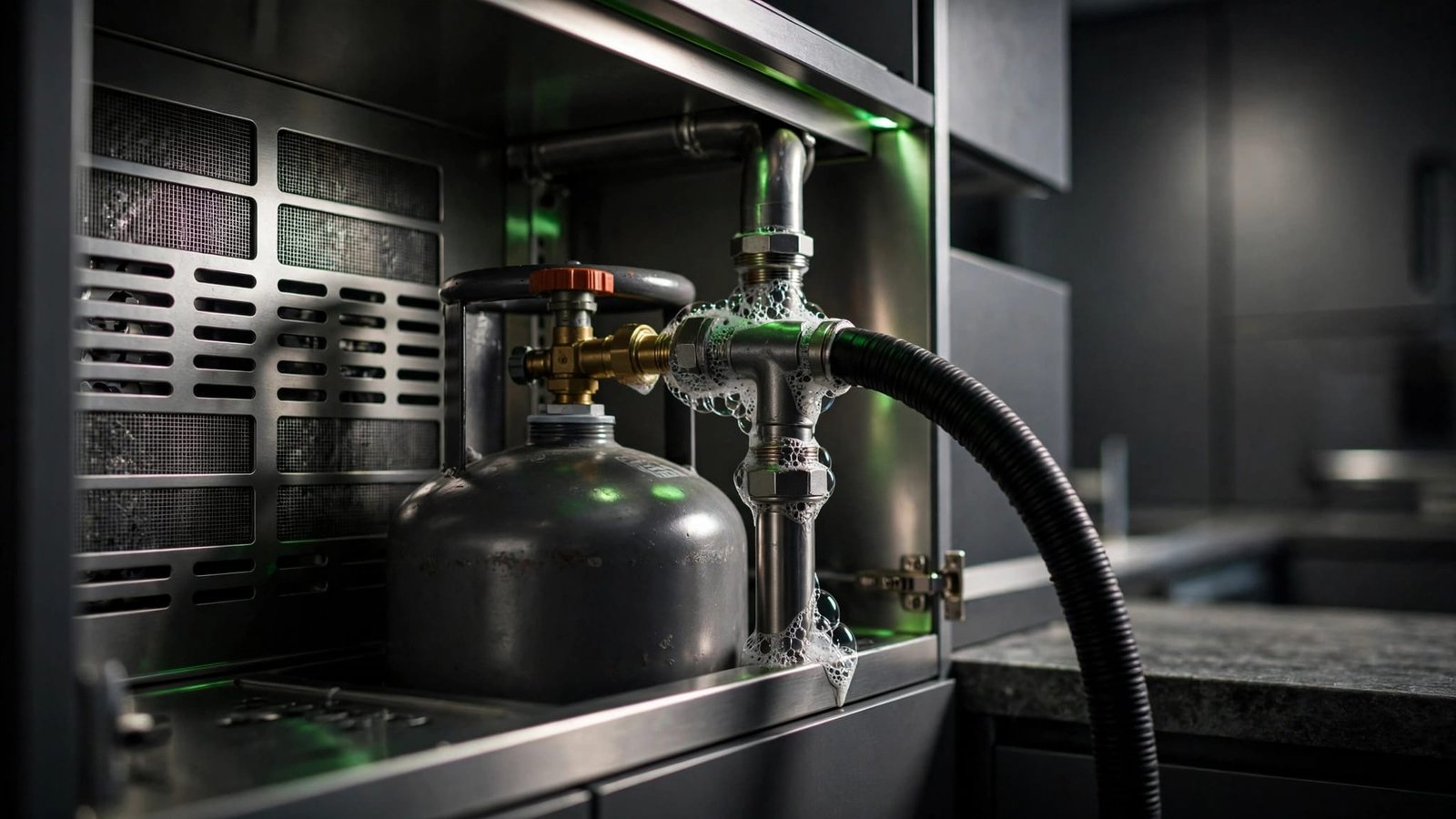
How to Check LPG Pipeline Safety Before Renting in India
 TBH Editorial
A shiny modular kitchen can hide a bad gas setup. The risk isn’t always dramatic, either. It can be a tired rubber hose behind a cabinet, a regulator that doesn’t sit right, or a piped-gas line nobody has serviced in years.
LPG pipeline safety should be part of your apartment viewing, right beside water pressure, damp walls, and electrical wiring. Give it 10 focused minutes before you pay a deposit. It may save you from inheriting a landlord’s neglected repair.
Key takeaways before you sign
- Check whether the flat uses an individual cylinder, a shared manifold, or piped LPG. Each setup has different responsibilities and warning signs.
- Inspect only what is visible and safe to inspect. Don’t dismantle pipes, regulators, or sealed cabinets to “test” the system.
- A cylinder should stand upright in a ventilated area, away from heat. Reject concealed, cramped storage that traps leaked gas near the floor.
- Use a soap-water test on accessible joints, never a matchstick, lighter, incense stick, or candle.
- Ask for records in writing. A landlord’s “it’s all fine” is not a maintenance history.
- If you smell gas, avoid flames and switches, ventilate the home, leave if the smell is strong, then call 1906 from outside.
A working kitchen is not proof of a safe kitchen. Safety is visible condition, ventilation, documented maintenance, and a clear response plan.
LPG Pipeline Safety Starts With Knowing the Setup
Don’t assume every apartment kitchen runs the same way. Identify the fuel source before inspecting anything else.
Identify what feeds the stove
An individual cylinder setup has a cylinder, pressure regulator, rubber hose, and stove inlet. You can usually see all four parts.
In larger apartments, the stove may connect to a fixed copper or steel line supplied by a central LPG bank. Some building-scale arrangements relate to industrial LPG systems, but that doesn’t mean the apartment contains industrial equipment. A central installation may include a manifold or gas vaporizer in a service area. Tenants shouldn’t open, adjust, or inspect this equipment themselves.
PNG is different from LPG. It is natural gas supplied through a provider network, not LPG stored in a household cylinder. Its regulator, meter, shutoff arrangements, and service provider may differ.
Ask the owner or broker: “Is this flat served by an individual cylinder, central LPG, or PNG gas pipeline installation?” Then ask who handles repairs, gas leakage detection, and shutoff access. Also ask whether the society controls drilling, renovation, and utility work near shared lines to reduce the risk of third-party damage.
For shared or external metal pipelines, ask whether the provider manages corrosion protection, such as cathodic protection. A documented route or right-of-way may matter for building-level infrastructure, but it isn’t something a tenant needs to verify visually during a casual viewing.
Find the shutoff point before you need it
For a cylinder, the regulator is the immediate control point. For a piped system, there may be a local isolation valve near the kitchen inlet.
You don’t need to operate it during a viewing. You do need to know where it is and whether it is accessible. A valve buried behind a fixed cabinet or blocked by appliances is a problem waiting for a stressful moment.
Check the Cylinder, Regulator, Hose, and Kitchen Airflow
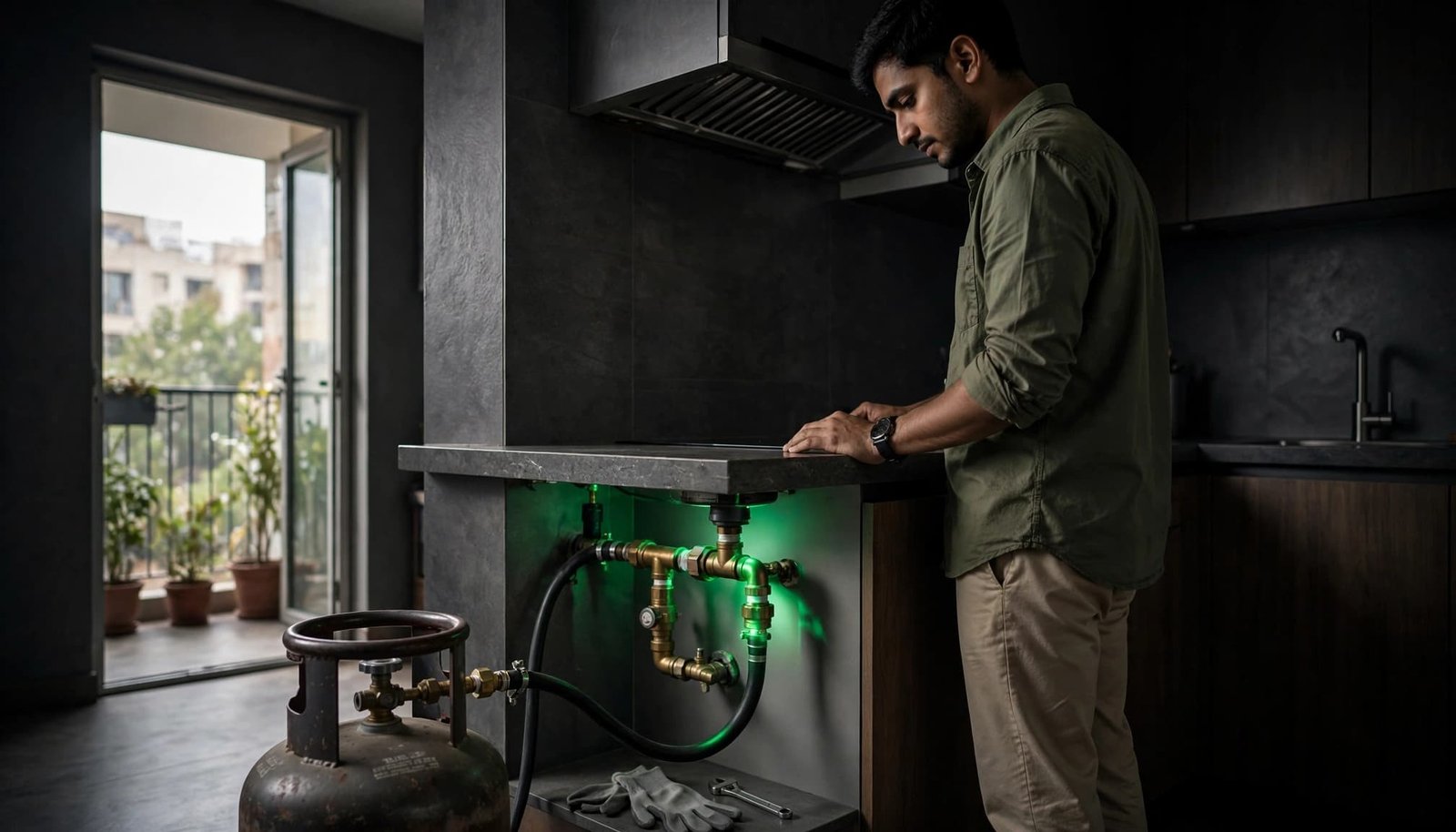
Start with the visible parts of gas cylinder safety. Look for poor condition, poor placement, and clear accountability.
Reject hidden or badly placed cylinders
The cylinder must stand upright. It shouldn’t sit inside a sealed wooden stand, a tight cabinet, or a cluttered corner beside cleaning chemicals and electrical plugs.
LPG vapour can settle low when it leaks. A closed storage space can allow gas to collect instead of disperse. IndianOil’s LPG safety guidance also calls for an upright cylinder kept away from heat in a ventilated place.
The gas regulator, attached to the cylinder, should remain visible and accessible. Check the kitchen’s ventilation requirements by opening the window and confirming that air can move through the room. A decorative exhaust fan that doesn’t work isn’t proof of adequate airflow. Confirm any installation-specific requirement with the provider or a qualified technician.
Follow the hose from end to end
Inspect the rubber hose where it joins the regulator and where it enters the stove. It shouldn’t be cracked, hardened, flattened, sticky, stretched tightly, scorched, or routed across a sharp metal edge.
Don’t accept tape wrapped around a hose as a repair. Don’t accept an excessively long loop that disappears behind cupboards where it can’t be checked.
The Bharatgas LPG manual advises checking the full hose length and both connection points. It doesn’t support treating a damaged hose as something to manage later. Ask the owner to replace it before possession.
Use the soap water test, not a flame
A gas smell, hissing noise, or damaged-looking joint deserves attention. Testing a suspected leak with fire is reckless. Never use matches, lighters, incense, or candles.
Test only accessible external joints
If the owner agrees and there’s no strong gas smell, mix ordinary soap with water. Apply the solution to the visible connection between the regulator and hose, and to the hose connection at the appliance.
Turn the gas supply on only as needed for the check. Watch for expanding bubbles. Bubbles can indicate escaping gas.
Don’t check concealed pipes, sealed fittings, wall valves, or the cylinder valve pin yourself. Pressure testing belongs to a distributor technician or another qualified professional, not a viewing checklist.
Stop at the first warning sign
If you see bubbles or a visible leak, smell the odourant strongly, or hear a hiss, stop immediately. Turn the regulator off if you can do so safely. Don’t tighten fittings with random tools or try to patch the line.
A repair promise should be written into the pre-possession list. Get a dated photo of the original defect and ask for confirmation after the repair is completed.
Ask the Landlord Questions That Need Real Answers
A rental viewing rewards confidence. Your job is to ask questions that make vague confidence useless.
Request maintenance records, not reassurance
Ask when the hose, regulator, stove, and gas pipeline installation were last inspected or serviced. For a piped system, request commissioning records, leak-test results, and the latest pipe inspection.
Ask whether the building has a service contractor, a written gas leakage detection record, and a contact person for emergencies. Also ask whether common lines, valves, manifolds, and detectors follow a preventive maintenance schedule.
Building manifolds and shared storage may involve industrial LPG systems. These are separate from your household cylinder, regulator, and stove. Ask whether any pressure sensor alarms have documented checks and maintenance records.
Request the latest society-level safety audit record, if one exists. Ask whether the external or shared line route has a documented and protected right-of-way.
Ask whether renovation, drilling, roadwork, or utility work could have caused third-party damage to common gas lines. Dated records help establish pipeline integrity, especially where lines are concealed or shared.
A landlord may not have every document. That is not automatically a deal-breaker. Refusing to provide any maintenance history or arrange a professional inspection is a concrete red flag.
The Petroleum and Explosives Safety Organisation, or PESO, is India’s statutory authority for petroleum and explosive safety. Its regulatory framework does not replace competent maintenance inside your flat. The household installation still needs proper inspection and repair.
Put responsibility into the agreement
Your agreement should state who pays for repairs to the regulator, hose, stove connection, and piped-gas fittings. It should also state who handles failures in shared pipes, basement manifolds, and society-controlled equipment.
Ask for the society’s written standard operating procedure for leaks, shutoff access, escalation, and emergency contacts. Confirm who can enter common areas when immediate isolation is needed.
Ask for a written note confirming:
- The fuel system was operational and free of known leaks at handover.
- The owner will arrange professional repair for defects that existed before possession.
- The housing society will provide emergency access for common piped-LPG infrastructure.
- You have been told the relevant emergency numbers and shutoff location.
Documentation turns “the gas was already like that” into a record someone must answer.
What to Do If You Smell Gas in the Apartment
The first minute matters. This emergency response is simple: avoid switches and flames, ventilate only if safe, leave, and call from outside.
Cut the fuel only if it is safe
Good emergency preparedness means knowing the accessible shutoff, provider number, society contact, and exit route before an incident.
If you can safely reach an LPG regulator or local shutoff, turn it off. Don’t operate a concealed valve or move through a strong concentration of gas. Extinguish any visible flame only if doing so does not put you at risk.
Do not turn lights, fans, chimneys, exhausts, doorbells, or appliances on or off. Do not plug in your phone or use it inside. Do not use a lighter to find the source.
Ventilate, leave, and call from outside
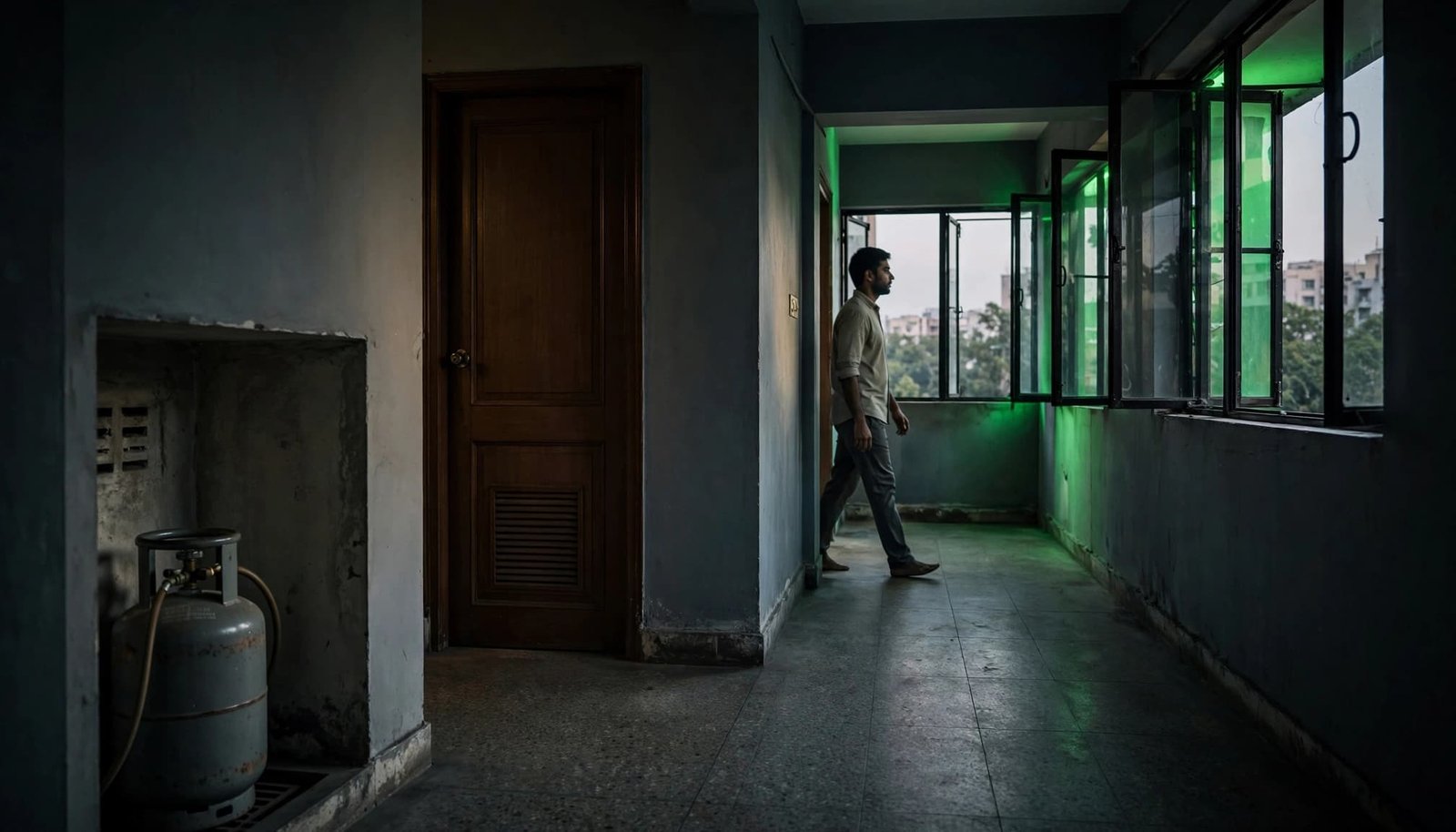
Open doors and windows manually only if you can do so safely. Leave immediately when the smell is strong or persistent, following the building’s documented fire safety requirements without delaying evacuation.
For LPG leakage, call the LPG emergency helpline 1906 from outside the home. PNG occupants should call their provider’s published emergency number or the society contact. A routine repair request isn’t enough during a gas emergency.
IndianOil lists 1906 as a round-the-clock, nationwide LPG leakage helpline on its official contact page. If there is fire, immediate danger, or anyone feels unwell, call 101 or 112 as well.
Don’t Confuse an LPG Detector With a CO Alarm
These devices monitor different hazards and failures. A home may need both.
An LPG detector looks for unburned fuel
An LPG leak detector senses combustible gas before it ignites. Larger shared installations, including industrial LPG systems, may use a pressure sensor, gas detectors, automatic shutoff valves, or a SCADA system for central monitoring.
Residents shouldn’t access, reset, or repair this equipment themselves. A leak detection system helps only when tested, maintained, and linked to a response process. A blinking device without a repair process is theatre.
A carbon monoxide alarm watches combustion
Carbon monoxide, or CO, is a poisonous gas produced when fuel burns without enough oxygen. It can come from an LPG stove, gas geyser, heater, generator, or charcoal source.
CO is odourless and colourless. A CO alarm is not an LPG detector. If you buy one, choose a domestic unit independently tested to a recognised household standard, such as UL 2034 or EN 50291-1. Follow the maker’s placement instructions and don’t install it right beside direct stove heat or steam.
Safety Is Part of Honest Sustainability
People committed to plant-based living, urban biodiversity, and lower ecological impact can still miss risks inside a rented kitchen. Climate literacy has to include the everyday systems that shape health, fuel use, and household stress.
LPG has reduced smoke exposure for many homes, but it isn’t a reason to ignore ventilation, affordability, or maintenance. A circular economy isn’t an excuse to keep using a brittle hose because it hasn’t “reached the end of life.” Replace unsafe parts through authorised channels.
Systemic change looks less glamorous than a campaign post. It means housing societies budgeting for inspections and maintenance of industrial LPG systems as shared infrastructure. Responsible societies document and protect the right-of-way for shared gas infrastructure during construction and utility work, holding contractors accountable for community impact. Landlords should fix defects before tenants move in, while sustainable businesses treat safety repairs as a basic operating cost. That’s everyday mindfulness with consequences.
If you care about accountable action beyond your own flat, Explore Our Active Missions supporting measurable community and climate work.
Frequently Asked Questions
How often should an LPG rubber hose be replaced?
There is no safe universal replacement schedule for every hose and apartment. Check it regularly and replace it immediately if it leaks, cracks, hardens, burns, or shows other damage. Ask the owner for the installation or replacement date.
Can I inspect a piped-LPG line myself?
You can inspect visible kitchen fittings, ventilation, valve access, and obvious corrosion or damage. Do not open ducts, loosen joints, remove covers, or attempt pressure testing. Request a qualified inspection if the line is hidden, old, damaged, or poorly documented.
Is it dangerous to keep an LPG cylinder inside a cabinet?
A sealed or poorly ventilated cabinet can trap leaking gas. Choose an upright cylinder in a ventilated location, away from heat and ignition sources. Storage should allow you to see the regulator and hose connections easily.
What if the landlord says the society handles everything?
Ask for the society office contact, emergency procedure, service-provider details, and the last available maintenance record. “The society handles it” is not a safety plan until you know who responds and how.
A Safer Lease Starts Before Move-In
Don’t let a polished kitchen make the decision for you. Check the visible LPG setup, ask for records, and put repair duties in writing before your deposit changes hands.
The strongest form of LPG pipeline safety is not fear. It is proof, ventilation, and a clear plan when something smells wrong.