

Rain Gardens India Needs for Safer Monsoons
 TBH Editorial
Floodwater doesn’t begin at the drain. Hard roofs, tiled driveways, and sealed lanes send rainwater runoff toward it.
By the time water reaches a blocked corner drain, the street has already lost its chance to slow it down. Well-designed rain gardens are not decorative patches beside an apartment gate. They are small pieces of water infrastructure that make neighbourhoods less dependent on overworked drains.
A planted depression cannot solve a city’s flooding crisis alone. But it can stop one roof, one courtyard, or one housing society from adding to it.
Key Takeaways
- Rain gardens are small pieces of water infrastructure that capture runoff, reduce peak flows, filter pollutants, and help prevent overworked drains from flooding.
- Start with the water, not the plant list: map runoff during a real shower, test soil infiltration, and keep the basin at least 10 feet from building foundations.
- Size the basin from the hard surface that drains into it, then design the soil profile, inlet, and safe overflow for local rainfall and ground conditions.
- Choose locally suitable plants for the wet centre, middle slope, and drier rim rather than treating all rain garden plants as interchangeable decorations.
- Assign maintenance responsibility before construction. Clear inlets, replace mulch, inspect plants, and check the overflow after major storms.
Why rain gardens India needs are more than landscaping
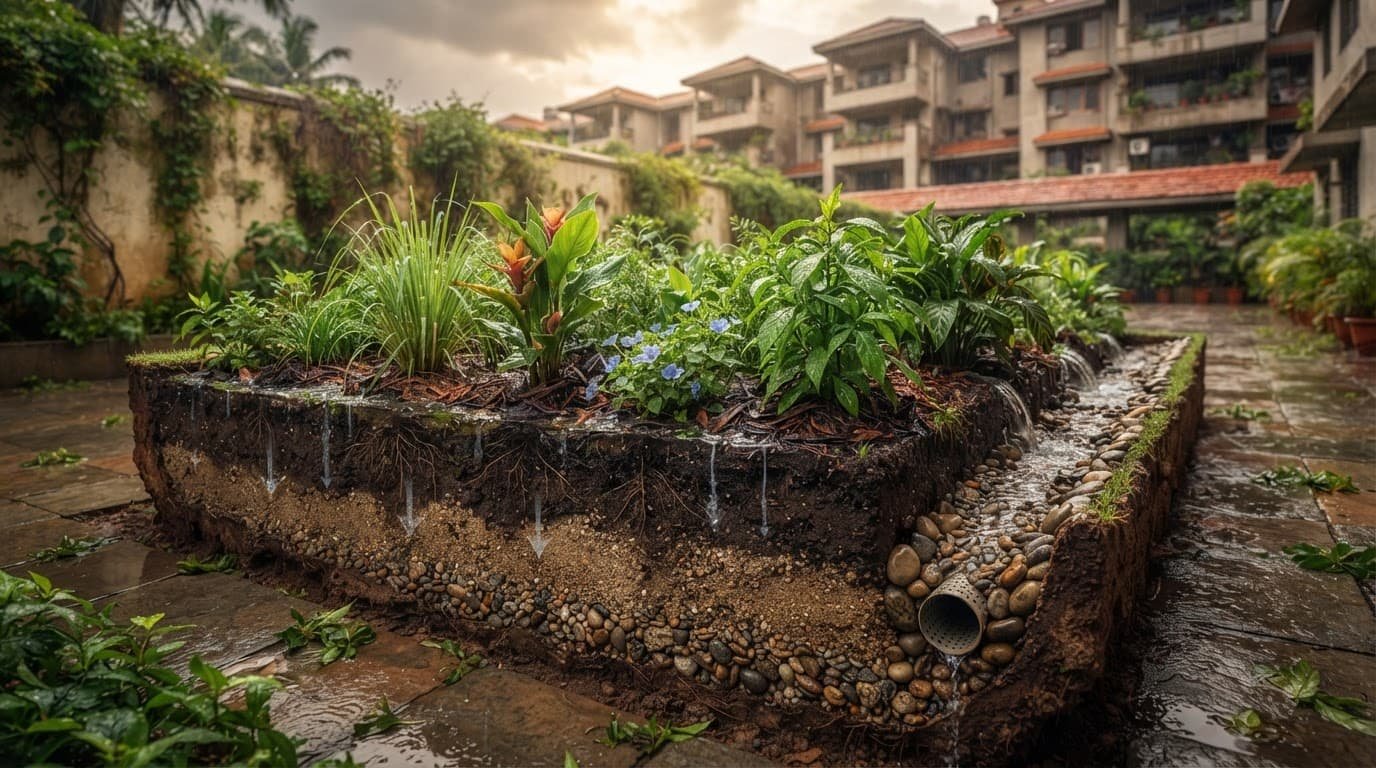
A rain garden is a shallow, planted bowl that receives rainwater runoff from roofs, patios, parking areas, or footpaths. It holds water briefly, lets it soak into the soil, and sends excess toward a safe outlet.
That sounds modest. It is. Yet urban flooding is often made of modest failures repeated across thousands of plots.
It holds water briefly, not permanently
A rain garden is not a pond, a mosquito breeding pit, or an open drain with flowers around it. Water should enter during rain, spread across the basin, filter through plant roots and soil, then disappear within about 24 hours.
The US EPA’s rain garden guidance describes the same basic function: capturing stormwater runoff where it lands instead of pushing polluted water downstream.
Mulch, roots, and porous soil provide pollutant filtration before runoff reaches a drain. That matters after dry spells, when the first monsoon downpour can carry tyre particles, soot, construction grit, loose soil, and litter into roadside water.
A rain garden improves water quality, but it is not permission to keep polluting the street. Dirty runoff needs less pollution at the source, not prettier places to collect it.
It cuts the peak before the drain is overwhelmed
A conventional drain has one job: move water away fast. This approach changes the timing. It pauses part of the flow, spreads it through soil, and reduces the sudden surge that floods a low corner.
India’s National Disaster Management Authority includes rain gardens among measures that absorb local runoff. A 2026 Ministry of Housing and Urban Affairs document also identifies them as green depressions suited to housing courtyards, traffic islands, roads, and paved public spaces.
Research on urban flood resilience has documented Hyderabad rain gardens built at depths of 400 to 500 millimetres that performed through monsoon conditions. The lesson is not that every home needs a half-metre excavation. It is that Indian cities can build for intense rain when they stop treating soil as wasted space.
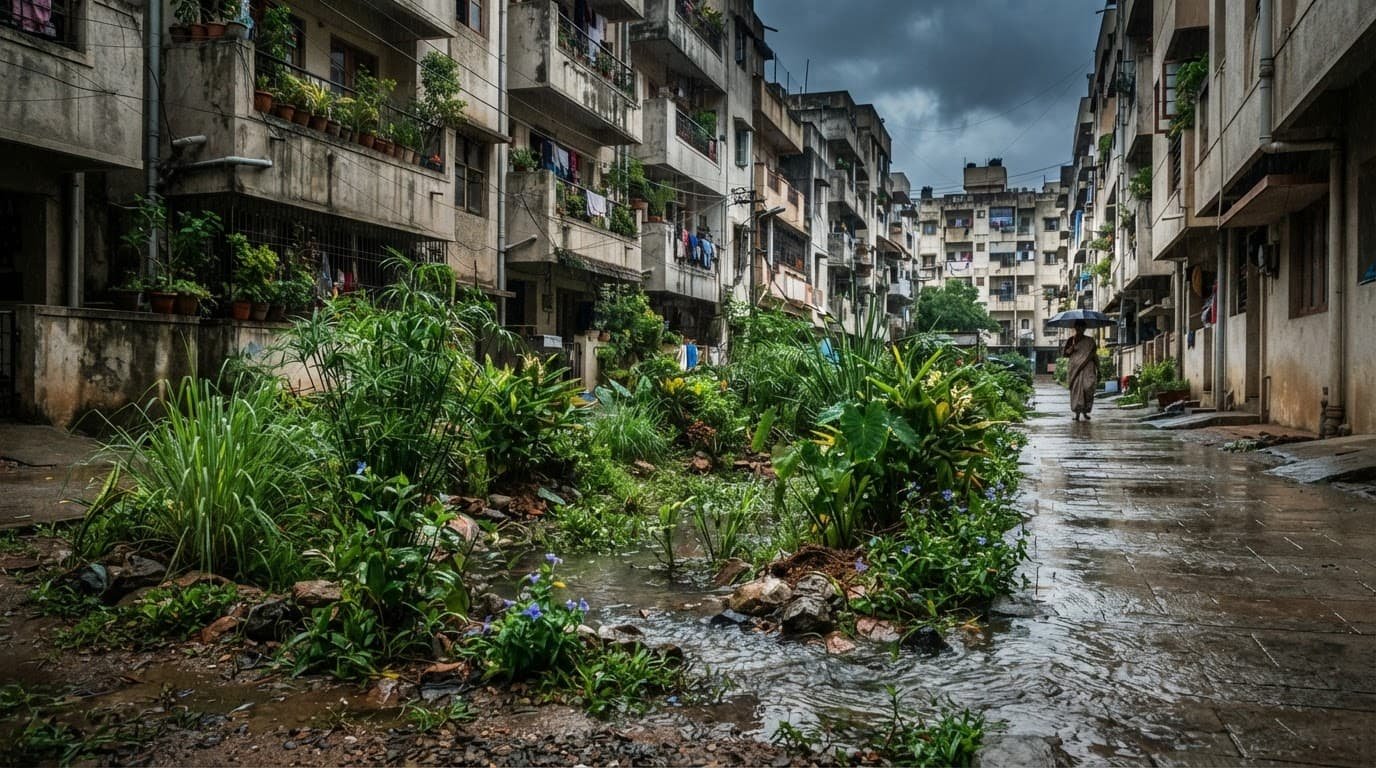
Begin with the water, not the plant list
Don’t choose rain garden plants before observing the site. Start outside during rainfall instead.
Map the site’s drainage patterns during a real shower
Watch where water leaves the roof, crosses paving, pools beside a wall, or carries street dirt into a drain. That ten-minute walk gives you more useful information than a mood board.
Trace rainwater runoff from its source to its current exit point. A downpipe, sloping driveway, air-conditioner drain, or paved courtyard may feed the same flooded patch.
Don’t build a basin where water already sits for days. That is a warning that the soil may be too compacted or contain heavy clay soils. Keep the garden at least 10 feet, or roughly 3 metres, from building foundations.
It also helps to place the basin close enough to intercept roof flow before it crosses the property. A gentle swale, shallow channel, or downspout extension can guide clean roof water into it.
Hard surfaces are part of the problem. Paver blocks can worsen urban flooding when they seal soil or send runoff straight into the street instead of into living ground.
Test infiltration honestly before digging
Start with an infiltration test: dig a hole about 30 centimetres deep. Fill it with water, let it drain once, then refill it and time the second drainage cycle, the decisive infiltration test. If water remains after 24 hours, don’t pretend a few flowering plants will fix the site.
Try a simple ribbon soil test too. Moisten a handful of soil and press it between your fingers. In that ribbon soil test, a long, smooth ribbon that doesn’t break points to heavy clay soils.
Clay is not a moral failure. Let the soil test guide the design. You may need a different location, carefully selected soil amendments, a shallower basin with an overflow, or professional help.
If the test hole stays full for a day, the garden needs redesign before it needs plants.
Build for heavy rain and a safe overflow
There is no one-size blueprint for a country with Ladakh’s dry cold, Delhi’s sealed streets, Mumbai’s downpours, and Chennai’s coastal storms. Rain gardens India builds well will match local rain, soil, plot size, and municipal drainage rules.
Size the basin from the draining surface
A useful first estimate is to make the basin about 5 to 10 percent of the hard surface producing the rainwater runoff. A 100-square-metre roof, for example, points to a starting basin of roughly 5 to 10 square metres.
That is a starting calculation, not a permit drawing. A soil test and infiltration test can reveal whether the ground will accept the volume. Steep roofs, compacted soil, intense rainfall, shallow groundwater, and seasonal groundwater levels may change the required depth and overflow design.
Many home gardens have a basin centre 10 to 20 centimetres below the edge. Larger community sites may need more depth, yet depth alone isn’t the answer. A deep hole in bad soil becomes a water problem with expensive plants around it.
Build the soil profile, then protect it
Mark the outline. Direct runoff toward the basin. Excavate gently, and keep the base level rather than packing it hard with machinery or repeated foot traffic.
The soil mix may need carefully selected soil amendments and organic matter to improve water infiltration. The Groundwater Foundation’s rain garden guide notes that many designs improve the top layer with tillage, compost, and sand. Follow the test results, not a universal recipe.
Cover exposed soil with mulch. It reduces soil erosion, splash, and sediment movement while helping the ground stay biologically active. Don’t fill the basin with construction rubble. Broken concrete can compact the base, change soil chemistry, and turn a water project into waste disposal.
Price the drainage work, not the flowers
There is no honest national price card for Indian rain gardens. Soil removal, access for labour, piping, edging, plant choice, and the need for an overflow route can change the cost sharply.
A DIY project covers excavation, compost, mulch, stone, and simple downpipe work. Prioritise excavation, soil quality, and overflow work over expensive rain garden plants. A professional quote should add a site assessment, grading, inlet design, overflow planning, and a maintenance period.
Ask for itemised quotes. The cheapest proposal may skip the parts that stop water from reaching your foundation or neighbour’s doorway. If you are pairing a garden with recharge infrastructure, learn why many rainwater harvesting pits fail before digging either one.
Plant the wet centre and dry rim differently
Rain garden plants are not interchangeable decorations. The centre may flood for hours, while the rim stays comparatively dry. Treating the wet centre, middle slope, and dry rim alike is how gardens die after a serious monsoon.
Choose local species for each moisture zone
Ask a local nursery, ecologist, or horticulture department to identify Indian native plants suited to your city. India’s climate varies too much for a universal list, so verify each plant’s moisture tolerance locally.
| Garden zone | Suitable plant direction | What it needs to tolerate |
|---|---|---|
| Basin centre | Vetiver, local sedges, Canna indica | Short periods of standing water |
| Middle slope | Lemongrass, smaller flowering natives | Wet roots, then dry intervals |
| Outer rim | Karanj, jamun, curry leaf, or shrubs suited to the region | Drier soil and deeper roots |
The table is only a regional starting point for rain garden plants. Check each species’ moisture tolerance, mature size, root spread, and nursery availability before planting.
Vetiver is often useful because its dense root system can hold soil in place. Jamun, neem, karanj, and drumstick trees can suit outer areas, but only where their eventual canopy and root spread have room.
Research on native plants in rain gardens links plant choice with runoff reduction, groundwater recharge, and habitat. A layered design with native vegetation is usually stronger than a lawn alone.
Let the garden support more than drainage
Buy rain garden plants as nursery-grown stock from responsible local growers. Avoid collecting plants from wild patches. Skip species that need constant watering, invasive ornamentals, and heavily sprayed plants.
A functioning basin with connected native vegetation can support insects, birds, soil organisms, and small amphibians. That local urban biodiversity is not a bonus feature. Shade and evapotranspiration may modestly reduce the urban heat island effect. Roots, microbes, pollinators, and decomposing leaf litter are part of the work.
The ecological impact is strongest when the garden stays connected to its surroundings. A lone planter boxed in by concrete can look green while doing little for water or wildlife.
Maintenance and accountability decide whether it works
The hard truth is boring: a rain garden can fail for the same reason a drain fails. Nobody owns the maintenance.
A clogged inlet, compacted soil, plastic waste, dead plants, or an eroded overflow can turn a good design into a muddy patch that residents begin to resent.
Give one person or group the job
Housing societies should assign garden maintenance duties before excavation starts. Review the basin after major storms and inspect it monthly during the wet season.
- Remove litter and silt from the inlet before water backs up onto paving.
- Replace washed-away mulch and bare soil to address soil erosion before channels deepen.
- Check rain garden plants after major storms. Pull invasive weeds and replace bare patches before monsoon rain hits.
- Check that the overflow still sends excess water somewhere safe.
The Massachusetts rain garden fact sheet is right to frame these gardens as stormwater treatment, not garden ornaments. Treatment systems need upkeep.
Stop treating a garden as a private fix
A planted basin beside one tower cannot solve every rainwater runoff problem. Street-wide stormwater runoff still crosses concrete, poorly maintained drains, uncovered construction debris, and failing public infrastructure.
Systemic change means making absorption part of building approvals, road design, maintenance contracts, inspections, and public reporting. Those standards should also protect native vegetation.
Sustainable business models in construction and real estate should pay for permeable surfaces, clean material storage, soil repair, and multi-year maintenance. A circular economy also has a role, but only when clean organic waste becomes compost and dangerous building debris stays out of soil.
Sustainable living can influence household choices, but it can’t make sealed roads porous. That’s a public design decision.
Real climate literacy begins when residents can read a street: where the runoff comes from, what it carries, and who must repair it. For work tied to local ecosystems and public accountability, Explore Our Active Missions connects concern with action on the ground.
Frequently Asked Questions
What is a rain garden?
A rain garden is a shallow, planted depression that receives rainwater runoff from roofs, paving, footpaths, or parking areas. It holds the water briefly, filters it through soil and roots, and directs excess water toward a safe outlet.
Can a rain garden prevent flooding on its own?
No. A rain garden can reduce runoff from one roof, courtyard, or housing society, but it cannot solve street-wide flooding caused by sealed surfaces, blocked drains, and failing public infrastructure. It works best as one part of broader stormwater planning.
How do I know whether my site is suitable?
Observe where water flows during a real shower, then conduct an infiltration test by filling a roughly 30-centimetre-deep hole twice and timing the second drainage cycle. If water remains after 24 hours, the site needs redesign, soil improvement, a different location, or professional help.
How large should a rain garden be?
A useful first estimate is 5 to 10 percent of the hard surface draining into the basin. Soil type, rainfall intensity, roof slope, groundwater levels, and the planned overflow can change the final size and depth.
How much maintenance does a rain garden need?
Inspect the basin after major storms and monthly during the wet season. Remove litter and silt, replace washed-away mulch, control invasive weeds, fill bare patches, and confirm that excess water still reaches a safe outlet.
Make the street absorb again
Rain gardens won’t stop every flood. They can stop a neighbourhood from treating every monsoon drop as waste to push onto someone else.
The strongest version is simple: test the soil, map the runoff, build a safe overflow, plant for local conditions, and maintain the basin after rain. Living soil is infrastructure.
When the next downpour arrives, don’t only watch the flooded road. Follow the water back to the roofs, the paving, and the missed chance to let it soak in.