

How to Check a Rental Home’s Flood History in India
 TBH Editorial
A clean bathroom and fresh paint can hide the costliest problem in a rental home. One hard monsoon can reveal whether water belongs outside, or whether it will come up through your drains, walls, and parking area.
Checking a rental home flood history before you pay a deposit is not paranoia. It is basic due diligence. You’re renting the flat, but you’re also assessing the rental property around it. Its road, drainage line, common areas, slope, and management decisions all shape its flood risk.
Prospective tenants should start before paying a deposit, before falling for the balcony view.
Flood risk and recorded flood history are not the same
A flood risk map shows whether an area faces heavy rain, overflowing water bodies, poor drainage, or floodplains. A flood-history check asks a harder question: Has this flat, building, or street actually flooded before?
You need both answers.
| What you are checking | What it can reveal | What it cannot prove |
|---|---|---|
| Hazard maps and satellite data | Wider flood exposure for residential properties | That a particular flat has never flooded |
| Repair records and society complaints | Past leaks, sewage overflow, pumping, and repairs | Whether every incident was recorded |
| A property visit | Visible water damage and bad drainage | Hidden damage behind paint or furniture |
| Neighbour conversations | Repeat problems during monsoons | A complete legal record |
The strongest decision comes from patterns, not one reassuring answer. The building’s flood history may differ from the wider area’s mapped conditions.
What official maps can tell you
The National Disaster Management Authority publishes Flood Hazard Atlases, including national and state-level resources. They offer a useful first screen for anyone comparing homes across a city.
NRSC and ISRO’s flood atlas uses historical satellite data from 1998 to 2022. Its technical document estimates flood-affected areas of about 15.75 million hectares across 435 districts. That is a serious reminder that flooding is not a rare inconvenience reserved for one unlucky neighbourhood.
Use NRSC’s flood atlas documentation to understand the data. Then use NDEM’s flood-hazard layer to screen the broader location and its flood risk.
Online maps provide area-level screening, not flat-level proof. Satellite and hazard layers can miss local drainage failures, recent construction, basement flooding, or a newly altered water path. A flood zone boundary should therefore guide questions, not end your checks.
You may also encounter terms such as fema flood map or special flood hazard area. These are US terminology and aren’t India’s official property-level classification system, so they shouldn’t determine a rental decision here.
Why the building still needs its own evidence
Maps don’t know whether a basement flooded because a pump failed. They don’t show a recurring toilet backflow on the ground floor. They can’t tell you whether a society repainted the lobby after sewage water entered it.
A building can sit outside a mapped high-risk area and still have terrible drainage. Another can be near a river but have sound elevation, maintained pumps, clear drains, and a responsible housing society.
A low-risk map isn’t a clean bill of health. It’s only the first question.
How to check rental home flood history before signing
Do this work before handing over your token amount. Prospective tenants should verify the rental home flood history first. A broker’s verbal reassurance is not a record.
Search the location, then widen the search
Enter the building name, road, ward, locality, and nearby landmark with terms such as “flood”, “waterlogging”, “sewage overflow”, “monsoon”, and “drainage”. Search in English and the local language where possible.
To assess flood risk, widen the search from the building to the road, ward, catchment, and nearby water body. Check news coverage from recent monsoons. The IMD Hazard Atlas of India can help identify wider flood hazards and reported events. It isn’t a complete record of local waterlogging, so don’t treat it as proof about one apartment.
Online maps may label an area as a flood zone, but that is only a screening tool. Local conditions can change around filled land, drains, and construction. Verify the result with municipal records and people who know the area.
Look at satellite images too. Is the property beside a lake edge, a covered drain, a nullah, a railway underpass, or land that appears newly filled? Water remembers where it once moved, even when a listing does not.
Build a dated flood history from news reports, society notices, resident messages, and official replies. Record the date, location, water depth if known, and how long the disruption lasted.
Ask for records that leave a trail
Request available documents from the landlord, property management, or housing society:
- Past maintenance complaints about seepage, overflow, terrace leakage, pumps, blocked drains, or other plumbing problems.
- Bills for waterproofing, plumbing replacement, desilting, repainting, or mould remediation.
- Pump-service and generator-maintenance records for basement or parking drainage.
- Details of any insurance claim related to water damage.
- Society notices issued during the last two monsoons.
Ask the landlord or society whether current tenants can share their experience. They may know about recurring dampness, sewage overflow, or repairs that aren’t visible during a dry inspection.
Then call or visit the relevant municipal corporation, development authority, panchayat, town-planning office, or disaster-management office. Ask what records are searchable for drainage complaints, building approvals, occupancy, repair permissions, or repeated waterlogging on that road.
Record the officer or department you contacted, the date, and the answer you received. Save any written replies, emails, application numbers, and copies of documents.
Not every city makes these records easy to search. Ask what can be checked and how to request it. A written request is harder to brush aside than a casual phone call.
Ask direct questions in writing
Send these questions by email or message after the viewing:
- Has the flat, parking area, lift lobby, or building entrance flooded, had sewage overflow, or faced serious seepage in the last two monsoons?
- Which areas were affected, and what repairs were completed?
- Was the moisture source repaired, or was the area only cleaned and repainted?
- Is there a sump pump, backwater valve, non-return valve, or flood barrier? Who services it and when was it last checked?
- Has any tenant complained about dampness, mould, slow drainage, bad odour, or water entering through windows?
A vague “There has never been an issue” is not an answer. Ask for dates, locations, repair invoices, and records.
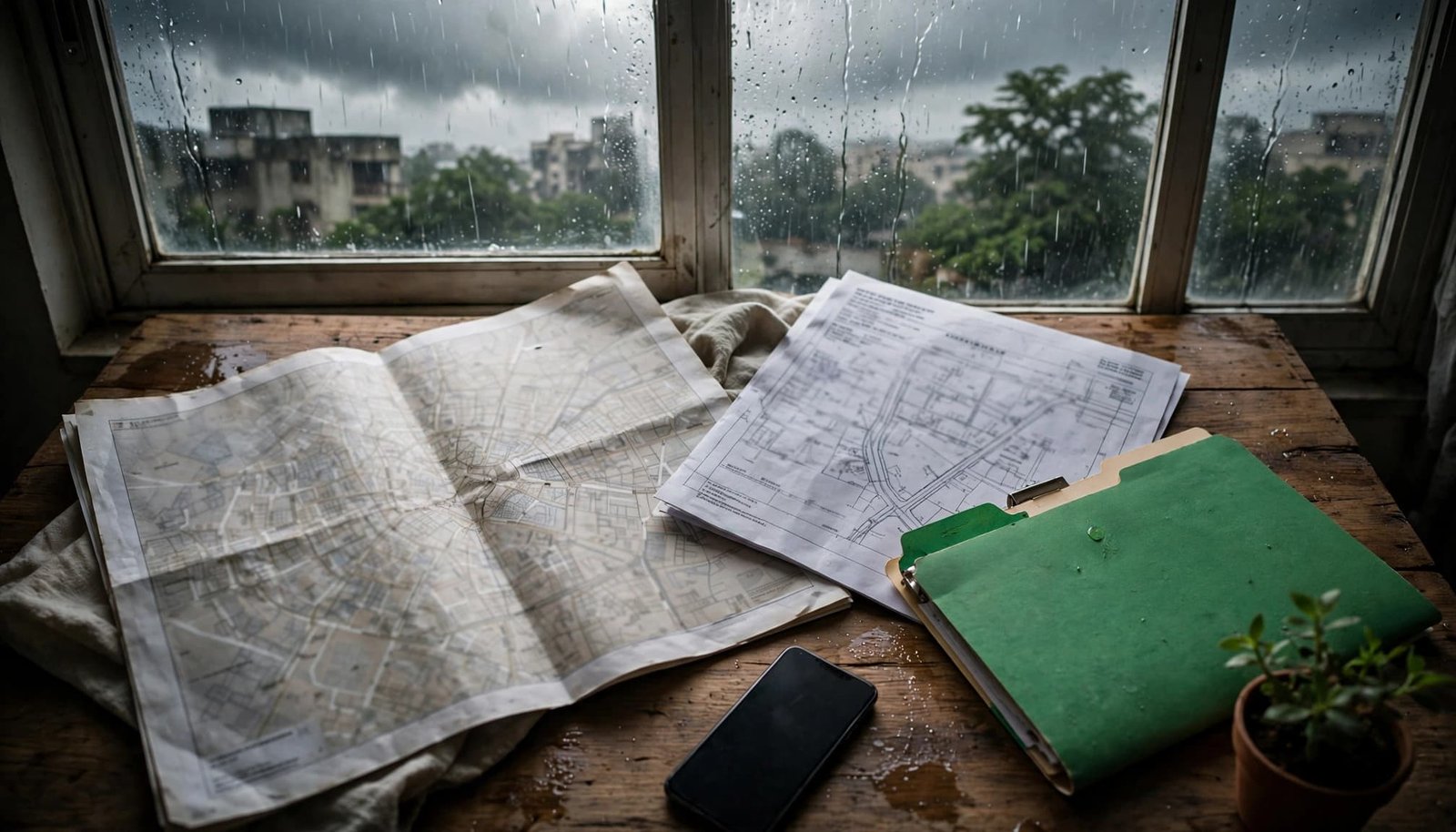
Inspect the flat like water has already entered once
Give yourself more than 10 minutes. Visit in daylight if you can. A visit during or soon after heavy rain is even better, provided it is safe.
Take a phone torch. Open cupboards. Look under sinks. Slow down when the broker speeds up.
Read the walls, flooring, and cupboards
Watch for fresh paint along lower walls, blistering paint, white salt deposits, warped skirting boards, loose tiles, swollen wood, rust marks, and a damp or musty smell. Fresh paint can conceal water intrusion behind walls, cupboards, or flooring.
Check behind wardrobes, under kitchen sinks, around window frames, near bathroom ceilings, and inside service areas. Look for signs of water intrusion. A dark patch does not prove mould, but it does prove you need a straight answer about moisture.
Ask whether any repainting happened recently and why. Fresh paint after a leak is not a repair record. Proper mold prevention means ventilation, thorough drying, and fixing the source instead of covering dampness.
If visible signs conflict with the landlord’s explanation, consider an independent home inspector before signing. A short inspection may cost less than replacing damaged belongings.
Check the places water reaches first
Inspect the parking level or basement, if the building has one, along with the ground-floor lobby, lift pit area, stairwell, utility spaces, electrical panels, and garbage room. This can reveal basement flooding even when the flat looks staged.
Look for water lines on walls, damaged plaster, corroded metal, warped wood, failed electrical protection, stored pumps, and other signs of flood damage. Strong disinfectant smells may mean someone is covering an odour problem.
Check whether a sump pump exists where it is needed, works properly, and has a recent maintenance log. Run taps with permission, then watch whether bathroom and balcony drains clear quickly. A floor that slopes away from its drain can turn a small overflow into a room-wide mess.
Step outside and follow the runoff
Stand across the road and look back at the building. Is the entrance lower than the street? Does the driveway slope inward? Are drain covers clogged with plastic, leaves, or silt?
Ask local residents, shopkeepers, and current tenants whether the lane repeatedly waterlogs. They may reveal patterns that a clean, staged flat conceals.
Nearby wetlands, ponds, and floodplains are not empty land waiting for concrete. They store water, recharge groundwater, and support life. Read about why seasonal wetlands matter in cities before dismissing a “dry” lakebed near a rental.
Everyday mindfulness is useful here. Notice the smell, slope, stains, and water path. But a home inspector can assess physical conditions, not establish a complete municipal flood history.

Put flood disclosures and repair promises into the lease
India has no single nationwide set of flood disclosure laws requiring every landlord to disclose known flooding, dampness, leaks, or mould before renting out a home. State tenancy rules, your lease agreement, and the facts of the case matter.
That gap is why your paperwork has to do more work.
Create a dated property disclosure record
Add an annexure or signed statement listing known seepage, flooding, water intrusion, roof leaks, plumbing leaks, sewage overflow, past remediation, and common-area moisture issues.
It should name the affected area, date of the problem, repair completed, and whether the underlying source was fixed. Note whether any flood damage was repaired properly or only covered with cosmetic repainting. Attach dated photos where both parties agree.
Also record the flat’s condition at handover. Photograph walls, ceilings, cabinets, flooring, bathroom fittings, meter boxes, and visible drains. A home inspector can document visible conditions, but their report doesn’t replace written landlord or society disclosures. Keep the files somewhere other than your phone.
Make responsibility clear before possession
Put these responsibilities in the lease agreement before possession. State who handles plumbing failures, terrace leakage, common drains, pumps, and society-maintained systems through property management.
Where the Model Tenancy Act, 2021 framework applies, it includes a repair-and-deduct route after notice, with the deduction for a month capped at 50% of rent. That framework doesn’t automatically govern every private rental or all residential properties. Don’t assume it applies to your tenancy. Do not withhold rent or deduct repair bills without checking your state law, agreement, and legal advice.
An “as-is” clause should not become a permission slip for concealing material water damage.
Check insurance before your belongings enter
Don’t assume standard renters insurance or a contents policy covers every water event. The exact wording matters, so read any flood insurance policy and its exclusions before moving belongings in.
Ask the insurer or agent, in writing, whether the policy covers:
- Water intrusion from rain through windows or walls, which may be treated differently from drain backup, seepage, or surface flooding.
- Storm surge, mainly relevant to coastal exposure and not the same as inland rainwater ingress.
- Sewer or drain backup.
- Flood damage to furniture, electronics, books, clothing, and appliances.
- Temporary accommodation if the flat becomes unlivable.
Policy definitions may treat floods, storms, and other natural disasters differently. The US National Flood Insurance Program is not an India-wide insurance scheme, so don’t present it as a resource for Indian renters.
Also ask about exclusions, deductibles or excess amounts, waiting periods, proof requirements, and whether damaged belongings need invoices. Take photos of major items before moving in. Obtain written confirmation from the insurer or agent, rather than relying on verbal assurances.
Flood safety is also a community accountability issue
Flooding isn’t only a private tenant problem. Overflowing drains can carry sewage through lobbies, homes, streets, and the hands of sanitation workers asked to clean it.
Building safety isn’t limited to the flat itself. Residential properties depend on shared roads, drains, basements, and common areas. Natural disasters can create genuine hazard exposure, but blocked drains, filled wetlands, and neglected pumps can make flooding worse.
The ecological impact is wider too. Hard paving sends rainwater racing into overloaded drains. Filled wetlands remove places where water could pause. Lost soil harms urban biodiversity while making streets flood faster.
Read how paver blocks worsen urban flooding and you start seeing the street differently. A footpath, a blocked drain, and a raised driveway are all water decisions.
Climate literacy means understanding how climate change can interact with rainfall, land use, drainage maintenance, elevation, and public decisions to shape flood risk.
Systemic change is often unglamorous: inspection logs, repair budgets, open complaint records, and working pumps. During severe weather, check local warnings, drainage response, and building procedures. Ask whether the society has an emergency response plan for power isolation, lift shutdown, evacuation, pump failure, and resident communication.
Landlords shouldn’t pass known damage to the next tenant, and renters shouldn’t be blamed for systemic drainage failures.
Key takeaways before you sign
- Check maps, local news, satellite images, and building records to verify flood risk.
- Treat a property’s flood history as separate from neighbourhood exposure.
- Inspect lower walls, bathrooms, parking, lifts, drains, and nearby streets for seepage, sewage overflow, flood damage, or cosmetic repairs.
- Ask about flooding and sewage overflow in writing, then save every reply.
- Put known defects, repair duties, common-area drainage, and deadlines in the lease agreement.
- Never rely on fresh paint, a clean lobby, or a broker’s verbal promise.
Frequently asked questions
Does India require landlords to disclose past flooding?
There is no clearly established nationwide Indian requirement that landlords disclose a rental home’s flood history before every residential lease. State laws, rental agreements, local rules, and evidence of concealment can affect a dispute. Get local legal advice if the landlord withheld material information.
Can I break my lease if the rental floods?
Don’t assume you can. Your rights may depend on whether the home is habitable, what caused the flooding, your lease agreement, the landlord’s response, and applicable state law. Photograph any flood damage, notify the landlord and society in writing, and seek advice before stopping rent payments or leaving.
Does renters insurance cover natural flooding?
Some renters insurance policies may cover certain water events, while excluding others. Check the flood insurance policy wording carefully, because floodwater, drain backup, rainwater ingress, storm damage, and damage to contents can be treated differently. Read the policy before you buy, not while your belongings are drying on the floor.
A safer rental starts before the deposit
The best time to find a weak drain is before your mattress, books, and savings are inside the flat. A rental property is only as safe as its flat, building, street, and drainage network.
Check the maps, ask the awkward questions, inspect the building, and keep the property’s answers, records, and inspection evidence about its flood history with the keys. A rental home isn’t safe because it looks clean on move-in day. It is safe when its flood risk is documented, and the truth about its water history comes with the keys.