
Water TDS in India: What That Number Really Means
 TBH Editorial
That “28 ppm” on a purifier display can look reassuring. It doesn’t prove a safe TDS level. water TDS in India is a useful clue, but one number cannot identify the salt, metal, germ, or chemical in your glass.
Homes across India make hard choices between municipal lines, borewells, tankers, and RO machines. We deserve better than a sales pitch built around “zero TDS.” The real question isn’t, “What’s the perfect number?” It’s, “What’s in this water?”
Measure the number properly, test the source behind it, then choose treatment based on the risk.
Key Takeaways
- TDS measures the total dissolved load in water, not its safety. It cannot identify specific contaminants such as bacteria, arsenic, lead, fluoride, or pesticides.
- BIS lists 500 mg/L as the acceptable TDS value and 2,000 mg/L as permissible only when no alternative source exists. These are boundaries for water quality, not targets to achieve or mineral levels to chase.
- A digital TDS meter is useful for tracking changes in raw and purified water, but laboratory testing is needed to check microbes, hardness, fluoride, nitrate, arsenic, and other local risks.
- Treatment should match the source and the contaminant. Do not choose an RO purifier or adjust a TDS controller blindly, especially when blending untreated water could reintroduce contamination.
- Safe drinking water depends on source protection, specific testing, suitable treatment, and regular maintenance—not on reaching zero or a fashionable TDS number.
What water TDS in India can, and cannot, tell you
TDS measures dissolved load, not safety
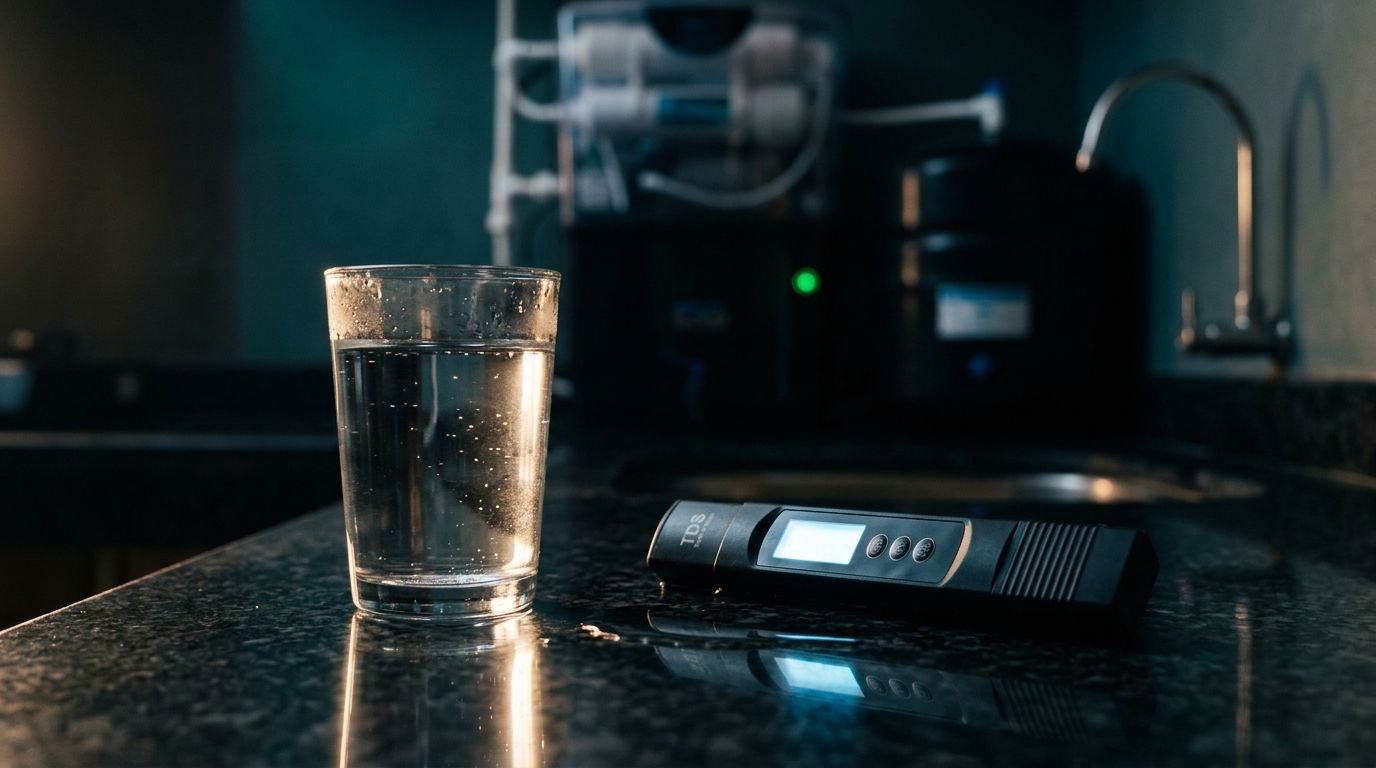
Total dissolved solids, or TDS, are the salts, minerals, and small traces of organic matter dissolved in water. A digital meter estimates this load through electrical conductivity and reports it as parts per million, or ppm. A drinking water TDS reading is a screening measure for dissolved load, not a safety certificate.
That reading may include calcium and magnesium. It may also include sodium, chloride, sulphate, nitrate, or substances you do not want. The meter cannot separate one from another.
A TDS reading tells you how much is dissolved, not what it is or whether it will make you sick.
It cannot identify E. coli, arsenic, pesticide residues, lead, or fluoride. The World Health Organization’s TDS guidance does not set a health-based guideline value for TDS. It treats the figure mainly as an issue of taste and acceptability.
BIS limits are boundaries, not a recipe
India’s Bureau of Indian Standards (BIS) sets 500 mg/L, or 500 milligrams per litre, as the acceptable value. 2,000 mg/L is the permissible limit only when no alternative source is available. These figures are water quality standards, but they set boundaries, not treatment targets.
You can see those wider drinking-water parameters in this IS 10500 reference table.
WHO’s taste-based ranges offer useful context:
| TDS level in mg/L | Typical WHO palatability rating |
|---|---|
| Below 300 | Excellent |
| 300 to 600 | Good |
| 600 to 900 | Fair |
| 900 to 1,200 | Poor |
| Above 1,200 | Unacceptable to many consumers |
The table describes taste and acceptability, not an optimum TDS range for health. These are not instructions to add minerals until a meter reaches a fashionable target. Water at 250 ppm is not automatically healthier than water at 40 ppm. The source and the contaminants matter more.
Test drinking water at home without fooling yourself
Use a digital TDS meter for trends
A handheld meter is a sensible first screen. Treat it like a bathroom scale. It can show a change worth investigating, but it can’t diagnose the whole problem.
To get a reading you can compare later:
- Run the cold tap for one or two minutes before taking a sample.
- Use a clean glass, not a cup carrying tea, soap, or food residue.
- Rinse the meter probe with the sample water before measuring.
- Check both raw inlet water and the purifier outlet if you use an RO system.
- Record the date, source, reading, taste, and any recent purifier service.
A sudden jump may point to a changed tanker source, a depleted membrane, or a shift in borewell conditions. It may also expose a sloppy service visit. Keep the record anyway.
A lab test answers the questions your meter cannot
If water comes from a borewell, tanker, storage tank, or visibly unreliable municipal line, use reputable water testing services or a qualified laboratory for a panel. Ask about E. coli or coliform bacteria, pH, hardness, chloride, fluoride, nitrate, iron, and any local risk such as arsenic.
Boiling can kill many microbes. It doesn’t reduce TDS. In fact, evaporation can leave dissolved salts more concentrated.
A low reading isn’t permission to stop asking questions. A high reading isn’t proof of poisoning. Both are reasons to look closer.
Match the treatment to your water source
The honest way to assess water TDS in India starts with the source, not the purifier catalogue.
Municipal lines and tankers need different caution
Municipal supply water may be treated at the plant, then pick up problems through cracked pipes, overhead tanks, or irregular supply. TDS can remain moderate while microbial contamination creates the bigger risk.
Tanker water is even more variable. The source may change without notice. So can the condition of the tanker and the building’s storage tank. If you depend on tankers, test after a source change, a flooding event, strange taste, repeated stomach illness in the household, or long gaps in cleaning.
Don’t buy an RO unit because a neighbour owns one. First find out what the water needs.
Borewell water demands a local picture
Groundwater moves through rock, soil, salts, and human waste. That is why one apartment block can have hard, high-TDS water while another nearby has a different problem entirely.
The Central Ground Water Board’s Goa shallow-aquifer report maps electrical conductivity well by well, showing that groundwater TDS levels can vary locally. That is the lesson worth carrying everywhere: local testing is more useful than city-wide assumptions. Groundwater conditions are local.
high TDS water often causes scaling on kettles, taps, geysers, and tiles. Test that scaling as water hardness rather than infer it from TDS alone. It can also taste salty or bitter. Claims that high TDS alone causes kidney disease or predicts kidney stone formation skip the evidence. TDS alone cannot predict either outcome. If sodium, fluoride, nitrate, or another substance is the concern, test it directly.
Don’t chase zero TDS with an RO water purifier
Choose the filtration stage that solves the problem
A purifier isn’t a morality test. It’s equipment. Each stage does a different job.
- A sediment pre-filter catches grit and protects the rest of the system.
- Activated carbon can reduce chlorine, odour, and some organic compounds.
- UV treatment targets microbes when the water is clear enough for light to work.
- Reverse osmosis systems reduce a broad range of dissolved ions, including many salts.
None of these stages should be chosen from TDS alone. A 450 ppm reading with microbial contamination needs a different response than a 450 ppm reading dominated by hardness.
Don’t accept the claim that low TDS water is automatically harmful. Water can contribute essential minerals, but a TDS number cannot reveal which minerals are present or whether your diet meets your needs. A low reading doesn’t prove you’re drinking over purified water or demonstrate an electrolyte imbalance. Very low-TDS water can taste flat and may be more corrosive in some plumbing systems, depending on pH and alkalinity. That’s an engineering question, not proof of mineral deficiency.
How a TDS controller can create a hidden risk
A TDS controller usually raises the outlet reading by blending some untreated inlet water with RO-treated water. That may improve taste. It may also reintroduce the very contaminants you installed the purifier to remove.
Never adjust a controller blindly because someone says 80, 100, or 150 ppm is “ideal.” Those settings aren’t universal targets. If the raw water has not passed the right chemical and microbial tests, bypass blending is a bad gamble.
A mineral cartridge can alter taste and add selected minerals. It doesn’t prove the water is safe. Nor does natural mineral water in a bottle. A bottle label or mineral claim can’t replace source testing, source protection, and regular maintenance.
Follow the purifier’s service schedule, but pay attention to real warning signs too: reduced flow, changed taste, unusual noise, or a sudden change in outlet TDS.
A clean tap needs public accountability
Household filters cannot replace systemic change
The point isn’t to chase one national TDS number. It’s to stop treating water quality as a private appliance problem.
Systemic change looks boring. It means municipal sampling results published by ward, cleaned overhead tanks with dated records, repaired pipelines, accountable tanker suppliers, and laboratories that explain what they tested. It means sustainable businesses selling purifiers with honest limits, rather than fear dressed up as marketing.
Ask your housing society for tank-cleaning records. Ask the supplier where tanker water comes from. Keep written results. A complaint with dates, readings, and lab reports is harder to dismiss than, “The water feels strange.”
Personal choices matter, but they have limits
Everyday mindfulness can mean noticing a sudden salty taste, scale on fixtures, or a tanker arriving from a new source. Plant-based living can reduce part of a household’s wider water demand. Neither action makes contaminated water safe.
Climate literacy means understanding that aquifers, drains, wetlands, and public health are connected. A circular economy that dumps used filters and concentrated RO reject water into stressed surroundings doesn’t erase its ecological impact. Local water stress also reaches urban biodiversity, especially where polluted runoff enters ponds, tree pits, and seasonal wetlands.
If you want community work that connects water awareness with climate literacy and local ecosystems, Explore Our Active Missions.
Frequently Asked Questions
Is low TDS water automatically safe?
No. A low TDS reading does not rule out bacteria, arsenic, lead, pesticides, or other contaminants that a TDS meter cannot detect. Safety depends on the source and laboratory testing for relevant risks.
What is the acceptable TDS level for drinking water in India?
BIS lists 500 mg/L as the acceptable value and 2,000 mg/L as the permissible limit when no alternative source is available. These figures are boundaries, not targets that every household should try to reach.
Should every Indian household use an RO purifier?
No. RO is useful when testing shows high dissolved salts or contaminants that RO can reduce, but it is not the right response to every water problem. Municipal, tanker, and borewell water may require different combinations of sediment, carbon, UV, or other treatment.
Can boiling reduce TDS?
No. Boiling can kill many microbes, but it does not remove dissolved salts. Evaporation may even leave those salts more concentrated.
Is a TDS controller safe to use?
A TDS controller often blends untreated water with RO-treated water to improve taste. It should not be adjusted to a target number unless the raw water has been tested, because blending can reintroduce contaminants.
The number should start the conversation
The number on your purifier is a starting point, not a verdict. A TDS display cannot explain the health impact of TDS or predict kidney stone formation. Clean drinking water depends on the source, specific contaminants, treatment, and records behind all of it.
Measure the water. Test for what the meter cannot see. Document the result, then demand a better source when the evidence calls for it.