How to Audit an Apartment STP in India Without Missing the Real Failures
-
by
 TBH Editorial
 - No Comments on How to Audit an Apartment STP in India Without Missing the Real Failures
Most apartment sewage treatment plants don’t fail when the lab report arrives. They fail months earlier, when a blower starts screaming, a logbook turns fictional, or treated water begins smelling wrong and everybody decides to look away.
An apartment STP audit is not a ceremonial walk through tanks and pipes. It is a hard look at your building’s wastewater management, including safe treatment, reuse, reliable records, worker protection, and pollution control. The goal is to keep pollution out of drains, soil, lakes, and groundwater.
Start with proof, then inspect the plant. A shiny control panel can hide a broken system.
Key Takeaways
- An apartment STP audit must test whether the plant produces compliant treated water every day, not merely whether pumps and blowers can be switched on during an inspection.
- Review the complete evidence file, including approvals, consent conditions, flow and power records, laboratory reports, maintenance logs, operator attendance, and sludge disposal documents.
- Trace sewage through every treatment stage and inspect biological tanks, blowers, pumps, filters, alarms, reuse lines, storage, and possible bypasses for hidden failures.
- Use accredited laboratory testing and repeat sampling under different loads and weather conditions, while applying the strictest applicable discharge or reuse standard.
- Treat handover and ongoing maintenance as accountability exercises, with named owners, dated repairs, retesting, worker-safety controls, and proof that red findings are closed.
Start an apartment STP audit with the right question
The wrong question is, “Is the STP running?”
Almost any plant can appear operational for ten minutes. Pumps can be switched on before an inspection. Chlorine can be added in a rush. A contractor can clean the floor while the actual treatment process remains unstable.
A performance audit asks: Can this plant produce compliant treated water every day, under normal apartment use?
Answering that requires a compliance audit that examines three things together:
- The physical plant, including tanks, pumps, blowers, filters, piping, panels, and safety systems.
- The operating record, including flow readings, power bills, lab reports, maintenance logs, and sludge disposal proof.
- The accountability chain, including the builder, operator, facility manager, RWA, and State Pollution Control Board conditions.
A treatment plant is living infrastructure. It depends on microbes, airflow, water balance, routine cleaning, and people who notice trouble before it becomes a drain full of black water.
A clean STP room proves almost nothing. Stable outlet quality, complete records, and repaired defects prove that the system is being managed.
Decide who owns each part of the audit
An RWA can conduct a strong preliminary inspection. It should still bring in a qualified third-party STP engineer and an approved laboratory for technical checks and sampling.
Put one named person in charge of collecting documents. Put another in charge of site observations. Ask the operator to explain each unit in plain language. If nobody can explain where sewage enters, where sludge leaves, and where treated water goes, the audit has already found a serious weakness.
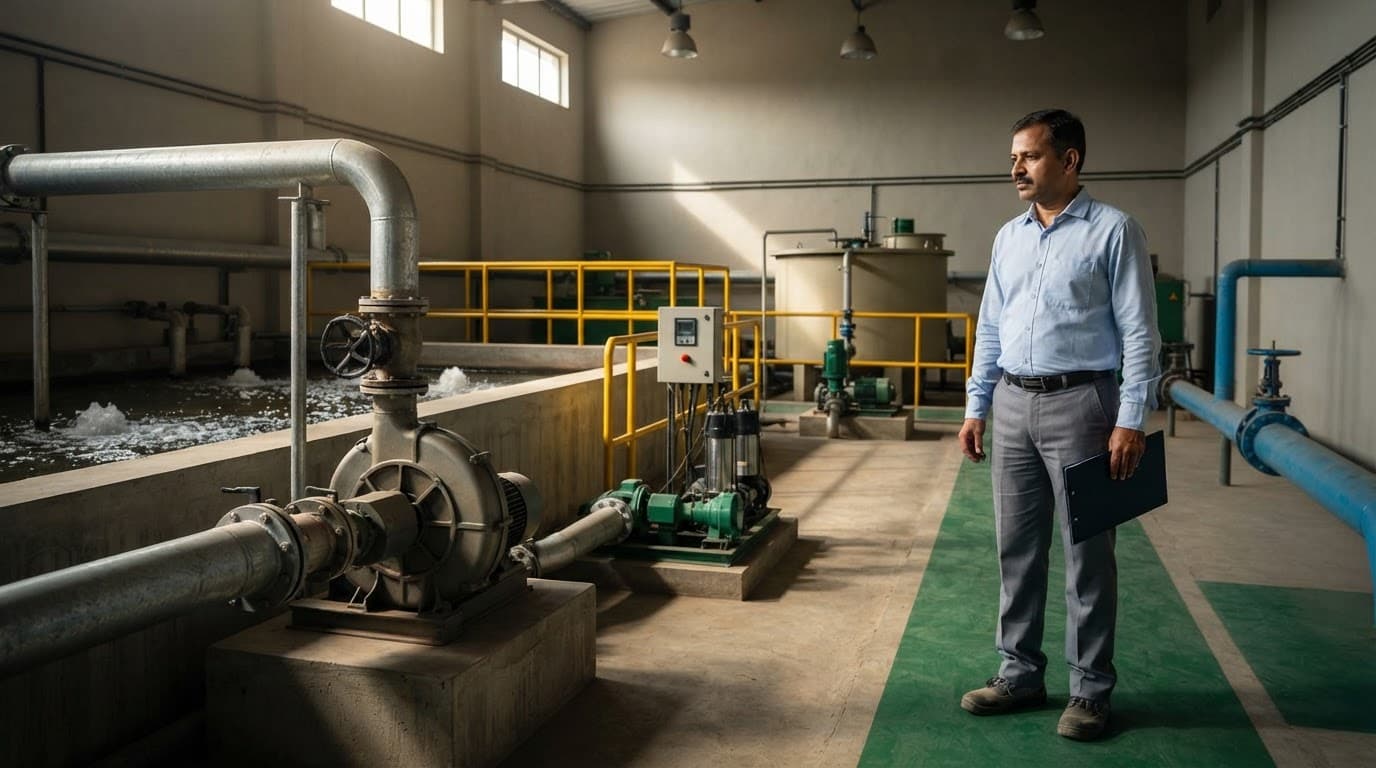
Check whether your apartment has the right approvals
India does not run on one simple national apartment threshold. Claims that every residential complex above a certain unit count must follow one identical rule can mislead residents.
The legal duty usually comes through the Water (Prevention and Control of Pollution) Act, 1974, local planning approvals, wastewater generation, plant capacity, and local authority conditions. Your building’s actual approval file matters more than a WhatsApp forward.
In Karnataka, the common path is Consent for Establishment (CFE) before installation, followed by Consent for Operation (CFO) after the working STP is inspected. Some documents may use the term Consent to Operate, but don’t treat CFO and Consent to Operate as interchangeable when the issued order uses different wording. KSPCB guidelines provide context, but current KSPCB requirements and the actual consent order control.
Pull the consent order, not a sales brochure
Ask for certified or legible copies of:
- CFE, CFO, the Consent to Operate document where issued, renewal letters, and any consent amendments.
- Approved STP design drawings and capacity calculations.
- Occupancy-related approvals that mention sewage treatment or reuse.
- Conditions related to discharge, reuse, sampling, and reporting, including any online continuous effluent monitoring system required by the consent order, board direction, or applicable category.
- Notices, inspection reports, or directions received from the pollution board.
A builder’s brochure saying “world-class sewage treatment” has no legal weight. A consent condition does.
The CPCB sewage treatment plant standards sheet is a useful reference for treated sewage standards, but your state board’s consent order may set tighter or differently worded sewage discharge standards. Site-specific reuse or discharge conditions can also apply. Verify current CPCB, NGT, and KSPCB materials before completing a compliance audit. Read the permit line by line.
Build an evidence file before you inspect equipment
Don’t let the audit depend on a facility manager’s memory. Create a shared folder with dated documents, photographs, and action records.
Request at least 12 months of data. A two-week record can hide seasonal overloads, monsoon inflow, festival occupancy, contractor gaps, and equipment failures.
Look for patterns, not perfect paperwork
The evidence file should include influent and treated-water test reports, daily flow logs, electricity bills, chemical purchase records, equipment service invoices, operator attendance, complaints, and sludge disposal receipts.
Compare dates. Did a laboratory report appear during a period when the blower was under repair? Does the logbook show normal flow every day even though occupancy dropped sharply? Are power bills flat despite claims of 24-hour aeration?
Those gaps matter. Pollution often survives because paperwork is treated as a prop rather than a record of what happened. A valid approval alone does not prove that the STP operates properly each day.
You can use India’s RTI process to request existing records from public authorities, including Consent for Establishment (CFE), Consent to Operate, consent renewals, amendments, inspection reports, sampling results, show-cause notices, and action-taken records. RTI can request records that already exist, but it can’t compel a new investigation.
Ask for defined documents over a clear period. “Provide inspection reports and sample results for this STP between April 2025 and March 2026” is stronger than asking why the plant is failing.
A useful audit file makes systemic change less glamorous and more real: named owners, dated repairs, repeat testing, and consequences when the same failure returns.
Follow sewage through every treatment stage
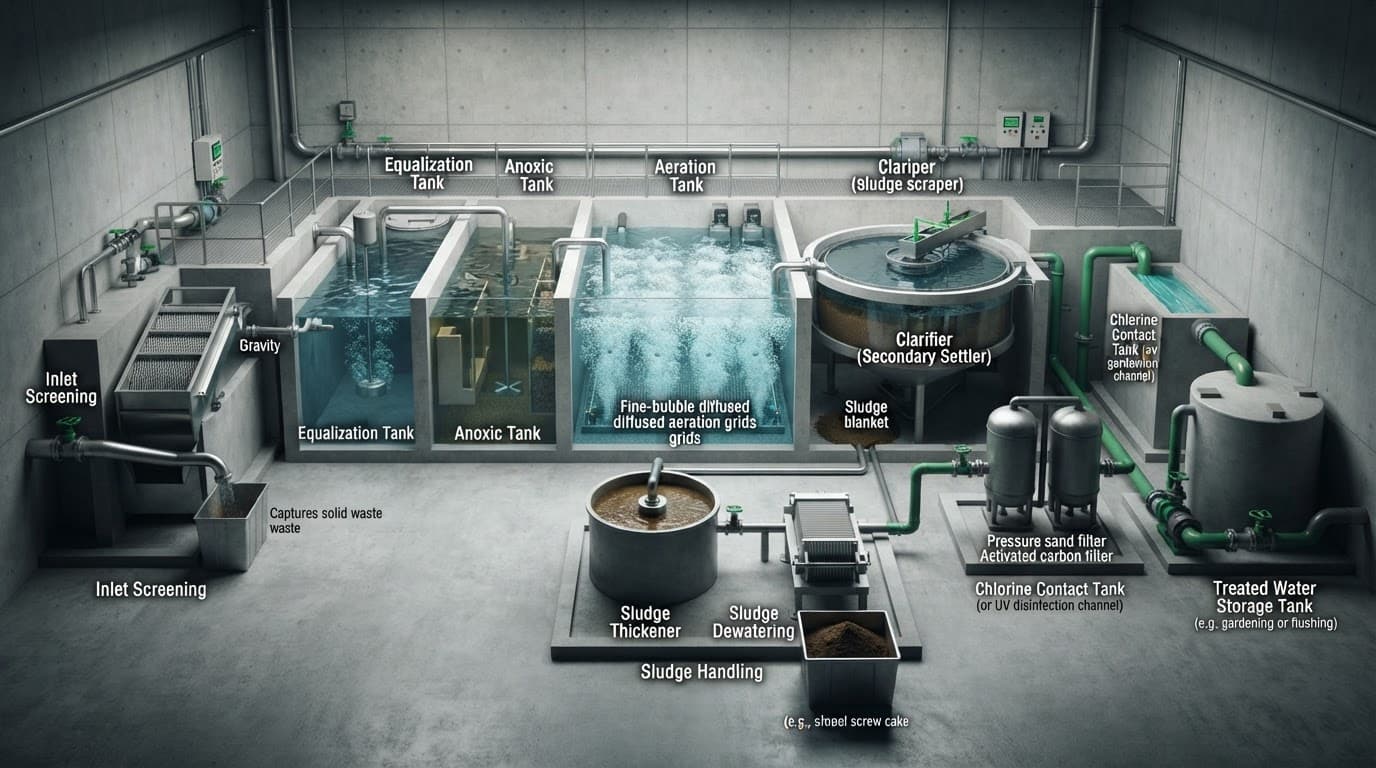
Stand at the inlet and trace the water through any downstream filter media and storage to its final destination. Don’t skip this. Hidden bypasses, overflowing chambers, and disconnected reuse lines are easier to find when you follow the actual route.
An apartment sewage treatment plant may use a sequential batch reactor (SBR), MBBR, membrane bioreactor (MBR), extended aeration, or another biological process. The technology name matters less than whether the system is designed, loaded, and operated properly.
Inspect the inlet, equalisation, and biological tanks
At the inlet, check screens and grit removal. Plastic, cloth, sanitary waste, and hair shouldn’t be flowing into pumps and aeration equipment. A neglected screen is a small failure that creates expensive pump damage.
Then inspect the equalisation tank. Its job is to smooth the rush of morning and evening sewage, so the biological process doesn’t face sudden surges. The approved design and actual peak-flow calculation should determine the required holding capacity. Next, inspect the aeration tank before checking downstream performance.
Check for:
- Septic smell, floating scum, stagnant corners, or visible solids escaping downstream.
- Broken level sensors, non-working mixers, and pumps cycling too often.
- Excess foam or dark, unhealthy-looking mixed liquor in the aeration tank.
- Air bubbles distributed evenly throughout the aeration tank, not only in one corner.
- Overflow points that could send raw sewage into stormwater drains.
For a sequential batch reactor, verify the fill, react, settle, and decant phases, including cycle timing and level controls.
Never ask a worker or resident to enter a tank to “have a look.” These are confined spaces. Any entry needs permits, isolation, atmospheric testing, rescue planning, and trained personnel. Use mechanical ventilation as a supplement, never as a replacement for those controls.
Treat technology claims with some scepticism
Activated sludge systems can work, but small decentralized plants often suffer when their loading swings wildly and trained supervision is missing. That is why many apartment projects use SBR, MBBR, or MBR configurations.
Still, no process is magic. Neglected membranes fail, so check membrane performance only when the approved design includes that equipment, whether as an ultrafiltration system or another approved configuration. A sequential batch reactor with damaged valves, poor cycle timing, or failed decanting fails. An MBBR with poor aeration fails. The audit should test performance, not fall for a technology label.
Test treated water against the applicable standard
Water that looks clear can still carry organic pollution, nutrients, pathogens, or fine solids. Colour and smell are warning signs, not a compliance test.
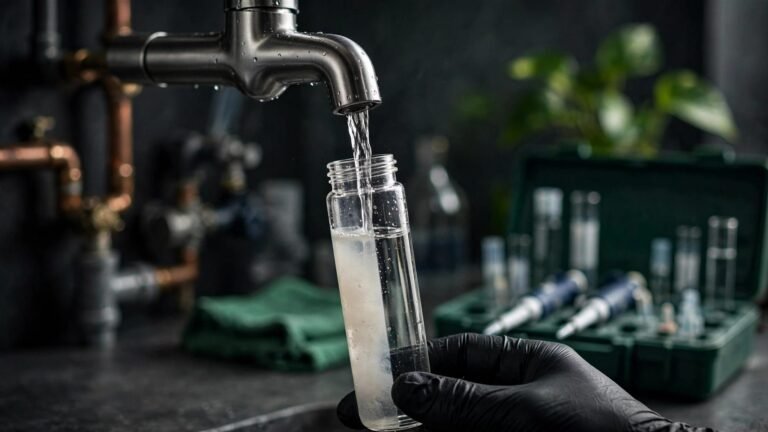
Use an accredited laboratory, collect samples at the final treated-water outlet, and record the date, time, weather, flow condition, sampler, and chain of custody. If the plant receives uneven flows, discuss composite sampling with the laboratory instead of relying only on one convenient grab sample.
The National Green Tribunal’s 30 April 2019 order cited treated sewage standards, including pH between 6.5 and 9.0, BOD at 10 mg/L or lower, COD at 50 mg/L or lower, ammoniacal nitrogen at 5 mg/L or lower, and total nitrogen at 10 mg/L or lower.
| Parameter | What it reveals | Audit question |
|---|---|---|
| Biological oxygen demand (BOD) | Remaining biodegradable organic pollution | Is the biological process doing its job? |
| Chemical oxygen demand (COD) | Wider chemical and organic load | Is treatment coping with wastewater strength? |
| Total suspended solids (TSS) | Fine solids leaving the plant | Is sludge carrying over from the clarifier? |
| Ammoniacal nitrogen | Incomplete nitrogen removal | Is aeration or biological treatment unstable? |
| Faecal coliform | Pathogen risk | Is disinfection working before reuse? |
These values aren’t universal. Your consent condition, State Pollution Control Board direction, current CPCB reference, or another binding requirement may be stricter or worded differently. Use the strictest applicable requirement, not the easiest number to meet. This guide to CPCB and state STP standards explains why those layers cannot be treated as interchangeable.
Don’t test only when an inspection is announced
A contractor can nurse a plant through one audit day. A performance audit should include repeat sampling under varying loads and weather conditions, including after a high-occupancy weekend or heavy rain. Compare faecal coliform results to confirm that disinfection remains effective.
If treated water is used for flushing or gardening, inspect storage tanks, signage, and the dual plumbing system. Verify separation between treated-water and potable-water lines against approvals and applicable local conditions. Check filter media condition and any ultrafiltration system specified for polishing, because polishing performance can affect final reuse quality. Cross-connections are unacceptable, as is sending supposedly treated water into a drain because the reuse system was never completed.
Find the mechanical failures that keep repeating
Most apartment STP breakdowns are painfully ordinary. A blower belt slips. A pump seal leaks. A float switch sticks. A filter is never backwashed. Nobody approves the repair because nobody owns the budget.
Start with the air blower. Aeration is usually one of the plant’s largest electricity loads and the heart of biological treatment. Listen for unusual noise, vibration, overheating, and erratic pressure. Check air filters, belts, lubrication, backup arrangements, and runtime records.
Inspect pumps, panels, filters, and ventilation
Lift pumps should have a duty-and-standby arrangement where the design requires it. Test automatic alternation. A standby pump that hasn’t run in six months is not standby equipment. It is an untested hope.
Inspect electrical panels for exposed wiring, corrosion, water entry, bypassed alarms, and locked access. Verify that emergency alarms and level sensors work, not merely that they exist.
Look at pressure sand filters and activated carbon filters if installed. Check the filter media for clogging or blinding. Confirm that backwashing restores performance, then review replacement records, service intervals, and spent-media handling. A bypass line left open can send poor-quality water to the reuse tank.
Persistent blower noise needs attention. If the design allows proper ventilation and maintenance access, consider an acoustic enclosure, but don’t treat noise control as a mechanical repair.
Odour needs attention too. Persistent odour can point to septic conditions, poor ventilation, excessive sludge, dead zones, or failed aeration. Covering that smell with room freshener is not maintenance.
Run an energy audit and check water balance and sludge separately
A plant can meet one lab number and still waste huge amounts of energy or dump sludge irresponsibly. A serious apartment STP audit checks the whole system.
An energy audit should establish monthly electricity use against treated volume. Calculate kWh per cubic metre of sewage treated. There is no honest universal energy benchmark because technology, load, aeration strategy, pumping head, and occupancy vary. Start with a reliable baseline, then explain every spike.
Use energy data to ask better questions
Use the energy audit to investigate changes, not just record them. If flow drops but power stays high, blowers may be running blindly. If energy use falls sharply while ammonia rises, operators may have cut aeration too far.
Measure or record:
- Daily treated-water flow and monthly electricity units.
- Blower, pump, filter, and sludge-handling runtimes.
- Periods when equipment was bypassed or operated manually.
- Leakages and unexplained differences between water supply, sewage generation, and reuse.
Water balance is not a spreadsheet ritual. It can reveal illegal stormwater inflow, broken meters, hidden discharge points, or inflated treatment claims. It also tests whether wastewater management matches reported sewage generation and reuse.
Sludge deserves the same scrutiny. Ask how often it is removed, who transports it, where it goes, and what documentation proves lawful disposal. Ask whether a sludge holding tank is installed, sized and maintained as designed, and how its contents are removed. Read more about STP sludge disposal risks in India before accepting claims that sludge is “used as manure” without applicable testing and authorization.
A real circular economy does not mean moving contaminated waste out of sight. It means closing loops only when health, soil safety, worker protection, and traceable disposal are built into the system.
Make RWA handover a test of accountability
RWA handover is where many communities inherit a plant built for an approval drawing, not for daily life. Do not sign off because the builder runs the STP for one clean demonstration.
Ask for a joint performance audit before handover. Include the builder, operator, RWA representatives, an independent STP specialist, and a laboratory where necessary. Record every finding with a photograph, location, risk level, responsible party, deadline, and proof required for closure.
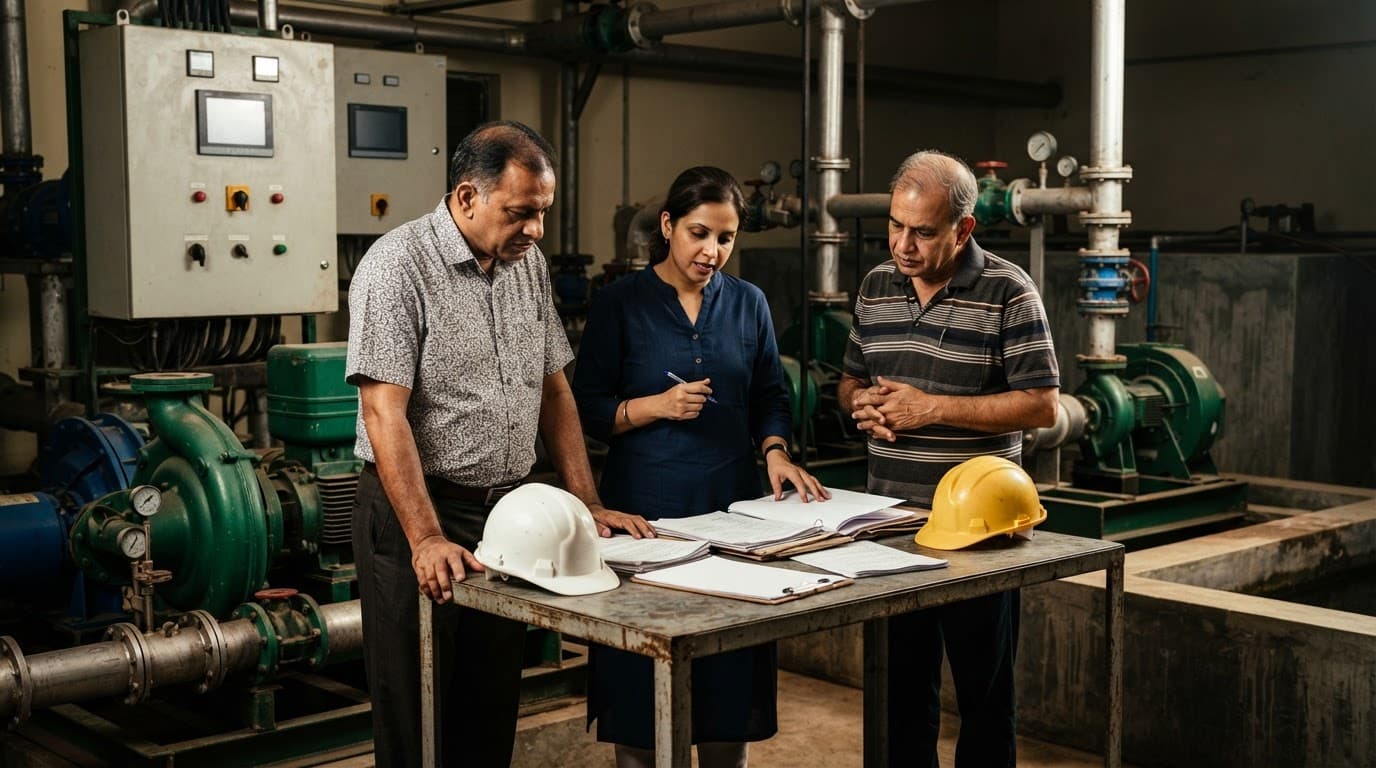
Use a simple red, amber, and green scorecard
Mark a finding red if it risks raw sewage discharge, worker injury, illegal operation, or unsafe water reuse. Mark it amber if it can become a serious failure without repair. Green means verified and functional, not merely present.
Your handover report should cover approval status, Consent to Operate validity, capacity, civil defects, equipment condition, and outlet quality. It should also cover electrical safety, spares, operator competence, annual operating costs, electricity trends, budget responsibilities, sludge disposal, warranties, and an energy audit.
Demand a defect-liability plan with dates. “Will be rectified” is not a commitment. A useful entry says, “Replace failed standby pump by 15 September, test automatic alternation, submit video and service report.”
Closure of the RWA handover should require evidence that red findings were repaired and retested.
This is where climate literacy becomes practical. Residents begin to see that sewage, rainfall, electricity, public health, drains, and lakes belong to one connected system.
The ecological impact reaches beyond the STP room. Failed treatment can feed algal growth, damage soil, pollute local water bodies, and shrink the fragile edges that support urban biodiversity.
Personal habits still matter. Everyday mindfulness might mean reporting a recurring smell, refusing to pour oil or chemicals into drains, and asking where treated water goes. Plant-based living can reduce broader resource pressure, but it cannot excuse a building that dumps wastewater badly. Sustainable business models for housing must budget for operation, maintenance, testing, and skilled labour, not only construction.
For visible work that connects community accountability, climate literacy, and local ecosystems, Explore Our Active Missions.
Frequently Asked Questions
What is the main purpose of an apartment STP audit?
The purpose is to verify that the sewage treatment plant can produce compliant treated water reliably under normal apartment conditions. It also checks approvals, equipment safety, water reuse, energy use, records, and sludge disposal.
Which documents should residents request before inspecting the plant?
Request the CFE, CFO or applicable Consent to Operate documents, renewals, amendments, approved designs, capacity calculations, inspection reports, and pollution board notices. Also collect at least 12 months of flow logs, laboratory results, electricity bills, maintenance records, operator attendance, and sludge disposal receipts.
Can a clean-looking STP be considered compliant?
No. Clear water, a clean room, or a working control panel does not prove treatment performance. Compliance requires valid approvals, representative laboratory testing, reliable operating records, and functioning equipment throughout the treatment process.
How often should treated water be tested?
Testing should follow the applicable consent conditions and State Pollution Control Board requirements. An audit should also include repeat samples under varying occupancy and weather conditions, rather than relying on one sample collected during an announced inspection.
What should happen when an audit finds a serious defect?
Record the defect with its location, risk level, responsible party, deadline, and evidence required for closure. Red findings involving raw sewage discharge, worker injury, illegal operation, or unsafe reuse should be repaired and retested before handover or acceptance.
A functioning STP is a promise kept every day
The plant below your apartment is easy to ignore until it smells, floods, or fails a test. By then, costs rise and harm may have reached a drain, lake, worker, or neighbour.
A strong apartment STP audit turns that hidden risk into a record of valid approvals, reliable test data, safe equipment, traceable sludge handling, and named people responsible for repairs.
Don’t accept a clean-looking plant as proof. Ask for the data, inspect the flow, and keep repair records tied to named owners.