Landfill Methane Monitoring Before Indian Landfill Fires
 TBH Editorial
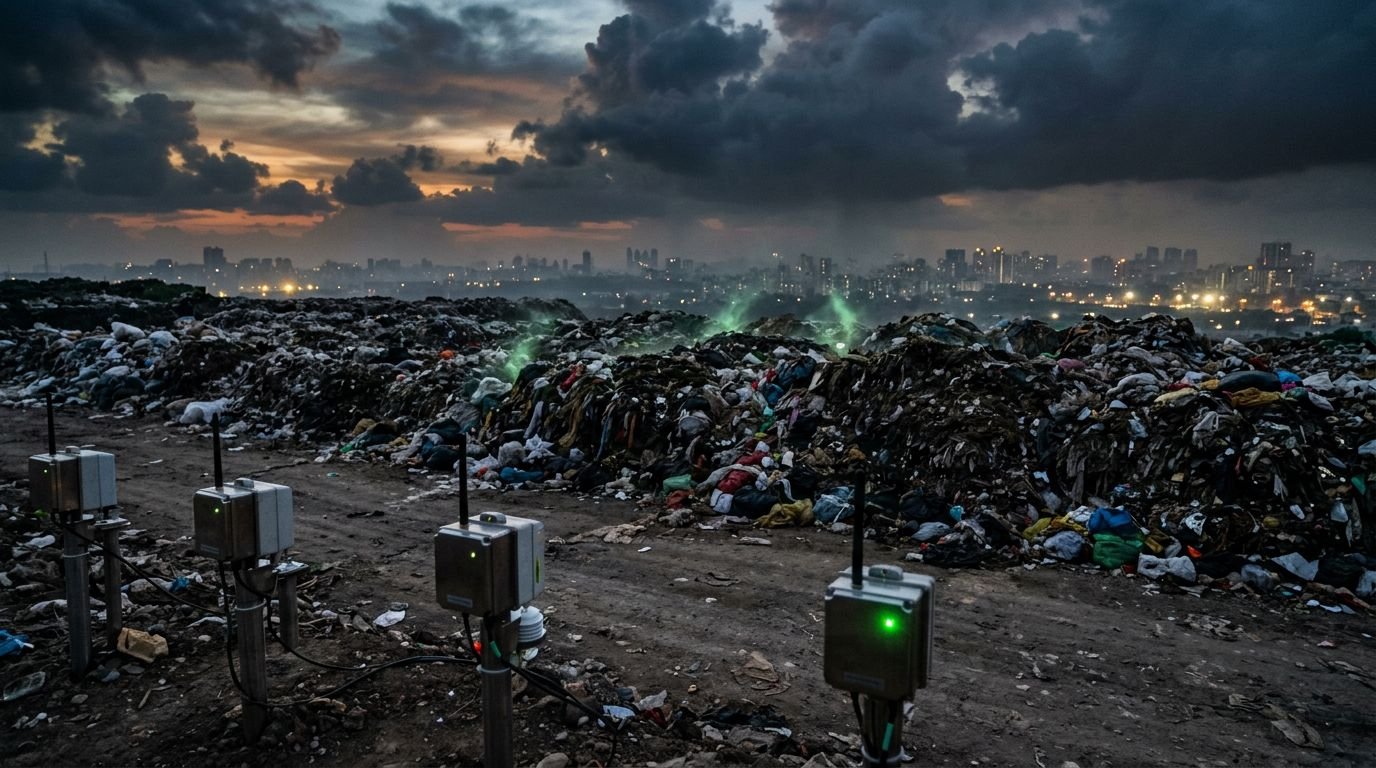
A landfill fire does not begin when black smoke climbs over a city. It begins earlier, inside hot, wet layers of mixed waste where landfill gas builds, pressure shifts, and nobody is checking closely enough.
That is why landfill methane monitoring must begin before a fire, rather than becoming a regulatory compliance task for a file. India’s dump sites hold decomposing food waste, plastic, paper, textiles, and construction debris in unstable combinations. When methane, heat, dry waste, and an ignition source meet, the cost lands on workers, nearby families, and already damaged urban ecosystems.
We need to stop treating smoke as the first warning. It is usually the last one.
Key Takeaways
- Landfill methane monitoring must begin before smoke appears. Methane can build and migrate through waste, soil, covers, and collection systems long before a landfill fire becomes visible.
- Effective monitoring combines surface walkover surveys, soil gas monitoring, perimeter wells, collection system checks, ambient air monitoring, and targeted satellite or remote sensing data.
- Handheld detectors and satellites are screening tools, not complete emissions inventories. Readings need to be linked to exact locations, weather conditions, follow-up inspections, and verified repairs.
- Every serious methane reading should receive an owner, response deadline, written work order, and repeat measurement after the repair.
- Gas capture, flaring, and energy recovery can reduce residual risk, but waste prevention, source separation, composting, and transparent public reporting remain essential.
Why methane monitoring cannot wait for smoke
Landfills are not inert mountains of rubbish. They are active biological systems. Buried municipal solid waste breaks down without oxygen and releases landfill gas, containing methane, carbon dioxide, and trace volatile organic compounds. Methane has no reliable smell, so a site can look calm from the gate while gas moves below its surface.
A recent study of Indian municipal landfills estimates national methane emissions at roughly 1.25 to 1.68 teragrams a year. That is not a small side effect of city life. It is a serious climate and public-safety problem beside roads, homes, markets, schools, and informal settlements.
A dump is a gas-making system
Fresh waste, rainwater, compaction, heat, and poor cover conditions all change how gas moves. A cracked slope can release methane at the surface. A clogged pipe can push gas elsewhere. Falling barometric pressure can alter movement across the site.
Methane is not the only reason landfill fires start. Dry plastic, spontaneous heating, open burning, electrical faults, and human negligence also matter. But ignoring methane means ignoring one fuel that can turn a waste pile into a stubborn, toxic fire.
This is why first order decay models are not enough. They help estimate annual greenhouse gas emissions from waste volumes and age. They cannot tell a field team that gas is escaping through one damaged patch today.
India’s current Solid Waste Management Rules require sanitary landfills to address fire hazards and manage gas emissions. Where captured gas can be used for heat or power, it should be recovered. Where that isn’t viable, it must be flared. This makes regulatory compliance part of fire prevention.
That standard matters because a landfill fire is not bad luck. It is often a record of missed inspections, poor waste handling, damaged gas infrastructure, and delayed action.
Measure the waste mound, not just an annual spreadsheet
A model gives a useful starting estimate. A field monitoring program gives operators a chance to prevent harm.
A field monitoring program should combine surface monitoring with soil gas monitoring, subsurface monitoring, and targeted follow-up. One yearly estimate cannot capture every changing condition. It may miss a leaking gas well, a split cover layer, a blocked header pipe, or pressure building beneath fresh waste.
Walk the cover with a detector
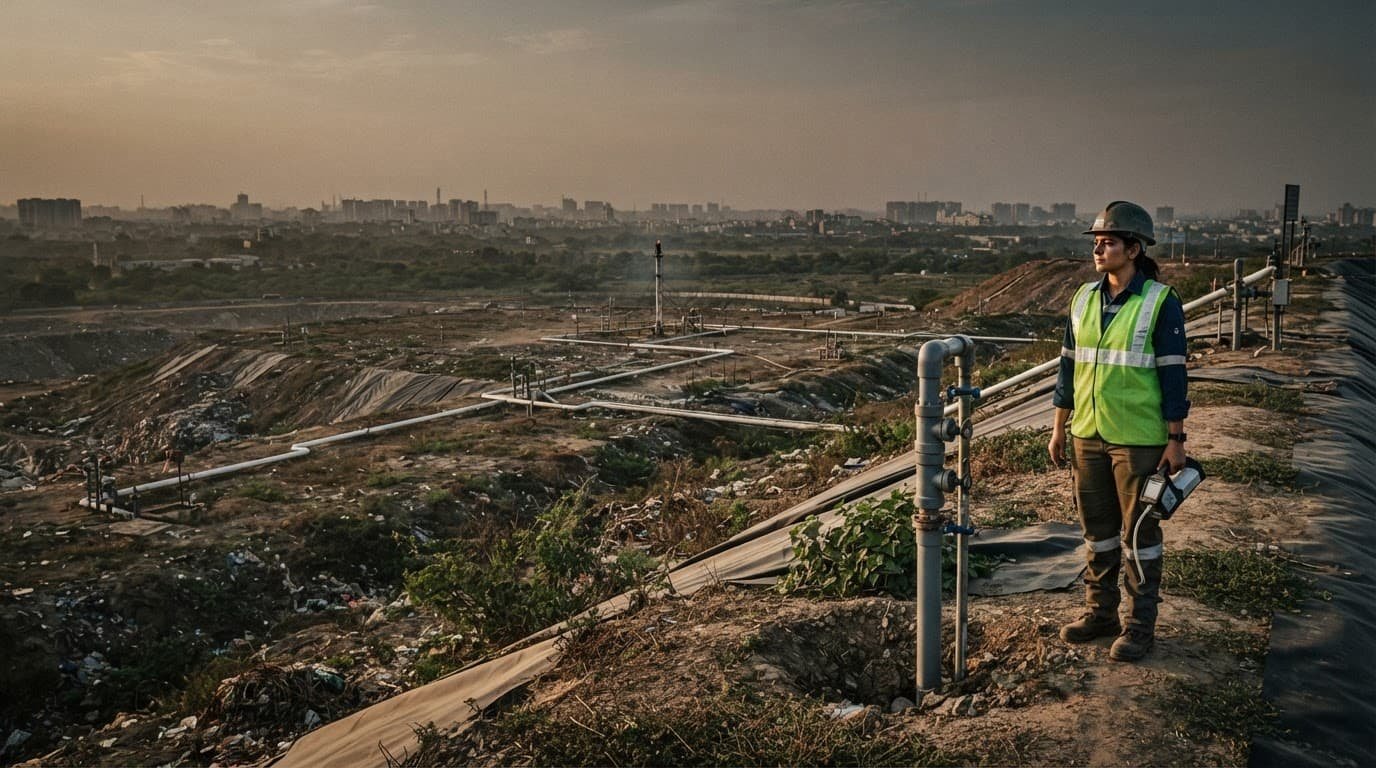
A walkover survey is the simplest place to start. Trained staff walk a planned grid across the landfill cover with a portable gas detector or flame ionization detector. They mark elevated methane concentration readings and suspected methane leaks.
After the walkover survey, targeted soil gas monitoring at those locations helps confirm whether the problem persists.
Operators should use calibrated instruments and approved site protocols when readings approach the lower explosive limit. A single reading isn’t an automatic ignition prediction.
The waste-sector methane monitoring guide from Clean Air Task Force makes an important distinction. Handheld surveys are practical screening tools, but they aren’t full measurements of methane emissions.
They show crews where to look harder. Flux chambers can complement soil gas monitoring by supporting surface flux estimates and emission rates. A detector reading alone cannot establish total site emissions.
A good survey log includes the date, time, weather, wind direction, barometric pressure, and detector readings. It should also record calibration status, visible site condition, and any soil gas monitoring result. A number without a location or weather record is barely useful.
Use soil gas monitoring beneath and beyond the heap
Cover surveys find leaks at the top. Subsurface checks ask a different question: is landfill gas moving through soil, along utility routes, or beyond the landfill boundary?
Perimeter soil gas monitoring wells can track methane, carbon dioxide, oxygen, and pressure outside active waste cells.
Low oxygen and rising methane may point to gas migration that a cover walk would miss. Interpret a soil gas monitoring result with nearby readings and site conditions.
Weather conditions matter for soil gas monitoring. Wind can disperse a plume. Rain can change surface permeability. Pressure shifts can affect gas flow.
Downwind ambient air monitoring can assess methane, carbon dioxide, and volatile organic compounds when exposure is a concern.
Those details should not become excuses for weak readings. They should help teams interpret the readings honestly.
A methane reading is not a verdict. It is a reason to inspect the exact place where soil gas monitoring points to a possible failure.
Use layered monitoring before the hot season
No single tool can see the whole problem. A handheld detector supports soil gas monitoring close to the ground, but it only sees the route staff walk. A satellite sees a much larger area, but it cannot repair a cracked landfill cover.
The strongest layered monitoring systems track landfill gas across several layers, then connect each reading to an actual maintenance response.
Four forms of monitoring catch different failures
| Monitoring layer | What it can reveal | What operators should do next |
|---|---|---|
| Surface walkover surveys | Surface releases through soil cover and slopes | Use surface monitoring and a walkover survey to identify repair needs, then repeat readings |
| Subsurface and perimeter wells | Soil gas monitoring can reveal gas migration below ground or off-site | Use soil gas monitoring to check barriers, pressure, and collection performance |
| Collection system monitoring | Weak vacuum, blocked pipes, or poor gas capture | Adjust wells, inspect each gas extraction well, repair headers, and document flow and quality |
| Ambient and downwind sampling | Ambient air monitoring can show gas moving toward nearby people or habitats | Verify the source and act before exposure grows |
The subsurface layer pairs wells with soil gas monitoring to identify migration beneath the mound. Operators can use soil gas monitoring to prioritize investigations around boundaries, barriers, and pressure changes.
The point is not to collect more numbers for a dashboard. Collection system monitoring matters only when readings lead to work orders, repairs, and confirmation that the fix stayed fixed.
Satellites can spot what the gate camera misses
Satellite data and other remote sensing tools can flag larger methane emissions that extend beyond a landfill boundary. They guide priorities, but they don’t provide a definitive site-wide emissions inventory.
Still, a satellite is a watchtower, not a repair crew. Clouds, revisit timing, wind, and detection thresholds can limit a satellite observation, especially for smaller or short-lived releases. Soil gas monitoring helps cover those gaps at ground level.
When satellite data or remote sensing flags a plume, ground teams should direct soil gas monitoring toward the priority area. They should verify the source with field instruments, including soil gas monitoring and ambient air monitoring, then inspect headers, wells, and controls in the gas collection system.
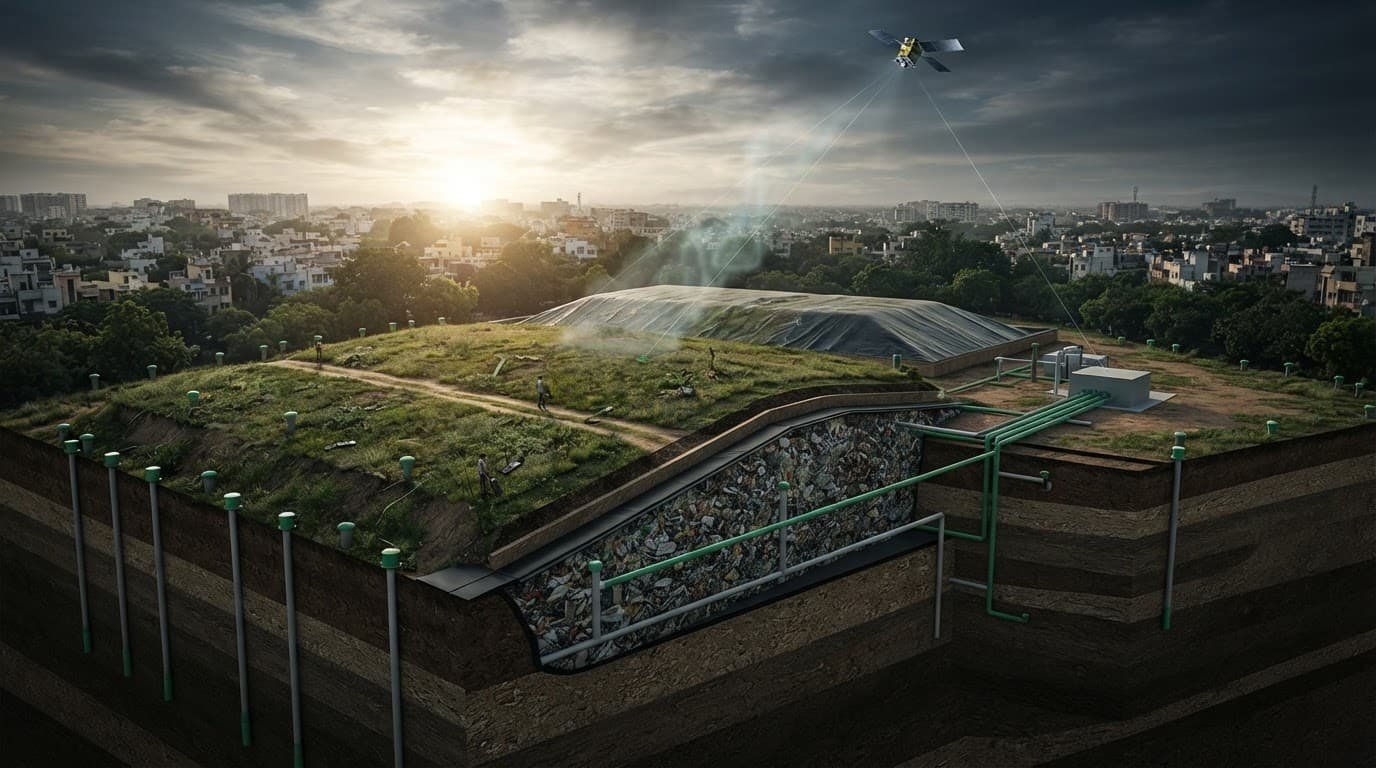
A city should not choose between satellite tools and boots on the ground. It needs both, with soil gas monitoring guiding field checks.
Turn methane readings into work orders
The familiar failure is painfully ordinary. A device records a high reading. Someone saves the number. Nobody returns to the spot until a fire, complaint, or inspection forces attention.
Monitoring only works when every serious reading has an owner, a deadline, and a written close-out record. That means assigning an owner to each soil gas monitoring alert.
Give every alert a response clock
An operator’s response plan should set action levels with the local Pollution Control Board and fire authorities. It should also say who has the power to stop unsafe work around a suspected gas leak.
A meaningful response can include:
- Linking soil gas monitoring results to cover and pipe inspections that check for cracks, settlement, exposed waste, and hot areas.
- Testing nearby gas wells, headers, valves, and vacuum settings across the gas collection system.
- Repairing collection failures, damaged cover, and poor compaction where gas is escaping to reduce methane emissions.
- Checking whether fresh mixed waste, open burning, or blocked collection lines are adding risk.
- Inspecting the site and downwind areas with ambient air monitoring before crews approach a suspected leak.
- Repeating measurements with soil gas monitoring after repairs and recording the result.
Collection system monitoring helps prove that a repair remained effective, not just that a crew visited the site. The written close-out record should include the soil gas monitoring result, repair details, and follow-up reading.
This is where Systemic change looks boring. Calibration logs. Field maps. Repair orders. Supervisors signing their names. That is exactly what makes it work.
Capture gas, but do not use it as a distraction
Landfill gas can be collected for thermal use, power generation, or upgraded into renewable natural gas where flow and gas quality make the project viable. The US EPA’s landfill gas overview explains the basics of collection, treatment, and energy recovery.
But gas recovery is not permission to keep burying food scraps in mountains of mixed waste. A real circular economy starts with prevention and source separation, while composting and biogas systems reduce methane formation underground. Gas capture or flaring then addresses residual risk.
Sustainable business models must pay for detector calibration, skilled staff, repair crews, and transparent reporting throughout the process. A flare that works is better than an uncontrolled plume. Waste prevention is better still.
RMI’s local-government methane reduction guidance reaches the same hard truth: methane mitigation, better landfill gas management, and less organic waste disposal must happen together.
Communities deserve the monitoring record
A landfill may be managed by a contractor, but its consequences spread far beyond the contractor’s gate. Sanitation workers, waste pickers, roadside vendors, children, and nearby residents carry the first burden when monitoring fails.
The ecological impact is wider too. Smoke and deposited waste can stress roadside vegetation, contaminate soil and drains, and worsen methane emissions and public-health risks. A city cannot claim to protect birds, pollinators, or street trees while allowing toxic dump fires to become routine.
Climate literacy means asking harder questions
Climate literacy is not memorising methane’s global warming potential. It is knowing what to ask when a landfill keeps smoking.
Residents, journalists, and local groups can request:
- The latest soil gas monitoring map or dataset, with sampling dates and locations, to show where gas may be moving.
- Dates and findings from soil gas monitoring and perimeter inspections, to show whether conditions are changing. Compare them with ground measurements and satellite data, rather than relying on imagery alone.
- Downwind ambient air monitoring results, which can show what nearby people may be breathing.
- Details of gas captured, flared, or used for energy, which can show whether controls are working.
- Fire incident records and repair orders, showing what happened and what was fixed after complaints. Ask the municipality to publish its methane mitigation plan, assigned responsibilities, and progress after each incident.
- The next scheduled soil gas monitoring inspection or follow-up record, showing whether promised action is happening. It is stronger than a vague claim that “action has been taken.”
A time-stamped photograph of smoke, exposed waste, or a damaged slope can help trigger an inspection. Ask for the full inspection report and action-taken record. Proof changes the conversation.
Personal choices matter, but public duty matters more
Plant-based living, food-waste reduction, and everyday mindfulness can lower the amount of organic waste entering city bins. Those are worthwhile habits. They do not cancel a municipal body’s duty to manage a landfill safely.
For people who want visible, accountable work that strengthens local ecosystems and public awareness, Explore Our Active Missions.
We should care about what enters our bins. We should care even more about what happens after the truck leaves.
Frequently Asked Questions
What is landfill methane monitoring?
Landfill methane monitoring is the planned measurement of methane in surface releases, soil gas, collection systems, and ambient air around a landfill. It helps operators identify leaks, gas migration, damaged infrastructure, and fire risks before they become emergencies.
Why is a handheld detector not enough?
A handheld detector can help crews locate elevated methane readings during a walkover survey, but it only covers the areas they inspect. It does not establish total site emissions, so soil gas monitoring, flux measurements, collection system checks, and other tools may be needed.
What should operators do after finding a high methane reading?
They should record the location and conditions, inspect nearby covers, wells, pipes, and valves, and assign the alert to a responsible person with a response deadline. After repairs, the site should be tested again and the result added to a written close-out record.
Can satellites replace ground-based monitoring?
No. Satellites and remote sensing can flag larger or unexpected methane plumes, but clouds, wind, revisit timing, and detection limits can leave gaps. Ground teams still need soil gas monitoring, ambient air monitoring, and collection-system inspections to verify the source and repair the failure.
Does capturing landfill gas solve the methane problem?
Gas capture, flaring, and energy recovery can reduce uncontrolled emissions when the system is properly designed and maintained. They do not replace waste prevention, source separation, composting, or biogas systems that reduce methane formation underground.
Stop waiting for the smoke
A landfill fire is not the first sign of a waste crisis. It is proof that earlier warnings were missed, ignored, or filed away.
Landfill methane monitoring gives cities a practical chance to find methane leaks, investigate failures, repair damaged systems, and reduce methane emissions before fire risk grows. It works only when readings lead to action.
The standard should be simple: measure the source, investigate the cause, repair the problem, verify the result, publish the record, and use methane mitigation to prevent recurrence.