
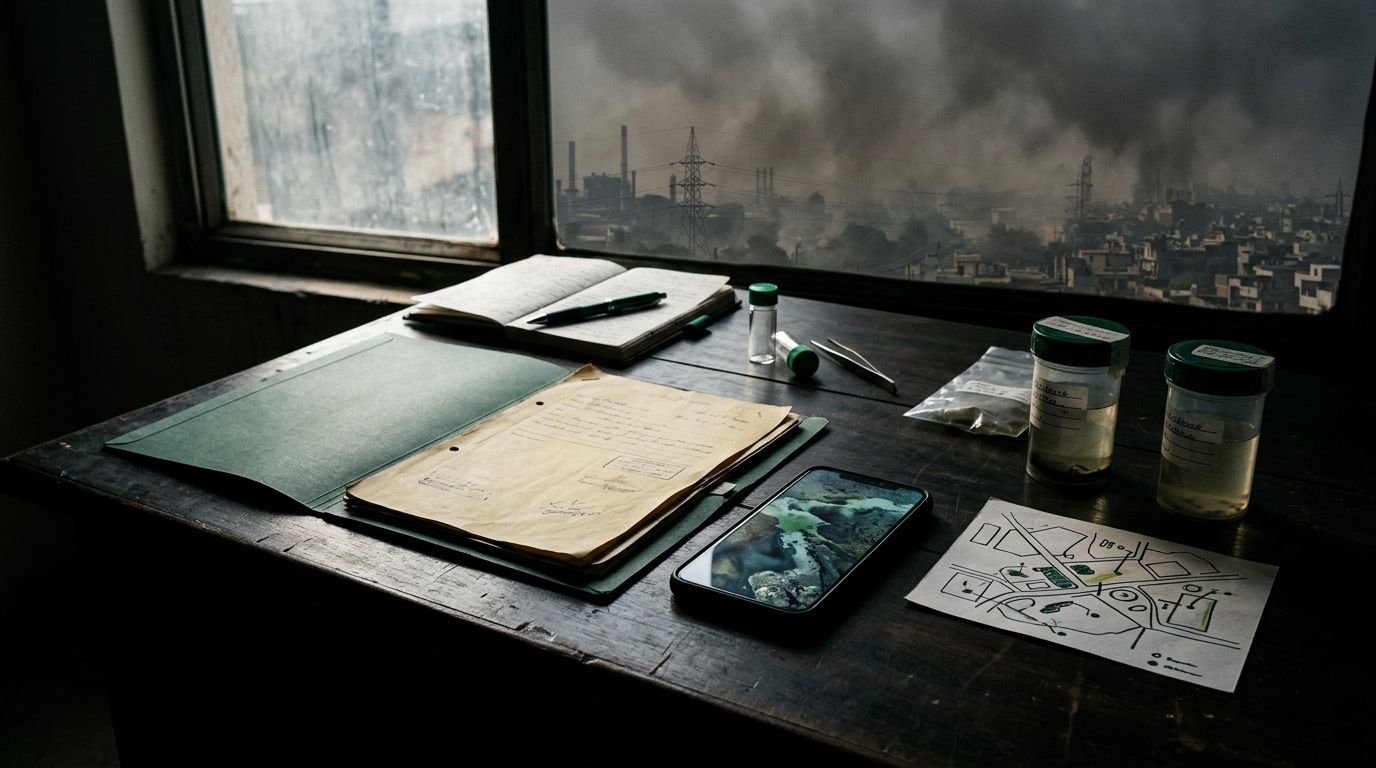
Pollution Complaint India: File Evidence, Not Anger
 TBH Editorial
A complaint is not a rant. It is a demand for the state to create a record, inspect a source, and stop treating someone else’s breathing space as collateral damage.
Searches for “pollution complaint India” often lead people to a generic form when they need a clear enforcement route. The right route depends on what is happening, where it is happening, and whether the harm is active right now.
Start with facts, not fury. A precise, evidence-rich complaint is much harder to dismiss.
Key Takeaways
- Route a pollution complaint to the authority that can act: call the police for active emergencies or night-time noise, contact the SPCB for industrial and ongoing pollution, and involve the municipality for local waste and drain problems.
- Build a factual evidence file with dated photographs, short videos, exact locations, timings, weather, source details, earlier complaint records, and proof of submission.
- Ask clearly for an inspection, sampling or readings where needed, a complaint number, the inspection report, and the action taken—not merely a promise to investigate.
- Escalate unresolved complaints through follow-ups, Right to Information requests for official records, and, where appropriate, the National Green Tribunal.
- Use the CPCB EPR support portal only for technical extended producer responsibility issues, not for general complaints about smoke, dumping, sewage, or construction dust.
Pollution Complaint India: Start With the Right Authority
A State Pollution Control Board, or SPCB, is not the only place to report pollution. It is the right authority for many violations, but an active emergency needs a faster response.
In Union Territories, the comparable agency is usually the Pollution Control Committee. The basic principle stays the same: send your complaint to the authority that can inspect or intervene.
Call police when the harm is happening now
Use the nearest police station for an active night-time noise pollution violation involving loudspeakers, burning waste, a dangerous obstruction, or a situation that could turn hostile. If there is a fire, chemical release, or immediate danger to life, contact emergency services first.
For repeated late-night noise, call while the noise is still happening. Ask for an acknowledgement or reference number. A complaint filed the next morning still matters, but a live visit can establish what people were exposed to.
Police are often the fastest route for residential noise and live incidents. The SPCB is more likely to investigate industrial emissions, construction dust, wastewater discharge, and ongoing environmental non-compliance.
Route the complaint by the source, not your frustration
A complainant should route the report by source, not frustration. A factory stack, an illegal dumping ground, a construction site, and a wedding DJ do not belong in the same inbox.
Send industrial smoke, contaminated water, dust, odour, ash, or hazardous waste concerns to the SPCB’s regional office. Report blocked drains, public-road debris, and uncollected municipal waste to the local municipal body as well. For persistent noise, write to the designated district authority, which may be the District Magistrate, Police Commissioner, or a designated officer.
A useful legal guide to noise complaints explains the routes available when noise causes annoyance, discomfort, or injury.
Build a File an Officer Can Inspect
A blurry video and an angry paragraph rarely move a complaint forward. As a complainant, make the source, location, pattern, and likely exposure easy for an inspecting officer to understand.
Don’t wait for laboratory-grade proof before reporting. You are documenting what you observed. The Board decides whether sampling, inspection, or monitoring is needed.
Record the pattern, not only the worst day
Keep your evidence factual and dated. A simple folder on your phone can become a strong public record.
- Photograph the source, surrounding road, drains, nearby homes, and any visible plume or discharge.
- Record dates, start and end times, weather, wind direction, smell, and the type of activity underway.
- Take short videos that show the sound, smoke, dust, truck movement, dry cutting, or wastewater flow.
- Note the exact address, nearby landmark, company name, vehicle number, or construction-project signboard.
- Save copies of messages, earlier complaints, and any reply from police, the municipality, or the Board.
A grey layer on a window grill, fruit cart, school bag, or roadside tree is useful evidence of repeated fallout. It is not proof of a particular chemical. Say what you saw, not what you cannot verify.
Write one clear request for action
Keep the complaint under two pages, excluding attachments. Avoid personal attacks. State the source, location, dates, observed release, who may be affected, and what you want the authority to do.
“Please inspect the site, record the findings, collect samples or take readings where required, and provide the complaint number and action taken.”
For construction dust, don’t be fooled by green mesh around a site. A screen can catch visible debris, but it cannot control dry cutting, uncovered rubble, loose truck loads, dirty tyres, or dust escaping through open gates.
That is where systemic change starts, with daily source control, inspections, repair logs, and consequences for repeat failures.
Report Noise Pollution While the Evidence Is Live
Noise pollution affects sleep, interrupts study, or makes an elderly neighbour shut every window. It is still pollution, and the rules give residents a basis to object.
The CPCB’s noise pollution guidance is a useful starting point for understanding India’s standards and enforcement framework.
Know the noise limits and night-time rule
Under the Noise Pollution (Regulation and Control) Rules, day time is 6:00 AM to 10:00 PM. Night time is 10:00 PM to 6:00 AM.
| Area category | Day limit | Night limit |
|---|---|---|
| Industrial area | 75 dB(A) | 70 dB(A) |
| Commercial area | 65 dB(A) | 55 dB(A) |
| Residential area | 55 dB(A) | 45 dB(A) |
| Silence zone | 50 dB(A) | 40 dB(A) |
A noise pollution complaint can be made when sound exceeds the applicable ambient standard by 10 dB(A) or more. Loudspeakers and sound-amplifying equipment also face restrictions between 10:00 PM and 6:00 AM.
A phone decibel app can support your diary, but it is not an official measurement. Do not make your complaint depend on one.
What police and district authorities can do
For an ongoing violation, contact the local police station while the event is live. Officers can visit, tell organisers to stop unlawful amplification, and record the incident. The designated authority under the Noise Rules can issue a written order to prevent, prohibit, control, or regulate the noise.
If the problem repeats, write to the District Magistrate or designated authority with your earlier noise complaint number attached. A lawyer can organise records or seek stronger directions, but a complainant doesn’t need one to report the incident.
Ask for enforcement, not a vague promise to “look into it.”
Send Your State Pollution Control Board Complaint Properly
Find your SPCB’s official website and identify the regional office responsible for the district where the pollution occurs. Use its online grievance route if available, then send the same complaint by email or signed letter when the issue is serious or recurring.
Save every proof of submission. A screenshot of a web form, email delivery receipt, speed-post receipt, and complaint reference number all matter later.
Ask the Board for a defined inspection
Tell the Board what you need it to check, including the source and operating hours for recurring noise pollution within its remit. For an industrial unit, ask it to inspect the emission source, discharge point, waste-storage area, or consent conditions that apply to the site.
For dust, ask it to inspect active work, debris storage, vehicle exits, material transport, water spraying, and road contamination. A site manager may present a clean front gate during an inspection. The work happening behind it is what matters.
Fine particles from demolition and construction can settle on leaves, clog drains, and damage already fragile urban biodiversity. Children, street vendors, delivery riders, and workers near school corridors carry the heaviest exposure.
Request records, not only reassurance
As the complainant, request the inspection report, sampling result, notice issued, and action taken report. A message saying “necessary action has been taken” is not a meaningful answer without a date, finding, or order behind it.
If someone reports breathing trouble, eye irritation, or worsening asthma, seek medical care. Do not turn a health symptom into a guess about a pollutant. Keep the environmental complaint focused on the observed source and the action needed.
Escalate When the File Goes Silent
Silence is not closure. If the Board does not respond within its published grievance period, send a dated follow-up that repeats the complaint number and asks for status.
Keep each follow-up short. A growing chain of factual emails is stronger than sending a fresh complaint every week.
Use the Right to Information route for records
If an inspection should have happened, seek records through a Right to Information application. Ask for the inspection report, sample-collection record, laboratory result, written order, notices issued, replies received, and action taken.
This changes the question from “Did anyone care?” to “What did the authority record?” That paper trail can reveal whether the problem is a one-off failure or a pattern of neglect.
Take persistent environmental harm to the National Green Tribunal
The National Green Tribunal is not a midnight-response service. It is a forum for sustained environmental disputes where administrative complaints fail or the damage needs wider relief.
The NGT can issue directions on pollution control, remediation, and compensation for environmental damage within its jurisdiction. Filing rules and limitation periods apply. If administrative remedies fail, speak with an environmental lawyer or credible local group before taking further legal action. Discuss whether the facts support compensation.
A tribunal case is strongest when a complainant’s evidence file includes inspection records, photographs, complaint numbers, and proof that earlier authorities did not resolve the harm.
Use CPCB Support Tickets Only for EPR Problems
The Central Pollution Control Board’s EPR support system handles technical trouble with waste management portals. A CPCB complaint here means an EPR support-ticket matter, not a general report about factory smoke, illegal dumping, sewage discharge, or construction dust.
That distinction matters. A circular economy cannot run on paperwork that hides broken collection, unsafe processing, or missing producer responsibility.
Register as a first-time EPR complainant
For EPR registration, go to the CPCB EPR support ticket tracker, the support portal, and select “First Time Complainant?” if you don’t already have an account. Enter the company details, choose a role, such as Producer, Importer, or brand owner, and select the issue. Review the information before ticket generation, and keep the ticket number for tracking updates or proving you reported the issue.
Public instructions also show the first-time complainant sequence for users facing the portal’s registration process.
Include technical details support teams can use
Common EPR issues include login failures, registration discrepancies, a document uploading error, procurement and sales-detail problems, and annual report filing. Other categories include post-registration changes, plastic waste, and e-waste management.
Attach a full screenshot, the time and date, the portal category, business ID, browser used, and the exact error message. Do not assume a universal resolution deadline. Follow up through the ticket if no update appears.
Sustainable business models don’t dump accountability onto informal workers or a broken portal. They keep material flows traceable and fix failures when they surface.
Turn a Complaint Into Community Accountability
A formal report about noise pollution will not clean an entire city. One complainant can still help force a visit, create a record, and make the next failure harder to keep invisible.
Climate literacy is not memorising air-quality numbers. It is knowing that a dusty school route, a smoking stack, and a clogged drain are public-health issues with named decision-makers.
Everyday mindfulness helps you notice patterns. Plant-based living can reduce part of your wider environmental pressure. Neither replaces action when a contractor covers a site with a token screen and keeps sending dust into public air.
Support for urban wildlife also belongs in this conversation. Projects like Operation Urban Oasis protect habitat where city pollution and heat hit first. For practical work that connects climate literacy with local ecosystems, Explore Our Active Missions.
Frequently Asked Questions
Where should I file a pollution complaint in India?
Send industrial smoke, wastewater, dust, odour, ash, or hazardous-waste complaints to the relevant State Pollution Control Board or Pollution Control Committee. Contact the municipality for public waste and drain issues, and call the police for an active emergency or ongoing night-time noise.
What evidence should I include in a pollution complaint?
Include dated photographs and short videos, the exact address, source details, timings, weather or wind conditions, and a description of who may be exposed. Also save complaint numbers, submission receipts, earlier correspondence, and replies from the authorities.
Can I report noise pollution to the police?
Yes, especially when the noise is occurring and officers can visit the site while the violation is live. For repeated incidents, send the police reference number and your evidence to the District Magistrate, Police Commissioner, or other designated authority under the Noise Rules.
What should I ask the State Pollution Control Board to do?
Ask it to inspect the specific source, record its findings, collect samples or take readings where required, and provide the complaint number and action taken. You can also request the inspection report, laboratory result, notices issued, and written order.
What can I do if my pollution complaint is ignored?
Send a short, dated follow-up quoting the original complaint number and asking for its status. If records are still unavailable, use a Right to Information application; persistent environmental harm may also justify advice from an environmental lawyer or consideration of proceedings before the National Green Tribunal.
The Record Is Where Accountability Begins
A clean complaint is not small civic work. It is a refusal to let dust, noise, smoke, and waste become normal background conditions.
Name the source. Keep the proof. Ask for the action record.
Together, they are practical foundations of environment protection and accountability.