
Benzene Near Petrol Pumps: A Community Guide for India
 TBH Editorial
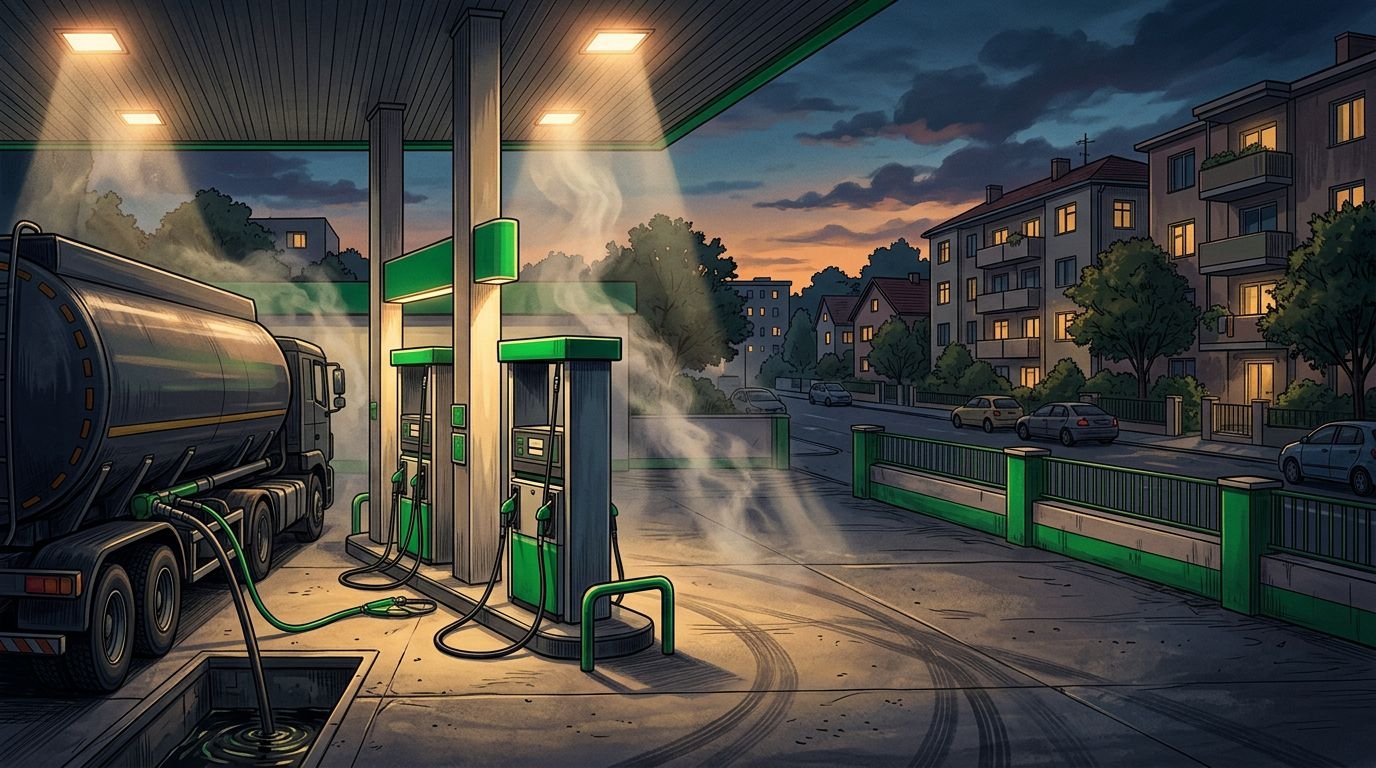
A petrol pump may look harmless at noon, then release sharp vapour bursts as a tanker unloads or cars refuel. The danger is not always visible, and an odour alone does not prove a harmful concentration.
If you are worried about benzene near petrol pumps, you are asking a legitimate public-health question. Cities, oil companies, and regulators should answer it with data, working controls, and clear accountability.
This guide explains how fuel-vapour exposure occurs, which controls matter, and how residents can obtain useful evidence. The goal is not panic. It is to reduce avoidable exposure and stop treating clean air as a private luxury.
Key Takeaways
- Benzene emissions near petrol pumps can occur during tanker deliveries, vehicle refuelling, spills, leaks, and poorly maintained equipment. The strongest concern is usually close to dispensers, vent stacks, delivery points, and idling queues.
- Distance may reduce exposure, but there is no universal distance that guarantees safety. Setback rules are planning requirements, not proof that benzene exposure disappears beyond a particular boundary.
- India’s annual ambient benzene standard is 5 micrograms per cubic metre. Short-term events still require site-specific inspection, repeated measurements, and attention to delivery times, queues, wind, and indoor air.
- Stage I and Stage II vapour-recovery systems can reduce emissions during tanker unloading and vehicle refuelling, but only when properly installed, tested, and maintained. Residents should request equipment records, pressure checks, maintenance logs, and throughput data.
- Communities can keep a shared record, request inspection and sampling, and use written complaints or RTI to obtain documents. Personal precautions may reduce temporary exposure, but source control and enforcement remain the real solutions.
Why benzene near petrol pumps deserves attention
Petrol is a volatile fuel mixture containing benzene among a broader mix of volatile organic compounds. In India, these sites are called petrol stations; international research often calls them gasoline stations. Fuel transfers between tankers, underground storage tanks, dispensers, and vehicles can create recurring benzene emissions.
A neighbourhood doesn’t need a dramatic chemical smell or visible smoke to have a legitimate concern. Vapour can escape through tank vents, leaky fittings, poor nozzle seals, fuel spills, and routine refuelling.
Refuelling creates repeated emission events
Every time petrol enters a vehicle tank, it displaces vapour already inside. Without effective capture, that vapour contributes to evaporative emissions in the surrounding air.
Tanker deliveries can create a larger short-term release. Fuel entering an underground tank pushes existing vapours out unless the system sends them back through a controlled recovery route.
High station throughput matters because more petrol sold means more transfers. More transfers mean more chances for vapour to escape.
The pump apron is not the whole story
The highest concentrations are often expected closest to a dispenser, vent stack, delivery point, or idling queue. But a roadside may also carry emissions from exhaust, traffic congestion, nearby workshops, generators, and other fuel sources.
Wind direction, heat, building height, street width, traffic, and the station’s monthly sales all affect where vapour travels. A home 40 metres away may not have the same exposure every hour.
That is why this local concern can’t be judged by a single whiff of fuel, a clean-looking forecourt, or a citywide AQI score.
Distance changes exposure, not the duty to act
People often ask for one number: “How far away is safe?” It is an understandable question. It is also not one that a responsible guide can answer with a magic radius.
Distance can reduce exposure. It doesn’t erase it. A tall building can channel air between blocks, while an enclosed lane can hold emissions close to ground level. A home directly downwind may experience a different reality than a home farther away. Air dispersion modelling can help assess how wind, heat, street width, building height, and vent location affect conditions.
A setback is a planning rule, not a health guarantee
CPCB issued guidelines for setting up new petrol pumps, including siting criteria. Reports on those rules described 30-metre minimum setback distances for new petrol stations near schools, hospitals, and residential areas. Check current CPCB guidance and applicable state or local requirements before treating that figure as universal.
That buffer matters during approvals, but residential proximity still calls for a site-specific review. It is better than building a fuel station against a school wall.
Still, meeting a setback criterion is not a scientific promise that benzene exposure disappears at 31 metres. It also does little for residents already living beside older outlets approved under earlier conditions. Setback compliance and actual exposure evidence are different questions.
A planning line can prevent bad new decisions. It cannot repair an old decision without monitoring, controls, and enforcement.
Existing neighbourhoods need evidence, not reassurance
If a station has stood near homes for years, focus on patterns that can be checked. Record delivery times and note tanker truck fuel unloading, which can create short-term differences between upwind and downwind locations. Also note long queues, strong odours, visible spills, vent-stack location, and whether windows or classrooms face the site.
Keep the concern focused. A child developing a cough does not prove benzene caused it. Symptoms or odours do not prove causation or measure concentration. But repeated vapour events beside homes, shops, or schools are valid reasons to seek inspection and sampling.
The people closest to the source should not need a chemistry degree to be believed.
India’s benzene standard and petrol-pump rules
India’s National Ambient Air Quality Standards set an annual benzene limit of 5 micrograms per cubic metre, an annual air quality standard for community air. This value is intended to represent ambient benzene concentrations over a year. CPCB’s ambient pollutant measurement guidance helps frame how they should be assessed.
The annual benchmark matters, but it isn’t a short-term alarm threshold. Occupational exposure limits apply to defined workplace conditions, not nearby homes, schools, or shops. Residents may need regulatory records and event-based measurements to assess short peaks during tanker deliveries or rush-hour queues.
At a specific site, air dispersion modelling can explore wind, buildings, and outlet layout. It should be checked against credible measurements, especially during deliveries and queues.
Station throughput explains why busy outlets need more scrutiny
CPCB directions have prioritised vapour recovery systems at high-throughput retail outlets. The commonly cited thresholds are more than 100 kilolitres per month in million-plus cities and more than 300 kilolitres per month in cities with populations between one lakh and one million. Verify these figures against current CPCB directions before relying on them.
One kilolitre equals 1,000 litres. That is not a small volume.
This policy logic is plain: higher sales volumes mean more delivery and dispensing events. More activity creates more benzene emissions unless controls work. Monthly sales volume, a practical measure of station throughput, should be disclosed or used to prioritise inspection.
Rules should be checked outlet by outlet
Requirements can depend on the city, outlet type, fuel sales, and directions issued to oil marketing companies. National benchmarks, court or NGT directions, and outlet-specific obligations should be treated as separate questions.
Delhi-NCR has had stronger vapour-recovery action after intervention by the National Green Tribunal and courts. Check whether those directions remain current before drawing conclusions.
Don’t assume every branded station has the same equipment or maintenance record. Indian Oil, BPCL, HPCL, Reliance, Nayara, Shell, and other operators may use different systems across locations.
The question is not whether a company logo looks familiar. Ask whether the specific outlet has working controls and documented commissioning and servicing. Request pressure checks, maintenance records, and a clear response process when residents report a problem.
Vapour recovery systems only work when maintained
Working vapour recovery systems can reduce releases, but only when tested and maintained. They are practical engineering, not a futuristic fix.
Stage I and II controls address different release points. A sticker or recovery hose means little if seals fail, checks are skipped, or staff miss malfunctions. Inspection frequency and servicing records matter more as station throughput rises.
Photo by Efrem Efre
Stage I captures vapour during tanker delivery
Stage I vapour recovery works during tanker truck fuel unloading, when petrol enters the station’s fuel storage tanks. As petrol enters the underground storage tanks, it pushes vapours out.
Instead of venting those displaced vapours into the air, Stage I equipment routes them back into the tanker or a controlled return path. Research on petrol-station vent-pipe emissions explains why this step matters during fuel transfer.
This is especially relevant for residents who notice strong odours during tanker deliveries.
Stage II captures vapour at the nozzle
Stage II recovery works during vehicle refuelling. It captures vapour displaced from a car or motorcycle tank as petrol enters, then returns it through the dispenser system.
A serious inspection shouldn’t stop at the nozzle. It should include delivery connections, tanks, vent stacks, hoses, seals, and pressure vacuum valves. Maintenance logs and pressure checks can also show whether the equipment is being serviced.
A visible recovery hose, sticker, or dispenser component isn’t proof that the system is airtight or functioning. The same lesson applies to broken dust screens, unused safety gear, and vapour systems that nobody tests after installation.
Benzene is a known cancer hazard, but risk needs honest language
The International Agency for Research on Cancer classifies benzene as a Group 1 human carcinogen. This means it can cause cancer in humans. Its benzene monograph draws on human evidence, animal studies, and biological mechanisms.
That classification describes a hazard, not an individual diagnosis. It doesn’t mean every person living near an outlet will develop cancer. Individual health risks depend on dose, duration, route, co-exposures, and susceptibility. Avoidable exposure still deserves serious control.
For nearby residents and workers, inhalation exposures are the primary concern when fuel vapour enters the breathing zone. Exposure pathways can include outdoor vapour, infiltration into indoor spaces, and workplace or refuelling contact. Their importance depends on conditions, duration, and the task involved.
Long-term exposure affects the blood-forming system
Benzene is not only a smell. Long-term exposure can affect bone marrow and blood cells. The US Agency for Toxic Substances and Disease Registry notes that benzene exposure can reduce red and white blood cells. Longer exposure may lead to leukaemia, as outlined in its benzene health information.
Short-term effects such as headache, nausea, eye irritation, dizziness, or respiratory symptoms can occur around strong petrol vapours. They are nonspecific and can’t identify benzene as the cause. Petrol fumes contain many volatile compounds. These symptoms need medical evaluation, not guesswork.
Childhood leukaemia evidence needs care, not dismissal
Children breathe more air for their body size and spend time close to the ground. They also have no power over where a fuel outlet, road, workshop, or school gate is located.
Research examining childhood leukaemia and childhood cancer and residential proximity to petrol stations found weak support for an increased risk. It also showed how hard this question is to study. Traffic, income, housing conditions, other pollution sources, and imperfect address-based exposure estimates can complicate estimates of cancer risks.
We shouldn’t claim that a particular outlet caused an individual case of childhood leukaemia. We also shouldn’t use scientific uncertainty as a reason to leave repeated fuel-vapour exposure unexamined.
How communities can monitor benzene exposure safely
Residents should not be asked to become unpaid industrial hygienists. Still, a careful record can turn a vague complaint into an inspection request that is harder to ignore.
Start with what you can observe. Avoid confrontation with station staff, and never interfere with tankers, dispensers, vents, or electrical equipment.
Build a simple record of recurring events
Keep a shared log for two to four weeks. Write down:
- Date, time, location, and duration of the fuel odour.
- Wind direction, and whether the smell seemed to reach homes, shops, or a school.
- Delivery timing, tanker arrivals, and the station’s operating pattern.
- Long vehicle queues, visible spills, damaged hoses, or vapour around the delivery area.
- Photos or videos taken safely from public space, with location details enabled if possible.
- Complaint numbers, emails, replies, and the name of the authority contacted.
A log can’t quantify benzene emissions. It can show a repeated pattern that deserves an on-site inspection.
Ask for sampling that can answer the actual question
A low-cost VOC sensor may react to a mix of gases, but it can’t reliably identify benzene on its own. If the concern is serious, ask a qualified laboratory about a sampling plan.
For serious concerns, active and passive sampling offer two measurement approaches. Active monitoring uses a calibrated pump to draw air through a sorbent tube during a defined event, such as tanker truck fuel unloading. Passive monitoring uses diffusion tubes to collect air over longer periods and estimate a time-weighted average.
Sampling duration and location should reflect inhalation exposures, including what people actually breathe indoors and outdoors. Ask the laboratory about its accreditation, analytical method, and detection limit. Confirm its use of blanks or other quality checks.
Also ask about sampling duration, weather conditions, and comparison sites. Air dispersion modelling can help select upwind, downwind, indoor, and outdoor locations, but it can’t replace field measurements. Confirm whether its diffusion tubes are validated for benzene, with suitable detection limits and quality controls.
For worker-related concerns, separate industrial hygiene testing may be appropriate, including a personal sample from the breathing zone.
The NIOSH Manual of Analytical Methods is a useful reference for workplace air-monitoring methods.
One sample on one calm morning is not a verdict. Repeated measurements across delivery timing, traffic, wind, and temperature conditions are stronger.
What homes, schools, and shops can do today
Personal precautions do not replace emission control or regulatory action. A family cannot seal itself away forever. These temporary steps may reduce inhalation exposures during clear, repeated events while a larger complaint moves forward.
Reduce entry during known high-emission periods
When tanker deliveries produce a strong petrol smell, close windows and balcony doors facing the station. Avoid confronting staff during delivery, and note the time for a formal report. Reopen windows when outdoor conditions improve instead of keeping a home sealed all day.
Seal obvious gaps around window frames, air-conditioner sleeves, service openings, and doors. Do not dry-sweep floors or balconies during a vapour event. Benzene is a gas, but dust can carry other traffic and fuel-related pollutants into the same living space.
A grey layer on a window grill is not proof of benzene. It is a reminder that neighbourhood air is a chemical mix, not a clean background.
Do not mistake a HEPA filter for a benzene solution
HEPA filters are designed for particles. Benzene is a gas, so a standard HEPA-only purifier will not remove it effectively.
A unit with substantial activated-carbon or another gas-phase sorbent filter may offer limited secondary help. Its value depends on capacity, room size, filter saturation, replacement schedules, and independent performance data. A tiny carbon sheet inside a glossy machine is not public-health protection.
Schools can ask operators to schedule tanker deliveries outside arrival, dispersal, and outdoor activity periods. The best solution remains source control at the station. Seek medical care for persistent or severe respiratory symptoms rather than trying to self-diagnose.
Make the problem public, specific, and hard to bury
A citywide AQI reading cannot show what a shopkeeper breathes beside a fuel forecourt each day. It cannot show whether a school corridor receives vapour during tanker deliveries. Residents living, studying, or working near petrol stations need records from that specific outlet.
Use community-based pollution monitoring to connect local patterns and responsible institutions, not blame residents for reporting harm.
Ask for records that reveal real performance
A written complaint to the State Pollution Control Board, local authority, oil marketing company, or outlet operator can request:
- Confirmation of the outlet’s vapour recovery equipment, commissioning date, and current operating status.
- Maintenance logs, pressure-test records, and repair history for that equipment.
- Monthly petrol sales, station throughput, and typical tanker delivery schedules.
- Inspection dates, complaint-handling records, notices issued, and action taken.
- Ambient or workplace sampling records, including dates, methods, locations, and results, if testing has occurred.
A complaint should request evidence and inspection, not assert that a particular outlet caused childhood leukaemia.
If responses stay vague, use RTI to obtain pollution data to request inspection reports, notices, sampling records, and action-taken documents. RTI can help obtain documents, but it doesn’t guarantee enforcement.
Personal values matter, but source control matters more
Plant-based living, public transport, a circular economy, and everyday mindfulness can reduce parts of a city’s broader pollution burden. None of them can repair a failed vapour system beside your home.
Systemic change means funded maintenance and working vapour controls, with inspectors testing equipment, companies disclosing failures, and fines costing more than neglect. Sustainable business models cannot treat residents as the unpaid monitoring department.
The ecological impact extends beyond human lungs. Petrol spills, traffic emissions, and chemical residues can pressure roadside soil, drains, and fragile urban biodiversity. Climate literacy means seeing that a fuel forecourt is not an isolated plot. It is part of the air, water, work, and health systems around it.
If you want to support grounded work connecting climate literacy with neighbourhood ecosystems, Explore Our Active Missions.
Frequently Asked Questions
Is there a safe distance from a petrol pump?
There is no single distance that guarantees zero benzene exposure. Wind, building layout, station throughput, vent locations, delivery activity, and local traffic can change conditions, so site-specific monitoring is more useful than relying on a magic radius.
Does a strong petrol smell prove that benzene levels are dangerous?
No. An odour can indicate a fuel-vapour event, but it does not identify the benzene concentration or prove a health effect. Repeated odours are still a valid reason to record the event and request inspection or properly designed sampling.
What are Stage I and Stage II vapour recovery systems?
Stage I systems capture vapour displaced when petrol moves from a tanker into underground storage tanks. Stage II systems capture vapour displaced from vehicle tanks during refuelling, but both controls only work when their hoses, seals, valves, and related equipment are maintained and tested.
Can a household air purifier remove benzene?
A standard HEPA-only purifier is designed for particles and will not effectively remove benzene, which is a gas. A purifier with substantial activated carbon or another gas-phase sorbent may provide limited secondary help, but it cannot replace source control or regulatory action.
What should residents do if they are concerned about a nearby outlet?
Keep a two-to-four-week record of odours, tanker deliveries, queues, wind direction, visible spills, and safely documented equipment problems. Submit a specific written request for inspection, vapour-recovery records, maintenance logs, sales throughput, and sampling, and use RTI when public records are not provided.
The air around a petrol pump is a public responsibility
Residents shouldn’t be told to worry less or rely on a better air purifier; functioning source controls come first. Credible monitoring can show whether controls reduce inhalation exposures; clear accountability treats preventable exposure and its health risks as a public-health responsibility.
Start with a shared record of tanker deliveries, odours, and visible failures. Request documents and testing to turn concern into evidence. Community records can’t by themselves prove that a particular outlet caused an individual case of childhood leukaemia.
That duty includes residents, students, workers, and people who can’t choose an outlet’s location. Evidence-based action can reduce avoidable long-term cancer risks without promising zero risk.
Nobody should have to trade clean air for the convenience of living, studying, or working near fuel.